
What this guide answers
- What should a community club concussion policy actually say?
Keep it to two rules the club can genuinely enforce. First, any suspected head injury means immediate removal from play or training for the rest of the day, not subject to appeal on the day.
- Who decides whether a player has a concussion?
A doctor. Nobody at the ground is being asked to diagnose anything, and a well-written club rule makes that explicit.
- How long does a player have to sit out after a head knock?
That is set by your sport's governing body, not by your club, and it commonly differs between junior and adult players.
- Do we need written medical clearance before a player returns?
Requiring it in writing is the practical standard because it removes the club from any judgement about readiness.
- Should we record a head knock even if the player seems completely fine?
Yes, and this is where most clubs' records fall down. The record costs two minutes and its value is entirely in the future — establishing the date, showing the club acted, and giving whoever assesses the player a…
USA edition. This guide is written for volunteer-run clubs in the United States. Where rules differ — grants, tax, incorporation, safeguarding — follow the USA-specific pointers below or check with your national body.
Two minutes into the second half of an under-14s game, two players go up for the same ball and one of them takes an elbow to the temple. He is back on his feet before anyone reaches him, brushing his shorts off, saying he is fine. The coach is down to one interchange. A parent on the fence has already called out that he looks all right. And the person actually holding the first aid bag is a volunteer who did a two-hour course three seasons ago and has never had to make this call before.
Everyone looks at them. That is the moment your club either has a rule or it does not.
The single most useful thing to understand about concussion in community sport is that your club's job is not to diagnose anything. Diagnosis belongs to a doctor, and the timeframes belong to your sport's own protocol. Your club's job is narrower and completely achievable — to make sure no volunteer is ever asked to make a medical judgement under pressure on a Saturday, because the decision was already made in writing before the season started. This guide covers how to write that rule so it holds, how to record a head knock so the record is worth something later, and how to brief coaches, parents and players so the rule is not a surprise the first time it bites. It is general information for committees, not medical or legal advice — your national or regional governing body publishes the protocol that applies to your sport, and that document, not this one, is your authority.
What your club is actually responsible for
Most of the anxiety around concussion in volunteer clubs comes from role confusion. People think the club is being asked to assess an injury, panic about being unqualified, and quietly do nothing. Write the chain down once and the anxiety mostly evaporates, because almost none of it is yours.
| Role | Owns | Does not own |
|---|---|---|
| Duty first aider / ground marshal | Removing the player, starting the incident record | Deciding whether it was a concussion |
| Coach or team manager | Accepting the removal, finding a replacement, contacting the parent or carer | Overriding a removal, assessing the player |
| Parent, carer or the player | Getting assessed, providing written clearance | Waiving the club rule on the day |
| Committee | Publishing the rule, holding the records, checking clearance before selection | Diagnosing, clearing, or setting stand-down timeframes |
| Treating doctor | Assessment, diagnosis, written clearance | Team selection |
| Governing body | The protocol, the minimum stand-down, competition sanctions | Being on your sideline |
Print that table and put it in the first aid bag. Two thirds of the sideline arguments you are ever going to have are about someone trying to do a job in the right-hand column.
The protocol itself — the stand-down periods, the graduated stages, whether junior timeframes differ from adult ones — comes from your sport, and it is revised more often than most committees realise. Do not paraphrase it in your own policy document. Reference it, link to it, print the current pocket version, and check once a year that the version in your kit is still the live one.
Most clubs sit under a state or regional organisation within the national governing body, and the protocol usually flows from the national body down. There is a second layer here that clubs outside school sport often miss — the United States has youth sports concussion legislation at state level, and it commonly covers removal from play, written clearance and coach education for youth programs, not just school teams. Check what applies where your club plays before you write your rule, because in some places parts of it are a legal obligation rather than a policy choice.
Recognise and remove, written as a club rule
The core of any workable club position on head injury is a single sentence that removes discretion from the sideline. Something close to this, adopted at a committee meeting and minuted:
Any player who sustains a suspected head injury is removed from play or training immediately and does not return that day, regardless of how well they look or feel. The removal is not a medical opinion and is not subject to appeal by the player, the coach or a parent.
Three properties make that sentence work, and dropping any one of them breaks it.
It is automatic. The trigger is a suspected head injury, not a confirmed one. Nobody has to be right for the rule to fire. That is deliberate — it means an untrained volunteer cannot get it wrong by acting.
It applies to the whole day. "Sit out for ten minutes and see how you go" is the single most common way community clubs get this wrong, because it hands the decision back to a person under pressure. One removal, one day, no re-entry.
It is not appealable on the day. Not by the coach who is short of players, not by the player who wants the second half, not by the parent who saw the incident from thirty metres and thought it looked fine. The committee will hear any complaint on Monday. Saturday is closed.
Who holds the authority
Name a role, never a person. "The duty first aider" or "the ground manager" or, in juniors, "the team manager" — a role someone fills every week, printed on the team sheet so nobody has to ask who it is today. Give that role the explicit power to stop play and remove a player without checking with the coach, and back it publicly the first time it is used, because the first use sets the precedent for the next five years.
The useful tie-breaker when a call is genuinely borderline is this — the person with the least at stake makes the decision. That is almost never the coach.
The card in the kit
Whatever your sport's protocol says, the sideline needs a laminated version that can be read in twenty seconds by someone whose hands are shaking. Include on it, in this order:
- The signs and symptoms list from your sport's current protocol, unedited and unabridged.
- The removal rule in one sentence.
- Red-flag signs that mean call an ambulance now rather than call a parent.
- The ground address and the emergency access details from your club emergency action plan.
- Who to notify at the club and how, with a real phone number.
- A reminder that the player does not drive themselves home.

The sideline run sheet
The gap between having a policy and having a practice is a run sheet. Yours should fit on the back of the card.
- Stop play. Do not move the player if they are unconscious, complaining of neck pain, or not making sense.
- If any red flag is present, call the emergency number and follow the emergency action plan. Send someone to the gate.
- Remove the player from the field to a quiet spot. Not the bench in front of the crowd.
- Tell the coach it is a removal, not a substitution decision. Say the words out loud so there is no ambiguity later.
- Contact the parent, carer or the player's emergency contact before the end of the game, not after it.
- Keep the player under observation with a responsible adult until they are handed over. They do not drive.
- Write the incident record while the game is still on, or immediately after. Not on Sunday night.
- Give the family the return-to-play summary from your sport's protocol before they leave the ground, so the first thing they hear is not a rumour from another parent.
Recording it properly
The record is the part clubs skip, and it is the part that matters six months later. It protects the player, because a graduated return only works if somebody knows the date of the injury and memories of which weekend it happened are unreliable. It protects the club, because a dated record written on the day by the person present is worth more than five people remembering it differently — and a blank file is not neutral, it reads as though nothing was done. And it protects the volunteer, who should never have to defend a removal decision from memory.
| Field | Why it earns its place |
|---|---|
| Date, time, venue, team | Anchors the stand-down clock and matches the fixture record |
| Player name and date of birth | Junior timeframes often differ, and names repeat within a club |
| What happened, factually | Mechanism only — "collided with an opponent contesting a mark", not "looked concussed" |
| Signs observed | Tick the list from the protocol card rather than writing prose |
| Action taken and time | Removed at 3.42pm, parent contacted 3.51pm, handed over 4.20pm |
| Who made the decision | The role and the name |
| Emergency services called | Yes or no, and the time |
| Family advised of protocol | Yes or no, and what they were given |
| Follow-up owner | One named person who checks in during the week |
Two disciplines make the record usable. Write facts, not conclusions — the person filling it in is not qualified to write "concussion" and should not, so describe what happened and what was seen. And restrict who can read it. Injury records are sensitive personal information and should sit behind a permission, not in a shared drive the whole committee browses. Our incident report form template sets out the full field list and the access question, and club risk management covers how incidents feed back into your risk register.
Return to play is paperwork, not medicine
Here is the reframe that makes the return side manageable for a volunteer committee. You are not managing a recovery. You are managing a filing cabinet with one gate on it.
The graduated return in almost every sport's protocol runs through the same broad shape — a period of rest, then light aerobic activity, then sport-specific exercise without contact, then full-contact training, then match play, with a minimum number of days at each stage and a step back if symptoms return. Your protocol sets the timeframes and they are frequently longer for juniors. The club does not decide any of it.
What the club does decide is one thing, and it should be written into the same policy as the removal rule.
No player returns to contact training or match play following a suspected head injury until the club holds written medical clearance and the minimum stand-down under our sport's protocol has elapsed. Until both are true, the player is not named on a team sheet.
That is a selection rule, which is comfortable ground for a committee. It is enforceable by the same person who picks the side.
| Player | Injury date | Minimum return date | Clearance received | Checked by | Cleared for |
|---|---|---|---|---|---|
| Example | 14 June | Per protocol | 27 June, on file | Registrar | Full contact |
Keep that table wherever your selection actually happens, and give the registrar or team manager a standing job — before the team sheet goes out, check nobody on it is on the list without a clearance. It takes thirty seconds and it is the whole control.
A few practical notes. Ask for written clearance rather than a phone call relayed by a parent, and ask that it names the sport and the level of activity being cleared. Keep it in the same place as the incident record. And do not let a well-meaning family talk you into an earlier return because "the doctor said he is fine" — if the doctor said it, the doctor can write it.
Families will typically go to a primary care physician, urgent care, or an emergency department for red flags, and in many places the clearance form is standardised because state law or the local school district requires one. If your players also play school sport in the United States, ask the family for a copy of whatever the school's athletic trainer or physician has already issued rather than sending them for a second appointment — but file your own copy, and never rely on the school's record being available to you when you need it.
Briefing coaches, parents and players before the season
A rule nobody has heard of is a rule you will lose an argument about. The whole education job fits in three touchpoints, and the pre-season window is the only time anyone has the patience for it.
The coaches' briefing — twenty minutes, before round one. Not a lecture. Run it as five questions with answers on a single slide or handout.
- What is the removal rule, word for word?
- Who has the authority to use it at your ground, and how do they identify themselves?
- What does the coach do in the sixty seconds after a removal?
- Where is the card, and where is the incident record filled in?
- What is the selection gate, and who checks it?
Finish by naming the thing everyone is thinking — that this will one day cost you a game. Say it out loud in the room, get agreement in the calm, and you have banked the argument you would otherwise have in the heat.
The parent letter — one page, sent with registration. Short, plain, and specific about what the club will do rather than what medicine says. Something like this:
Our club follows the concussion protocol published by our sport's governing body. In practice, that means three things. If your child has a suspected head injury, they are removed from the game and do not return that day, even if they feel fine. We will contact you before the end of the game. And your child cannot be selected again until we hold a written clearance from a doctor and the minimum stand-down has passed. We will never ask a volunteer to judge whether a head knock was serious — that is a doctor's job, and our rule exists so nobody on the sideline has to make that call.
Send it once at registration and again in the week before finals, which is when the pressure arrives. Registration is the natural moment because families are already reading club policy — if you collect acknowledgements alongside your membership forms and waivers, you get a dated record of who has read it without chasing anybody.
The player message — thirty seconds, from the coach. For juniors, the message is that telling someone is the brave option, not the soft one. For seniors, it is that hiding it puts the person next to them at risk, because a player who is not right is a player who does not protect themselves or a teammate. Both messages land better from a coach than from a policy document, and neither takes more than half a minute at the start of a training session.
Keep a simple record of who has been briefed and when. Coach accreditation and safeguarding checks already need tracking each season — adding a "concussion briefing completed" column to the same list costs nothing, and it answers the only question anyone will ever ask you afterwards. Our guides on child safe standards and the pre-season checklist cover how the rest of that pre-season compliance stack fits together.
The three conversations that break the rule
Every club that has held this line has held it against the same three pressures. Rehearse the answers.
The coach in finals week. "He's our only ruck." The answer is not a debate about the injury — it is the rule, quoted, plus a reminder that the coach agreed to it before round one. Then move straight to the practical problem, which is who plays instead, because that is a problem you can actually help with.
The parent who wants to override it. "I'm his mother and I say he's fine." Acknowledge the authority genuinely, then draw the line where it sits — a parent decides about their child's health, and the club decides about selection at the club. Nobody is telling the family what to do; the club is saying what the team sheet requires.
The player who hides it. This one you cannot argue your way out of, which is why the pre-season culture work matters more than the policy. The countermeasures are teammates who report, a coach who thanks the player who told them, and never making an example of someone who came off.
Keeping the record where the committee can find it
The failure mode in community clubs is almost never the rule — it is that the rule was applied correctly and then the paperwork evaporated into a volunteer's phone. A head knock on Saturday becomes a text message, becomes a memory, becomes nothing, and by the time the player is being picked again nobody can say when it happened. ClubHelix keeps that chain in one place — incident reporting so the record is written on the day and visible only to the roles you choose, forms and surveys for the registration-time acknowledgement and the clearance upload, and accreditations tracking so a coach's briefing sits beside their qualifications and screening rather than in a separate spreadsheet.
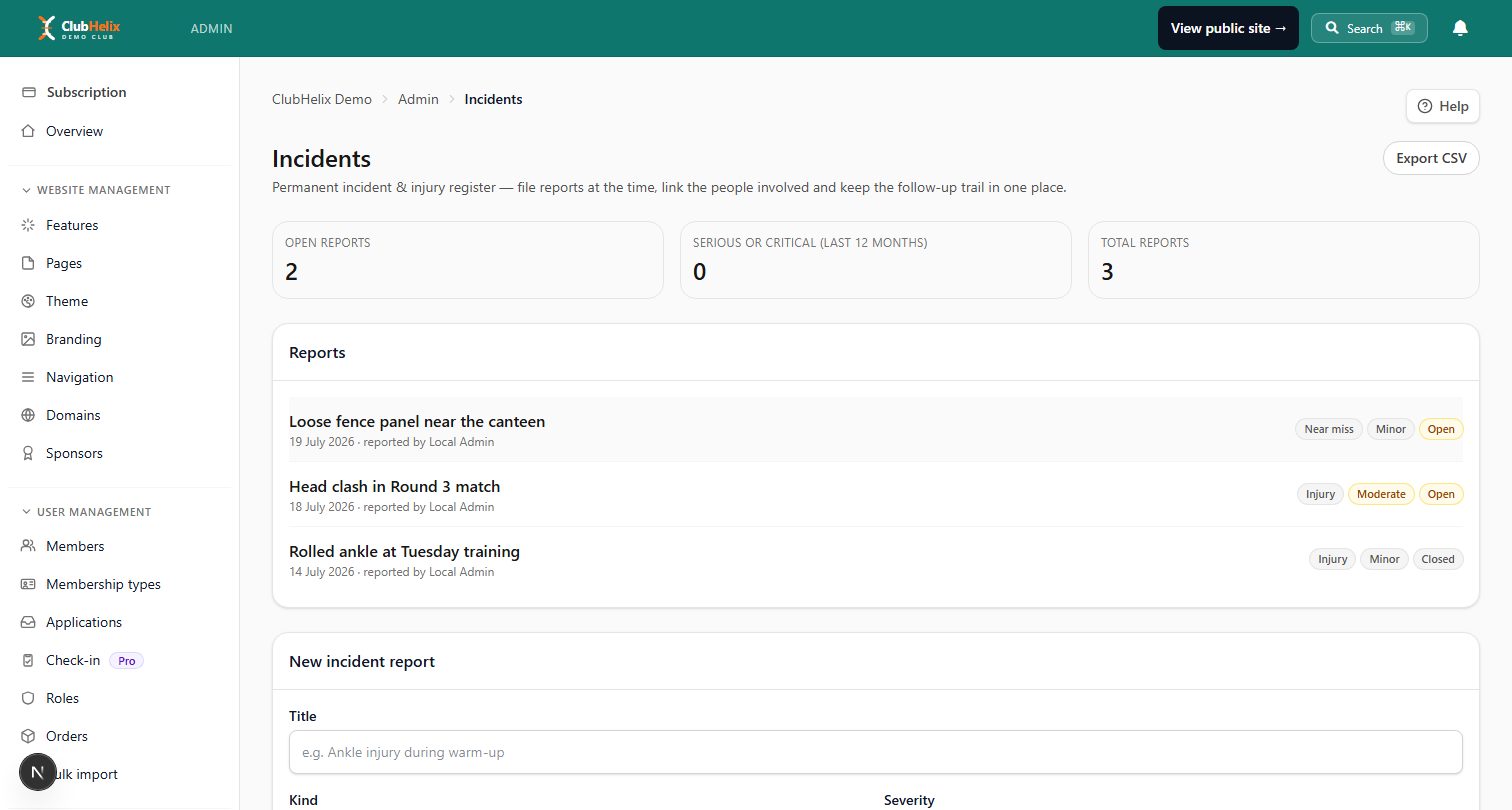
It is a club website and admin system with a free tier that is genuinely enough for a small club to run its records on, and pricing published on the page rather than hidden behind a sales call. If your safety paperwork currently lives in three notebooks and a group chat, you can create your club site and have the incident log, the forms and the member records in one place before the next round.
Frequently asked questions
What should a community club concussion policy actually say?
Keep it to two rules the club can genuinely enforce. First, any suspected head injury means immediate removal from play or training for the rest of the day, not subject to appeal on the day. Second, no return to contact training or matches until the club holds written medical clearance and the minimum stand-down under your sport's protocol has passed. Everything else — the signs, the graduated stages, the timeframes — belongs to your sport's published protocol, which you reference rather than rewrite.
Who decides whether a player has a concussion?
A doctor. Nobody at the ground is being asked to diagnose anything, and a well-written club rule makes that explicit. The volunteer's decision is only whether a head injury is suspected, which is a much lower bar and deliberately so — the removal is a precaution, not a diagnosis, and it does not need to be right to be correct.
How long does a player have to sit out after a head knock?
That is set by your sport's governing body, not by your club, and it commonly differs between junior and adult players. Look up the current protocol rather than relying on what someone remembers from a few seasons ago, because these documents are revised regularly and the community-level version often has longer stand-downs than the elite version people see on television.
Do we need written medical clearance before a player returns?
Requiring it in writing is the practical standard because it removes the club from any judgement about readiness. Ask for a document that names the sport and the level of activity cleared, file it with the original incident record, and make checking it part of picking the team. A relayed phone message from a parent is not a clearance, and if a doctor genuinely said it, they can write it.
Should we record a head knock even if the player seems completely fine?
Yes, and this is where most clubs' records fall down. The record costs two minutes and its value is entirely in the future — establishing the date, showing the club acted, and giving whoever assesses the player a factual account of the mechanism. Record what happened and what was observed, never a conclusion about what the injury was.
Keep reading — club first aid and emergency planning covers the wider ground-day plan, and the incident report form template gives you the record itself, field by field.

