
What this guide answers
- What should be in a sports club first aid kit?
Work in tiers rather than one big bag. A light sideline kit that always travels with the team covers gloves, a resuscitation face shield, sterile dressings and pads, adhesive dressings, crepe and elastic bandages, a…
- What is an emergency action plan for a sports club?
It is a one-page document, written for one specific venue, that tells anyone present what to do in an emergency and in what order.
- How often should a club check its first aid kit?
Seal the kit and check the seal every match day, run a full inventory monthly during the season, and do an expiry sweep before the season and again mid-season.
- Does a community club need a defibrillator?
Many clubs choose to have one and it is frequently the highest-value equipment purchase a club makes, though whether it is required of you depends on your governing body, your venue owner and local rules — check with…
- Who should hold first aid qualifications at a club?
More people than you think, and never only the two who always volunteer.
South Africa edition. This guide is written for volunteer-run clubs in South Africa. Where rules differ — grants, tax, incorporation, safeguarding — follow the South Africa-specific pointers below or check with your national body.
The part of an emergency that catches clubs out is almost never the injury. It is the phone call. A volunteer is standing at the edge of a field with a phone to one ear and an ambulance dispatcher asking a perfectly reasonable question — what is the address? — and the honest answer is that nobody has ever needed to know. The ground has a name. It has a gate. It has never had a street number that anyone has said out loud.
Meanwhile the second gate, the one wide enough for a vehicle, is padlocked, and the only person who knows the combination is at an away game two suburbs over.
None of that is a medical problem. It is an admin problem, and admin problems are solvable in an afternoon by people with a laminator. This guide covers the three things every community club should have before the season starts — a kit that is actually stocked, a one-page emergency action plan written for the specific ground you play on, and a defibrillator that has been checked in the last twelve months. It is general information for volunteer committees rather than clinical or legal advice, and your governing body, insurer and venue owner may all set requirements that sit above what is here. Check with them, then build the page.
Three documents, one of them laminated
Clubs tend to think about first aid as a box of supplies. The box is the least important part. What you need is a small stack that fits in the front pocket of the same bag.
| Document | What it does | Where it lives |
|---|---|---|
| Emergency action plan (one page) | Tells a stranger what to do and who to call, in order | Laminated in the kit, on the clubroom wall, in the away bag |
| Kit inventory and restock sheet | Says what should be in the bag and when it was last checked | Inside the lid of the kit |
| Incident record | Captures what happened, on the day, in the words of whoever was there | Wherever your club actually keeps records |
The emergency action plan is the one that has to be laminated, because it will be read in the rain by someone whose hands are not steady. Everything else can live wherever your committee already keeps things, provided somebody can find it.
The design goal for the plan is worth stating plainly — it should make a person who has never dealt with an emergency behave competently for the first ninety seconds. That is the window where good outcomes are decided and where volunteers freeze. After ninety seconds, professionals are on the phone with you and the plan has done its job.
The one-page emergency action plan template
Write one per venue. Not one for the club — one per ground, because the address, the gate, the meeting point and the nearest hospital all change when you play across town. Copy this, fill the brackets, print it, laminate it.
VENUE — [ground name]
ADDRESS TO GIVE EMERGENCY SERVICES — [exact address, plus the nearest cross street and any gate number]
WHAT TO SAY FIRST — [service required], [address], [what has happened], [how many people injured], [is the person conscious and breathing]
AMBULANCE ACCESS — enter via [which gate]. It is [locked / unlocked]. The key or code is held by [role, phone number]. A vehicle [can / cannot] drive onto the playing surface.
MEETING POINT — [the exact spot someone stands to wave the ambulance in]
DEFIBRILLATOR — located [where]. Cabinet is [unlocked / code]. Round trip on foot [x] minutes.
FIRST AID KIT — located [where]. Duty first aider today is [role].
NEAREST HOSPITAL WITH AN EMERGENCY DEPARTMENT — [name and address]
CLUB CONTACT TO NOTIFY — [role], [phone number]. Backup [role], [phone number].
AFTER THE EVENT — complete an incident record the same day and send it to [role].
Then, underneath, the four jobs. The reason emergencies go badly at community grounds is not that nobody helps — it is that eleven people help with the same thing and nobody opens the gate.
- The caller. Makes the call, stays on the line, does not hang up until told to. Reads the address off the plan rather than from memory.
- The guide. Goes to the meeting point with the gate key or code and waits there, in view, until the ambulance arrives. This person does nothing else. It is the most under-appreciated job on the list and the one that saves the most time.
- The carer. Stays with the injured person. Usually the duty first aider. Keeps everyone else back.
- The recorder. Notes times, names and what was done, so the incident record can be written properly afterwards. Also the person who contacts family.
Name those four jobs by role on your team sheet or duty roster every week, the same way you name a canteen shift. If your club already builds a weekly duty roster, add the four jobs to it — volunteer rostering turns that from a group-chat negotiation into a published list people can see.
Dial 10177 for an ambulance, or 112 from a mobile. Put GPS coordinates on the plan alongside the street address — many club grounds in South Africa are hard to find from a street name alone and a set of coordinates removes the guesswork. If your club has an arrangement with a private ambulance service, list that number first and the public number second, and be explicit about which one members should call. Add a visible landmark to the plan, because it is what the driver will actually navigate by.

What actually goes in the kit
Build in tiers, because the failure mode is a single enormous bag that stays in the clubroom while the injury happens 200 metres away.
Tier 1 — the sideline bag. Small, light, always goes to the field with the team.
| Item | Notes |
|---|---|
| Disposable gloves | Several pairs, and in more than one size |
| Resuscitation face shield | Cheap, small, and the thing people hesitate without |
| Saline or sterile eyewash | Single-use pods beat a big bottle nobody replaces |
| Sterile wound dressings and pads | A range of sizes, individually wrapped |
| Adhesive dressings | Including a few large ones, not just small strips |
| Crepe and elastic bandages | The most-used item in almost every club bag |
| Triangular bandage | Sling, pressure, immobilisation |
| Tape and scissors | Blunt-ended shears that cut through a sleeve |
| Instant cold packs | For when the ice supply has not arrived |
| Thermal or foil blanket | Shock and exposure |
| Waste bag and a sharps-safe container | Somebody has to carry the used dressings home |
| Pen, notepad, incident record form | The recorder's job needs paper |
| Small torch | Evening training, unlit car parks |
Tier 2 — the clubroom kit. Bulk supplies, restock stock, ice, the eyewash station, spare bandages, and a copy of the emergency action plan on the wall beside it.
Tier 3 — the away bag. A duplicate Tier 1 kit that lives in the gear bag permanently, plus a laminated blank emergency action plan the team manager fills in on arrival with the host club's details. Ten seconds of asking "where is your defib and which gate does the ambulance use?" when you arrive is worth more than any equipment you can carry.
Two things deliberately not on the list. Community clubs generally do not stock medications — including the ordinary over-the-counter ones — because giving them to someone else's child or teammate is a different kind of decision entirely, and your governing body or insurer may have a firm position on it. Ask, do not assume. Second, a kit is not a substitute for a trained person. The bag is only as useful as whoever opens it.
The common baseline is an accredited first aid certificate at the entry level, with higher levels available for clubs running contact sport or large events. Accredited providers in South Africa are plentiful but variable, so ask your provincial union or federation who they recognise before booking. If your club has an arrangement with a private ambulance service for match days, clarify exactly what that covers — event standby and an emergency response call-out are different products with different response expectations.
The restock roster that actually runs
Every club kit decays the same way. Somebody uses the last two large dressings in round three, means to replace them, and does not. By round nine the bag is full of tape and empty of everything else. The fix is not enthusiasm — it is a small system.
Seal the kit. Put a numbered plastic tag or a dated sticker across the zip. If the seal is intact, the kit is complete and the check takes five seconds. If the seal is broken, someone opened it, so it gets a full inventory check before it goes out again. This single trick does more for kit readiness than any roster.
Split consumables from durables. Consumables get replaced on use — dressings, tape, cold packs, gloves, eyewash. Durables get checked for condition — scissors, torch, face shield, the bag itself. They need different rhythms and different budgets.
Put a named owner and a date on it. Not "the first aid officer" as an abstraction. A person, in a role, with a monthly reminder.
| Check | When | Who | Signed off where |
|---|---|---|---|
| Seal intact | Every match day, before it leaves | Duty first aider | Verbal to the team manager |
| Full inventory | Monthly in season | First aid officer | Sheet inside the kit lid |
| Expiry sweep | Pre-season and mid-season | First aid officer | Same sheet, with dates |
| Kit replacement | Annually, at the pre-season meeting | Committee | Minutes and the budget |
Budget for consumables as a line item rather than treating them as an emergency purchase. A club that spends a modest fixed amount every year on kit restocking never has the conversation about whether it can afford to. Our pre-season checklist puts the kit check next to the other jobs that have to happen before round one, and club risk management covers how these checks roll up into the register your committee reviews.
Defibrillators, access, and the annual check nobody does
A defibrillator is the single highest-value piece of equipment a community club can own, and it is also the one most likely to be quietly out of service. The failure is never dramatic. Pads have an expiry date. Batteries have an expiry date. Both pass silently.
Placement. The right question is not "where is it safe?" but "how long is the round trip?" Someone has to run to it and back while another person is doing compressions. Walk it, time it, and write the number on your emergency action plan. If the round trip is longer than a couple of minutes, the unit is in the wrong place, no matter how secure the cupboard is.
Access. A defibrillator locked in an office nobody can open at 7pm on a Wednesday is a decoration. The options in ascending order of usefulness are — a locked cabinet with the code on the emergency action plan and in the duty roster; an unlocked cabinet with an alarm; or an externally mounted cabinet accessible to the whole community. The third one has a cost and a small theft risk, and it is also the only version that helps the netball club training next door.
The annual check that nobody does. Write these five things into a recurring committee job with a named owner.
- Pad expiry date recorded and diarised, with a reminder set two months before.
- Battery expiry date recorded and diarised the same way.
- Status indicator visually checked monthly — a thirty-second job for whoever opens the clubrooms.
- Spare pads on hand, including paediatric pads if your club has junior teams and the unit supports them.
- Location, access details and hours confirmed as still correct on every copy of the emergency action plan.
Add the unit to your equipment register with its serial number and both expiry dates so it appears in the same list as everything else the club owns and has to replace on a schedule. If your clubrooms are locked outside training hours, the defib access question is really a keys question — see managing club keys and access for how to give the right roles entry without twenty keys in circulation.
Ask your ambulance service or national defibrillator network how to list your unit on their register, so a dispatcher taking a call near your ground can direct a bystander straight to it. Registration is usually free and quick, and it is the step clubs skip once the fundraising has finished and the unit is on the wall. Tell your council or land manager too, since many keep their own list of publicly accessible units, and some will help with the recurring cost of replacement pads if the unit is available to the wider community outside your club's hours.
Practising it, once, for ten minutes
A plan nobody has walked through is a plan with an untested assumption in it — usually about a gate. Run this at the first training session of the season, with the committee present, and time it.
- Read the emergency action plan aloud. Someone will immediately correct a phone number.
- Send one person to the meeting point by the route they would actually take. Time it.
- Send another to the defibrillator and back. Time it. Write both numbers on the plan.
- Open the vehicle gate with the key or code on the plan. This is where roughly half of all clubs discover a problem.
- Assign the four jobs to four people standing there and ask each to say their job out loud.
- Fix whatever broke, reprint, relaminate.
Ten minutes, once a year. Then do a shortened version at the away venue every time you play somewhere new — the team manager asks three questions on arrival and writes the answers on the blank plan in the away bag.
The venues that break the plan
- Training at a school or shared ground. Access is often through a gate controlled by someone who is not there in the evening. Sort the after-hours access before the season, not during an incident.
- Grounds with no clubroom. Junior fixtures at a park with a portable goal and no building. The kit, the plan and the phone are all in one car, and the plan must name whose car.
- Water and open venues. Rowing, sailing, open-water swimming and surf clubs need a plan that covers a casualty who is not standing on a road, including how the emergency services reach the water and who has a radio.
- Night training. Everything is harder in the dark, including describing where you are. Add lighting and torch checks to the pre-season walk-through.
- Weather cancellations. The decision to abandon is a safety decision, and it needs a person and a deadline — our wet weather communication plan covers how to get the call out fast once it is made.
Heat is the seasonal risk that most often gets underestimated. Add shade, water and a heat policy to the plan — who monitors conditions, at what point sessions are shortened or moved, and who has the authority to call it off. Sun protection is a first aid item as much as a comfort item, so keep sunscreen in the kit and treat it as a consumable that expires. If your area is exposed to grass and bushfire smoke in the hotter months, decide in advance which air quality reading triggers a cancellation and who checks it, rather than debating it an hour before a junior fixture.
Getting it out of the glovebox and into the club
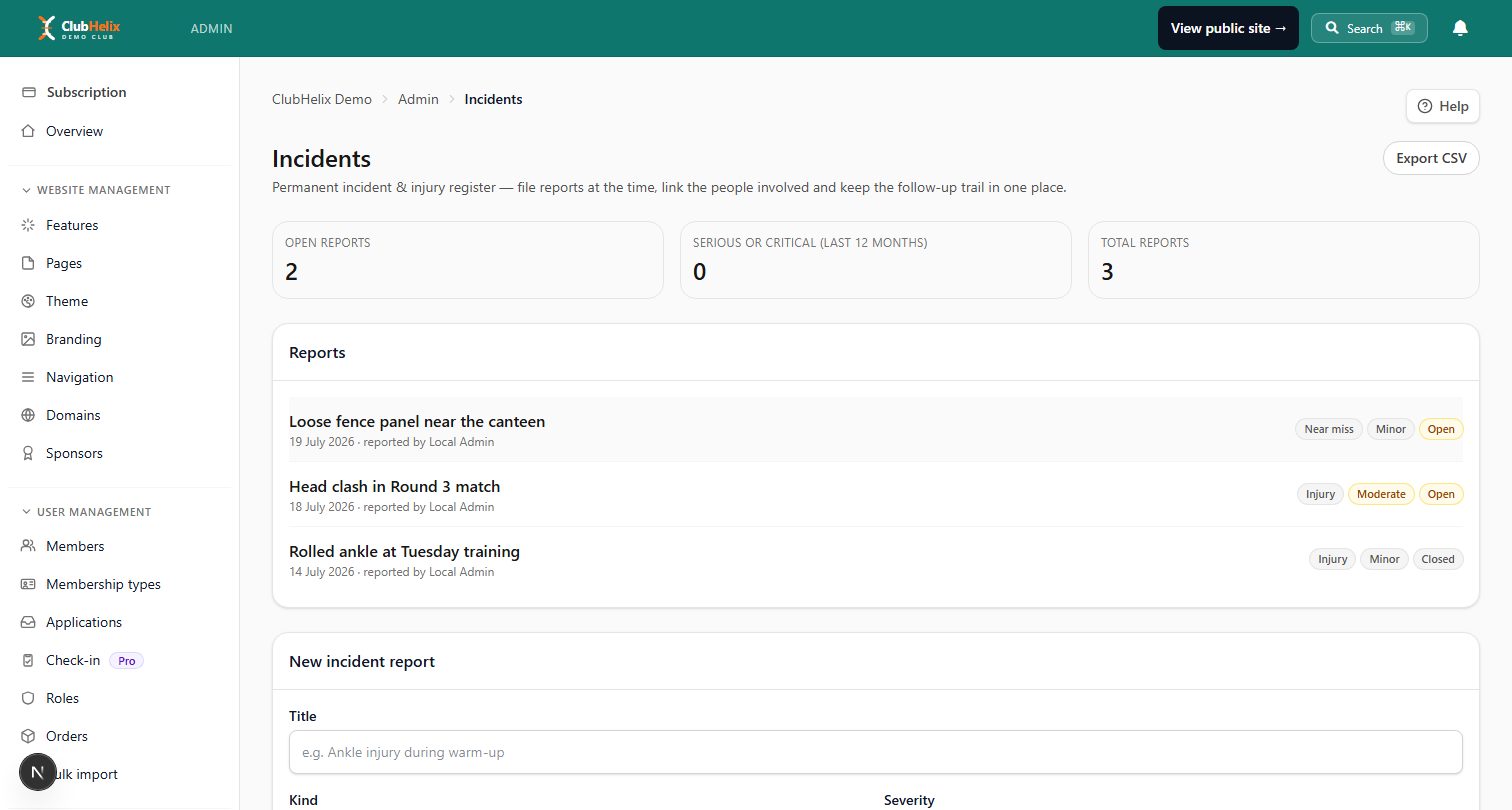
The plan, the roster and the records only work if they exist somewhere other than one volunteer's car. That is the part ClubHelix is built to fix — incident reporting so the record is written the same day by whoever was there and visible only to the roles you choose, volunteer rostering so the duty first aider and the four emergency jobs are on a published roster instead of a group chat, and SMS messaging for the moment you need to reach every team manager at once because a ground has been closed.
There is a free tier that comfortably covers a small club's records and rosters, and the pricing is on the page rather than behind a quote form. If your emergency action plan currently exists as a photo on somebody's phone, you can set your club up this week and give every team manager the same version.
Frequently asked questions
What should be in a sports club first aid kit?
Work in tiers rather than one big bag. A light sideline kit that always travels with the team covers gloves, a resuscitation face shield, sterile dressings and pads, adhesive dressings, crepe and elastic bandages, a triangular bandage, tape and blunt-ended shears, instant cold packs, a thermal blanket, a waste bag, and a pen and incident form. A larger clubroom kit holds the restock supplies, and a duplicate sideline kit lives permanently in the away bag.
What is an emergency action plan for a sports club?
It is a one-page document, written for one specific venue, that tells anyone present what to do in an emergency and in what order. It carries the address to give emergency services, the access gate and who holds the key, the meeting point, where the defibrillator and kit are, the nearest hospital, and who at the club to notify. Write one per ground you use, laminate it, and keep a copy in the kit and on the wall.
How often should a club check its first aid kit?
Seal the kit and check the seal every match day, run a full inventory monthly during the season, and do an expiry sweep before the season and again mid-season. Give the job to a named role with a recurring reminder rather than to the committee in general, and record each check on a sheet inside the lid so anyone can see when it was last done.
Does a community club need a defibrillator?
Many clubs choose to have one and it is frequently the highest-value equipment purchase a club makes, though whether it is required of you depends on your governing body, your venue owner and local rules — check with them. If you do have one, the important part is upkeep — pads and batteries expire silently, the unit needs to be reachable in a short round trip from the field, and the access details must be current on every copy of your emergency action plan.
Who should hold first aid qualifications at a club?
More people than you think, and never only the two who always volunteer. Aim for enough trained members that every team and every training night is covered when someone is away, and keep the certificates and their expiry dates in one central list rather than in individual inboxes. Your governing body may set a minimum for sanctioned competition, so confirm what they require and what they will subsidise.
What should happen after an incident at the club?
Write the record the same day, while details are accurate, using facts rather than conclusions — what happened, what was observed, what was done and when. Notify whoever your plan names, tell your insurer if the incident could lead to a claim, and put the incident on the next committee agenda so any lesson reaches the risk register instead of dying with the people who were there.
Keep reading — concussion guidance for community clubs covers head knocks specifically, and the incident report form template gives you the record your plan refers to.

