
What this guide answers
- What is the best free club management software?
It depends entirely on which free model suits you. For a single team that needs communication and RSVPs, a free app-first tool is excellent.
- Is free club software actually free?
The software is free; the model is not. The four ways it is funded are advertising shown to your members, a margin on payments you collect, a governing-body contract, or a paid tier you are expected to upgrade into.
- Is a free club app worth it if it shows ads?
For many clubs, yes, and it is a fair trade for a product that costs nothing.
- How do I compare transaction fees between platforms?
Take last season's real numbers — total processed and total number of payments — and run each published rate card across both.
- When should a club move from free to paid software?
Usually at one of three moments — when real money starts flowing through the system, when more than one person needs their own login and their own permissions, or when somebody asks a question that needs two separate…
Every club treasurer has had the same moment. The platform is free, the committee is delighted, and then the first season's payout lands and it is several thousand dollars short of what the members were charged. Nobody was misled. The bill simply arrived somewhere other than the line item marked "software".
Free club management software is not a con. Several of the products in this article are genuinely good and cost a club nothing, and for some clubs they are the correct answer. But free is a business model, not an act of charity, and there are only four of them in this market. Once you can name which one a product is running, you can work out who ends up paying — because it is always somebody, and surprisingly often it is your members rather than your club.
This is the forensic version of the comparison. We name products, we quote only figures that are published and dated, and where a company does not publish a price we say so instead of repeating a directory estimate. Everything below is current as at July 2026 and worth verifying before you commit. Our bias, declared up front: we build ClubHelix, a paid club platform with a small free tier, so we have an obvious interest in you concluding that free has limits. We have tried to earn the conclusion rather than assert it, including by being blunt about what our own free tier is not.
The four ways a free product makes its money
One — advertising in front of your members. The club pays nothing and the members see ads. Stack Team App, the Melbourne-based product in the Stack Sports family, is free to clubs and ad-supported, with end-users able to pay roughly A$4.49 a year to remove ads according to its app-store listing. That is a coherent bargain and it has built an enormous installed base. It is also worth naming plainly at the committee table: the audience being sold is your membership, including junior families, and you do not control what is placed in front of them.
Two — a margin on the money you collect. The platform is free and takes a slice of every payment. Spond, from Oslo, has no subscription at all and monetises payment processing plus its Superdraw fundraising product, where the club keeps 65% of ticket sales according to Spond's own site. ClubSpark, the Sportlabs white-label platform, is free to LTA-registered venues and accredited coaches in the UK and adds 0.8% per Stripe transaction on top of the processor's own fee. This is the most common shape of free, and the one where the true cost scales with how successful your club gets.
Three — somebody else's contract. A governing body buys the platform for its clubs. PlayHQ is funded by national body contracts with AFL, Cricket Australia, Basketball Australia and Netball Australia; clubs pay no subscription, and costs surface as participant-side transaction fees instead. Cricket Australia's support documentation describes a 1.49% processing fee added to the participant and 1.80% deducted before disbursement — arrangements differ by sport, so check your own body's fee schedule rather than assuming. Squadi is distributed free to clubs under governing-body deals in football, touch and netball on the same logic. The catch here is not money. It is that you did not choose the platform, cannot leave it, and its roadmap answers to your national body rather than to you.
Four — free is the ground floor of a paid product. Freemium: a real free tier that stops at a wall you will eventually hit. Pitchero has a free plan, and payments are not available on it at all — its paid tiers are £38 and £99 a month with payment fees from 2.42% + 17p down to 1.67% + 15p. TidyHQ runs a free plan alongside Pro at US$69 a month, published as A$89, £49 and NZ$99. membermojo in the UK is free to 50 members and around £75 a year at 500, with no platform transaction fee of its own on top of Stripe's 1.5% + 20p. SportMember, the Danish multi-country product, is freemium with paid upgrade specifics it does not publish. TeamSnap is free for single teams, with club and league pricing quoted individually rather than listed.
| Model | Who actually pays | Named examples | What it costs you if the club grows |
|---|---|---|---|
| Advertising | Your members' attention | Stack Team App | Nothing in cash; more ads in front of more people |
| Payment margin | Everyone who pays you | Spond, ClubSpark | Rises directly with turnover |
| Governing-body contract | Your national body | PlayHQ, Squadi | Nothing; but the platform is not your choice |
| Freemium upgrade wall | You, later | Pitchero, TidyHQ, membermojo | A subscription the day you cross the wall |
The fee maths on a real club budget
Percentages are abstract until you put a season through them. Here is an illustrative club — invent your own numbers, the method is the point.
Riverside, 240 members. 160 seniors at A$220 and 80 juniors at A$120 is A$44,800 in subscriptions. Three events sell 500 tickets at A$25, which is A$12,500. The shop turns over A$6,000 across about 120 orders. Call it A$63,300 processed across roughly 860 transactions in a year.
Now run the published Australian-dollar rates across it.
| Rate structure | Percentage part | Fixed part | Total on Riverside | Effective rate |
|---|---|---|---|---|
| 2% + A$1.60 per transaction | A$1,266 | A$1,376 (860 × 1.60) | A$2,642 | 4.2% |
| A 0.8% platform margin, on top of a processor | A$506 | — | A$506 extra | 0.8% on top |
Three things fall out of that table, and they are the whole argument of this article.
The fixed component is where small clubs bleed. Riverside's A$1,376 in per-transaction cents is more than half its total payment cost, and it exists because the club takes lots of modest payments rather than a few large ones. A club selling A$25 tickets and A$40 junior fees pays a much higher effective rate than one collecting A$400 memberships, on exactly the same published schedule. Before you compare two platforms, count your transactions, not just your turnover.
The subscription is usually the smaller half of the bill. Riverside's payment fees at 2% + A$1.60 come to A$2,642. A paid annual subscription in the same market — revolutioniseSPORT publishes A$396 a year for clubs up to 500 members — is about 13% of that. Which means the choice between a free platform and a paid one moves your total cost far less than the difference between a 2% schedule and a 3.5% one. Clubs argue about the subscription because it is the visible number. It is rarely the number that matters.
A "free" surcharge can quietly outweigh a paid subscription. A 0.8% platform margin on Riverside's A$63,300 works out at A$506 a year. Compare that with what an annual club subscription costs in the market where each is sold — these two products are not alternatives for the same club — and the point is simply that a percentage on turnover is not a smaller number than a subscription. It just appears in a different column of your books.
The same logic applies in every currency, which is why it is worth reading rate cards structurally rather than by headline number. Pitchero's Standard tier charges 2.42% + 17p and its Pro tier 1.67% + 15p — three-quarters of a percentage point of difference that only pays for itself above a certain turnover, which is a calculation the club can actually do. membermojo charges no platform fee of its own, so a club pays Stripe's 1.5% + 20p and nothing else, which is about as clean as this market gets at the small end. And on a governing-body-funded platform, the participant-side model means your members see a fee added at checkout that never appears in your accounts at all — the cheapest option on your books and not necessarily the cheapest for the family paying.
One date belongs in that comparison. From 1 October 2026 a card payment in Australia cannot be surcharged: the Reserve Bank of Australia removed the rule that had stopped the card networks banning surcharges, so eftpos, Mastercard and Visa each enforce a no-surcharge rule of their own, and American Express has decided to do the same without being formally regulated by the RBA. What that does to a participant-facing fee depends on what the fee actually is — the RBA does not treat a payment provider's own charges for its services as a surcharge, so a platform fee charged however the family pays is a different animal from an amount added for using a card. Ask which one you are looking at, and ask in writing. The Reserve Bank publishes surcharging FAQs. General information, not financial advice.
Our guide on collecting membership fees online walks through how to present those fees to members without an argument at the AGM. And it is worth remembering what those percentages are competing with: a club that clears a few thousand dollars a year at the barbecue is losing a comparable amount to a fee schedule nobody has read since 2021.

Where the free tier stops
Every freemium product draws a line somewhere, and the line tells you what the company thinks it is selling. Published positions as at July 2026:
| Product | The free offer | Where it stops |
|---|---|---|
| Pitchero | Free plan with a club website | No payments on the free plan at all |
| TidyHQ | Free plan | Pro at US$69/mo (A$89 / £49 / NZ$99) for the full product |
| membermojo | Free up to 50 members | Around £75/yr at 500 members |
| TeamSnap | Free for a single team | Club and league pricing is quoted, not listed |
| Stack Team App | Free to clubs, ad-supported | Members see ads unless they pay to remove them |
| Wild Apricot | A free tier by contact count | Published tier figures we could not verify on their own page, so we will not quote them |
| SportMember | Freemium core | Paid upgrade specifics not published |
| Jersey Watch | No free tier | From US$29/mo by athlete volume, US$19 first month |
| Join It | No free tier | From US$29/mo, sliding by member count |
Two patterns are worth naming. The first is that payments are the most common wall, because payments are the product. If a free plan cannot take money, it cannot run your registration day, which is the one week of the year the software genuinely has to work. The second is that member or contact count is the second wall, which means the free plan expires not on a date but on a good recruitment season.
Where free is genuinely the right answer
We would rather you spent nothing than spent badly, so here is the honest list.
- A club that does not exist yet. Before your first season, with no members and no money moving, paying for software is premature. Build the site, get the name right, open a bank account. Setting up a club website for free is the guide for that stage.
- A single team. One squad, one coach, eighteen parents and a weekly message. That is what free app-first tools are built for and they do it extremely well. A platform with membership bands, ladders and a shop would be equipment you never take out of the bag.
- A club whose governing body already funds the rails. If registrations, fixtures and results are handed to you at no cost, use them. Duplicating a national body's registration pipeline is a waste of a volunteer's evening. The gap left over is usually a public website and the community half of club life, not the competition machinery.
- A very small members' club with no online payments. Under about fifty members, with fees collected in person or by transfer, a free membership tool with a "who has paid" list is genuinely sufficient. membermojo's free band exists precisely for this club, and it is a fair offer.
- Any club, for a season, as a trial. Free tiers are the cheapest way to find out whether the committee will actually adopt a system. What matters is that you can export everything when you outgrow it.
Where free stops being right is fairly predictable: the season you start taking money online at volume, the season a second person needs their own login, and the season somebody asks a question that requires you to join two lists together.
What we charge for, and what we do not
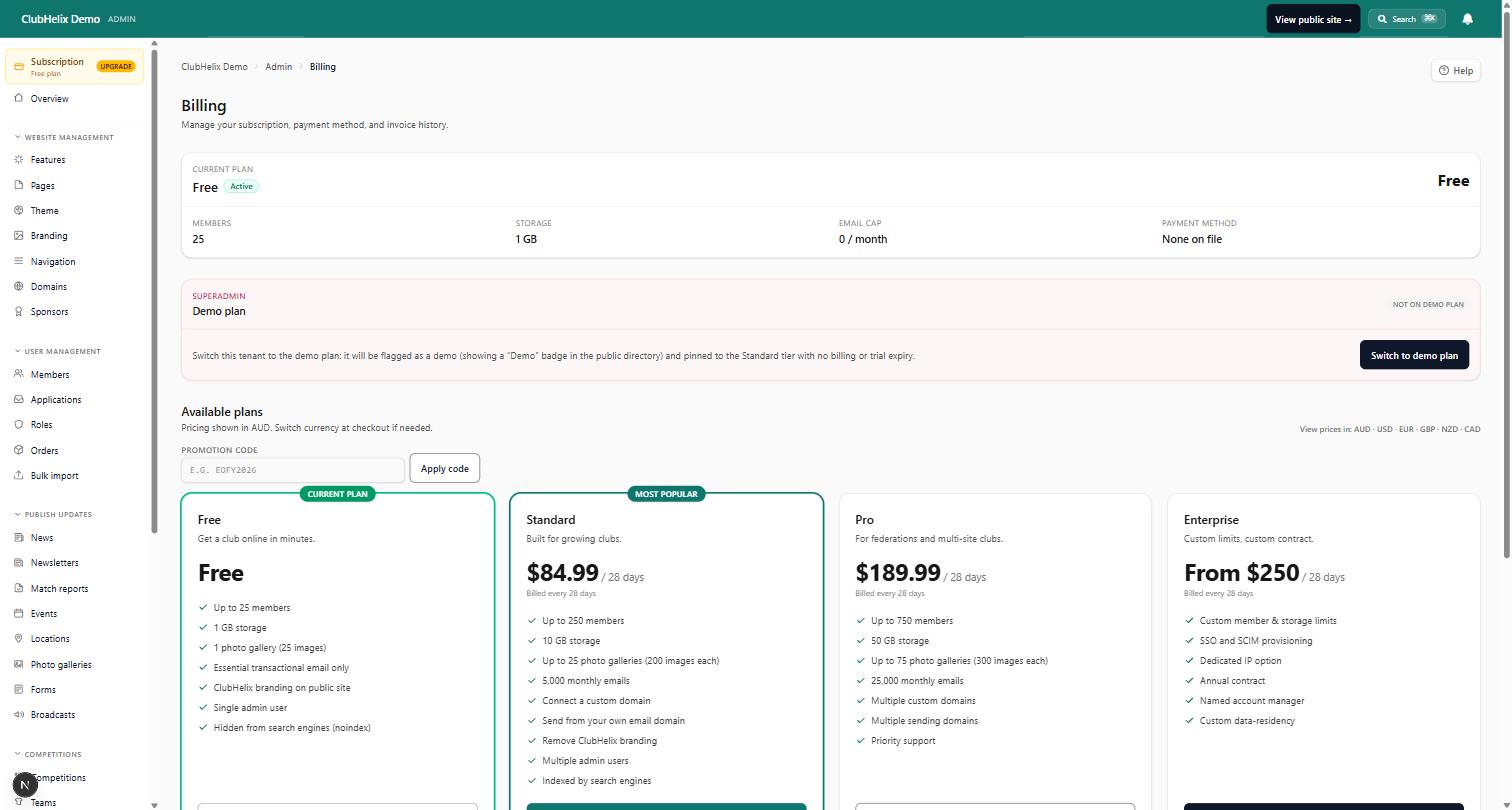
Our own answer to this article, stated plainly. ClubHelix has a free tier, and it is a build-and-try sandbox with a small member cap rather than a way to run a real club — the current limit is on the pricing page and we would rather you knew that before signing up than after. We do not run advertising in front of your members and never will, and we do not add a platform margin on top of your payment processor, so the percentage you pay is the processor's, not ours plus theirs. What you pay us is a subscription band based on club size, published, on a 28-day cycle, with no per-registration levy.
What that subscription buys is the machinery the free products stop short of: membership and self-registration with payment status attached to the member rather than sitting in a separate report, billing and sponsorship records your treasurer can reconcile, a club shop with tax handled, and an installable web app with push notifications so the message still lands without an app-store build. If your club's honest position is one of the five cases above, take the free option with our blessing. If it is not, you can try ours free first and create your club site in an evening.
Head-to-head write-ups against the free products named above sit at /compare — Team App, Spond, TidyHQ, Wild Apricot and the club website alongside PlayHQ case.
Our limits, since we have been counting everyone else's. ClubHelix has no governing-body distribution deals, so we are never the free-because-your-federation-paid option. We ship an installable web app rather than native app-store apps. We do not do video streaming or match analysis, we do not integrate with access-control hardware, and beyond our own website the product is English-only today: our marketing site, help wiki and guides are available in Spanish and Brazilian Portuguese as a preview, but the admin, member accounts, your club's public website and the emails it sends are in English. If one of those is decisive for your club, one of the products above will suit you better and we would rather say so here. The full set of head-to-heads is on the club software comparisons page.
Frequently asked questions
What is the best free club management software?
It depends entirely on which free model suits you. For a single team that needs communication and RSVPs, a free app-first tool is excellent. For a small members' club under fifty people, a free membership tier is genuinely enough. For an affiliated club whose national body funds a registration and competition platform, that platform is the best free software available to you because it is also mandatory.
Is free club software actually free?
The software is free; the model is not. The four ways it is funded are advertising shown to your members, a margin on payments you collect, a governing-body contract, or a paid tier you are expected to upgrade into. None is dishonest, but each puts the cost somewhere — and on a busy club, a payment margin can cost more per year than a published subscription would have.
Is a free club app worth it if it shows ads?
For many clubs, yes, and it is a fair trade for a product that costs nothing. The things to weigh are that the advertising is shown to your members including junior families, that you do not control what appears, and that the club has no leverage over the experience. Some committees are comfortable with that and some are not; it is worth a minute of discussion rather than an assumption.
How do I compare transaction fees between platforms?
Take last season's real numbers — total processed and total number of payments — and run each published rate card across both. The percentage and the fixed cents behave very differently: a club taking many small payments is punished by the fixed part, while a club taking a few large ones is punished by the percentage. Only compare like for like, and check whether the platform adds its own margin on top of the payment processor's fee.
When should a club move from free to paid software?
Usually at one of three moments — when real money starts flowing through the system, when more than one person needs their own login and their own permissions, or when somebody asks a question that needs two separate lists joined together. Before that, free is prudent. After it, free is quietly costing you volunteer hours that nobody is measuring.
Keep reading — club website platforms compared sorts the four kinds of supplier, and how much a club website costs puts real numbers on the whole line. Think we have a figure wrong? Tell us — accuracy is the only thing this page has going for it.

