For wrestling clubs
Registrations, cards and mat time — sorted before the room fills.
From the first folkstyle practice in November to a home tournament with three mats running, ClubHelix keeps a wrestling club's registrations, cards, practice groups, entries and money in one place — with the dues landing in the club's own Stripe account.
Folkstyle Nov–Feb · freestyle & Greco in spring and summer · Updated 12 Sept 2026

Why committees of wrestling clubs come to us
The same problems show up in every committee meeting. ClubHelix is built to retire each one for good.
- A hundred and twenty kids signed up for a room that holds eighty, and no single list of who has paid.
- USA Wrestling card numbers tracked in a spreadsheet that was last accurate in October.
- Tournament entries collected by text message and reconciled against a cash box.
- Weigh-in sheets on a clipboard nobody can find when an entry is queried.
- Table workers, hospitality room and gate volunteers begged for the week of your home tournament.
What ClubHelix does for wrestling clubs
The platform mapped onto the moments your season actually runs on.
Season registration
One flow captures the birth date that sets the age bracket, the school and grade that tie the athlete to a high-school feeder program, the USA Wrestling card number, the signed waiver and the physical on file — with season dues paid in the same step, so a wrestler is registered, cleared and financial before their first practice rather than three weeks into it.
Practice groups and mat space
Run 6U through 14U, novice, intermediate and open as separate program intakes, each with its own capacity, fee and waitlist, and publish the room schedule as capped bookable sessions — so the little-kid practice at 5:30 and the open group at 7:00 stop colliding over the same square footage of mat.
Weigh-ins and eligibility
Weigh-in results, weight class and skin checks recorded privately against the athlete on the day, sitting beside card status and the physical on the same record — so nobody lands on a bracket without an eligible entry behind them, and a queried entry is settled from a dated sheet instead of a recollection.
Entries, brackets and duals
Tournament and dual entries run as paid forms with weight class, style — folkstyle in winter, freestyle and Greco-Roman in the spring and summer — and card number as required fields. Each club event carries its own entry list and schedule, with a knockout bracket for the club championship.
Hosting a home tournament
Gate admission and coach passes sell as ticketed events, table workers, mat crews and the hospitality room fill through volunteer rosters parents claim themselves, and singlets, tees and spirit wear sell through the club shop — so the weekend's money arrives itemised rather than as a cash box and a sign-up sheet.
Coach compliance
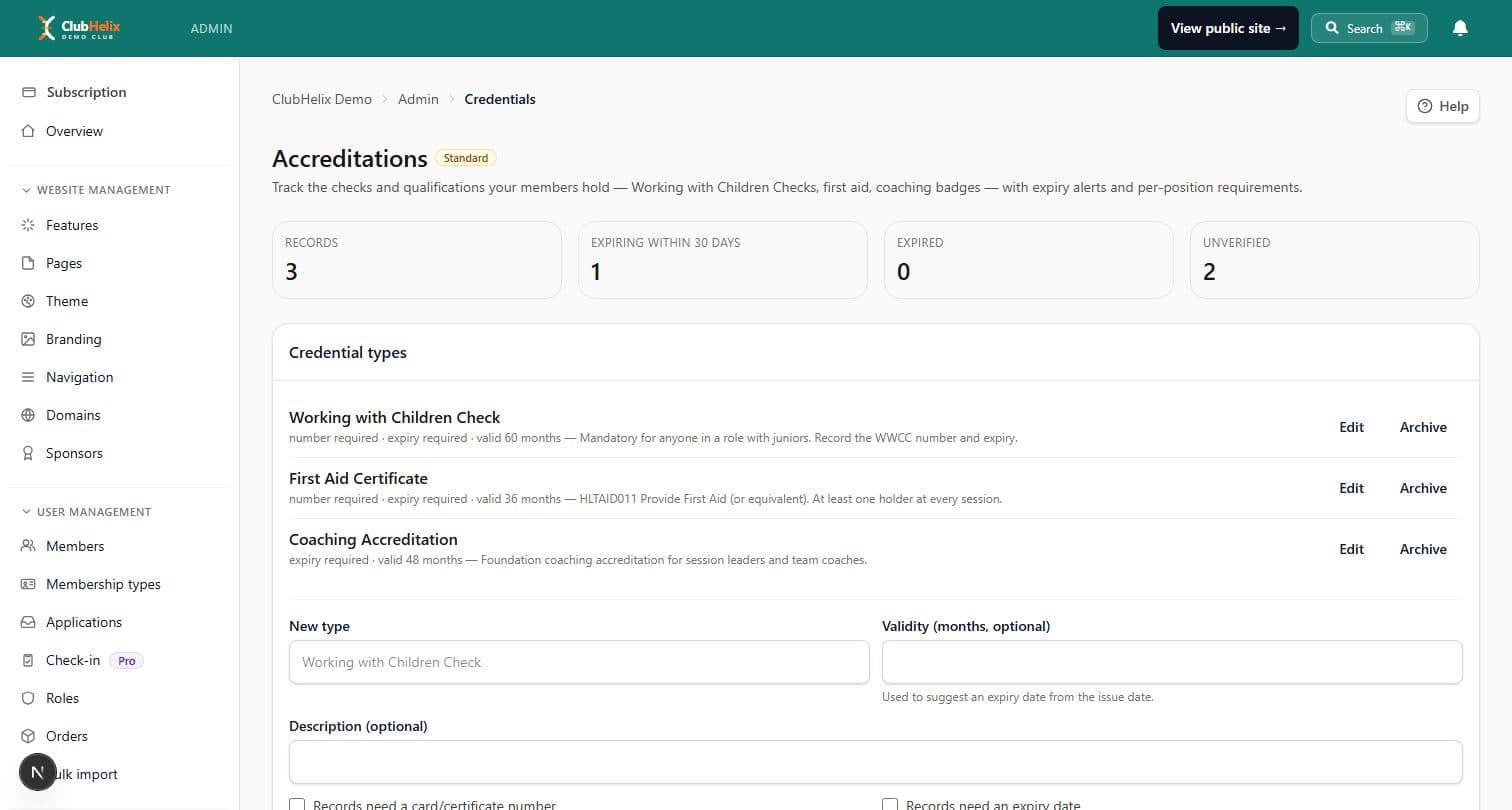
Coaching certification, background screening and safe-sport training tracked against each coach with expiry dates, so a lapse is flagged before that coach walks into the room — and the record exists the moment the school district, the sanctioning body or your insurer asks who was supervising the mat.
Wrestling-family communications
Broadcast the snow-day cancellation, the weigh-in time change or the 6am bus departure to a single practice group or the whole club, with SMS for the calls that cannot wait for a parent to open email and push notifications for families who have installed the club app.
The season audit
Registered athletes by age bracket, how many hold a current USA Wrestling card, which coach screenings are still valid, and what the home tournament actually cleared once gate, entries and spirit wear are counted against the room hire — reports rather than a January evening re-reading bank statements.
What is wrestling club management software?
Wrestling club management software is the front office a youth wrestling club has never had: one place holding the roster, the season dues, every athlete's current USA Wrestling card, the practice groups, the tournament entries and the money. In ClubHelix that means online registration that captures card number, school, grade and weight at sign-up, digital waivers signed on the same screen, practice groups run as programs with their own caps and fees, mat time booked and capped, and broadcasts that reach every wrestling family instead of only the parents who still read the team chat.
Clubs usually come looking in early November, four days before the first folkstyle practice, when a hundred and twenty kids have signed up for a room that holds eighty and nobody can say which of them have paid, which hold a current card, and which are still waiting on a physical. That is not a coaching problem. It is an admin problem, and it is the one this software exists to end.
Registration, cards and the paperwork the season runs on
A wrestling registration is not a name and a fee. It is a birth date that decides an age bracket, a school that decides which high-school program the athlete feeds, a card number that has to be current before the first tournament, a signed waiver, a physical on file, and a parent contact who will actually answer at 6am on a Saturday. Collect all of it once, in one flow, with payment attached — the athlete is registered, paid and cleared in the same ninety seconds rather than across three weeks of chasing.
The register then answers the questions a board keeps asking. Who is financial. Whose card lapsed over the summer. Which family paid for two of their three kids. Coaches sit in the same register with their own requirements: certification, background screening and safe-sport training tracked as accreditations with expiry dates, so a coach whose screening ran out in September is flagged before they walk into the room, not after. Physicals, medical notes and photo-consent questions ride along as forms attached to the athlete record.
Mat time, practice groups and a room that only holds so many
Every wrestling club is limited by the same thing: square footage of mat, in a room somebody else owns. Publish the schedule as bookable, capped sessions so the little-kid practice at 5:30 and the open group at 7:00 stop colliding, and run each level — 6U through 14U, novice, intermediate, open — as its own program intake with a capacity, a fee and a waitlist that fills the spot when somebody drops in week two.
Attendance stops being a clipboard on the scorer's table. Mark the room from a phone with attendance and RSVPs, and by January you can tell a parent exactly how many practices their wrestler has made before you talk about a state qualifier. When the school district closes the building for a snow day or a gym conflict bumps you to the auxiliary space, one broadcast goes out to the affected group, with SMS for the calls that cannot wait for anyone to open email.
Weigh-ins, entries and hosting your own tournament
Duals and open tournaments are where the club's admin either holds or falls apart. Run entries as paid registration forms with weight class, style — folkstyle in winter, freestyle and Greco-Roman in the spring and summer — and card number as required fields, so the bracket you draw on the day is built only from wrestlers with an eligible entry behind them. Weigh-in results and skin checks are recorded against the athlete on the day, privately, and the sheet exists later when an entry is queried.
For the club's own tournament, the event holds the date, the entry list and the schedule, and the results go up as a news post the same evening — your bracket software still runs the bracket, but families read the outcome on the club's own site instead of a phone photo of a wall chart. Hosting is its own business: gate admission and coach passes sell as event tickets, the hospitality room and the table-worker shifts fill through volunteer rostering, and the singlet, tee and hoodie order runs through the club shop instead of a sign-up sheet taped to a wall. Every dollar of it — entries, gate, spirit wear, concession stand float — lands in one ledger the treasurer can actually reconcile.
A wrestling club website that recruits from the high school
Youth wrestling recruits through schools, and a parent who hears about the club at a middle-school open night will search for it that evening. Give them something real to land on. Build the site with the page editor: practice times by age group, the coaching staff and their credentials, the tournament calendar, the fee schedule, and a join button that works on a phone at the kitchen bench. Start from the template gallery, or look through the live demo to see what a new family sees.
It also matters to the high-school program you feed. A head coach deciding whether to point incoming freshmen at your club wants to see a real schedule, current coaches and a club that looks like it will still exist in March.
Free wrestling club management software to start
Every ClubHelix club starts on the free plan, with no time limit and no expiry date on it. When you want the paid pieces — online dues, tournament entries, ticketed gate, the shop — paid plans carry a 14-day free trial, bill on a 28-day cycle and can be cancelled at any time; the current tiers are on the pricing page. Money settles directly into the club's own Stripe account, so the treasurer sees payouts in the club's bank rather than waiting on a platform to release funds, and the platform fee is never surcharged to your wrestling families.
ClubHelix runs clubs in the US, Canada, Australia, New Zealand, the UK, Ireland and South Africa — wherever a folding table, a cash box and a laminated bracket are still doing the work.
Retiring the cash box and the sign-up sheet
Most wrestling clubs arrive with dues in a shoebox, cards tracked in a spreadsheet that was accurate in October, and a roster that only the head coach can reconstruct. Import the athletes you have, open registration with the waiver and card field built in, and run one season with the paperwork enforcing itself. If you would like a hand setting it up before the room fills, talk to us — and for the wider picture, from securing mat space to weigh-in standards and school partnerships, read the full guide to running a wrestling club.
Features in your plan
Every plan starts free and includes the whole platform below — browse all features or compare plans.
Canvas page editor
A no-code, drag-and-drop club website editor with 45 section types and real sidebars. Your page, exactly as it publishes: click a section to edit it, drag to reorder, add new ones right where you want them.
Self-registration
Club membership software that handles the joining for you: online registration and season sign-ups on your own branded site, with email verification and optional admin approval.
Events
A club events calendar with one-off and recurring events — and ticket sales built in, so you never send members off to an external ticketing site.
News
A club news page for announcements, match reports and committee updates — the club notice board, published from the same editor as your pages.
Team management
Team rosters with captains and jersey numbers, training sessions and practices with availability, and scoped access for coaches.
Broadcasts
Send a message to everyone, a role, or a custom segment of members.
Club shop
Run a club shop or team store: take uniform, kit and spirit wear orders online with variants, carts and order management — with GST handled properly on every sale.
Mobile app
A club app of your own — install-to-home-screen with your branding, push notifications and digital membership cards, no app store required.
Frequently asked questions
The questions wrestling club committees ask before signing up.
- Yes. Add the card number and its expiry as required fields on the registration form. They are stored against the athlete record and reportable, so you can see which wrestlers are card-current before entries close instead of chasing parents the night before a tournament.
- Each level runs as its own program intake with a capacity, a fee and a waitlist. A family registers the athlete into the right group and pays online, and when somebody drops in week two the spot is offered to the next name on the list automatically.
- Yes. Entries are paid forms, gate admission and coach passes are ticketed events, and spirit wear runs through the club shop. All of it settles into the club's own Stripe account, itemised so the treasurer can reconcile the whole weekend in one place.
- Accreditations carry expiry dates, and the club can see who is missing what before the season starts. The alternative — discovering in February that a mat coach has been unscreened since September — is exactly what the register exists to prevent.
Can we collect USA Wrestling card numbers at registration?
How do we run practice groups with different caps and fees?
Can we take tournament entries and gate money through the same site?
What happens when a coach's background screening lapses?
Bring your wrestling club online in under 30 minutes.
Start on the free plan, then take a 14-day free trial of paid features when you're ready — nothing to pay today, cancel any time before the trial ends.