For squash clubs
Courts booked, boxes running, pennant on track.
A squash club lives and dies on court utilisation and a healthy internal comp. ClubHelix gives you online court booking, box leagues that run themselves, pennant fixtures and self-serve memberships.
Year-round boxes · winter pennant · Updated 10 Sept 2026

Why committees of squash clubs come to us
The same problems show up in every committee meeting. ClubHelix is built to retire each one for good.
- The court booking sheet is a pencil on a string in the foyer.
- Box leagues collapse mid-cycle because the organiser went on holiday with the spreadsheet.
- Pennant availability chased individually by text every single week.
- No one really knows how many members are financial until the AGM panic.
- Casual players can’t find how to book a court, so they play somewhere else.
What ClubHelix does for squash clubs
The platform mapped onto the moments your season actually runs on.
Online court booking
Members book courts against live availability from their phone — slots are clash-proof at the database level, casual visitors can pay per booking, and utilisation stops depending on a pencil in the foyer.
Bookings before the card reader
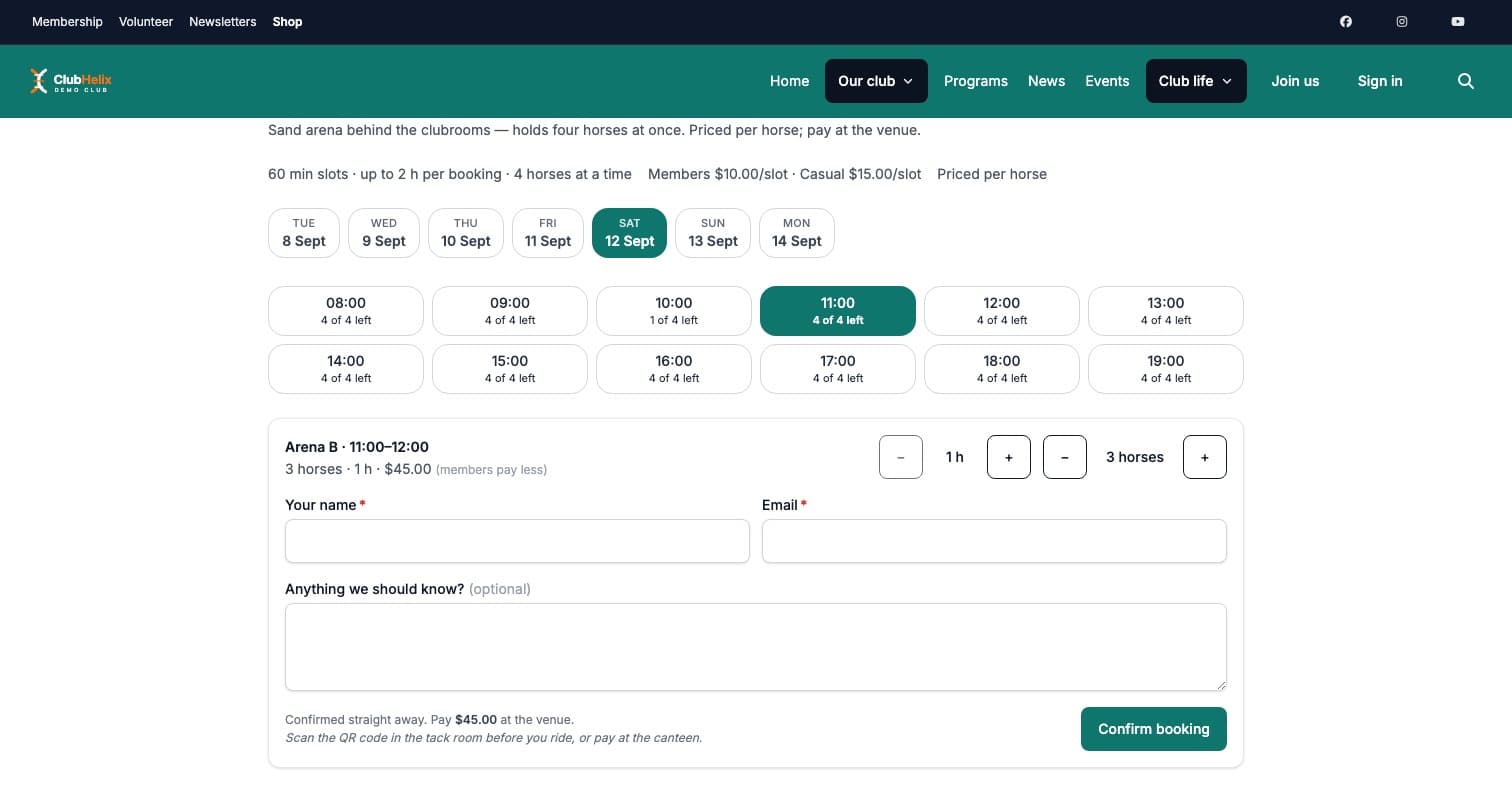
Set courts to pay at the venue and they are bookable today without a payment provider: the booking confirms, the player is told what they owe and how (EFTPOS at the bar, cash in the honesty box), and the Bookings page shows what is owed until you mark it paid. Count players and charge per head on coaching courts, and give bookers a comments box the committee reads.
Box leagues
Run each box cycle as a competition: players grouped into boxes, fixtures published, results entered from a phone, and standings visible to everyone — promotion and relegation between cycles without a spreadsheet in sight.
Pennant teams
Pennant sides are teams with fixtures, results and their own pages. Selections broadcast to exactly the picked players, and everyone’s personal calendar feed carries their matches.
Club championships
Season-end championships run as knockout brackets with published draws and results — from first round to the final on the glass court.
Memberships
Self-serve sign-up and renewal with your own membership categories, paid online, with a register that shows exactly who is financial at any moment — not just at the AGM.
Club comms
Broadcast court-maintenance closures, box-cycle deadlines and pennant results to the right group — one box, one team, or the whole club.
Court utilisation and the lease
Court bookings by hour, membership by category, and pennant participation — the three numbers a squash club needs when the lease or the court-time allocation comes up for review. A squash court is hired one booking at a time, so busy means booked hours rather than places; the peak-times heatmap and resource comparison show which court and which hour earn their keep.
What is squash club management software?
A squash club lives and dies on two numbers: court utilisation and how many members are actually financial. Squash club management software exists to keep both visible. In ClubHelix that means online court booking that replaces the pencil on a string in the foyer, box leagues and pennant run as competitions with live standings, pennant sides as teams with personal calendar feeds, self-serve memberships paid online, and broadcasts targeted at one box, one team or the whole club.
The register question matters more in squash than most sports: too many clubs discover how many members are financial only at the AGM. With payments and renewals online, the answer is on screen every day of the year.
Box leagues that outlive the organiser's holiday
The classic failure mode of a box league is a spreadsheet that goes on annual leave with its owner. Run each cycle as a competition instead: players grouped into boxes, fixtures published automatically, results entered from a phone straight off the court, standings visible to everyone. When the cycle ends, promote and relegate between boxes and start the next one — no spreadsheet, no single point of failure, and no mid-cycle collapse because one person got busy.
Pennant runs alongside it. Each side is a team with its own page, fixtures and results; selections broadcast to exactly the picked players instead of a weekly round of chasing texts, and every player's calendar feed carries only their own matches. Season's end, the club championship runs as a knockout draw with a published bracket, from round one to the final on the glass court.
Courts that casual players can actually book
Members book against live availability from their phones, with slots clash-proof at the database level. Just as importantly, casual players — the ones who currently give up and play somewhere else because they can't work out how to book — pay per slot online through the club's own Stripe account, against the same availability the members see. Court-maintenance closures go out as a broadcast to everyone affected, not a note taped to the foyer door.
Courts online before the card reader arrives
A squash court is one booking at a time — that never changes, and the clash-proofing is what stops two pairs meeting at the door. What's new is everything around the booking. Count the players if you want to: set the court to ask "how many players?", cap it at two or four, and either charge per player — an illustrative $6 a head for a coaching session rather than a flat court fee — or just record the number for the lights and the visitors' book. Facility booking does the arithmetic on the booking page before anyone pays.
A comments box the club labels — "Anything we should know?" — is private to the committee and sits beside the booking in the admin. It's where a casual player asks "first time here, where's the key safe?" and a member says "bringing a guest for the second half-hour".
Payment can be by card at booking or at the venue. Card at booking suits casual players you'd rather see paid before they arrive. Pay at the venue suits a club that hasn't set up a card reader or connected a payment provider yet: the courts are bookable online today, the booking confirms straight away, the booker sees what they owe and how to pay it in your words ("EFTPOS at the bar", "cash in the honesty box"), and the Bookings admin shows an Owed at the venue total until Mark paid records the payment, with a receipt if they'd like one. Download CSV gives the treasurer a filtered list to reconcile against the till.
Venue-settled bookings need no payment processor, and money the club records itself carries no platform commission, so utilisation becomes visible weeks before the money side is finished. Setup is walked through in the guide to setting up online court booking, and taking payment at the venue covers the reconciliation.
A squash club website with the courts up front
Your public site is where a casual player decides whether booking a court looks easy or impossible. Build it with the page editor: booking front and centre, box-league standings, pennant news and a clear path for new players. Start from the template gallery — a site can be live before the current box cycle closes — and the live demo shows the whole thing working end to end.
Free squash club management software to start
Every ClubHelix club begins on the free plan — core admin and your club website at no cost, with no time limit. Paid plans add features like paid court bookings and online membership payments; each carries a 14-day free trial, bills on a 28-day cycle, and can be cancelled any time — details on the pricing page. All money settles directly to the club's own Stripe account. ClubHelix never holds your funds, and the platform fee is never surcharged to your members.
Squash clubs run on ClubHelix in Australia, New Zealand, the UK, the US, Canada, Ireland and South Africa.
Cutting the string on the pencil
Import your member list, load the courts and open the first box cycle — most clubs find utilisation becomes visible within a fortnight and the AGM panic never happens again. If you want help planning the move, get in touch, or read the full guide to running a squash club for the long view on courts, comps and keeping members.
Features in your plan
Every plan starts free and includes the whole platform below — browse all features or compare plans.
Canvas page editor
A no-code, drag-and-drop club website editor with 45 section types and real sidebars. Your page, exactly as it publishes: click a section to edit it, drag to reorder, add new ones right where you want them.
Self-registration
Club membership software that handles the joining for you: online registration and season sign-ups on your own branded site, with email verification and optional admin approval.
Events
A club events calendar with one-off and recurring events — and ticket sales built in, so you never send members off to an external ticketing site.
Competitions
Leagues and divisions with published fixtures and game schedules, entered-once results, and ladders (standings) that compute themselves.
Team management
Team rosters with captains and jersey numbers, training sessions and practices with availability, and scoped access for coaches.
Broadcasts
Send a message to everyone, a role, or a custom segment of members.
Club shop
Run a club shop or team store: take uniform, kit and spirit wear orders online with variants, carts and order management — with GST handled properly on every sale.
Mobile app
A club app of your own — install-to-home-screen with your branding, push notifications and digital membership cards, no app store required.
Frequently asked questions
The questions squash club committees ask before signing up.
- Yes. Each box cycle is a competition — boxes are the groupings, fixtures publish automatically, players enter results from their phones, and standings update live. Next cycle, regroup and go again.
- Casual visitors can book and pay per slot online through the club’s Stripe account, while members book under their membership — both against the same clash-proof availability.
- Yes. Every member gets a personalised calendar feed filtered to their teams — a pennant player subscribes once and their phone only ever shows their own matches.
- Yes. A court set to pay at the venue needs no payment provider — the booking confirms straight away, the booker sees what they owe and your instructions for paying it, and the Bookings page tracks what is owed until you mark it paid, with a CSV for the treasurer. Switch the court to card at booking whenever you’re ready.
Can we run box leagues without a spreadsheet?
How does court booking handle casual (non-member) players?
Can pennant players see just their own fixtures?
Can we take court bookings before we have card payments set up?
More clubs like yours
ClubHelix isn't a single-sport tool — browse other sports we support out of the box.


Bring your squash club online in under 30 minutes.
Start on the free plan, then take a 14-day free trial of paid features when you're ready — nothing to pay today, cancel any time before the trial ends.