For fencing clubs and academies in Canada
Beginner intakes, class tuition and the competitive squad — one system.
Six-week beginner courses that fill, monthly class tuition that collects itself, a squad heading to rated tournaments and an armoury that stays accounted for — ClubHelix gives fencing clubs one place for registration, billing, bout nights and comms, with the money landing in the club’s own Stripe account.
Fall to summer season · weekly classes, monthly bout nights · Updated 8 Oct 2026

Why boards of fencing clubs come to us
The same problems show up in every board meeting. ClubHelix is built to retire each one for good.
- Beginner course sign-ups taken by email and paid by whoever remembers, so the class list lives half in a coach’s inbox.
- Monthly class tuition chased by text message, and nobody is certain which families are three payments behind.
- Private lesson blocks tracked on a whiteboard, so the coach and the parent disagree about how many are left.
- Club masks, jackets, blades and body wires walking out the door with no record of who took what.
- Lapsed national memberships and safe-sport credentials discovered at the tournament check-in desk instead of a fortnight before.
What ClubHelix does for fencing clubs
The platform mapped onto the moments your season actually runs on.
Beginner course intakes
Each intake is a term program with fixed dates, a cap that holds the coach-to-beginner ratio, uniform included in the price and payment taken at booking — plus an ordered waitlist when the six-week foil course fills in the first week.
Class registration and squad dues
Intro, improvers and the competitive squad each run as their own class group with their own fee and roster, registered and billed online rather than chased by text — and a family with two fencers in different classes signs up once and pays once.
Private lessons and lesson blocks
Sell private lessons in blocks of ten as a paid registration item, so the coach and the parent read the same balance instead of two whiteboards, and open bouting nights take a drop-in fee online without anyone holding cash at the door.
Bout nights and the club championship
Run the monthly pool night as a capped event with online entry, publish the night’s results on the club site that evening, and close the season with a direct elimination bracket for the club championship by weapon and age group.
Tournament travel and hosting
One intent form with a deadline replaces twelve text threads: who is entering which sanctioned event, in which weapon, and who needs the coach on the day. Hosting a rated event rosters the bout board, check-in desk, armourers and concession stand.
The armoury and loan uniform
Number every mask, jacket, plastron, glove, blade and body wire, and record who has what and when it is due back — so the annual audit before the first course of the year is a report rather than a search of the storeroom.
Waivers, screening and club comms
Signed waivers and parent consents sit against every fencer, coaching, refereeing and safe-sport credentials carry expiry dates you see a month out, and a cancelled session reaches every family by broadcast or a push to the club app.
The pre-season renewal check
Before entries open the club has to know which fencers hold current national membership, whose safe-sport and screening credentials lapsed over the off-season, and which families still owe class tuition from last term. Expiry and outstanding-payment reporting produce all three, alongside how many fencers earned or improved a rating this season.
What is fencing club management software?
Fencing club management software runs the two businesses a fencing club is really in at the same time: teaching a sport nobody walks in already knowing, and supporting a competitive squad that travels to rated tournaments. In ClubHelix that means beginner course intakes with a cap, a price and a waitlist, online membership sign-up, open bouting and pool nights with numbers confirmed in advance, results published on your own site the evening they are fenced, signed waivers held against every fencer, and broadcasts that reach every family instead of only the ones still watching the group chat.
Clubs go looking for software because of the shape of the money. Almost nobody joins a fencing club at the gate — they buy a six-week beginner course first, borrow a mask and a jacket to do it, and only then become a paying member. So the club's income arrives as tuition in course-shaped bumps and monthly class fees, while the strip space is invoiced every single week whether eight people show up or twenty-eight. Software that cannot show you who is on the class list, whose tuition is current, and where the club's uniform went is not solving the fencing problem.
Beginner course intakes and the class timetable
Treat the beginner course as a product with fixed dates, a cap and an outcome — six weeks, one weapon, uniform provided, paid in full at booking. Published as a term program, each intake carries its own capacity, so the coach-to-beginner ratio you actually want holds without anyone counting heads at the door, and the thirteenth sign-up joins a waitlist in order rather than turning up to a full strip.
Publish all of next year's intakes at once — one at the start of each term or season — so a curious adult can plan around a start date instead of emailing to ask when the next one is. When a graduate moves up, the class timetable is the next product: intro, improvers, the competitive squad, minor by age group. Each level is its own group with its own fee and its own roster, and fencing class registration opens online the same way the course does — a family with two fencers in different classes registers once and pays once. Ask for attendance on the strip at classes and squad practice — it answers "is this fencer practice often enough to be entered?" with a number rather than a coach's recollection, and it tells you which Tuesday slot is quietly dying before the lease renewal comes round.
Tuition billing, private lessons and squad dues
Fencing clubs run more revenue lines than most community sports, and they collect badly by default. There is the beginner course fee, monthly class tuition, private lessons sold in blocks, an open bouting drop-in fee, a squad levy covering the coach's tournament days, and equipment hire for members who have not yet bought their own uniform. Every one of those can be an online payment attached to the thing being bought, so the treasurer stops matching bank transfers to surnames on a Sunday night.
Put private lessons on the same footing: sell a block of ten, and the coach and the parent are looking at the same balance instead of two different whiteboards. Run sibling and multi-class reductions as discount codes rather than mental arithmetic at the desk. Sell club shirts, knickers, socks and replacement gloves through the team store so spirit wear stops being a shoebox of cash in the coaches' office. Money settles straight into the club's own Stripe account — ClubHelix never holds your funds — and the member register shows who is financial before entries open, not in the week the invoice for the hall lands.
Open bouting, pool nights and tournament travel
The clubs that keep adult beginners are the clubs where a mid-table fencer gets real bouts every month without getting on a plane. Run a monthly pool night as a capped event: the club draws pools of five or six from the fencers who actually turned up, everyone fences everyone to five hits, and the results go up as a news post that night rather than "later in the week". Finish the season with a club championship by weapon and age group, so the Y12 fencers get a title of their own — published as its own event, with the result posted when the last bout is fenced.
Travel is the other half. A single intent form with a real deadline turns twelve text-message conversations into one list: who is going to which sanctioned tournament, in which weapon and event, who needs the coach on the day, and which minor need a signed permission and medical form. Hosting is bigger still — a local rated event needs a bout board, a check-in desk, armourers on call, referees paid at the end of the day and a concession stand running for eight hours. Roster those positions a fortnight out with named slots and confirmations through volunteer rostering, because "someone will do it" fails hardest at the check-in desk. Venue changes and cancelled sessions go out as a push notification through the club app, not an email opened on Sunday.
The armoury, waivers and coach credentials
Club uniform is the second-largest line in a fencing club's budget and the one most likely to be managed badly, because it lives in a cupboard and nobody owns it. Number every mask, jacket, plastron, glove, blade, body wire and spool, and keep a loan register showing who has what and when it is due back — every club past about twenty members eventually finds three masks have left the building permanently. Grade condition A/B/C rather than pass or fail, run an annual audit before the first course of the year, and take a bond or a signed agreement for season-long loans.
The compliance side is three registers a fencing club has to be able to produce on demand: signed waivers and parent consents for every fencer, current national membership numbers for anyone entering a sanctioned event, and coaching, refereeing and safe-sport credentials with their expiry dates. Hold them as accreditations against the person, and an expiry is something you see a month out instead of at a tournament check-in desk with a fencer already in uniform.
A fencing club website that fills the next beginner course
Nearly everyone who joins a fencing club started by searching for lessons near them, and what they land on decides whether they book. Build the site with the page editor: the next course dates and price at the top, what to wear, where to park, whether uniform is provided, and a join button that works on a phone. Start from the template gallery and walk through the live demo to see exactly what a parent finds before they ever email a coach.
Free fencing club management software to start
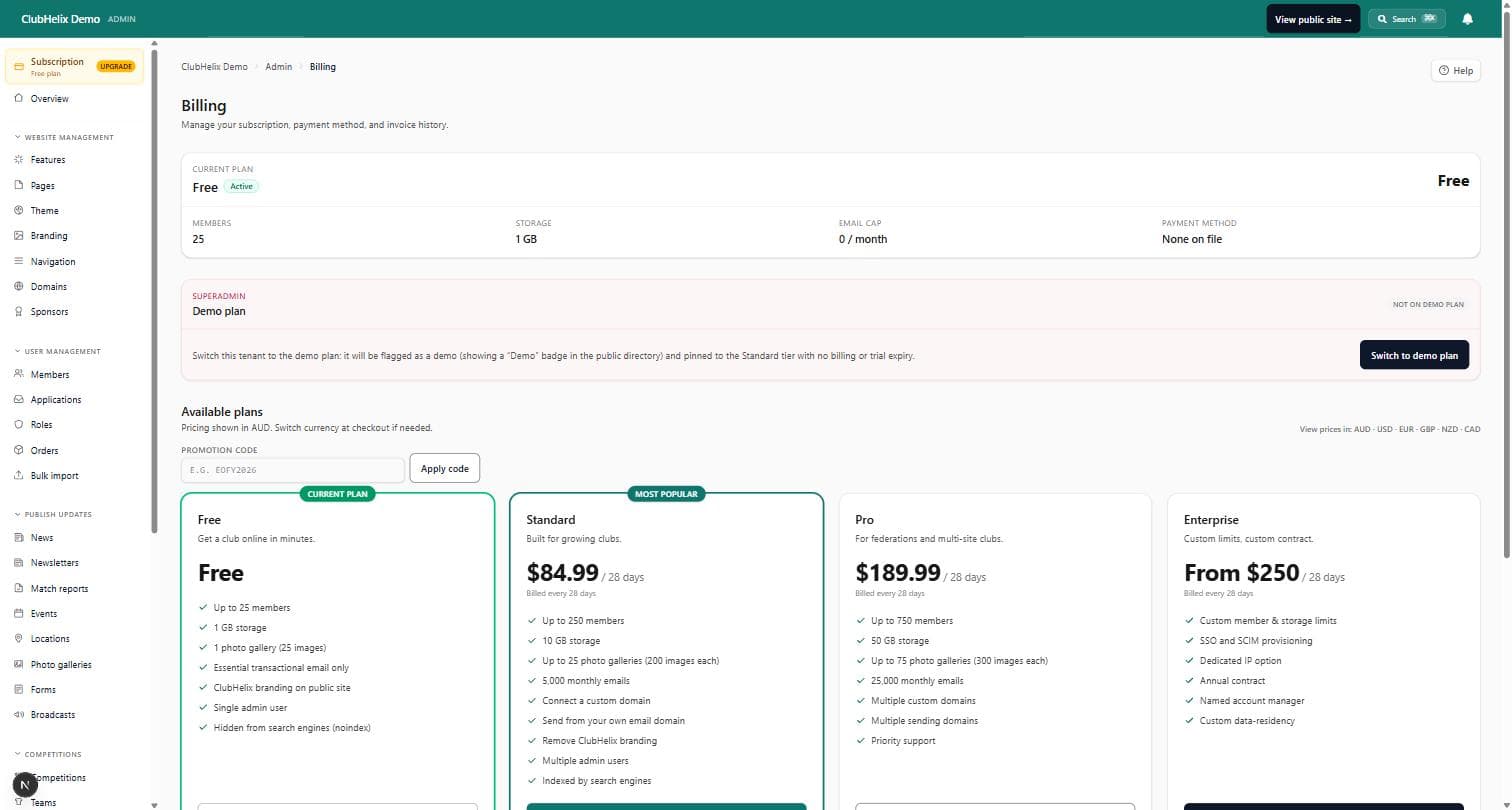
Every ClubHelix club starts on the free plan — no time limit, no expiry. When you want the paid pieces, such as online tuition payments, paid course bookings or a hosted tournament entry form, paid plans carry a 14-day free trial, bill on a 28-day cycle and can be cancelled at any time; current tiers are on the pricing page. Money settles directly to the club's own Stripe account, and the platform fee is never surcharged to your members.
ClubHelix runs fencing clubs in the US, Canada, the UK, Ireland, Australia, New Zealand and South Africa — wherever a club is laying strips down on a rented gym floor.
Moving the club off the sign-up sheet
Most fencing clubs arrive with the beginner course on a clipboard, tuition in a spreadsheet and the armoury in someone's memory. Move one thing first — usually the course intake, because it is the piece that pays for everything else — then bring class tuition across before the next term starts. If you would like a hand, talk to us. And for the bigger picture, from course design and uniform testing to in-club competition and the money shape of a small club, read the full guide to running a fencing club.
Features in your plan
Every plan starts free and includes the whole platform below — browse all features or compare plans.
Canvas page editor
A no-code, drag-and-drop club website editor with 45 section types and real sidebars. Your page, exactly as it publishes: click a section to edit it, drag to reorder, add new ones right where you want them.
Self-registration
Club membership software that handles the joining for you: online registration and season sign-ups on your own branded site, with email verification and optional admin approval.
Events
A club events calendar with one-off and recurring events — and ticket sales built in, so you never send members off to an external ticketing site.
News
A club news page for announcements, match reports and committee updates — the club notice board, published from the same editor as your pages.
Team management
Team rosters with captains and jersey numbers, training sessions and practices with availability, and scoped access for coaches.
Broadcasts
Send a message to everyone, a role, or a custom segment of members.
Club shop
Run a club shop or team store: take uniform, kit and spirit wear orders online with variants, carts and order management — with GST handled properly on every sale.
Mobile app
A club app of your own — install-to-home-screen with your branding, push notifications and digital membership cards, no app store required.
Frequently asked questions
The questions fencing club boards ask before signing up.
- Yes. Each class level is its own group with its own fee, and families pay online at registration and on renewal. The member register shows who is current at a glance, and the money settles straight into the club’s own Stripe account.
- Publish each six-week course as a term program with fixed dates, a price and a cap. Registration and payment happen in one step, and once the cap is reached the next person joins an ordered waitlist you can promote from when someone withdraws.
- Yes. Number each item and record who has it, when it went out and the condition it came back in, so season-long loans and the annual armoury audit stop relying on anyone’s memory.
- Yes. A parent registers once, links each child, puts them in the right class or squad, pays in a single transaction, and only receives the comms for the groups their fencers are in.
- Yes. Every ClubHelix club starts on the free plan with no time limit — put your club website and core admin online at no cost, and upgrade when you want online tuition collection. Paid plans carry a 14-day free trial and bill on a 28-day cycle you can cancel any time.
Can we bill monthly class tuition online instead of chasing it?
How do beginner course intakes and waitlists work?
Can we keep track of club masks, jackets and blades on loan?
Can one parent manage two fencers in different classes?
Is there free fencing club management software?
Bring your fencing club online in under 30 minutes.
Start on the free plan, then take a 14-day free trial of paid features when you're ready — nothing to pay today, cancel any time before the trial ends.