
What this guide answers
- What does a student society president actually do?
The president chairs meetings, holds the society's relationships with the student association and outside partners, and — most importantly — distributes work rather than doing it.
- How many people should be on a student society committee?
Five is the workable minimum, seven to nine suits most societies, and past about twelve the meetings get slower without more getting done.
- Can the same person be secretary and treasurer?
Many constitutions permit it, your student association may prohibit it outright, and either way it is a bad idea.
- Are committee members personally responsible for the society's debts?
It depends entirely on your society's legal form, and it is one of the few areas where a committee should get this right before signing anything.
- What do we do when a committee member disappears mid-year?
Ask once, kindly and privately, because the usual cause is assessment load or something harder rather than indifference.
Ireland edition. This guide is written for volunteer-run clubs in Ireland. Where rules differ — grants, tax, incorporation, safeguarding — follow the Ireland-specific pointers below or check with your national body.
Seven people were elected at the AGM. By week three of the new teaching year, two have stopped replying, the treasurer has discovered the society's money sits in an account only last year's president can open, and the president is personally designing posters, booking rooms, keeping the sign-up list and answering the inbox. Nothing has formally gone wrong yet. Everything is about to.
A student society committee is an unusual organisation: everyone is a volunteer, most have never done the job before, the whole leadership turns over every twelve months, and the busiest fortnight always lands on an assessment deadline. Titles copied out of a constitution template do not survive that. What survives is a written description of what each role does, when it does it, and what it hands to whoever comes next.
This guide goes role by role — president, secretary, treasurer, events, publicity, welfare and first-year rep — with the real work, an honest hours-per-week figure, the failure mode to watch for, and what each owes at handover. A one-page position description template near the end takes about ten minutes per role to fill in.
Work out the jobs before you argue about the titles
Most committees inherit their structure rather than choosing it, which is why so many societies have a publicity officer nobody will stand for and a vice-president nobody can describe. The fix is a forty-minute job audit at your first meeting.
Put every task last year's committee actually did on the table, one per line. Not "run events" — "book the room", "write the risk assessment", "design the poster", "take money at the door", "chase the caterer's invoice", "post the photos". A society running a fortnightly social, one formal and a careers night will generate sixty to eighty lines. Group them, put an honest hours figure against each group, and only then argue about who is called what.
Two tests tell you whether a role is real: can you name three things it does in an average week, and is there one thing that simply would not happen if it sat vacant? A role that fails both is a seat, not a job, and whoever is elected to it disengages by week six.
| Role | The week-to-week work | Hours/week in teaching time | Peak weeks |
|---|---|---|---|
| President | Chairs meetings, holds outside relationships, unblocks people, does the asking | 3–5 | Affiliation deadline, club fair, AGM |
| Secretary | Agenda and minutes, membership register, the inbox, deadline calendar | 2–4 | Affiliation, grant rounds, AGM notice |
| Treasurer | Payments in and out, reimbursements, budget vs actual, grant acquittals | 2–3 | Start of year, the formal, acquittal |
| Events officer | Bookings, run sheets, suppliers, ticketing, the door, the debrief | 3–6 | The fortnight before every event |
| Publicity officer | Posts, posters, event listings, photos, the website, the weekly email | 2–4 | Club fair week, 10 days before an event |
| Welfare officer | Sign-up conversations, accessibility checks, referrals, conduct concerns | 1–2 | Sign-ups, big socials, exam period |
| First-year rep | Brings new members in, runs one first-years-only event a term, feeds back | 1–2 | The first six weeks |
| General committee (×2–4) | One named project each, plus a shift on the roster at every event | 1–2 | Their own project's delivery window |
Those are in-session averages. Every role has weeks at three times its number — a treasurer in ball week, a publicity officer in club fair week — which is exactly why they need to be different people, and why a two-person "committee" collapses the first time both have an exam.
Your student association will also impose a shape on your committee. Its affiliation rules are the floor, not the ceiling.
Your students' union sets the affiliation standard, usually through separate clubs and societies committees with their own officers, and it will specify a core committee: chairperson or auditor, secretary and treasurer at minimum, all current students, with a rule against one person holding two of the three. A minimum membership figure is common — often twenty or more paid members before you can draw capitation funding.
Recognition is annual, not permanent. Each year you re-register: an updated committee list lodged within days of your AGM, the AGM minutes, end-of-year accounts and any constitution amendments for approval by the C&S committee. Let that slip and the effects are immediate — no capitation allocation, no room bookings through the union, and your stall at societies day or clubs and socs day can be reallocated to a society that filed on time.
Most unions also require the treasurer to attend a finance briefing and the officers who sign event paperwork to complete safety training before the society can spend or book. Put the dates in your position descriptions the week you are elected. This is general information — your own C&S handbook and union officers are the authority on what your society must file and when.
Write those requirements straight into your own position descriptions, with dates. The most common way a society loses a funding round or a stall at the start-of-year club fair is not misconduct — it is a form asking for current office bearer details that went unanswered while everyone assumed the secretary had it in hand.
The core three: president, secretary and treasurer
These three carry the society's obligations — the relationships, the record and the money. Everything else on a committee is delivery. Nearly every affiliation standard expects all three to exist, to be currently enrolled students, and to be three different people.
President: a job that is mostly asking people
The president's real work is not chairing meetings, although they do that. It is holding the society's relationships — with the student association, the department, venues and sponsors — and being the person who asks. Asks a member to run the trivia night. Asks a second-year to shadow the treasurer. Asks the events officer, kindly, whether the run sheet exists yet.
A president doing the work instead of distributing it is not a hero, they are a single point of failure, and the symptom is a committee where every task passes through one inbox. Three habits prevent it: a forty-five-minute committee meeting each fortnight with the agenda out two days ahead, a standing round where each officer names what they are stuck on, and a personal rule of one ask a week — one specific job, offered to one specific member, in a message that says why you thought of them. Succession belongs here too, and it starts in month one: pick likely successors for the three core roles by mid-year, give them something real to run, and tell them you think they could do the job. Societies rarely fold from lack of interest; they fold because nobody was asked. The year-round view of running a society shows where a president's attention needs to be in each part of the calendar.
Time: 3–5 hours a week, more around affiliation, the club fair and the AGM. Failure mode: becoming the bottleneck — all logins, contacts and decisions in one person. Owes at handover: contacts, the year's calendar with what worked, live grant and sponsor conversations.
Secretary: the society's memory
The secretary is the reason a society knows what it decided. The job is agendas, minutes within seventy-two hours, custody of the constitution, the membership register, and one deadlines calendar covering affiliation, funding rounds, room-booking windows, AGM notice periods and reporting dates.
Two practices are worth insisting on. First, the society's email lives at a role address the committee owns, never a personal account — otherwise a graduating secretary takes three years of correspondence with them and the sponsor who writes over the break gets no reply. Second, minutes record decisions rather than conversation: the motion, who moved it, the result, and each action with a name and a date. One page of that beats six of narrative, and it is the document your student association asks to see — a meeting minutes template gets you to a usable format first try. Keeping meetings, motions and resolutions in the society's own system rather than one student's drive is what makes the record survive the person, which matters more here than in any other kind of club.
Time: 2–4 hours a week. Failure mode: the personal inbox and personal drive; three years of history leaving with a graduate. Owes at handover: the register, minutes archive, constitution, deadline calendar and every login.
Treasurer: the role with an audit trail
The treasurer is the only committee member whose work is examined by outsiders. Money comes in from membership fees, ticket sales, grants and sponsorship; it goes out to venues, caterers, printers and reimbursements; and somebody will eventually ask for the reconciliation.
Four rules do most of the work. Reconcile monthly on a fixed date, not in a panic the week before the AGM. Never let one person both approve and pay — different committee members must do each, and that single control prevents most society finance disasters, the honest ones included. Reimburse against receipts on a published internal turnaround, so members stop fronting money they cannot afford. And keep a per-event budget-versus-actual line, because "we think the trivia night made money" is not a fact and will not survive a grant panel's questions. Our student society budget template sets out a term-by-term cash view built for exactly this.
For many societies the money never touches a society bank account. The union or C&S office holds society funds centrally and the treasurer transacts through their system: purchase orders, expense claims with receipts attached, and income lodged against a society code. That is slower than a debit card and considerably safer, and it means your real skill is knowing the office's forms and deadlines rather than banking. Where your society does hold its own account, expect a two-signatory rule with both signatories current students.
Capitation funding allocated by the C&S committees comes with conditions and a report on what the money did. Societies lose their next allocation far more often through a missed report than a weak bid, so diarise it the day the allocation lands.
Legal form matters once the numbers grow. A small society is an unincorporated club under the union's umbrella; a body holding significant money over years sometimes becomes a company limited by guarantee, which brings limited liability along with filing duties. VAT arises mainly around ticketed events and merchandise and is usually handled centrally. All general information — your C&S office is the authority, and an accountant past a certain size.
Time: 2–3 hours a week, six or more around a major event or an acquittal. Failure mode: one person approving and paying; a shoebox of receipts reconciled the week before the AGM. Owes at handover: access, the reconciliation to date, outstanding debts and invoices, grant conditions still running, and the float.
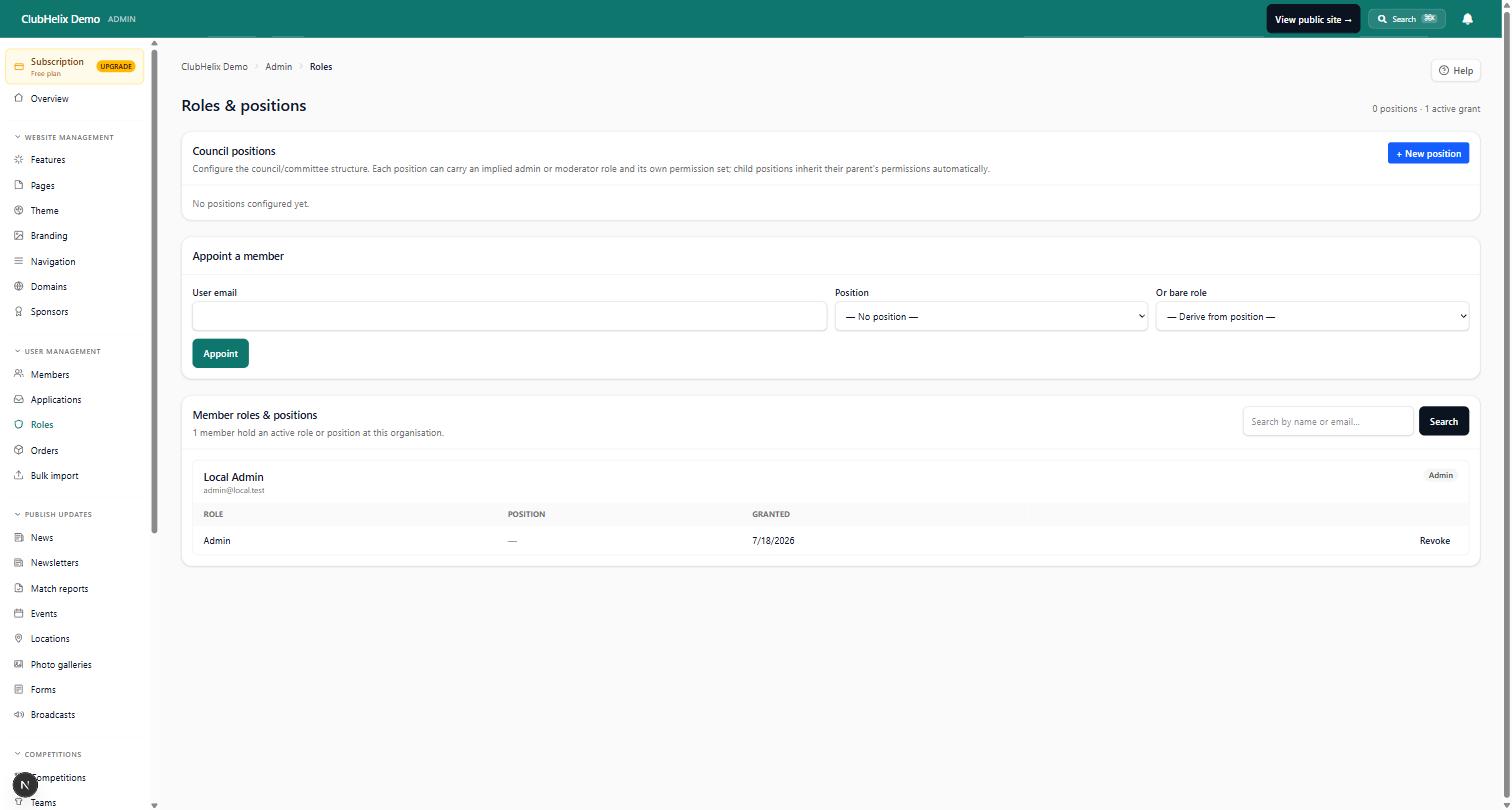
Give each role its own access, not a shared password
The most damaging thing student committees do is share one login. It feels efficient in week one and becomes a crisis the moment the person who set it up graduates: the recovery email is a deactivated university address, nobody remembers the answer to the security question, and nobody can tell who deleted the member list.
Map roles to individual accounts, with permissions attached to the position rather than the person: the treasurer needs payments and reports, the publicity officer needs the website and mailing list but no business in financial records, the welfare officer may need contact details but not payment history, and a general committee member running one project needs only that project. When someone steps down you revoke one account instead of changing a password half the committee has written down. That is what roles and permissions are for — a handover becomes a transfer of the position, and the audit log records who changed what.
The delivery roles: events, publicity, welfare and first-year rep
Events officer
Owns the calendar and the run sheet. In an average week: confirm the next booking, chase one supplier, publish one listing, check ticket numbers against the break-even line. In the fortnight before a big event this is the heaviest job on the committee, which is why the events officer should be running the process and delegating shifts, not carrying trestle tables alone at 8am. Insist on three artefacts per event — a budget with a break-even number, a run sheet with times and names, and a fifteen-minute debrief written down within two days. The debrief is what turns a good night into a repeatable one.
Publicity officer
Owns how the society sounds: one email or newsletter a week, a few posts on whatever channels your members actually use, the listing on the society's own website, and photos afterwards. The trap is treating a social page as the society's home — you do not own that audience, the reach is unpredictable, and none of it survives a handover. Concrete targets for a society of 120 members: an email open rate above 40 per cent, and one photo set published within 48 hours of each event. Both get far easier when the member records and the mailing list are the same list.
Welfare and inclusion officer
The welfare officer is not a counsellor and should never be presented as one. The role is to make the society easy to belong to and to know where to refer people: a dietary and access question in every event registration, at least one alcohol-free option each term, a quiet check on the member who came once and never returned, and a named contact when something goes wrong at an event. Our guide to welfare and inclusion for student societies goes deeper.
Two things are worth getting right early. If your society runs activity involving children or vulnerable persons — a schools visit, a mentoring scheme, a community volunteering project — the committee members involved will usually need Garda vetting, arranged through the union or C&S office rather than by you. It takes weeks to process, so start before you commit to the activity. Your union will tell you when it applies; treat this as general information and confirm it with them.
Second, know your referral points before you need them. Campuses have a student counselling service, a union welfare officer who handles academic, financial and housing problems, and an out-of-hours crisis line. Put those three contacts in a shared note the whole committee can reach in thirty seconds and at the bottom of your welfare page. In a difficult moment the welfare officer listens and connects the person to the service — they do not diagnose, and they should not carry it alone. Debrief with the chairperson the same day.
Agree a conduct process before you need one: who a complaint goes to when it concerns a committee member, and how it escalates to the union, whose procedure will supersede yours in any serious case.
First-year representative
The highest-return position on most committees and the most commonly skipped. The whole job is that new members meet each other in the first six weeks: one low-stakes, first-years-only event a term, a personal message to every sign-up who has not been to anything yet, and an honest report to the committee on what the society feels like from outside. They are also, usually, your next secretary or events officer.
How big should the committee be?
Five is the practical minimum, seven to nine is the sweet spot, and past twelve you are running a meeting about a meeting. Size it to the real jobs from your audit, plus two or three general members who each own a named project rather than a vague seat.
Two structural habits matter more than size. The two-deep rule: every critical position has a named understudy, ideally a year below, who sits in on the work and could cover a fortnight's absence — that is your succession plan, and it costs nothing. And big projects get subcommittees, not new officer titles: the formal needs a working group of five for four months, not a permanent "ball officer" with nothing to do for the rest of the year.
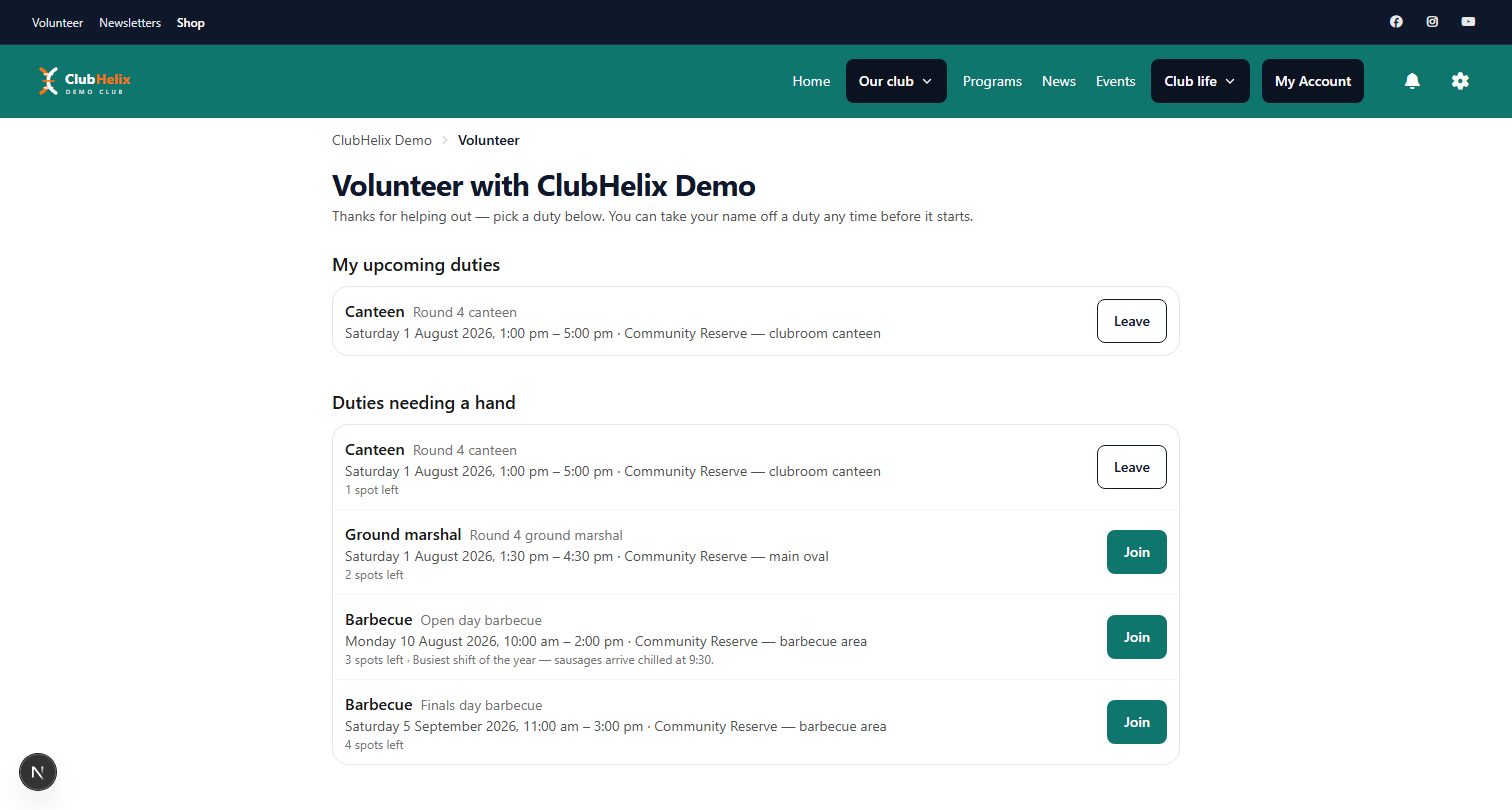
Above all, stop treating the committee as the only people who do work. A society of 150 members does not have nine willing hands, it has forty people who would do one two-hour shift if asked specifically and given a time, a place and a one-sentence job. Publishing shifts and letting members claim them — a volunteer roster rather than a group-chat plea — routinely doubles the help a committee gets, and it is the most reliable recruiting ground for next year's committee. Our guide to recruiting volunteers covers the ask itself.
The one-page position description
Fill this in for every position at your first meeting. It is what you circulate before nominations open, and it is the best defence against the "I did not know that was my job" conversation in week nine.
Position: Treasurer Reports to: The committee, via the president Term: One year, from the AGM
Purpose in one sentence: Keep the society solvent, spend its money properly, and be able to prove both.
The work, week to week: Process reimbursements against receipts. Bank event takings. Keep budget vs actual for each event. Answer members' payment questions. The work, monthly: Reconcile accounts on the first Monday. Report a one-page position to the committee. The work, once a year: Build the annual budget. Prepare the annual financial statements for the AGM. Submit funding applications and their acquittals. Hand over.
Time: 2–3 hours a week; 6+ in event and acquittal weeks. Decisions it can make alone: Spending already in the approved budget, under the agreed limit. Decisions it must not make alone: Any payment it also approved. Any commitment above the limit. Anything that changes fees. Skills you need on day one: None. A spreadsheet, a calendar and the willingness to ask. Must hand over: Access and signatory changes, reconciliation to date, outstanding invoices and debts, live grant conditions, the float.
Adapt the same frame for every position — the volunteer position description template has a general-purpose version to start from, and the club committee roles guide is a useful comparison once a society has grown into something closer to a community club.

What each role owes at handover
Handover is not a coffee. It is a transfer of assets, and every role holds different ones.
| Role | Hands over |
|---|---|
| President | External contacts, the year's calendar with notes, live grant and sponsor conversations |
| Secretary | Membership register, minutes archive, constitution, deadline calendar, role-address access |
| Treasurer | Signatory change booked, reconciliation, unpaid invoices, grant conditions, the float |
| Events officer | Supplier list with prices, venue contacts, run sheets, every event debrief |
| Publicity officer | Website and mailing-list access, brand assets, photo archive, what actually got opened |
| Welfare officer | Referral contacts, the conduct process, any matter still open (handled with proper care) |
Do it as a two-hour meeting in the fortnight after the AGM, outgoing and incoming committee in the same room, working down each role's list — then write it up. The student society handover checklist is the long version, and the AGM and elections guide covers getting people into these positions in the first place.
Frequently asked questions
What does a student society president actually do?
The president chairs meetings, holds the society's relationships with the student association and outside partners, and — most importantly — distributes work rather than doing it. In practice that is three to five hours a week: a fortnightly committee meeting, a short check-in with each officer, and a steady habit of personally asking members to take on specific jobs. A president designing posters at midnight is doing the wrong job, and the society feels it at the AGM when nobody will stand to replace them.
How many people should be on a student society committee?
Five is the workable minimum, seven to nine suits most societies, and past about twelve the meetings get slower without more getting done. Size the committee to the real jobs your task audit produced, then add two or three general members who each own a named project. Committee size is not workforce size: a healthy society of 150 members should have thirty or forty people doing one rostered shift each across the year.
Can the same person be secretary and treasurer?
Many constitutions permit it, your student association may prohibit it outright, and either way it is a bad idea. Combining the two puts record-keeping and money in one pair of hands and removes the separation that protects both the society and the person holding the money. If your committee is genuinely too small to split them, make a third member the second approver on every payment and have the president countersign the monthly reconciliation.
Are committee members personally responsible for the society's debts?
It depends entirely on your society's legal form, and it is one of the few areas where a committee should get this right before signing anything. The general shape is that if your society is not a separate legal entity, the individuals who sign contracts can be personally exposed — which is why you should never sign a venue contract or a large deposit in your own name if there is an institutional route available.
Most societies are unincorporated clubs under the union with no separate legal identity, so a contract signed by a committee member is a contract with that person. In practice the union reduces this exposure a great deal: the C&S office will usually contract with venues and suppliers on the society's behalf, and union insurance covers approved activity. Use that route without exception. The classic mistake is a committee member booking a coach or a venue directly because the office's process felt slow, then discovering the deposit is personally theirs when the trip does not fill.
Insurance is not limited liability. It responds to injury and damage arising from approved activity; it does not answer for money the society owes a supplier. That is why the C&S committees cap what a society may commit to without sign-off, and why the cap protects you — a committee member who goes around it has usually also taken the society outside its cover for that event.
Bodies that outgrow the union's umbrella — a large society holding assets, or one operating beyond the teaching year — sometimes become a company limited by guarantee, which gives limited liability along with filing duties and directors' obligations. That is a step for a standing body with property or staff, not for a typical society. This is general information rather than legal advice: your C&S office will tell you exactly what you may and may not sign, and that is a five-minute conversation worth having in your first fortnight.
What do we do when a committee member disappears mid-year?
Ask once, kindly and privately, because the usual cause is assessment load or something harder rather than indifference. If they cannot continue, most constitutions let the committee fill a casual vacancy by appointment until the next AGM — check your own rules for the wording. Then do the part everyone forgets: revoke their access, reassign the position properly, and check whether anything sat only with them, such as a supplier relationship or the mailing-list login.
Where ClubHelix fits
A committee that changes every twelve months needs its records to live somewhere other than a graduating student's laptop. ClubHelix gives a society one place for member records, paid sign-ups, events, the mailing list and the meeting record — with committee positions carrying their own permissions, so handover is a transfer of a role rather than a shared password, and meetings and resolutions staying with the society rather than the secretary. Rosters spread the load past the committee, and the audit log tells the next committee who changed what. See pricing for what each plan includes at your society's size, or begin from a ready-made site template and have a working society website before your next meeting.


