
What this guide answers
- How much does it cost to start a men's shed?
Incorporation and initial insurance typically run to a few hundred dollars, so the real variables are premises and machinery.
- Do men's sheds have to be men-only?
No — each shed sets its own membership rules in its constitution.
- How many people do you need to start a shed?
A founding committee of five to ten covers the workload of incorporation, premises-hunting and grant-writing.
- Do members need trade skills to join?
Not at all. Sheds thrive on a mix of experienced tradesmen and complete beginners, and passing skills across that gap is much of the joy.
The men's shed movement is one of Australia's great community inventions: a shared workshop where men (and, in many sheds, women too) work on projects side by side, share skills, and — the real point — talk. Sheds began here in the 1990s and there are now well over a thousand across the country, with the model exported around the world.
Starting one is very achievable for a small group of committed locals, but it involves more moving parts than a typical club: premises, machinery, safety systems and insurance all arrive on day one. This guide walks through the process in order, from first meeting to open doors.
Why sheds exist (and why yours will matter)
A men's shed is a health initiative wearing a workshop's clothes. The founding insight of the movement is that many men socialise shoulder-to-shoulder rather than face-to-face — they'll talk over a workbench in a way they never would across a table. Sheds have become recognised contributors to men's health and social wellbeing, particularly for retired men, men adjusting to life changes, and anyone at risk of isolation.
Keep that mission at the centre of every decision. The projects — toys for the kinder, repairs for the neighbourhood, furniture for the school fete — are the means. The cuppa at smoko is the end.
The national peak body, the Australian Men's Shed Association (mensshed.org), supports new and existing sheds with resources, insurance pathways and a network of experienced shedders. Getting in touch early is the single best shortcut you can take — most regions also have shed cluster groups happy to show a new committee around.
Build a founding group before you build anything else
Every successful shed starts with a handful of people, not a building. Aim for a founding group of five to ten:
- Hold a public interest meeting. A hall, a notice in the local paper and community social media groups, and a sausage sizzle will surface far more interested men than you expect — including tradies, retired engineers and blokes who "just want somewhere to go on a Tuesday".
- Visit two or three existing sheds. Committees are generous with hard-won lessons about layouts, machinery mistakes and what they'd do differently.
- Form an interim committee. President, secretary, treasurer as a minimum — the classic structure covered in our guide to committee roles and responsibilities. Look for a spread of skills: someone comfortable with paperwork matters as much as someone comfortable with a thicknesser.
- Agree the basics. Name, purpose, who the shed is for (men only, or open membership — both models exist), and the rough opening pattern you're aiming for.
Incorporation, insurance and the legal groundwork
A shed needs to be a legal entity before it can hold a lease, insure a workshop, or receive grants. For nearly all sheds that means becoming an incorporated association in your state or territory — a straightforward, low-cost process handled by your state regulator (for example Consumer Affairs Victoria or NSW Fair Trading). Our guides on how to incorporate a club and writing a constitution walk through the process; model rules exist so you rarely start from scratch.
Alongside incorporation, sort out:
- Insurance. Public liability is essential before anyone picks up a tool, and personal accident cover for members is strongly recommended. The national association offers established insurance pathways for member sheds — one of the strongest practical reasons to join. Our guide does our club need insurance? explains the cover types.
- An ABN and a bank account in the association's name, with two signatories.
- Charitable registration. Many sheds register with the Australian Charities and Not-for-profits Commission (acnc.gov.au) given their community-health purpose — worth exploring once incorporated, as it opens more grant doors.
This is general information, not legal or financial advice — check the current requirements with the official bodies linked above.
Finding premises
Premises are usually the long pole in the tent. Sheds have successfully started in:
- Council-owned buildings — old depots, disused halls and showground buildings. Councils are often enthusiastic; a men's shed ticks community-health boxes in their own plans, so approach the community development team, not just property.
- Showgrounds, sporting precincts and school grounds — shared sites with existing power and amenities.
- Donated or peppercorn-lease industrial space from local businesses.
- A purpose-built shed on leased land — the most expensive path, usually a later stage funded by grants once the shed has a track record.
Whatever the building, you'll want: three-phase power (or a plan to install it), decent ventilation and dust management, accessible toilets, a separate clean area for the kitchen and social space, and secure storage. The kitchen is not optional — smoko is the beating heart of the shed.

Setting up a safe workshop
Machinery safety is where a shed committee earns its keep. The movement has mature, well-tested practice here, and your state association can provide current templates. The pillars:
- An induction for every member before they use anything with a plug or an edge, recorded and signed.
- Machine-level competency. Members are signed off per machine by a nominated supervisor; unfamiliar machinery is off-limits until then. A simple register of who is cleared on what, kept up to date, is your most important safety document.
- Supervisors on duty. Every open session has a nominated supervisor responsible for the workshop; the shed doesn't open without one.
- Guarding, maintenance and the tag-out habit. Donated machinery is wonderful and occasionally lethal — assess every donation, and be prepared to politely decline or strip for parts. Faulty gear gets tagged out immediately.
- First aid and incident reporting. A well-stocked kit, trained first aiders among the regulars, and a written record of every incident and near miss. Recording near misses is what prevents the real ones — a habit worth building from day one, and one an online incident reporting tool makes painless.
Frame all of this positively with members: sign-offs and supervision aren't red tape, they're what lets an 84-year-old keep using a lathe safely — which is the whole point.
Safety requirements vary by state and by equipment — treat this as general information and work from your state shed association's current guidance.
Money, membership and the weekly rhythm
Most sheds run on modest money: an annual membership fee plus a gold-coin or small session fee that covers tea, coffee and consumables. Grants do the heavy lifting for machinery and buildings — councils, state community-grant programs and men's-health funding streams all have a long history of supporting sheds. Check current rounds on official sites, and see our guides to grants for community clubs and writing a grant application.
Day to day, a typical shed opens two to four sessions a week, mixing project work, community jobs (the school's planter boxes, the kinder's toy repairs) and social time. Community projects deserve special attention: they give the shed purpose, visibility, and a steady stream of thank-you stories for your grant applications.
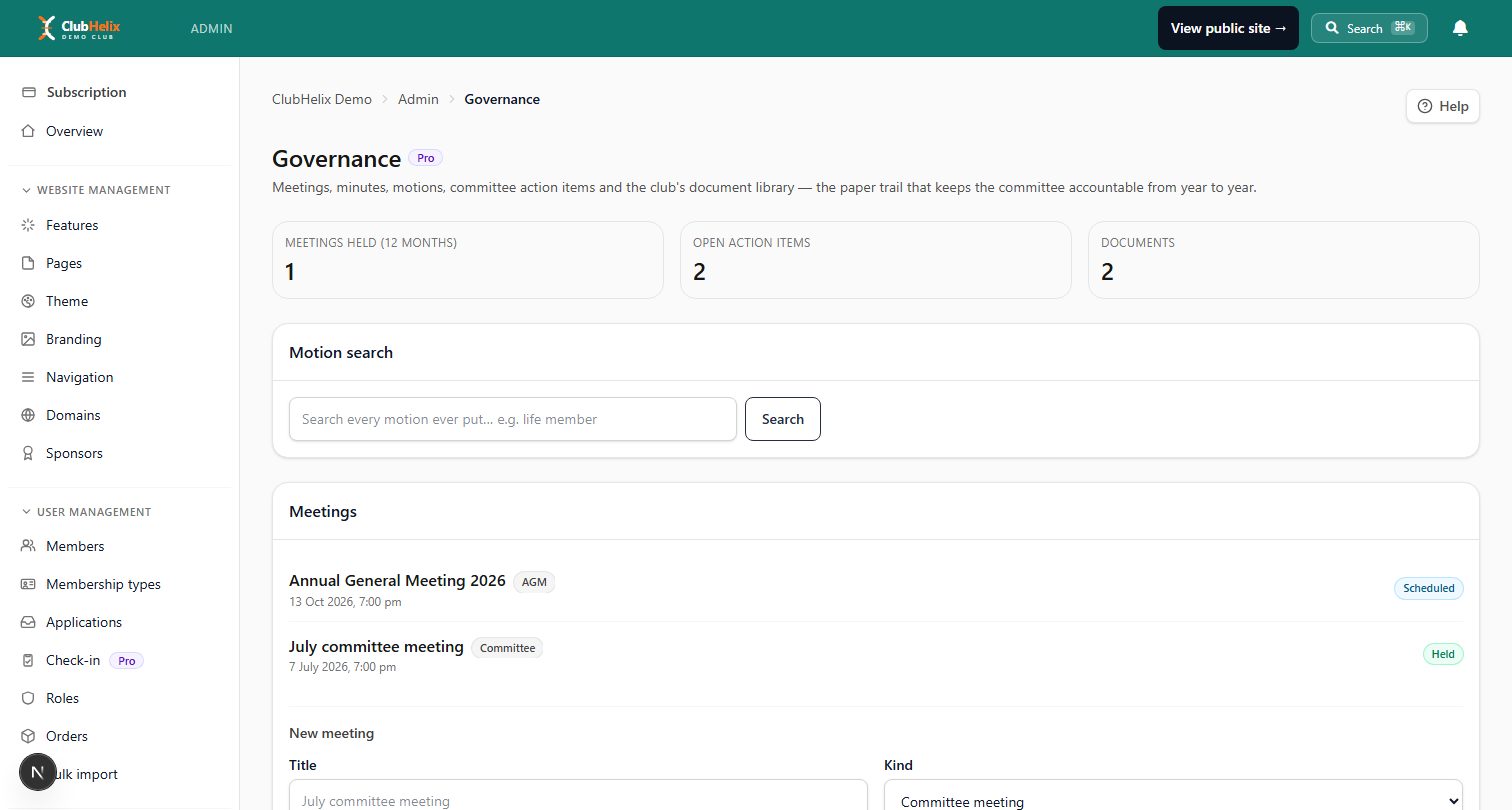
Committee-wise, run it like the incorporated association it now is: regular meetings, minutes, an AGM, and documents kept somewhere findable rather than in a retiring secretary's garage. Keeping meetings, minutes and documents online means the next committee inherits a working shed, not an archaeology project — a theme our succession planning guide covers well.
Telling your community you exist
The men who most need a shed are, almost by definition, the hardest to reach — they're not scrolling community social media groups. Reach them through:
- GPs, health services and community workers, who actively look for places to refer isolated men. A simple flyer in every waiting room within 10 km is remarkably effective.
- Partners and adult children — a large share of new members are signed up by someone who loves them. Speak to them in your promotion, not just to the men themselves.
- A community shed website with your location, opening times, photos of real projects, and a friendly "just turn up for a cuppa" message. Make joining possible online with a simple membership registration form, but never make it the only door — the first visit is always just a look around and a chat.
- Open days and the sausage sizzle circuit — presence at community events is how a town learns the shed is there.
ClubHelix suits sheds well: a clean website the community can find, online membership, an events calendar for open days, committee minutes and documents in one place, and email newsletters for members — all manageable by a volunteer secretary without technical help. See how community and service groups use it on our service and community organisations page, or get started free.
Frequently asked questions
How much does it cost to start a men's shed?
Incorporation and initial insurance typically run to a few hundred dollars, so the real variables are premises and machinery. Sheds that begin in a donated or council building with donated tools have started on a few thousand dollars, while a purpose-built shed is a six-figure, grant-funded project usually tackled a few years in.
Do men's sheds have to be men-only?
No — each shed sets its own membership rules in its constitution. Many sheds are men-only in line with the movement's men's-health origins, others run women's sessions or are fully open; decide early, write it into your rules, and be upfront about it in your promotion.
How many people do you need to start a shed?
A founding committee of five to ten covers the workload of incorporation, premises-hunting and grant-writing. Interest almost always outstrips expectations once doors open — established sheds commonly have 30 to 100+ members.
Do members need trade skills to join?
Not at all. Sheds thrive on a mix of experienced tradesmen and complete beginners, and passing skills across that gap is much of the joy. Machine use is gated by induction and sign-off, not by background — and plenty of members mainly come for the company and the kettle.


