
What this guide answers
- What is the most important system in an open water swimming club?
The head count. One sign-on marshal, one board, a rule that nobody enters after the group has started, and a sign-off that happens on the sand rather than at the coffee shop.
- How many water safety craft does a club swim need?
There is no universal number. Many clubs plan around one craft for every eight to ten swimmers, then tighten that for long or point-to-point courses and difficult conditions.
- Who should decide whether to cancel a swim?
One named role — usually the rostered swim leader — working from a published policy with green, amber and red thresholds, and announcing the decision by a fixed time before the start.
- What should an open water club collect from new members?
Emergency contacts, relevant medical information, a plain-language swim history self-assessment, and consent choices for photos and contact.
- Do we need to record near misses as well as incidents?
Yes, and they are the more useful record. Near misses are frequent, cost nothing to learn from, and reveal the patterns — a course that pulls swimmers wide, a group that always splits, a temperature threshold set too…
South Africa edition. This guide is written for volunteer-run clubs in South Africa. Where rules differ — grants, tax, incorporation, safeguarding — follow the South Africa-specific pointers below or check with your national body.
The most important piece of equipment your club owns is a laminated board and a marker pen. Not the buoys, not the radios, not the rescue board strapped to somebody's roof racks. The board, because it is the only thing at the water's edge that knows how many swimmers went in, who each of them is swimming with, and how many have come back out.
Every other club sport has a playing surface that stays where you left it. Yours changes character overnight — twenty-eight swimmers on the sand, three paddlers dragging craft down to the water, and conditions that are not the conditions you briefed for last week. The water is two degrees colder than last week, the wind has swung around, the tide is running the other way, and something has bloomed in the shallows. You do not own the venue, you cannot line-mark it, and you cannot close it. What you can control is the system on the sand: who is in the water, who is watching them, who decides when the swim does not go ahead, and what gets written down afterwards.
This guide is for the committee of an open water swimming club — ocean, harbour, lake, river or dam. It covers the head count and buddy system, water safety craft, the conditions call, membership and medical declarations, running your own event swim, and the incident records that protect both your swimmers and the volunteers who lead them. If you also run a pool squad, read it alongside how to run a swimming club, which covers meets, lane hire and timekeeping rosters.
The head count is the club
Strip an open water club back and it is one repeated ritual: everyone signs on, everyone goes in, everyone comes back, someone closes the board. Get that ritual tight and most of your risk disappears. Let it drift and you will eventually spend forty minutes searching a car park for someone who went home for breakfast.
Four rules make it work.
One board, one marshal. Sign-on is a person, not a clipboard left on a rock. That person ticks names in, ticks names out, and does not swim. Rotate the job so it does not always land on the same reluctant volunteer.
Nobody enters after the group. Late arrivals join the next group or swim the short loop with a leader. A swimmer who slips in behind the pack is invisible to every count you take.
The board closes on the sand. Not in the car, not at the coffee shop. Sign-off happens where the marshal is standing, and the swim is not over until the board shows zero in the water.
Three numbers get called out loud. How many went in, how many groups, how many are back. Saying them aloud catches the arithmetic error that a written tally hides.
| Role on the day | Owns | Arrives |
|---|---|---|
| Swim leader | Conditions call, briefing, final say on course and groups | 30 minutes before start |
| Sign-on marshal | The board, ticks in and out, late arrivals | 20 minutes before start |
| Water safety lead | Craft numbers, positions, radios, spotting | 20 minutes before start |
| Group leaders | Pace discipline, keeping their group together | With their group |
| Sweep swimmer | Swims last in each group, nobody behind them | In the water |
| Land contact | Phone, first aid kit, emergency plan card, stays ashore | Whole session |
The land contact is the role clubs skip and regret. One person stays dry, keeps the club phone, and has the emergency plan card in their pocket with the access gate name, the nearest street address, the closest defibrillator and the club's two escalation numbers on it. In an emergency, the person calling for help should not be the person who just swam a kilometre.
Once the ritual is solid, move the board itself onto a phone. A session listed as an event, with members marking themselves in and the marshal tapping them off, gives you the same tally with a permanent record attached — RSVPs and attendance do exactly this job, and the attendance history becomes your evidence trail if a claim or a query ever arrives. Paper is fine on the sand. Paper is useless six months later.
Groups, buddies and cap colours
Open water swimmers self-sort badly. Ask a mixed field to "swim to the second buoy and back" and you will get a five hundred metre spread inside ten minutes, which is unsupervisable. Publish groups instead, and hold the line on them.
A workable structure for a club field of thirty to sixty:
| Group | Cap colour | Typical pace | Course | Supervision |
|---|---|---|---|---|
| Sunrise | Pink | New or returning | Short loop, close to shore | Leader plus one craft |
| Steady | Yellow | Comfortable 1-2 km | Two laps of the marked loop | Leader plus sweep |
| Long | Orange | 2 km and up | Point to point or three laps | Craft escort essential |
Cap colour is not decoration. It is how a paddler two hundred metres out knows whether the swimmer drifting sideways is an experienced member or someone on their third ever open water swim. Buy in bulk and give one to every new member at joining.
Buddy pairing is the second layer. Pair by pace, not friendship, and make the pair responsible for each other's sighting stops — every buoy, look for your buddy. If a pair separates, both swimmers head for the nearest craft or the shore. A repeated short loop close to shore is far easier to supervise than a long point-to-point, and on marginal mornings the loop is the answer to almost every question.

Water safety craft and the people on them
Your paddlers are the club's safety margin. Treat the craft roster with the same seriousness as a competition team sheet, because a session with two paddlers is a different session from one with five.
- Set a working ratio and publish it. Many clubs plan around one craft for every eight to ten swimmers as a starting point and adjust for conditions, group spread and the course. Confirm the number your insurer and governing body expect rather than inventing one.
- Position them deliberately. One craft leads at the front of the fastest group, one sweeps behind the slowest, and any others sit mid-field on the seaward side, between the swimmers and open water.
- Kit every craft the same. Tow float or rescue tube, whistle, spare goggles, small first aid pouch, and a radio or a phone in a dry pouch. Standardise it so no paddler has to remember anything.
- Agree signals before launch. Voices do not carry over chop.
- Roster paddlers like a team. Publish it a fortnight ahead, let people swap it themselves, and cancel honestly when the roster is thin rather than running the session anyway.
| Signal | Meaning |
|---|---|
| One arm straight up, held still | I need assistance, come to me |
| Arms crossed overhead | Stop, everybody out of the water |
| Tapping the top of the head | Are you okay, or I am okay |
| Both arms waving side to side | Emergency, all craft converge on me |
Craft duty is where most clubs bleed goodwill, because it gets organised in a chat thread at ten o'clock the night before. Volunteer rostering handles the sign-ups, swaps and reminders, and how to recruit club volunteers covers widening the pool.
Qualification expectations vary. In South Africa, many clubs share water safety people with a neighbouring lifesaving club and expect current first aid on every craft. Confirm with your provincial body and your insurer what qualifications they require, particularly for club-run event swims.
Making the conditions call
This is the decision that turns a friendly club into a divided one, because someone always thinks it was swimmable. Take the personality out of it by publishing a policy, naming one role that makes the call, and fixing a time by which the call is made.
| Factor | Green — swim as planned | Amber — modify | Red — cancel |
|---|---|---|---|
| Wind and chop | Light, sheltered water | Fresh onshore, choppy — shorten loop | Whitecaps across the course |
| Swell or surf | Small, clean | Rising — move to the sheltered end | Dumping shorebreak, difficult exit |
| Current or tide | Slack or mild | Running — swim into it first, return with it | Cannot hold position against it |
| Visibility | Clear, full daylight | Low light or haze — bright caps, tight loop | Fog, darkness, no line of sight to craft |
| Water quality | Normal | Recent rain — shorten, advise members | Advisory or closure in force at the venue |
| Marine hazards | None reported | Isolated sightings — brief and stay grouped | Active warning or a closed beach |
| Electrical storm | Clear sky | Distant activity — hold on the sand | Thunder heard, or lightning seen |
| Craft available | Full roster | One short — cap numbers, shorten course | Two or more short of your minimum |
Three details make the policy stick.
One person calls it. The rostered swim leader, not a vote, and not the loudest swimmer in the car park. Give them the authority in writing so they never have to argue for it in the dark.
There is a deadline. If your swim starts at 6:15, the call goes out at 5:45. Members are getting into cars; they need the answer before they drive.
The message always goes out. Send "swim is on" on good mornings too. A channel that only carries bad news gets muted, and then the one cancellation that matters is the one nobody sees. Push notifications and SMS both work; pick one channel, say which it is at every sign-on, and never split the message across three places.
Between green and red sits a ladder of modifications that keeps the club swimming: shorten the loop, move to the sheltered side, swim parallel to shore instead of out to a buoy, run the session as a beach and skills morning, or send only the experienced group with double the craft. Cancelling is always defensible. Running an unchanged session in changed conditions is not.
Water temperature is the other half of the call. In the southern-hemisphere season, most clubs swim comfortably in an ocean sitting in the low twenties, treat the high teens as a wetsuit-recommended morning, and set a hard floor somewhere around 14 degrees Celsius with a shortened swim, mandatory wetsuits and a warm-drink plan. Publish the floor, measure the water rather than the air, and remember that the cold matters most on the way out.
Membership, medical declarations and the swim history question
Joining an open water club is not the same as joining a pool club, because your committee is accepting people into an environment it cannot control. Collect four things at sign-up and re-collect them every year.
- Emergency contact and next of kin, with a second number.
- Relevant medical information — cardiac conditions, epilepsy, asthma, diabetes, anything affected by cold water immersion, and any medication a first responder should know about.
- A swim history self-assessment, in plain language. Can you swim 400 metres continuously without stopping? Have you swum in open water before? Are you comfortable putting your face in cold water and swimming away from shore?
- Consent choices — photographs, contact preferences, and who may be told what in an emergency.
Two follow-through habits matter more than the form itself. First, the information has to reach the people who need it on the sand, and nobody else: restrict who in the club can open a member's medical detail, which is a roles and permissions decision rather than a policy you hope people follow. Second, run a proper trial process for newcomers — bright cap, buddied with an experienced member, short loop, and a conversation afterwards about whether the group they picked is the right one.
An acknowledgement of risk, signed digitally at join time and stored against the member record, is standard practice for open water clubs. As general information — what it does is record that the swimmer understood the environment, declared their health honestly and agreed to the club's rules. What it does not do is make your club immune from a claim, and how much weight it carries differs by jurisdiction and changes again where minors are involved. Have yours reviewed by someone qualified, keep the signed versions, and treat digital waivers as a record-keeping tool rather than a shield.
Running your own event swim
The club event swim is where an open water club earns its reputation, its biggest income of the year, and its largest single dose of risk. Give it a nine-month runway and a written safety plan.
| When | What |
|---|---|
| T-9 mth | Date locked, venue permissions started, insurance confirmed |
| T-6 mth | Course drafted, water safety providers approached, entries open |
| T-3 mth | Safety plan drafted, marshals and craft rostered, first aid provider booked |
| T-6 wk | Entry numbers reviewed, wave structure set, caps and bibs ordered |
| T-2 wk | Briefing script written, contingency and abandonment triggers agreed |
| T-3 day | Entries close, wave lists published, final conditions watch begins |
| Day | Set up, brief, start, count, finish, reconcile, debrief |
Entries. Take them online with a hard capacity limit per wave, a swim history declaration, and a stated cut-off. Publish the refund and transfer policy on the entry page — the single most common event complaint is a cancellation nobody had rules for. Events and ticketing handles the caps, the waves and the money in one place; how to promote a club event covers filling it.
Timing. You do not need chip timing for a club swim of two hundred. Two people at the finish — one calling numbers, one recording — plus a tear-off bib tag as a backup is accurate enough and far cheaper. Write numbers on hands as well as caps, because caps come off.
The briefing. Course and turn buoys, wave start order, what the craft look like and what the signals mean, how to signal for help, where the exit is, the cut-off time, and one sentence on what happens if the event is abandoned mid-swim. Ninety seconds, said loudly, twice.
The count. Entries in, starters per wave, finishers, withdrawals. Every swimmer who leaves the course is recorded by a marshal before they go near the car park. The event is not over when the last swimmer finishes — it is over when those four numbers reconcile.
Incidents, near misses and the debrief nobody wants
Write it down. A swimmer pulled onto a board, a member who got cold and confused, a paddler who lost sight of their group, a jellyfish sting that needed treatment — all of it goes into a report on the day, while the detail is fresh and while three people who saw it are still standing on the sand.
Keep the record short and consistent: what happened, when, where, who was involved, who responded, what was done, what the outcome was, and what the club will change. Then hold a five-minute debrief before everyone leaves, and review the register as a committee once a quarter looking for patterns rather than blame. Three cold-water incidents in one month is not three bad mornings; it is a temperature floor that needs lowering.
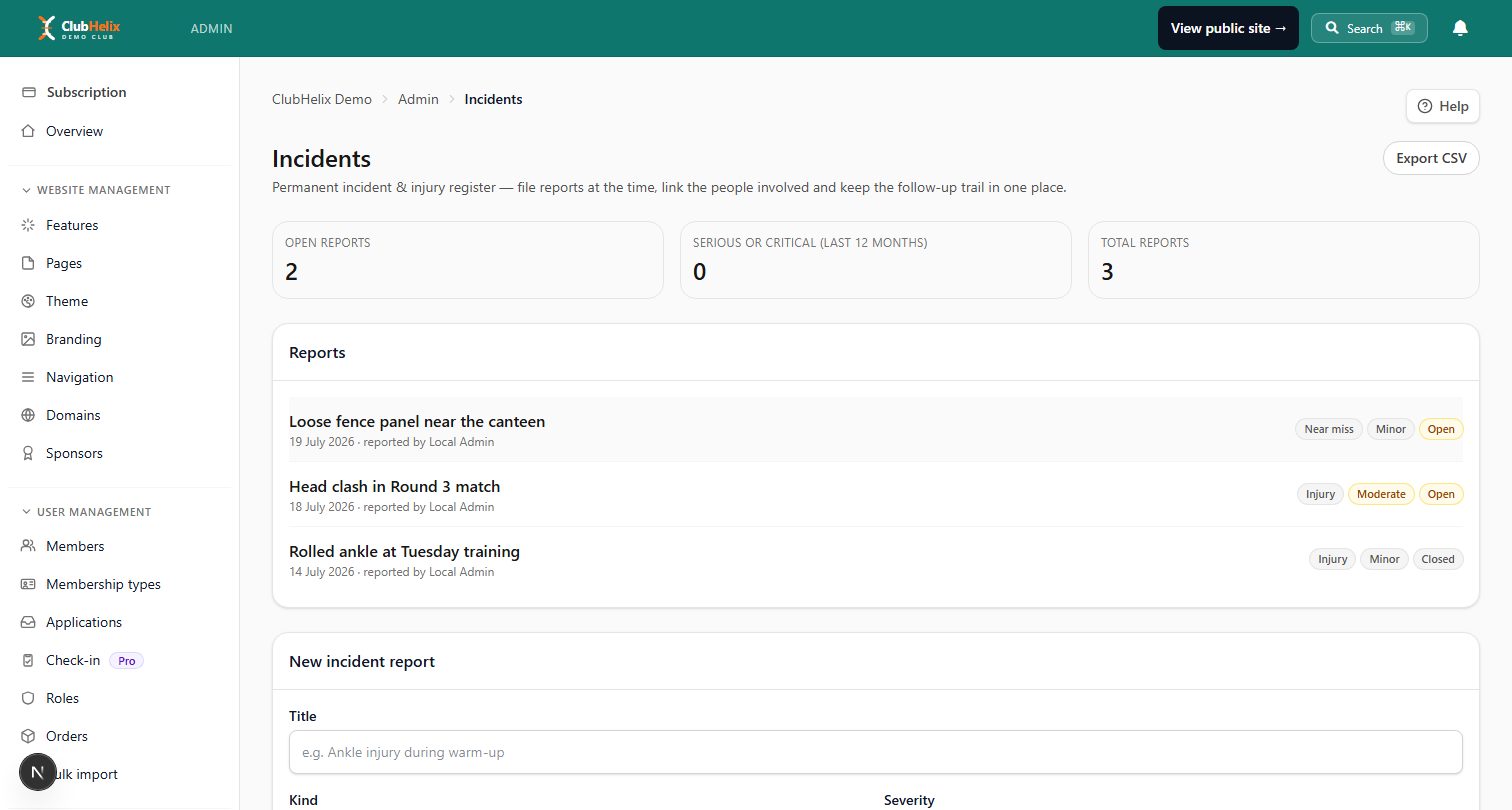
Near misses matter more than incidents, because there are more of them and they are free lessons. Make them easy to log — incident reporting built into your club site means a leader can file one from the beach in two minutes rather than promising to email the secretary. Sports club risk management covers the wider framework, and the incident report form template gives you a starting structure. Notify your insurer and governing body according to their rules, not your judgement of severity.
Gear, money and the club's small fleet
An open water club owns less than a pool club and more than it thinks. Caps, tow floats, buoys and anchors, radios, a first aid kit, a defibrillator, marker flags, a gazebo, storage, and often a shared craft or two. Keep a gear register with purchase dates and service intervals, and name one person who owns it.
Income is simple: an annual membership, a per-swim levy from casuals, the event swim, and a local-business sponsorship that pays for caps and a gazebo. Costs are affiliation and insurance first, then gear, then the event. Budget once a year with the club budget template and keep a replacement line so a failed radio is a purchase rather than a crisis.
For capital items — rescue boards, a trailer, storage — municipal community funding and corporate social investment programs in South Africa are the usual routes, and safety equipment paired with a learn-to-swim or water safety outreach program is a far stronger application than equipment alone.
Keeping the board, the roster and the records in one place
The admin load of an open water club is not large, but it is scattered across exactly the moments when nobody has time — a wet morning, a phone in a dry bag, a leader deciding at 5:45. Pulling it onto one club site fixes that: sessions listed as events with attendance marked off instead of a laminated board, craft duty published as a roster, medical and emergency-contact details held against the member record with access limited to the roles that need it, waivers signed at join time, and an incident report filed from the beach while the detail is still fresh.
ClubHelix is built for community clubs — the swimming club setup shows what that looks like end to end — with a free tier that will comfortably carry a club of forty swimmers, clear pricing as you grow, and no contract to sign before you try it. If your club currently runs on a spreadsheet, a group chat and a laminated board, you can create your club site between one dawn swim and the next.
Frequently asked questions
What is the most important system in an open water swimming club?
The head count. One sign-on marshal, one board, a rule that nobody enters after the group has started, and a sign-off that happens on the sand rather than at the coffee shop. Everything else — groups, cap colours, craft positions — exists to make that count accurate and quick.
How many water safety craft does a club swim need?
There is no universal number. Many clubs plan around one craft for every eight to ten swimmers, then tighten that for long or point-to-point courses and difficult conditions. Confirm the expectation with your governing body and insurer, publish your minimum, and shorten or cancel when the roster falls below it.
Who should decide whether to cancel a swim?
One named role — usually the rostered swim leader — working from a published policy with green, amber and red thresholds, and announcing the decision by a fixed time before the start. Decisions made by group discussion in a dark car park are slow, inconsistent and hard to defend afterwards.
What should an open water club collect from new members?
Emergency contacts, relevant medical information, a plain-language swim history self-assessment, and consent choices for photos and contact. Re-collect it annually rather than at joining only, keep medical detail visible to safety roles alone, and pair every newcomer with an experienced swimmer for their first few sessions.
Do we need to record near misses as well as incidents?
Yes, and they are the more useful record. Near misses are frequent, cost nothing to learn from, and reveal the patterns — a course that pulls swimmers wide, a group that always splits, a temperature threshold set too low — long before those patterns produce an actual emergency.
Keep reading — how to run a swimming club for the pool side of the operation, and how to run a surf life saving club for patrol-style rostering at scale.


