
What this guide answers
- Should we charge membership in the first week, when half our members have no bank account yet?
No — sequence it instead. Make everything in the first fortnight free or pay-on-the-door, then open a paid membership window in weeks three to five once local bank accounts exist.
- How do we stay out of home-country politics without pretending it does not exist?
Write the position into your constitution before you need it: the society does not take positions on the politics of any country, does not host party-political campaigning, and welcomes members regardless of their views.
- What permits do we need to run a cultural festival with food and drink?
It depends on where you are and, more than anything, on the venue.
- How do we get a pre-arrival list when the international office will not give us contact details?
You do not ask for their list — you ask to be inside their message.
- Should our campus have one international society or one per country?
Both, and they should not be competing. The umbrella society is better at arrivals, scale and being the university's obvious partner; the national and regional societies are better at belonging, food, language and the…
Ireland edition. This guide is written for volunteer-run clubs in Ireland. Where rules differ — grants, tax, incorporation, safeguarding — follow the Ireland-specific pointers below or check with your national body.
In the first fortnight of the main intake your society ran a meeting point at the airport, a supermarket walk, a phone-plan session and a welcome dinner for 180 people. Nobody slept. By week nine, 24 people turn up to the regular meet-up. Two of your five committee members are on twelve-month coursework degrees and will be on a plane home before the next intake lands — and one of them is the treasurer, whose personal bank account is where the dinner ticket money went.
That is the shape of the problem, and it is not the same problem other societies have. An international student society does more genuine pastoral work than almost any other group on campus and has the least continuity to do it with. Your members arrive in waves rather than once a year. A large share of them are gone within twelve or eighteen months. Half of your best recruitment happens while your future members are still in another country, on another time zone, reading English carefully rather than fluently, and deciding whether this place is going to be all right.
This guide covers the parts that are specific to you: the pre-arrival window that decides your whole year, writing announcements for a room where English is a second language, the festival that has to break even, where the money comes from, the pastoral load nobody warns a committee about, and a handover designed for people who leave the country. If you also want the generic society mechanics — constitutions, quorum, minutes — the complete student society guide covers those and this one will not repeat them.
First, work out which society you actually are
Three quite different groups get filed under "international". They have different strengths, different failure modes, and they should not be competing for the same weekend.
| Shape | Best at | How it fails | The control that fixes it |
|---|---|---|---|
| Umbrella international students' society | Arrivals support, reach, being the university's obvious partner | Broad and shallow — 900 names, nobody feels it is theirs, becomes an events service | An anchor event every week that the same 30 people can belong to |
| Single-country or single-language society | Deep belonging, food, language, the national day people travel for | Drifts into a community club with fewer and fewer current students on the committee | A rule that a majority of committee must be currently enrolled |
| Regional, faith or language society | Serving a cohort too small to run alone; cross-country friendships | Internal politics about which countries are represented and who gets the festival slot | A written rotation for the festival slot and the committee positions |
Most campuses need all three. What they do not need is three welcome dinners in the same week, three separate referral cards and three committees quietly resenting each other. One shared arrivals calendar, agreed before the intake, is a 40-minute meeting that saves everyone a term of duplication.
Whatever shape you take, you affiliate the same way every other club does — and you need a second relationship that other societies do not: the university's international student support office. That office runs orientation, holds the pre-departure communications your sign-up link needs to be inside, and frequently has money.
You affiliate through the students' union's clubs and societies structure — usually a societies committee with its own officer, budget and paperwork. Your second relationship is the university's international office: ask for a named contact and a standing meeting each semester, not an inbox you only use in a crisis. Two more doors are worth knocking on. The Erasmus and exchange coordinators matter more to you than to any other society, because a large slice of your members are one-semester students who arrive twice a year, know almost nobody, and leave before they would ever renew a subscription — they are your most grateful members and your least captured ones. And the national council for international students publishes guidance your welfare officer should read once and bookmark, because it will answer half the questions your inbox produces. Where a campus has both an international students' society and a set of national societies, agree who runs arrivals week rather than staging three competing welcome dinners. This is general information; your C&S handbook and the international office govern.
The arrivals window starts six weeks before anyone lands
Here is the difference between you and every other society on campus: your recruitment happens before your members are in the country. By the time the start-of-year club fair opens, the students who most needed you have already spent six weeks anxious, googling, and joining whatever chat group a stranger linked them to.
You cannot get the international office's contact list — it holds that data for the university, not for you, and it should not hand it over. What you can get is a sentence and a link inside the pre-departure email the office already sends. That is the single highest-value thing your president will ask for all year, so ask for it in writing, three months out, with the link and the wording already drafted so it takes the office ninety seconds to say yes.
Keep the pre-arrival sign-up short — name and preferred name, a personal email address (not the university one, which many have not activated yet), course and start date, roughly when they arrive, the languages they are comfortable in, and whether they would like a buddy. Do not ask for passport or visa numbers, dates of birth or anything financial. You have no use for them and no way to protect them. A form on your own site that writes straight into your member records means the welcome message can go out the same evening rather than after somebody types up a spreadsheet.
Then run this. It is not ambitious; it is what a committee of six can actually deliver twice a year.
| When | What happens | Owner | Rough cost |
|---|---|---|---|
| Six weeks out | Arrivals page live; sign-up link placed in the international office's pre-departure email | Communications | $0 |
| Four weeks out | Pre-arrival email 1: accommodation warnings, what the weather really does, what not to pack | Communications | $0 |
| Two weeks out | Pre-arrival email 2: airport-to-campus transport, the first-week timetable, a named contact | Welfare | $0 |
| Days 0–7 | Staffed meeting point at the airport or main transport hub, in rostered shifts with a sign | Welfare | $60 signage |
| Day 2 | Supermarket and phone-plan walk, ending with a cheap shared meal | Events | $0 |
| Day 3 | Campus and city orientation walk, finishing where the cheap food is | Events | $0 |
| Day 5 | Admin session: bank accounts, transport cards, doctor registration, campus systems | Welfare | Room hire |
| Day 7 | Welcome dinner, ticketed and deliberately cheap | Events | $12–18 per head |
| Week 2 | Safety and scams briefing, plus the printed referral card | Welfare | $30 printing |
| Week 3 | First ordinary weekly event — the anchor begins | Events | $0 |
| Week 4 | Membership window closes; count who attended three things, not who signed up | Secretary | $0 |
Two warnings about the airport. First, a roster of student volunteers driving strangers and their luggage in private cars is a genuine liability question — licences, insurance, fatigue at 5am, and a duty of care nobody consciously accepted. A staffed meeting point in the arrivals hall, a pre-booked group shuttle you sell seats on, or a "meet me at the station" buddy pairing all deliver most of the benefit with almost none of the exposure. Your student association will have a policy on volunteer driving; read it before you offer, not after. Second, arrival times are chaotic and flights are late, so roster in three-hour shifts with two people per shift and a named coordinator holding the list, or you will end up with one exhausted volunteer doing eleven hours.
Then do the whole thing again for the mid-year intake at half the scale. The mid-year cohort is the most under-served group on any campus — orientation is thinner, the friendship groups have already formed, and everyone assumes someone else is looking after them. A society that shows up properly for them earns loyalty that lasts the rest of their degree.
Write for a room where English is a second language
Most of your members read English well enough to follow a lecture and not quite well enough to catch a joke. Unfortunately, most society announcements are mostly jokes.
The fix is boring and it works. One instruction per sentence, under about 20 words. No idiom, no slang and no in-jokes anywhere near the operative details. "Bring a plate" is the classic disaster — people arrive holding an empty plate, mortified — so write "bring a dish of food to share, enough for about four people". Never abbreviate a building name or give a room code without a map link. Write dates in full ("Friday 14 March"), never as numbers, because day-month order is not universal, and never say "next Friday" to a group that will read it as two different days. Say the price, say whether food is included, say whether there will be alcohol, and say whether there is a vegetarian or halal option — every single time, even when it feels repetitive to you.
Then say what will actually happen. "Quiz night, 7pm" means nothing to someone who has never been to one. "You sit in a team of six, someone reads out questions, you write the answers down, there are prizes, it costs $5 and finishes by 9.30" means everything.
Bilingual announcements work best as two short paragraphs in the same message rather than two separate lists — one list, one send, no risk of one language quietly falling behind. It is committee work, not something a tool does for you, so decide up front which two or three languages you can genuinely sustain and stop there.
Channel choice matters more for you than for anyone else. Your members arrive using different chat apps; some cannot use certain apps from where they currently are; many will change their mobile number in week two when they buy a local SIM, which quietly breaks both your SMS list and their two-factor codes. So treat chat as chatter and put anything that must be findable — the calendar, the referral card, the sign-up, the committee contacts — on the website and in email. Pre-arrival emails routinely open at 60–70%, far above the 35–50% a healthy society list manages mid-term, because anxious people read everything. Do not waste that window.
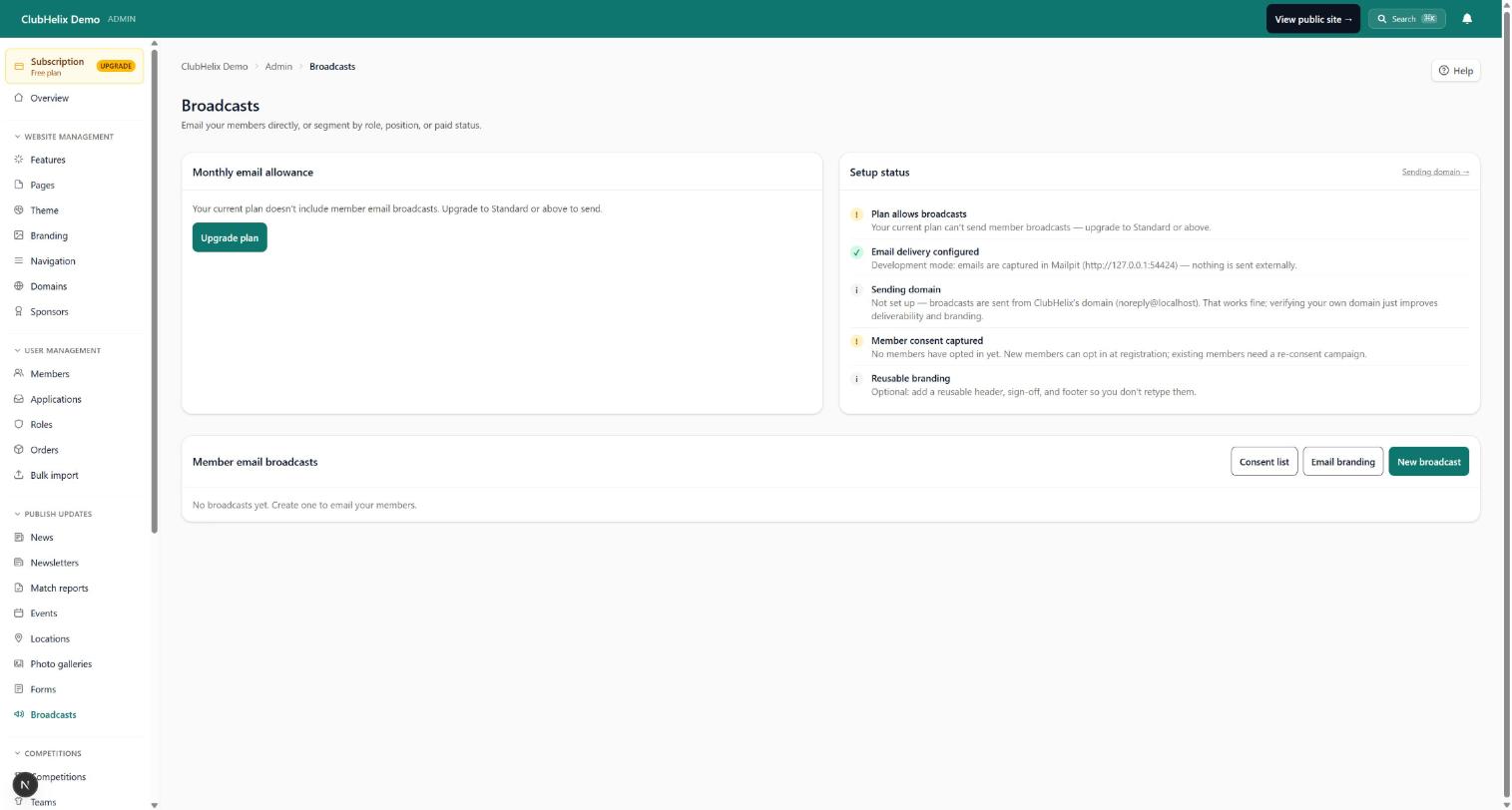
Sending through a proper broadcast system rather than a personal address gives you unsubscribe handling, a send log and a list that survives the person who built it — which matters doubly here, because your list is the only thing that outlives a cohort. The mechanics of a list that actually lands are in the society email and newsletters guide and, for the technical half, why club emails go to spam.
The festival is your flagship — plan it like a small business
Almost every international and cultural society's year peaks on one night: the new year, the national day, the culture show, the food festival. It is the event people bring their families to, the one the university photographs, and the one that can lose a year's money in four hours.
Write the break-even before you announce anything. A worked example: hall hire $900, staging and AV $500, decor and printing $250 gives $1,650 in fixed costs. Catering at $18 a head is variable. At a $30 ticket, each ticket contributes $12 towards the fixed costs, so you must sell 138 tickets to stop losing money. If the room holds 250, that is 55% of capacity and you have a plan. If the room holds 180, that is 77% and you have a gamble.
The catering cut-off is the control that saves you. Your caterer wants final numbers about seven days out, so close online sales eight days out, then sell any remainder on the door at a higher price. Never discount in the final week — do it once and you have trained every member to wait, permanently.
You are also selling to two audiences at once. Students need a $25 ticket. Community and family attendees will happily pay $45 and bring three people. Price two tiers, cap the community tier so the room still feels like a student event, and offer a genuine child ticket rather than pretending nobody brings children. Attach dietary and access questions to the ticket itself — halal, vegetarian, no pork, no beef, allergies, and whether someone needs a seat rather than standing — so the answers arrive attached to a name instead of scattered across a chat thread.
On the night, the most common failure is not money, it is the running order. A nine-act show that has never been run end to end finishes 50 minutes late, the venue starts charging overtime, and the last two acts perform to a half-empty hall. Close the running order five days out, do a tech check in the actual venue rather than a rehearsal room, and give one person the stage manager job and nothing else.
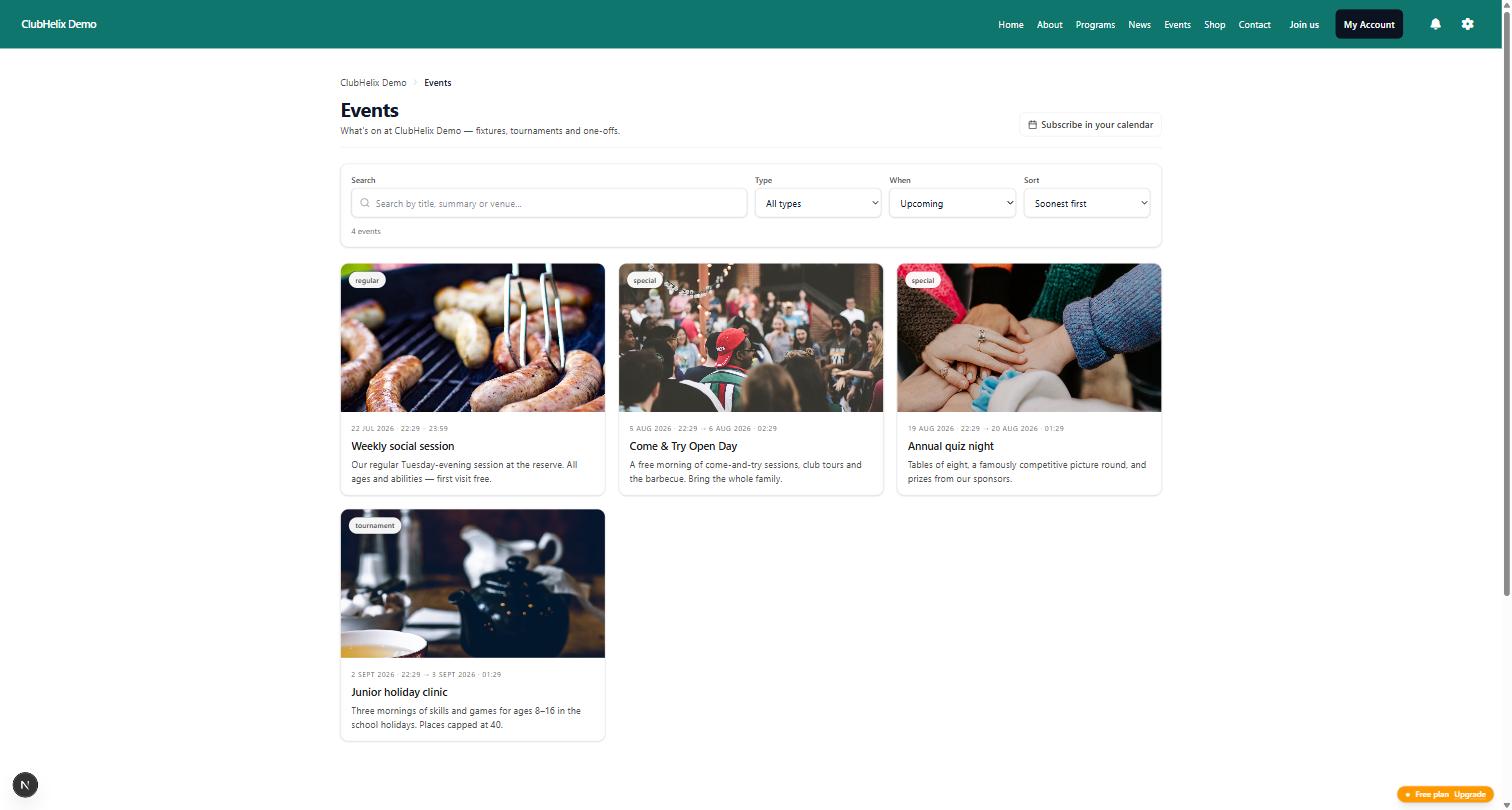
Sell where you announce. Every hop — chat message to form to external ticketing site to payment link — loses people, and it loses most of the ones who are least confident navigating a new country's websites. A site with events and ticketing built in removes the hops, and the attendance data it produces is exactly the evidence your next grant application needs. For the mechanics, work through the end-to-end event guide, and if your flagship is a formal or a ball, the ticketing guide covers pricing against a venue minimum properly. For the other 40 weeks, the social event ideas list is sorted by budget and effort.
Money: grants, community funders and the float
Your income has the usual three sources — membership, events and external money — plus one problem no other society has. In week one, a lot of your members genuinely cannot pay you. They have no local bank account yet, their home card gets declined at the local card-verification step, or the one-time code goes to a mobile number they stopped using when they boarded the plane.
So sequence it. Make everything in the first fortnight free or pay-on-the-door, open a paid membership window in weeks three to five when bank accounts exist, and accept international cards online for the people who still have not sorted one out. Chasing 120 people for $10 in cash at a stall is not a fundraising strategy; it is a fortnight of your treasurer's life. The membership fees guide works through pricing, and the budget template gives you a term-by-term cash view rather than an accountant's one.
Your float matters more than most societies' too, because your biggest costs — the venue deposit, the catering deposit, the printing — all land before your biggest income. Budget $400 to $600 of working cash and write it in as a line item so it does not get spent in week ten.
Your first pot is the capitation funding allocated by the clubs and societies committees, usually decided early in the year against a submitted budget and released against receipts. Your second is the university's international office, which often holds an events budget far easier to reach than a formal grant — a one-page request for €400 towards a culture night, with last year's attendance attached, routinely beats a twelve-page application. Beyond campus, local authority community and integration grants reward exactly what you already do: public events that bring communities together. Embassies and cultural institutes will often fund a national day celebration, the Erasmus and exchange budgets sometimes support intercultural programming, and local community businesses sponsor in kind far more readily than in cash. Be careful who you take money from: immigration advisers, job agencies and accommodation brokers all want access to your members, and endorsing one of them can hurt people who trust you. VAT is normally handled centrally where the union holds society funds, but confirm before pricing a large ticketed festival. General information only, not tax advice.
The funding and grants guide covers what selection panels actually reward — attendance numbers, cost per head, and whether you acquitted last year's money on time. All three are things you can only prove if you were recording them all along.
The pastoral load nobody warns you about
Read your committee inbox at week five of any semester and you will find things no constitution mentions: homesickness that has turned into not leaving a room; a landlord keeping a rental deposit; a housemate dispute that has become a housing crisis; a phone call demanding money and threatening deportation; an employer paying below the legal minimum and hinting they will report the member if they complain; an illness with no family nearby; a death at home and no money for a flight; academic misconduct proceedings the member does not understand and is too ashamed to ask about.
The rule that keeps a committee functional is simple: you are a referral service, not a service. Your job is to know where to send someone within thirty seconds and to walk with them to the door if they are frightened. Build a one-page referral card, print it, hand it out in week two, and put the same list on your website where a panicking person can find it at midnight:
- The university's international student support office, with a name and a phone number.
- University counselling, plus whatever after-hours mental health line covers your area.
- Your student association's advocacy or advice service — free, independent of the university, and the right people for tenancy, employment and academic appeals.
- Campus security's emergency number and the local emergency number.
- The police non-emergency line, and the nearest after-hours medical clinic.
- Any free legal service for students on or near your campus.
The safety and scams briefing in week two is the highest-value twenty minutes your society will ever run. Cover the impersonation call from a supposed government official, the accommodation deposit paid before anyone viewed the property, the "pay us in gift cards or cryptocurrency" demand, the job offer that requires a fee up front, and the parcel-and-customs call. Then give the flat rule people can remember while frightened: no real government agency asks for payment in gift cards or cryptocurrency, and no real official tells you to stay on the phone and not speak to anyone. Repeat it at the mid-year intake, because the scammers do.
Finally, never let one committee member carry a member's crisis alone — for the member's sake, and for theirs. Two people, a shared note of what was referred where, and a firm end to the conversation at the point of referral. The welfare and inclusion guide covers the wider version of this, including accessible and alcohol-free events, which for your membership is not a nice-to-have.
There is one boundary you must never cross, and it is worth writing into your welcome material in plain words.
Immigration advice is a regulated activity and your committee is not qualified to give it. The university's international office and the students' union advice service are the routes, both are free, and you should say plainly on your website that the society does not answer visa questions. Two arrival tasks belong in your run sheet all the same, because they catch people out every single year: registering with the immigration service after arrival, which runs on an appointment system that fills up fast, and holding private medical insurance, which is normally required for non-EEA students. On paid work, student permissions carry conditions on hours that differ by course and change over time — never quote a figure from memory or from a friend's experience. Employment problems are a different thing entirely: underpayment, unpaid trials and threats to report someone are matters for the union's advice service and the workplace regulator, and immigration status does not remove someone's employment rights. General information, not legal or immigration advice.
A committee that turns over completely — and how to survive it
Ordinary societies lose half a committee a year. You can lose all of it, and often at the wrong moment: a twelve-month coursework degree that started mid-year finishes mid-year, and the person finishing has usually booked a flight for the week after their last assessment.
Four habits carry a society through that.
Elect from both intakes. Reserve at least two general committee positions for the mid-year cohort and fill them at a short by-election six weeks after that intake arrives. It costs you one notice and one meeting, and it means half your committee is never simultaneously in its final semester.
Deputy everything critical. Treasurer, communications and welfare each get a named deputy drawn from the newer cohort, with real access and one real task, not a title. The test is simple: if this person vanished tomorrow, could someone else send the newsletter or see the bank balance this week?
Hold the AGM before flights, not after exams. Six weeks before the end of the final teaching period is right. Run it after exams and half your candidates have already left the country, and your quorum is people on a video call at 3am.
Write a leaving-the-country checklist and work it two weeks before departure, not from the airport. Bank signatory removed and replaced. Any refunds or payouts redirected. Personal phone number taken off every account recovery and two-factor setting. Accounts transferred to the incoming holder, tested by them logging in while the outgoing holder watches.
That last one has a trap specific to you. A refund to a cancelled card, or a payout to a bank account that closed when its owner left the country, fails quietly — sometimes weeks later, when nobody is watching. Money that belongs to the society should never pass through a personal account, and a member's refund should never depend on a graduate still having a local bank. Take payments into something the society owns, keep per-person logins with permissions attached to roles rather than a shared password in a pinned message, and remove access the week someone leaves. The full sequence, with a printable meeting agenda, is in the committee handover checklist.
One more thing worth doing while people are still here: capture a personal email address, not just the university one, which is switched off after graduation. Your alumni are the single best recruitment channel you have, because the student deciding whether to come here next year will ask someone from home who has already done it. A list that survives is a list that keeps working. How to hold that list safely is covered in the member records and privacy guide.
Frequently asked questions
Should we charge membership in the first week, when half our members have no bank account yet?
No — sequence it instead. Make everything in the first fortnight free or pay-on-the-door, then open a paid membership window in weeks three to five once local bank accounts exist. Trying to collect in arrivals week produces declined cards, awkward conversations and a treasurer holding cash, and it filters out exactly the people you most want to reach. If you do take online payment early, make sure the checkout accepts cards issued overseas, because a decline at that moment reads to a nervous new arrival as "this is not for me".
How do we stay out of home-country politics without pretending it does not exist?
Write the position into your constitution before you need it: the society does not take positions on the politics of any country, does not host party-political campaigning, and welcomes members regardless of their views. Then apply it evenly and visibly, because a rule applied to one group and not another is worse than no rule. At the festival, keep the program cultural rather than political, agree in advance how flags and anthems are handled, and give the committee a script for the moment somebody tries to make a speech into something else. Also take photo consent seriously: some members have genuine reasons not to appear in a public photo or a livestream, so offer a "please do not photograph me" lanyard or wristband and actually honour it.
What permits do we need to run a cultural festival with food and drink?
It depends on where you are and, more than anything, on the venue. The single biggest simplification available to you is to use a campus venue that already holds the necessary licences and health approvals, and a licensed caterer rather than home kitchens — that moves nearly all of the compliance onto people whose job it is. Home-cooked food from members is the emotional heart of a cultural festival and also the thing most likely to breach the rules, so if it matters to you, ask before you plan around it. Allow at least eight weeks, because anything involving alcohol is the slowest permission you will seek. This is general information — your student association and the venue will tell you what actually applies.
Selling food generally means notifying the local authority's environmental health service and meeting hygiene and temperature requirements for a temporary food stall. Alcohol at a one-off ticketed event needs an occasional licence applied for through the courts, so the lead time is measured in weeks rather than days and it is not something you can arrange late. The students' union bar or another licensed campus venue avoids the whole process, which is why most societies run the big night there.
How do we get a pre-arrival list when the international office will not give us contact details?
You do not ask for their list — you ask to be inside their message. Draft the sentence and the link yourself, send it three months before the intake, and make saying yes a ninety-second job for a busy staff member. Then build your own list from that link, from last year's members telling the people coming from their home city, and from a clearly labelled arrivals page that turns up when someone searches for your university and their country. Over two intakes a society that does this ends up with a better pre-arrival list than the office could have shared anyway, and it belongs to the society.
Should our campus have one international society or one per country?
Both, and they should not be competing. The umbrella society is better at arrivals, scale and being the university's obvious partner; the national and regional societies are better at belonging, food, language and the festival people bring their families to. The friction only appears when they duplicate — three welcome dinners in the same week, three referral cards, three funding applications for the same room. Agree a shared arrivals calendar and a festival slot rotation before the intake, and the whole thing works. If a national society is drifting away from current students towards a community club, the fix is a constitutional rule that a majority of the committee must be currently enrolled.
Where ClubHelix fits
Nearly everything that makes an international society fragile is administrative: the pre-arrival list in a graduate's drive, the ticket money in a personal account, the announcements scattered across apps half your members cannot open, the handover that happens from an airport. ClubHelix gives the society one home it owns — a public site with an arrivals page, member records with the personal email address that outlives the university one, self-serve paid sign-ups that accept overseas cards, events and ticketing with dietary questions attached, email broadcasts with a send log, and per-person access tied to committee roles rather than a shared password. A students' association can even sit above its affiliated societies in the same structure, so the umbrella group and every national society keeps its own site and its own records.
If you want to see the shape of it, the university clubs and societies solution covers the whole society use case and cultural and heritage groups covers the festival-and-community side. The ready-made site templates will get an arrivals page live in an evening, and the pricing page includes a free tier for building the site and trying it out, with taking payments online and being found in search on the paid plans.
ClubHelix gives your society one place for events and ticketing, email to the whole list and sign-up forms that write straight into your member records. Start free before your next intake arrives.


