
What this guide answers
- What records should a woodworking club keep for machine inductions?
For each sign-off, record the member, the specific machine and its asset number, the assessment date, the assessor, what was demonstrated, the member's acknowledgement, any conditions, and a review or lapse date.
- Should woodworking club members be allowed to work alone in the workshop?
Most clubs allow hand tools and low-risk powered tools during supervised opening hours, and prohibit solo use of higher-risk machines such as table saws, thicknessers and spindle moulders entirely.
- How do you handle donated machinery safely?
Assess every donation before accepting it: completeness, guarding, wiring, parts availability, space, and whether anyone in the club knows the machine.
- Can a club charge for items its members make?
Many do, and it can fund tooling and community projects — but agree the ground rules first.
- How often should machine sign-offs be renewed?
A common approach is one to two years for machines needing a specific sign-off, with a shorter cycle for the highest-risk equipment, plus a refresh for anyone who has not used a machine in about twelve months.
South Africa edition. This guide is written for volunteer-run clubs in South Africa. Where rules differ — grants, tax, incorporation, safeguarding — follow the South Africa-specific pointers below or check with your national body.
Picture a Tuesday morning. A visitor arrives with a bag of tools and a project he has been planning for months, and he asks whether he can use the thicknesser. He is friendly, he is clearly experienced, and he is standing in front of a machine that removes fingers. Whoever is on duty has about four seconds to give an answer that will still look right if it goes wrong.
The answer is not about that man. It is about whether your club has written down which machines need what, who is allowed to sign somebody off, and where that sign-off is recorded. Woodworking clubs are one of the very few volunteer organisations where the paperwork genuinely is the safety system. A footy club can lose its fixtures spreadsheet and still play. A workshop that cannot say who is cleared on the spindle moulder is a workshop with no defence — for the member who gets hurt, for the volunteer who let them, and for the committee that appointed them both.
None of that has to be heavy. The clubs that get it right have a machine list on one page, a competency record that takes ninety seconds to update, and a culture where being signed off is something to be proud of. This guide covers all three, plus the parts nobody warns a new committee about: dust and the slow hazards, keeping donated machinery honest, timber stock, and what happens when someone offers your club money to make something.
Know which kind of workshop you are
The rules that fit a small guild meeting in a hired hall will strangle a shed that opens five days a week, and vice versa. Work out which you are before you write a policy.
| Model | How members use it | Supervision reality |
|---|---|---|
| Guild or society with no workshop | Meetings, demonstrations, a shared tool library, members work at home | Light. The library needs a borrowing register, not an induction regime |
| Club with a hired or shared space | Machines wheeled out for sessions, packed away after | Every session is a setup and a supervisor; storage and transport are the risk |
| Permanent club workshop | Fixed machines, scheduled open sessions, keyed access | A duty supervisor for every open hour, and a real maintenance program |
| Open shed with drop-in hours | Long opening hours, mixed skill levels, high turnover of visitors | The heaviest — tiering, inductions and visitor rules do most of the work |
| Community makerspace hybrid | Wood alongside metal, laser or 3D printing, often paid staff | Multiple competency streams and a proper booking system |
The other decision to make early is who the workshop is for. Members only, members plus supervised guests, or open community sessions — each has a different insurance conversation and a different induction load. Write it into your rules rather than deciding it at the door.
It is worth knowing which wider network your club belongs to, because that is where the policy templates, the insurance pathways and the experienced committees are.
In South Africa, volunteer workshops usually sit within woodworkers associations and woodturning guilds, with a smaller number of community sheds and makerspaces in the larger centres. Association membership is worth having for the demonstrations, competitions and the network, and a club running its own workshop will generally be writing its own safety documentation — so borrow the structure from an established club and adapt it, rather than starting from a blank page.
Tier your machines before you induct anybody
A single "workshop induction" is too blunt. A member who is excellent on a lathe may never have used a spindle moulder, and treating those the same either over-restricts good makers or under-restricts risky ones. Tier the machines instead, put the tier on a sticker on the machine itself, and publish the list.
| Tier | What it means | Typical machines |
|---|---|---|
| Green — general induction | Any inducted member, working alone during open hours | Hand tools, cordless drills, sanders, scroll saw, drill press, bench grinder |
| Amber — machine sign-off | Inducted, plus a recorded sign-off on that specific machine | Table saw, bandsaw, thicknesser, jointer, mitre saw, router table, wood lathe |
| Red — sign-off plus supervision | Machine sign-off, and a second competent person in the workshop | Spindle moulder, panel saw, large lathe work, anything with a tenoning or moulding head |
| Restricted — named operators only | A short, named list approved by the committee; nobody else, ever | Chainsaws, sawmill or resaw equipment, anything the club has decided is out of scope |
Two rules make the tiers work in practice. First, the tier belongs to the machine, not the member's confidence. Second, a machine with no current sticker is out of service — which gives your maintenance coordinator a simple way to take something out of use without an argument.
Set out the guest rule in the same document. The common approach is that a visitor may watch, may use hand tools under direct supervision, and may not start a powered machine on a first visit under any circumstances. It is much easier to enforce a rule that exists in writing than to invent one while somebody is holding a plank.
Inductions and the competency register
The register is the single most important document your club keeps. It needs to answer one question instantly: is this person cleared on this machine today?
What a sign-off record must contain
| Field | Why it matters |
|---|---|
| Member name and membership number | Identifies the person, not a nickname on a whiteboard |
| Machine, by name and asset number | "The bandsaw" is ambiguous once you own two |
| Date of assessment | Everything else depends on this |
| Assessor name and signature | Shows a qualified person made the call |
| What was demonstrated | A short checklist — guard set, stock support, correct feed, isolation, clean-down |
| Member's acknowledgement | They confirm they were shown, and will ask if unsure |
| Review or lapse date | The record has a shelf life |
| Any conditions | "Cross-cut only", "not to be used for resawing", "supervision required" |
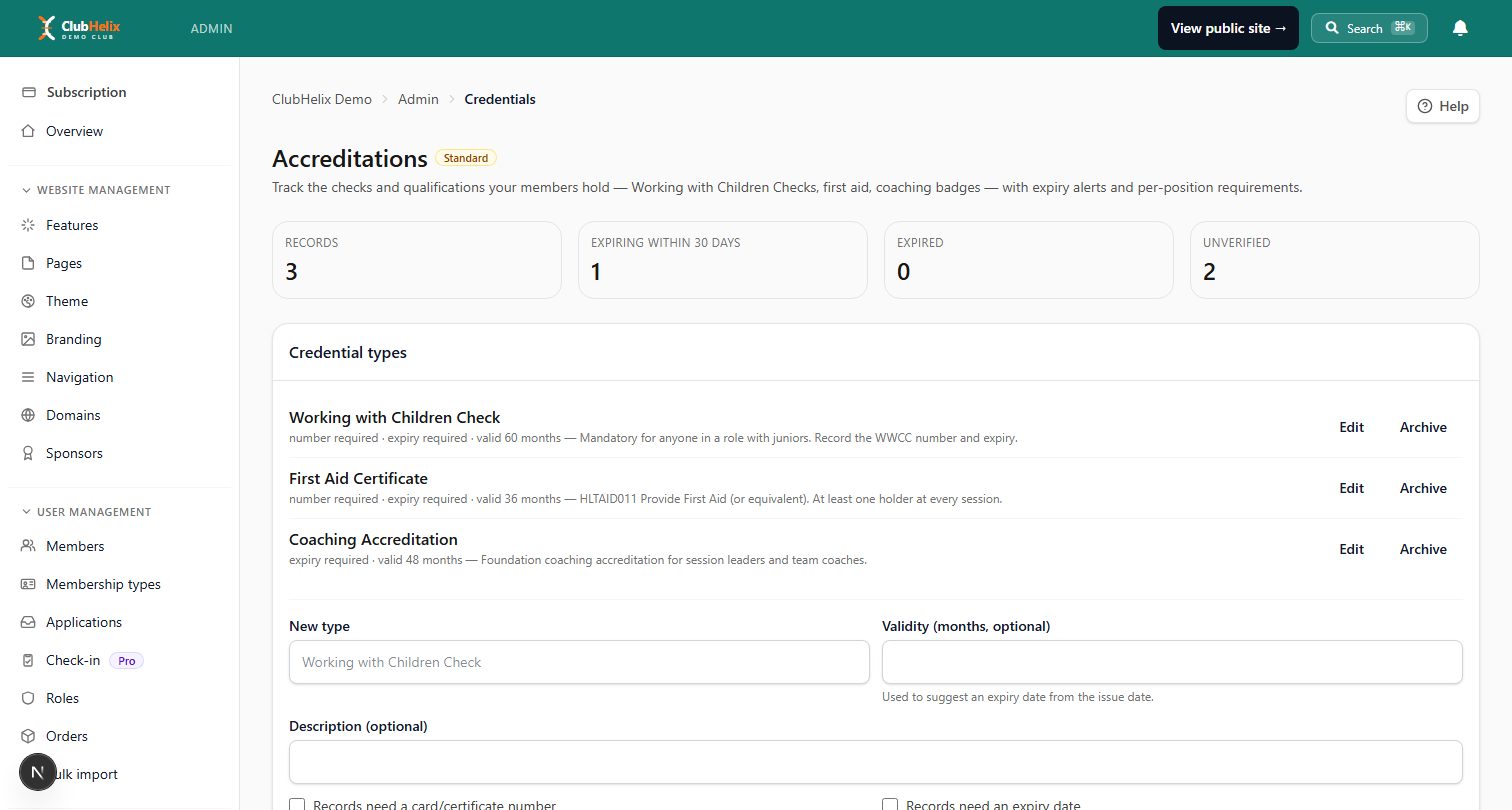
Paper cards in a filing box work until the day the assessor is away and nobody can find the card. Keeping the same records digitally — searchable, visible to every duty supervisor on their phone, with automatic reminders before they lapse — is exactly what a tracked accreditations and competency register is for, and it is the difference between a policy on a wall and a system that operates.
Currency, lapse and the rusty member
Skill fades and habits drift. Most clubs settle on a currency rule of one to two years for amber machines, with a shorter cycle for red ones. Add a use-based trigger as well: a member who has not touched a machine in twelve months does a short refresh rather than a full reassessment. Say this out loud when you introduce it, because members hear "lapse" as an insult unless you frame it properly. The framing that works: the sign-off is the club's record, not a certificate of your worth, and refreshing it is how an eighty-year-old keeps using the lathe for another decade.
Who may assess, and who may revoke
Name your assessors in the minutes, not by tradition. An assessor should be experienced on that machine, comfortable saying no, and trained in how to assess — which is a different skill from being a good woodworker. Two or three assessors per machine class avoids a bottleneck.
Revocation is the part nobody wants to write. Write it anyway: any duty supervisor may suspend a member's use of a machine on the spot for a safety reason, the suspension is recorded that day, and the committee reviews it at the next meeting. Having the process on paper turns an ugly personal confrontation into a procedure — which protects the supervisor as much as anyone.
Supervision and opening the workshop
The duty supervisor is the most important volunteer role in the club, and it should have a written position description like any other. The core of it:
- The workshop does not open without a rostered supervisor, and closes when they leave.
- They run the opening checklist, set the sign-in board, and know who is in the building.
- They have the authority to stop any job, refuse any machine, and close the workshop early.
- They complete the closing checklist, including extraction bins, offcut bins, finishing rags and isolation.
- They record incidents and near misses before they go home, not next week.
The opening and closing checklist
Laminate it and hang it by the door. A workable version:
Opening: unlock and turn on lights; check the emergency stop and isolators; check extraction is working and the bin is not full; check first aid kit and eyewash; check fire extinguishers are in place; check no machine carries an out-of-service tag that has been ignored; open the sign-in board; note who is on duty.
Closing: all machines off and isolated; blades and cutters lowered or guarded; finishing rags in the metal bin with a lid; solvents back in the cabinet; extraction bin emptied if over the line; floor swept and offcuts binned; compressor drained; sign-out board checked against people in the building; incident book completed; lights, doors, alarm.
Lone working and capacity
Two numbers deserve committee decisions. The first is whether anyone may work alone, and on what. Most clubs settle on: no solo work on amber or red machines, hand tools and green machines only, with a check-in call. The second is the maximum number of people in the workshop at once, which is about circulation space around machines rather than floor area. Both should be on the roster page so the supervisor is not making them up.
Rostering supervisors is the ongoing chore. Publish the roster where members can see it, claim a shift and swap with each other — a volunteer roster they can fill from their phone gets far better coverage than a sheet on the noticeboard, and it gives you a record of who was on duty on any given day, which you will one day need.
Members, visitors and the open day
Most woodworking clubs have the opposite of a marketing problem: they have a capacity problem in the middle of an ageing membership. Both are solved the same way — with a front door that shows what happens inside.
- Run a scheduled visitor session, not an open-ended invitation. One morning a month, a nominated host, a short tour, a cup of tea, and a small hands-on project that produces something to take home. Our guide to running a come-and-try day has the format.
- Convert on the day. A visitor who leaves with a form to fill in later mostly does not come back. Take joining details on the spot, on a phone or a tablet, and book their induction before they leave.
- Stagger inductions. Six new members in a week will swamp your assessors. Run inductions as a scheduled monthly session with a cap, and let people book a place.
- Make the open day pay for itself. A barbecue, a raffle of a member-made piece, a small stall of chopping boards and toys, and a donation tin for the community projects. It is a genuinely good fundraiser and a better recruitment tool.

The community projects deserve their own place on your website. Repairs for the local school, planter boxes for the kindergarten, toys for the hospital appeal, a bench for the reserve — these are what make a council or a funder take your grant application seriously, and they are far more persuasive with photographs and dates attached than as a sentence in an annual report.
Dust, noise and the slow hazards
The injuries that close workshops are dramatic. The hazards that shorten members' lives are not.
- Dust extraction is a health control, not a housekeeping tool. Fine dust is the fraction that reaches deep into the lungs, and some hardwood dusts are recognised carcinogens. Extract at the machine, not just at the floor, keep filters serviced, and site the dust bin outside the workshop if you can.
- Respiratory protection needs to fit. A cheap dust mask worn over a beard does close to nothing. If your club provides masks, provide the right class, keep them clean and stored properly, and be honest with members about their limits.
- Sweeping makes it worse. Compressed air makes it much worse. Vacuum with a suitable filtered unit instead, and make that the rule rather than a preference.
- Hearing. Routers, thicknessers and extraction motors together are loud for hours at a time. Hearing protection at the door, in a bin, free, in more than one style — the cheapest health intervention a workshop can make.
- Finishing and solvents. A metal cabinet with a lid, kept away from ignition sources, plus a metal bin with a closing lid for oily rags. Rags soaked in oil-based finish can self-heat and ignite in a pile with no external ignition at all. Every experienced shed has a story about this. Do not let yours be the next one.
- Sharpening and blade changes. Blunt tooling causes kickback, which causes the injuries. A sharpening routine is a safety control disguised as maintenance.
- Housekeeping as a control. Trip hazards, offcuts around machines, and cords across walkways cause a large share of the incidents that actually happen.
Record every incident and near miss, including the ones with no injury. A near-miss record is the cheapest safety information your club will ever collect, and the pattern in it is usually obvious within a year. Doing it on a phone at the machine, through built-in incident reporting, is what makes it actually happen — a paper book in the office is a book of the incidents somebody remembered at four o'clock. Our incident report form template covers what to capture, and the broader risk management guide puts it in context.
Maintenance, machine records and donated machinery
Every machine needs a record card: asset number, make and model, date acquired, source, electrical test date, service history, guarding notes, and its current tier. Keep it with the club equipment register rather than in someone's head.
Then run a simple cycle:
| Frequency | Job |
|---|---|
| Every session | Visual check by the duty supervisor, guards in place, extraction connected |
| Monthly | Blade and cutter condition, table alignment, fence square, dust hoods clear, emergency stops tested |
| Quarterly | Bearings and belts, lubrication, filter check on extraction, tool sharpening round |
| Annually | Full service on major machines, electrical testing, insurance review, tier list reviewed by committee |
Donated machinery is a gift and a liability in the same box. Assess every donation before it comes through the door: is it complete, does it have its guards, are parts still available, is the wiring sound, and do you have space and a person who knows it. Be prepared to decline politely, or accept it for parts. A club that accepts everything ends up with three unusable machines occupying the space where a good one should be.
Any machine that is unsafe or unserviced gets a tag and comes out of use immediately. One tag design, one tag box, one rule: only the maintenance coordinator or the committee removes a tag.
There is no single national testing scheme in South Africa for portable tools in a club workshop, so the practical standard is a documented internal inspection routine plus whatever your insurer requires. Occupational health and safety legislation sets duties around machinery guarding and training that are worth reading with your committee, and a shared workshop should also plan for power interruptions — an unexpected outage mid-cut, and the moment power returns, are both genuine hazards worth a written rule.
Insurance, and what your insurer will actually ask
General information only. Cover, duties and terminology differ by jurisdiction — your broker, insurer and local regulator set what applies to your club.
When you renew, expect to be asked for a machine list with tiers, evidence of induction and competency records, your supervision arrangements, your maintenance routine, and your incident history. Clubs that can produce those in one email get better outcomes than clubs that describe a culture of care.
Four things worth confirming explicitly rather than assuming:
- Whether volunteers are covered as well as members, and whether personal accident cover exists at all.
- Whether visitors and guests using hand tools under supervision are covered.
- Whether items your club sells or gives away — toys, chopping boards, furniture — are covered by products liability, and what conditions attach.
- Whether off-site work at a community project, a school or a show is included.
Ask your insurer what would void the policy. The answers usually come back to the same things: an unguarded machine, an untrained operator, or no record that training happened. Which is the argument for the register, made by someone other than you.
In South Africa a club workshop will usually want public liability, property and contents cover, and product liability if it sells what it makes. Occupational health and safety legislation places duties on those who control premises and machinery, including around guarding and training, and where a club has any employees the compensation fund obligations apply as well. Confirm with a broker whether your policy covers volunteers, visitors and off-site community work, and get the answer in writing.
Timber, member projects and paid commissions
Timber stock
Timber is money sitting on a rack, and it disappears quietly. Three habits fix most of it:
- A rack policy — club timber on one side, member timber on the other, labelled with name and date. Anything unlabelled becomes club stock after a stated period.
- A metal detector by the rack, used every time on reclaimed timber. A nail through a thicknesser's knives is an expensive afternoon; a nail into a bandsaw blade at speed is worse.
- Priced sale of club timber to members, recorded, rather than an informal help-yourself. Ambiguity about timber causes more resentment in woodworking clubs than money ever does.
Cap project storage as well. A published rule — one project on the rack, a name and date on it, six months maximum — is the only thing that stops the workshop silently converting into a storage unit.
Species availability shapes what your club teaches. Pine and saligna are the everyday timbers in South Africa, with kiaat, imbuia and other indigenous species prized and expensive — so agree how they are stored, priced and allocated before a member assumes the offcut bin is fair game. Check the provenance of indigenous stock, and keep a written note about timbers known to cause skin or respiratory reactions.
Commissions and selling what members make
Sooner or later somebody asks the club to make something for money. Handled well it funds the tooling budget; handled badly it creates a member who feels exploited and a customer who feels let down. Use a written workflow.
| Stage | What happens |
|---|---|
| Enquiry | Logged centrally, not agreed in the car park. One nominated contact |
| Feasibility | Does the club have the skills, the machines, the timber and a willing maker |
| Quote | Materials plus a stated hourly rate plus a contingency, in writing, with a delivery window |
| Deposit | Materials paid up front. No exceptions, however well you know them |
| Build | Hours logged against the job, so the next quote is based on evidence |
| Handover | Written note of care, finish and any limitations, and a receipt |
Three principles keep commissions healthy. Price so you are not undercutting local trade — a club that quotes below a working cabinetmaker damages its own community and its reputation. Decide where the money goes before the job starts — into club funds, split with the maker, or to a nominated community project — and put it in writing. And be honest about liability: anything you sell to the public may bring obligations that a private gift does not, so ask your insurer about products cover before you accept a commission for something structural, something for a child, or something that will hold weight.
Putting the register, the roster and the bookings in one place
Every part of the safety system above is really an administrative system: a competency record that has to be current and visible, a supervisor roster that has to be filled, a machine register that has to be maintained, and an incident book that has to be usable at the machine. ClubHelix runs all of it from one member list — accreditations and competency tracking with expiry reminders, volunteer and duty rosters members claim and swap themselves, incident reporting from a phone, and session and bench booking so a busy workshop is not first-in-best-dressed.
The honest test is the one this guide opened with. Put your machine list, your tiers and your existing sign-offs in, hand the duty supervisor a phone, and see whether the visitor at the thicknesser is now a ten-second question instead of a judgement call. That much fits inside the free tier, pricing is published on the site, and getting started takes an evening in a quiet workshop. If your club is close to the shed movement, our guide to starting a men's shed covers the founding stage, and workshop-based community groups can see the wider fit on our community and service organisations page.
Frequently asked questions
What records should a woodworking club keep for machine inductions?
For each sign-off, record the member, the specific machine and its asset number, the assessment date, the assessor, what was demonstrated, the member's acknowledgement, any conditions, and a review or lapse date. Keep them somewhere every duty supervisor can check in seconds, and set reminders before they expire — an induction record nobody can find during a session is not doing its job.
Should woodworking club members be allowed to work alone in the workshop?
Most clubs allow hand tools and low-risk powered tools during supervised opening hours, and prohibit solo use of higher-risk machines such as table saws, thicknessers and spindle moulders entirely. Whichever line you draw, write it down, publish it beside the roster, and give the duty supervisor explicit authority to enforce it — including the authority to close early.
How do you handle donated machinery safely?
Assess every donation before accepting it: completeness, guarding, wiring, parts availability, space, and whether anyone in the club knows the machine. Anything that fails is politely declined or stripped for parts. Accepted machines get an asset number, a record card, electrical checks, a tier and a sticker before anyone switches them on.
Can a club charge for items its members make?
Many do, and it can fund tooling and community projects — but agree the ground rules first. Quote in writing with materials, an hourly rate and a delivery window, take a deposit for materials, decide before the job starts where the money goes, price so you are not undercutting local tradespeople, and check with your insurer whether products liability applies to what you are selling.
How often should machine sign-offs be renewed?
A common approach is one to two years for machines needing a specific sign-off, with a shorter cycle for the highest-risk equipment, plus a refresh for anyone who has not used a machine in about twelve months. Frame it as maintaining currency rather than retesting competence — it is what lets long-standing members keep using the machines safely for years.
Two documents this guide leans on, ready to copy — the club equipment register template and the incident report form template.

