
What this guide answers
- How much does it cost to run a swimming club?
Lane hire is the dominant cost and varies widely by pool and region, followed by coaching, affiliation fees and equipment.
- How do swim meet entries work?
Swimmers nominate for individual events with an entry time (usually their personal best) before a published closing date, the host club seeds heats from those times, and entries are submitted to the meet host or…
- How many timekeepers does a swim meet need?
For manual timing, plan on two timekeepers per lane plus a chief timekeeper — sixteen or more people for an eight-lane pool.
- Does a small swimming club really need a website?
Yes — it's usually the first place a prospective family looks, and it's where squads, fees, meet dates and rosters can live permanently instead of being re-answered weekly.
New Zealand edition. This guide is written for volunteer-run clubs in New Zealand. Where rules differ — grants, tax, incorporation, safeguarding — follow the New Zealand-specific pointers below or check with your national body.
Swimming clubs are unusual among sports clubs: you don't own your ground, your season runs on meets rather than a weekly home-and-away round, and almost everything — squads, lane hire, timekeeping, meet entries — depends on a small committee keeping a lot of moving parts in sync. Whether you're a club-night club at the local pool or a competitive squad program feeding into representative championships, the job is the same: keep swimmers progressing, keep parents informed, and keep the lanes paid for.
This guide walks through how to run a swimming club end to end — affiliation, committee roles, squads and fees, swim meet entry, timekeeping rosters, lane hire and the club's online presence — with the vernacular a swimming family actually uses.
Getting set up and affiliated
Most competitive swimming clubs affiliate with their regional swimming association, which in turn sits under the national body. Affiliation is what gets your swimmers registered for sanctioned meets, gives you access to insurance arrangements, and plugs your results into the official times database — those recorded times are what qualify swimmers for higher-level meets, so they matter enormously to families.
If you're starting fresh, sort the legal basics — a formal structure, a bank account and a constitution — before you promise families anything.
Our guide on starting a sports club in New Zealand covers incorporated societies, bank accounts and constitutions, and everyone in a children's role needs current police vetting tracked from day one.
For a swimming club specifically, sort these early:
- Pool access. You'll need a written lane hire agreement with an aquatic centre or council pool before you can promise families anything. Lane availability drives your entire program.
- Coaching accreditation. Coaches generally need recognised qualifications through the national coaching pathway, plus the child-safeguarding checks described above. Track expiry dates from day one.
- Club night format. Many clubs run a weekly or fortnightly club night — an informal in-house meet where swimmers race for personal bests. It's the heartbeat of a community swimming club and the easiest entry point for new members.
Committee and volunteer roles
A swimming club leans on a wider set of specialist volunteers than most sports, because meets can't run without accredited officials on deck.
| Role | What they actually do |
|---|---|
| President | Club direction, relationship with the pool and the association |
| Secretary | Affiliation paperwork, meet sanctioning, correspondence |
| Treasurer | Lane hire invoices, squad fees, meet entry fees, fundraising money |
| Race secretary | Swim meet entry — collecting nominations, seeding, submitting entries |
| Chief timekeeper | Recruiting and rostering timekeepers, managing watches and pads |
| Officials coordinator | Getting parents accredited as timekeepers, judges and starters |
| Squad/coaching coordinator | Squad structure, coach liaison, lane allocation |
The race secretary and chief timekeeper roles are peculiar to swimming and they burn people out fastest — spread the load, document the process, and read our volunteer roster template guide for patterns that make rostering feel fair rather than like conscription.
Squads, membership and fees
Most swimming clubs run tiered squads — something like junior development, age squad, performance squad, plus masters — each with different session counts and different fees. Your fee structure usually has three layers:
- Annual membership — club membership plus the affiliation component passed through to the state body.
- Squad fees — charged per term or per month, reflecting how many sessions a squad trains. This is where lane hire costs are recovered, so price each squad against the pool time it actually consumes.
- Meet entry fees — per event, per meet, collected as swimmers nominate.
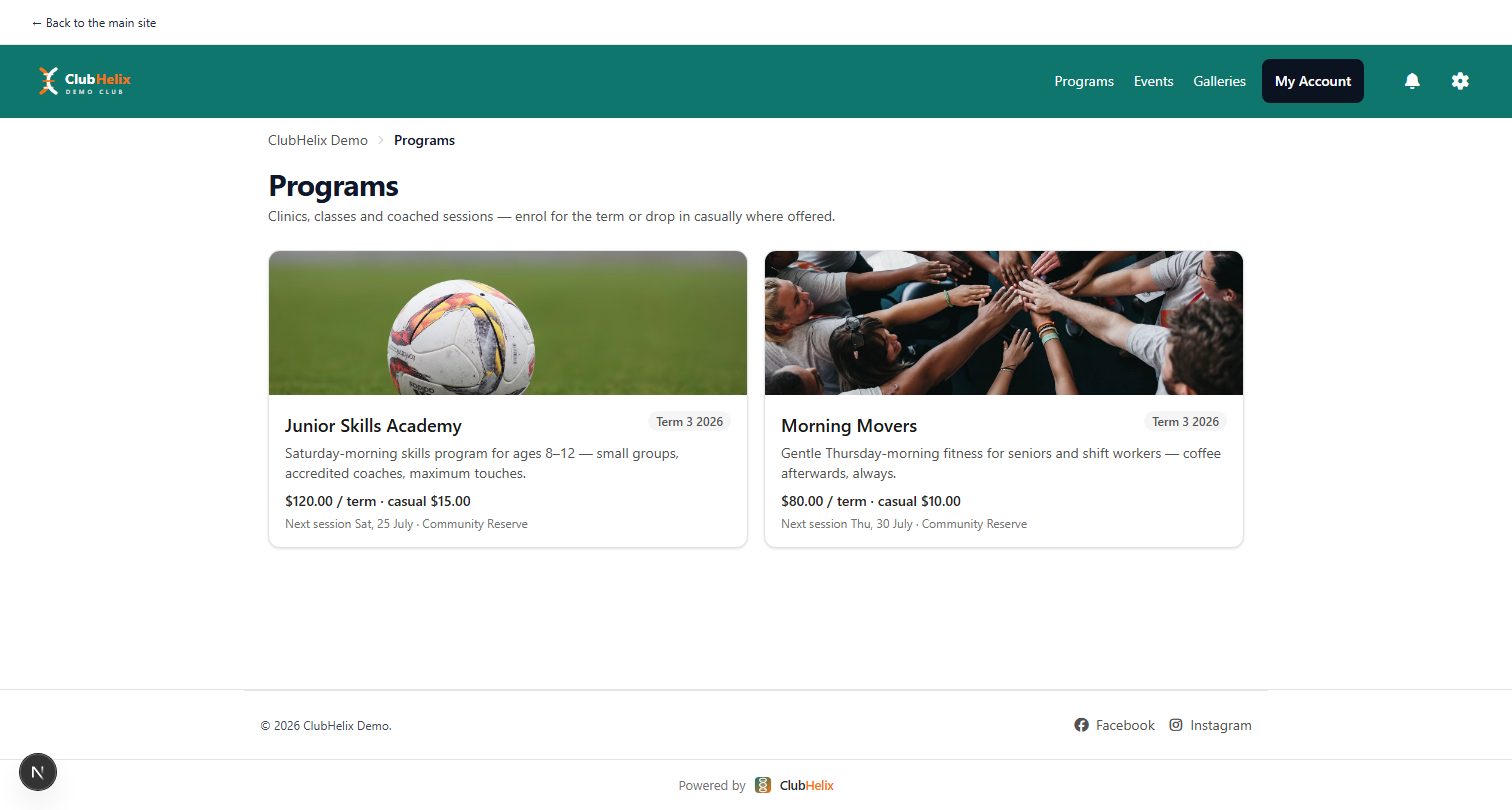
Because squad fees recur every term, chasing them manually is the treasurer's biggest time sink. An online system that handles term-based program enrolment with payment at the point of enrolment removes the awkward pool-deck conversations about who has paid. ClubHelix also supports instalments, which helps families with two or three swimmers across different squads.
When you're setting prices, benchmark against local competition but be honest about your costs — our guide on how much club membership should cost has a simple costing method that works well for lane-hire-driven clubs.
Swim meet entry and race day
Meets are where swimming clubs earn their keep. There are broadly three kinds: your own club night, interclub or invitational meets hosted by other clubs, and championship meets run by the association. Each involves the same cycle — publish the meet, collect nominations with entry times, submit entries before the closing date, then get everyone (and enough officials) on deck.
Make swim meet entry self-serve. The traditional model — a paper nomination sheet at the pool, or a spreadsheet emailed around — collapses the moment entries close at 11:59pm and half your families haven't responded. Publish each meet as an event with an entry form attached, collect event nominations and payment online, and set a hard closing date. Parents nominate from their phones; the race secretary exports a clean list instead of deciphering handwriting.
Seed from entry times. Swimmers nominate with their current personal best for each event. Keep PBs visible to families — chasing a PB is the single biggest motivator for young swimmers, and it's what makes club night worth turning up to.

Race day logistics. A home meet needs a marshalling area, a recording desk, a starter, stroke judges and a full complement of timekeepers — typically two per lane if you're timing manually. Brief new timekeepers in the ten minutes before warm-up ends, and pair every rookie with someone experienced. If you're hosting something bigger, our guide to organising a sports carnival covers the day-of-event playbook.
Timekeeping rosters (the volunteer problem, solved properly)
Ask any swimming club what breaks first and they'll say timekeeping. Every meet needs a bench of timekeepers, and the same six parents end up doing it every fortnight while everyone else studies their shoes.
The fix is structural, not motivational:
- Roster by family, per season. Every squad family owes a set number of timekeeping duties per season, published in advance. People accept a clear, evenly-spread obligation far more readily than a weekly plea.
- Publish the roster where people already look. A volunteer duty roster on your club website, with automatic reminders before each duty, beats a laminated sheet at the pool every time. Swap requests should be visible to everyone so gaps get filled by the group, not by the chief timekeeper's late-night phone calls.
- Make accreditation easy. Encourage parents to do the (short) technical official course for timekeeping and judging. The more accredited parents you have, the more meets you can host — and hosting meets is a genuine revenue stream.
Lane hire, money and fundraising
Lane hire is usually a swimming club's largest expense, and it's billed whether or not swimmers show up. Keep a simple monthly view of lane hours bought versus attendance, and resize squads or negotiate sessions each term rather than at crisis point. On the income side, home meets (entry fees plus food and drink sales), raffles and local sponsorship of squad caps all pull their weight — see our club fundraising ideas for a longer list.
The same lane hours can earn something back. If the club sells places in a lane — lap sessions for adult members, a masters squad, an open session on a quiet morning — treat each lane as a shared facility with a capacity rather than a booking one person can take whole. How to share a facility between bookings covers choosing a capacity, per-place pricing, a grid that shows places left, and when named lanes beat a shared one.
The sausage sizzle at the pool on meet day remains the traditional extra, and it earns more than its humble reputation suggests.
If you take sponsorship, put sponsors on the website and in meet programs so the offer is real.
Communication that swim families actually read
Swimming generates a lot of time-sensitive information: entries closing, warm-up times, session changes when the pool closes a lane, results after a meet. Consolidate it. One weekly email covering the week ahead, push notifications for genuinely urgent changes (pool closure, meet cancellation), and everything else on the website where it can be found later. Avoid running club comms through a parent's personal social media account — when that parent leaves, the channel dies with them.
Your swimming club website
A swimming club website has a specific job: answer the questions every prospective family asks — which squad suits my child, when do they train, what does it cost, how do we join — and give current families one place for meet information, rosters and results. Pair it with online member registration so joining doesn't depend on catching the secretary on deck, and publish your meets calendar with event pages and entries so nominations run themselves.
ClubHelix was built for exactly this shape of club — squads with term enrolment, meets as events with entries and payment, timekeeping rosters with reminders, and a proper club website on your own domain. See how it fits swimming specifically in our swimming club management software, or start free and set up your squads in an evening. There's a free tier, and paid plans are listed openly on the pricing page.
Frequently asked questions
How much does it cost to run a swimming club?
Lane hire is the dominant cost and varies widely by pool and region, followed by coaching, affiliation fees and equipment. Most clubs cover it through a mix of annual membership, per-term squad fees and meet revenue — price squads against the pool time they actually use.
How do swim meet entries work?
Swimmers nominate for individual events with an entry time (usually their personal best) before a published closing date, the host club seeds heats from those times, and entries are submitted to the meet host or association. Collecting nominations and payment through an online form avoids the closing-night scramble.
How many timekeepers does a swim meet need?
For manual timing, plan on two timekeepers per lane plus a chief timekeeper — sixteen or more people for an eight-lane pool. A published season-long roster shared across all squad families is the only reliable way to fill that bench meet after meet.
Does a small swimming club really need a website?
Yes — it's usually the first place a prospective family looks, and it's where squads, fees, meet dates and rosters can live permanently instead of being re-answered weekly. A simple site with online registration pays for itself in committee time alone.


