
What this guide answers
- Do we have to become an incorporated society to start a sports club in NZ?
No — you can start as an informal group and incorporate later.
- How many people do we need to start a club?
Enough to run a session and fill three committee roles — in practice around ten committed people is a comfortable start.
- How much does it cost to start a sports club in New Zealand?
Beyond modest registration fees, your real early costs are ground hire, basic gear, affiliation fees and insurance.
- What should we do first — paperwork or playing?
Playing. Run casual sessions to prove demand and build a core group, then do the paperwork (committee, rules, bank account, incorporation) once you know the club has legs.
Every great New Zealand club — from a small-town football side to a harbour sailing club — started the same way: a handful of people who wanted somewhere local to play, and one person willing to organise the first meeting. If that person is you, this guide walks through what actually needs to happen to start a sports club in New Zealand, roughly in the order you'll face it.
None of it is complicated on its own. The trick is doing things in a sensible sequence, keeping the paperwork light, and getting people playing as early as you can — momentum recruits members far faster than a perfect constitution does.
Why start a sports club?
A club is more than a fixture list. It gives your sport a permanent home in the community: a shared identity, a pathway for juniors, a reason for people to turn up on a cold Saturday, and a structure that can outlive its founders. Practically, being a formal club (rather than a loose social group) also unlocks things individuals can't easily get — affiliation with your sport's governing body, entry into local competitions, council ground allocations, grant funding, a club bank account, and insurance.
Before you commit, test the demand. Run a few casual sessions at a park or school gym, start a social media group, and see who keeps coming back. Ten reliable people is enough to found a club; two enthusiastic people is a hobby.
Choosing a structure — incorporated society or not?
Most community sports clubs in New Zealand are incorporated societies. Incorporation makes the club a legal entity in its own right, so it can sign a lease, hold a bank account and enter contracts as "the club" rather than in a committee member's personal name — and it gives members a layer of protection because the society, not the individuals, carries the club's obligations.
The official home for all of this is the New Zealand Companies Office. The Incorporated Societies Register is where societies are registered and searched, and the wider Companies Office site explains the requirements — including the rules (constitution) your society must have, the minimum number of members, officer duties, and the re-registration regime introduced by the Incorporated Societies Act 2022. Some clubs also register as charities if their purposes qualify, which is a separate process with its own regulator.
A brand-new club doesn't have to incorporate on day one. Plenty start as a simple unincorporated group for their first season, then incorporate once there's money, gear and a lease involved. As a rule of thumb, the moment the club holds real assets or signs anything long-term, incorporation is worth doing.
This is general information, not legal or financial advice — check the current requirements with the official body linked above.
Form your first committee
You need three roles filled before anything else: a president/chairperson to lead and front the club, a secretary to handle notices, minutes and correspondence, and a treasurer to open the bank account and track every dollar. Add a club captain or coaching coordinator once training starts. Our guide to committee roles and responsibilities breaks down who does what.
Alongside the committee, draft your rules. Even before incorporation, a one-page constitution — the club's name and purpose, who can be a member, how the committee is elected, and what happens to assets if the club winds up — prevents most early arguments. See how to write a club constitution for a structure you can adapt; if you incorporate, the Companies Office sets out what your constitution must contain.
Funding your club in New Zealand
Most Kiwi clubs run on four income streams:
- Subscriptions. Membership fees are your only fully reliable income. Set them to cover known costs (affiliation, ground hire, gear, insurance) rather than guessing low and chasing top-ups later.
- Grants. New Zealand has a strong community funding culture — regional community trusts, council community grants and class 4 gaming trusts have long funded grassroots sport for gear, ground fees and junior programmes. Each funder publishes its own criteria and rounds, so always check the current round on the funder's official site before applying, and never budget on a grant until it's confirmed.
- Fundraising. Sausage sizzles, quiz nights, raffles and club socials — small, repeatable earners that double as community-building. There are ideas in our club fundraising guide.
- Sponsorship. Local businesses will back a visible, well-run club. Start small: a playing-strip sponsor and a couple of sign or website sponsors.
Keep it boring and transparent: one club bank account, two signatories, and a treasurer's report at every committee meeting.
Insurance pointers
Before your first official session, think about cover. Most clubs consider public liability insurance (for injury or damage claims arising from club activities) and, if the club owns gear or leases rooms, contents/asset cover. In New Zealand, personal injury is handled differently than in many countries because of the national accident compensation scheme, but that does not remove the need for liability cover — and your sport's national or regional body may offer group insurance schemes to affiliated clubs, which is usually the cheapest route. Ask the governing body first, then an insurance broker if you need standalone cover.
This is general information, not legal or financial advice — check current requirements with your governing body and insurer.
Finding a home ground or venue
Talk to your city or district council early — most parks, courts and community halls are council-owned, and councils allocate seasonal ground bookings, often months ahead of the season. Schools are the other big option: gyms, fields and courts are frequently available for community hire outside school hours. When you're small, share: hiring one night a week at an existing club's facility gets you lights, toilets and a clubroom for a fraction of the cost of going alone. Whatever you agree, get it in writing — hire dates, costs, cancellation terms and who's responsible for damage.
Growing your first members

Nothing recruits like visibility. Run a come-and-try day with free entry, gear provided and a barbecue going; invite local schools, put posters in cafés and the library, and post in community Facebook groups. Make joining frictionless — if someone has to email a stranger and wait three days for a form, you've lost them. Capture names on the day, follow up within the week, and give new members one clear next step ("training Tuesday, 6pm, here's the address").
Then keep them: welcome people by name, mix social events between fixtures, and communicate one way (not five). Our guide on how to grow club membership covers the retention side in detail.
Get your club online from day one
A new club lives or dies on being findable. Before your launch day you want three things online: a simple website (what/where/when, fees, contact), a way for people to register and pay without paperwork, and a public events calendar for trainings and come-and-try days.
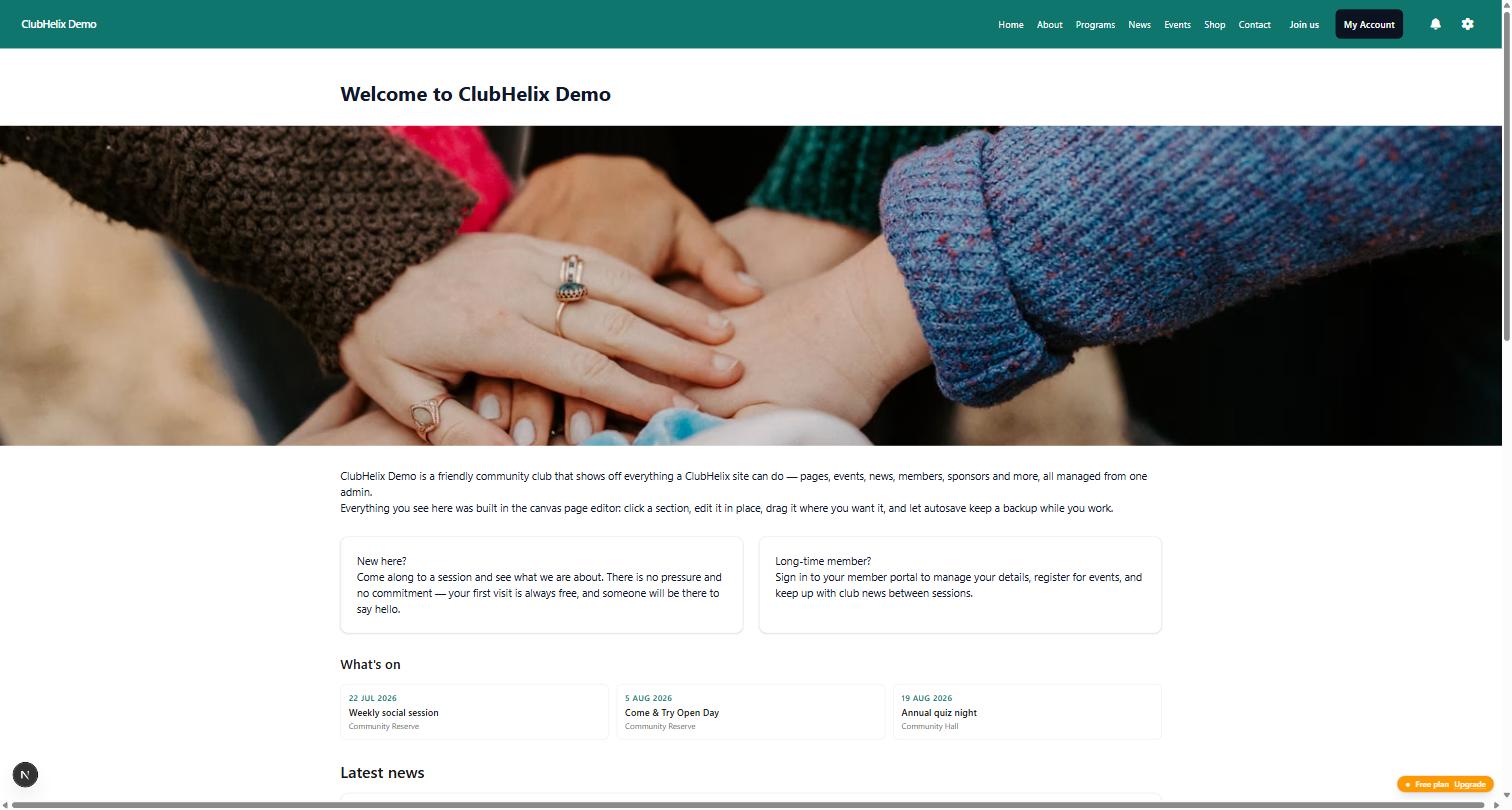
This is exactly what ClubHelix was built for. You can stand up a club website with a drag-and-drop page editor, take memberships through online registration with payments handled for you, and publish club events people can RSVP to — no technical committee member required. There's a free tier to start on, and pricing scales only as your club does. When you're ready, create your club in an afternoon and you'll look established before your first official season starts.
Frequently asked questions
Do we have to become an incorporated society to start a sports club in NZ?
No — you can start as an informal group and incorporate later. Most clubs incorporate once they hold money, own gear or need to sign a lease, because incorporation makes the club its own legal entity and protects members. Check the current requirements on the Companies Office's Incorporated Societies Register.
How many people do we need to start a club?
Enough to run a session and fill three committee roles — in practice around ten committed people is a comfortable start. The Companies Office sets a minimum membership number for incorporation, so confirm the current figure before you register.
How much does it cost to start a sports club in New Zealand?
Beyond modest registration fees, your real early costs are ground hire, basic gear, affiliation fees and insurance. Most founding committees cover the first season from membership subscriptions plus one or two small fundraisers.
What should we do first — paperwork or playing?
Playing. Run casual sessions to prove demand and build a core group, then do the paperwork (committee, rules, bank account, incorporation) once you know the club has legs.


