
What this guide answers
- How much pool time does a water polo club need?
At minimum, one deep-water training slot per squad per week plus competition access; ambitious clubs run two sessions for senior squads.
- What is flippa ball?
Flippa ball is the shallow-water introductory form of water polo for primary-school-aged kids — standing depth, simplified rules, smaller balls.
- Who runs the table at water polo games?
Home clubs typically supply table officials: a timekeeper for the game clock, a shot-clock operator and a scorer recording goals and exclusions.
- How many players do you need for a water polo team?
Seven play at once (six field players plus a goalkeeper) with rolling substitutions, and squads of eleven to thirteen are comfortable for a full four-quarter game.
Water polo clubs live with a constraint most sports never face: you can't train or play without deep water, and deep-water pool time is scarce, expensive and controlled by someone else. Everything about running a water polo club — squad sizes, how many teams you enter, when juniors train, whether you can grow at all — flows from how much pool time you can secure and afford.
The good news is that water polo clubs tend to be tight-knit and multi-generational: senior players coach juniors, parents run the table, and old players referee. This guide covers how to run a water polo club — affiliation, committee, teams and caps, flippa ball, fees, fixtures and table duty — so that energy goes into the water rather than into administration.
Getting set up and affiliated
Affiliation registers your players (which matters for insurance and eligibility), qualifies teams for finals, and usually brings obligations with it: supplying referees or table officials, paying team entry fees, and meeting junior safeguarding requirements.
Competitions are typically run by a state association or a metropolitan or regional league, with clubs entering teams into graded divisions each season.
Before your first season, get these locked down:
- Pool time. A written agreement with an aquatic centre for training lanes deep enough for polo, plus access to a competition-ready pool if you host games. Weeknight deep-water slots are gold — treat the pool operator as your most important relationship.
- Goals, caps and balls. Each team needs numbered caps in club colours (plus red goalkeeper caps), match balls in the right sizes for each age group, and access to floating goals. Caps get lost constantly; buy spares and number-track them like kit.
- A club structure. If you're new, incorporate first — our how to start a sports club guide covers the legal setup, bank account and constitution.
Committee and volunteers
A water polo club committee looks like most club committees — president, secretary, treasurer — with a few sport-specific roles that matter more than their titles suggest. Our club committee roles guide covers the standard positions; add these:
- Pool liaison / bookings officer. Owns the relationship with the aquatic centre, chases invoices, and fights for slots each season. Arguably your most valuable volunteer.
- Team registrar. Manages player registration, transfers and team nominations for each grade before the season deadline.
- Referees and table coordinator. Every match needs table officials — timekeepers running the shot clock and game clock, plus a scorer recording goals and exclusion fouls. Clubs are usually obliged to supply them for their own games, and sometimes referees too.
- Junior coordinator. Runs the flippa ball program and the pathway into cap-numbered junior teams.
Teams, caps and grading
Most clubs field teams across several grades — top grade down through reserves, plus masters and junior age groups. Each season you'll nominate teams, and grading matters: a team graded too high gets flogged weekly and loses players; too low, and they get promoted mid-season anyway.
Keep team lists, cap numbers and availability in one place rather than in each captain's head. A proper team management setup — squads, positions, contact details, availability for each round — makes the Thursday-night scramble to find a thirteenth player visible to everyone instead of one captain's private crisis. Water polo squads need depth: with rolling substitutions and exclusion fouls, turning up with eight players is survivable but miserable.
Juniors and flippa ball
Flippa ball — the shallow-water introductory version — is where almost every junior pathway starts, and it's the best recruitment engine a club has. It needs less pool depth (which means cheaper, easier-to-book water), minimal equipment, and it welcomes kids who can swim but have never held a ball.
Run it as a term-based program with its own enrolment and fee, separate from senior season registration. Parents of seven-year-olds want to commit to one term, not a season. From flippa ball, feed kids into junior age-group teams as their swimming strength and rules knowledge grow. Everyone involved with juniors needs the child-protection clearance your jurisdiction requires — and whichever scheme applies, track expiry dates centrally rather than in a drawer.
Here that means a working with children check or your state's equivalent — see our guide to WWCC requirements for clubs.
Membership, fees and pool costs
Water polo fees have to carry pool hire, association affiliation, team entry fees and referee levies — so be transparent about where the money goes. A typical structure:
| Fee | What it covers |
|---|---|
| Annual club membership | Club running costs, insurance component, affiliation pass-through |
| Season team fee (per grade) | Team entry, referee/table levies, share of competition pool hire |
| Training fee or term fee | Training pool hire for that squad |
| Flippa ball term fee | Shallow-water hire, junior equipment, coaching |
Collect it all online at registration — cash-at-the-pool-deck never reconciles. With online registration players sign up, pick their grade and pay in one pass, and the registrar sees exactly who is financial before team nominations close. Instalments help families with multiple kids in the water.
Fixtures, table duty and match night
Season fixtures usually come from the association, but the club still has real work: publishing which team plays when and where, confirming availability, and rostering the table.
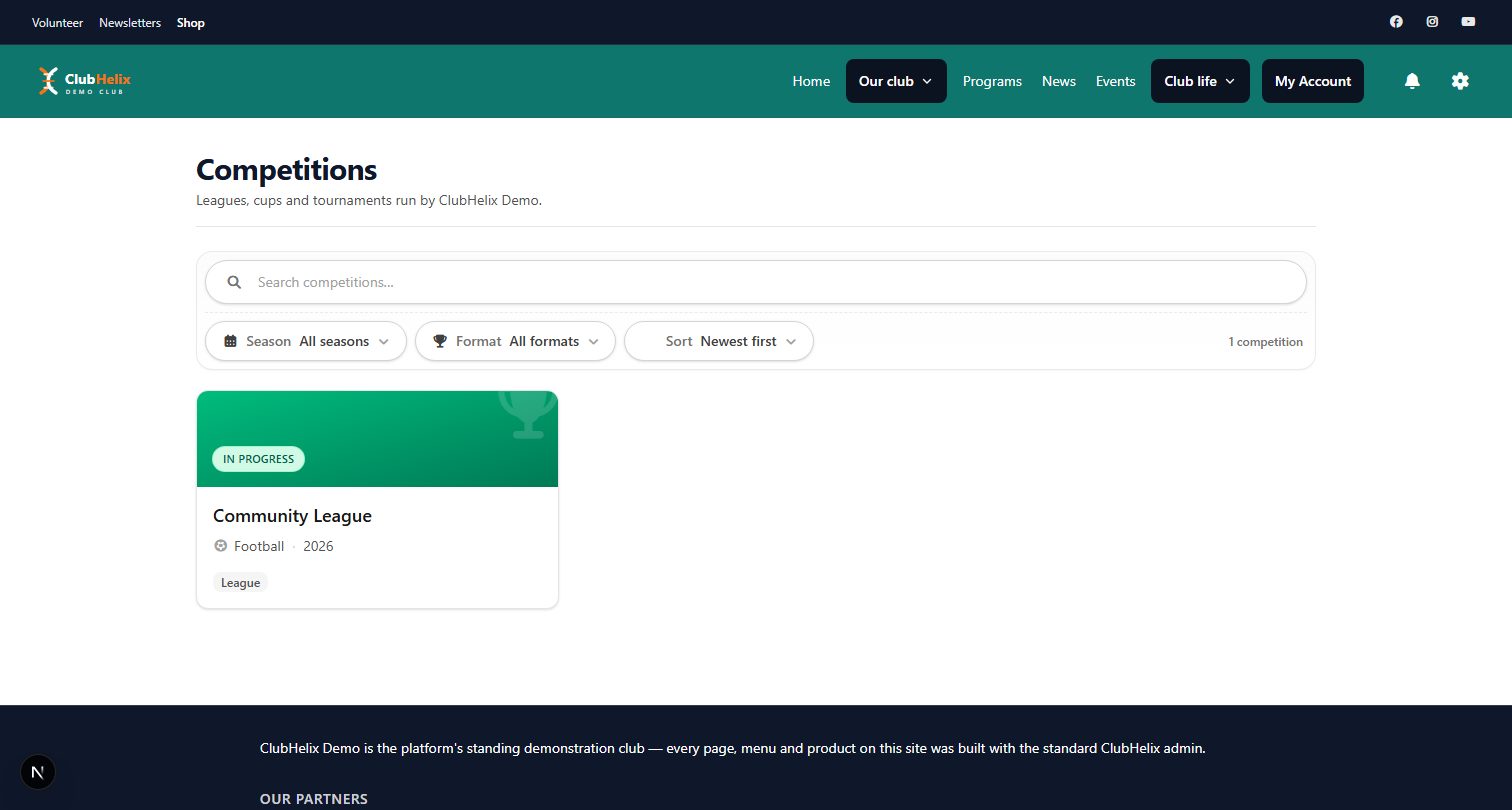
Publish fixtures where players actually look. A competitions and fixtures page on your club website — each team's draw, results and ladder in one place — kills the weekly "what time do we play?" messages. If you run an internal or social competition yourself, our guide on how to make a fixture draw covers round-robin structures.
Roster table duty like patrols, not like favours. Every home game needs a table: game clock, 30-second shot clock, scorer. Assign table duty to teams (the team playing before or after covers the table) or roster it across families per season, publish it in advance, and send reminders. The clubs that struggle are the ones where table duty is negotiated match by match — our guide on recruiting club volunteers explains why specific, bounded asks get volunteers that vague pleas never do.

Money, fundraising and the social engine
Water polo clubs are social clubs — post-game barbecues, presentation nights, the annual club trip to a country carnival. Lean into it: the canteen and barbecue at home game nights, a major raffle, and sponsorship from local businesses (pool-side signage at hosted rounds, logos on caps and towels) are the classic revenue lines. Sponsors stay when they're visible — put them on the club website and thank them publicly at finals.
Your water polo club website
Most water polo clubs are invisible online, which is a recruitment problem: a swimmer looking for a team sport, or a parent whose kid loved flippa ball at a school clinic, can't join a club they can't find. Your website needs to answer four questions fast — where do you train, what grades do you field, what does it cost, how do I join — and then serve current members with fixtures, ladders, duty rosters and news.
ClubHelix gives a water polo club all of that in one place: a proper club website on your own domain, online registration with payment, team management, fixtures and ladders, and duty rosters with reminders. See how it fits the sport in our water polo club management software — there's a free tier, and you can start free and have fixtures published the same evening.
Frequently asked questions
How much pool time does a water polo club need?
At minimum, one deep-water training slot per squad per week plus competition access; ambitious clubs run two sessions for senior squads. Pool hire is nearly always the largest line in the budget, so match squad sizes and team nominations to the water you can actually book.
What is flippa ball?
Flippa ball is the shallow-water introductory form of water polo for primary-school-aged kids — standing depth, simplified rules, smaller balls. It's the standard junior entry point and the most effective recruitment program a club can run.
Who runs the table at water polo games?
Home clubs typically supply table officials: a timekeeper for the game clock, a shot-clock operator and a scorer recording goals and exclusions. Roster the duty across teams or families for the whole season rather than asking for volunteers match by match.
How many players do you need for a water polo team?
Seven play at once (six field players plus a goalkeeper) with rolling substitutions, and squads of eleven to thirteen are comfortable for a full four-quarter game. Nominate teams only when you're confident of that depth week to week.


