
What this guide answers
- How long should games be at a short-format carnival?
Short enough that the schedule maths works, long enough to be a real game — typically 8–15 minutes total per game depending on the sport and age group, plus an honest 3–5 minute changeover in every slot.
- How many teams can we fit in a one-day carnival?
Work it backwards from field-hours: each field gives you about 60 ÷ slot-length games per hour, and a round robin pool of 4 needs 3 rounds.
- How many volunteers does a carnival need?
A 16-team, 4-field junior carnival typically needs 35–45 volunteer shifts: control desk, a marshal per field, first aid, gate, a canteen crew in short shifts, setup and pack-down crews, and officials.
- What's the best format for a junior carnival?
Pools of 4–5 playing short-format round robins, with short cross-over finals for the older grades and a stations/festival format for the youngest.
A sports carnival — gala day, lightning carnival, round-robin day, whatever your sport calls it — is the biggest single-day logistics exercise most clubs ever attempt.
Done well, it's the highlight of the season: hundreds of players, dozens of short games, a humming canteen, and a club that looks like it could organise the Olympics. Done badly, it's four courts running forty minutes late by 10am while eight-year-olds melt down and parents check their watches.
The difference is almost entirely decided before the day: the format you choose, the schedule maths you do (or don't do), and how clearly every volunteer knows their station. This guide walks through all three, plus the checklist that holds it together.
Step 1 — Define the day before you design it
Three decisions shape everything downstream:
- Who is it for? A junior gala day for your own age groups, an invitational carnival for neighbouring clubs, a school-linked come-and-try day, or a senior pre-season tournament? Everything — format, timing, catering, trophies — hangs off this.
- What does success look like? "Every kid plays at least four games and nobody waits more than 20 minutes" is a design brief. So is "hit a fundraising target for the club" or "introduce 50 new families to the club". Write it down; when trade-offs come, the brief decides.
- When and where? One venue with enough fields/courts beats split venues every time. Book the venue (and wet-weather backup or refund terms) before announcing anything, and check what your booking includes — line marking, goals, lights, canteen access, PA.
Step 2 — Choose your format
Round robin. Everyone plays everyone within their pool. Fair, predictable, maximum games per team — the default for a day that's about participation. For more than 5–6 teams per grade, split into pools of 4–5 with cross-over finals, or the maths stops fitting daylight.
Lightning carnival format. The classic Australian gala-day structure: very short games (one short half or two tiny halves, typically 8–15 minutes total), no breaks beyond changeover time, rolling on a siren across all fields simultaneously. A lightning carnival trades game length for game count — every team gets lots of starts, and one central siren keeps the entire venue synchronised. It's the right choice when you have many teams, young players, or limited hours.
Knockout / championship. Win-or-go-home brackets create a real champion and real drama, but half your teams are done after two games — poor value for travelling families. If you want a trophy and participation, run pools first and a short knockout among pool winners at day's end.
Festival / stations format. For the youngest age groups: teams rotate through skill stations and mini-games with no ladder at all. Pairs beautifully with a carnival for older grades running on adjacent fields.
Step 3 — The schedule maths
This is where carnivals are won and lost. The formula for the total time each round of games needs:
Slot length = game time + changeover time. Changeover (teams off, teams on, ball ready) realistically takes 3–5 minutes; pretending it takes zero is how days run late. A "10-minute game" is a 14-minute slot.
Number of rounds for a round robin of n teams in a pool: every team plays n−1 games; a pool of 5 needs 5 rounds (one team sits each round); a pool of 4 needs 3 rounds.
Now the master equation — check the whole day fits:
total minutes needed = rounds × slot length rounds you can host per field-hour = 60 ÷ slot length
Worked example. Junior football carnival: 16 teams in one age group, 4 pools of 4, playing on 4 fields. Pool stage: 3 rounds. With 12-minute games + 4-minute changeovers (16-minute slots), each round of 8 simultaneous games needs 2 slots per field... no — with 4 fields and 8 games per round, each round takes 2 × 16 = 32 minutes. Three rounds: 96 minutes. Add cross-over semis and a final (2 more slots, 32 minutes) plus a 20-minute lunch pause and 15 minutes of buffer, and the age group needs roughly 2 hours 45 minutes of field time. Run two age groups on a morning/afternoon split, or double the fields and run them in parallel.
Rules of thumb that keep schedules honest:
- Build in buffer — a 5–10 minute recovery gap every 4–5 rounds. If you're on time, it's an extended break; if you're behind, it's how you catch up without shortening the final.
- One central siren/hooter, one timekeeper. In a short-game format, all fields change on the same signal. The moment fields self-time, the venue desynchronises.
- Shorten games, never cut games. If weather or delays bite, the pre-announced contingency is "all remaining games drop to 8 minutes" — not "the under-10s lose their last game." Announce this policy in the pre-day pack so no one relitigates it at 1pm.
- Schedule sibling-friendly. Where families have kids across age groups, avoid scheduling those grades simultaneously at opposite ends of the venue if you can.
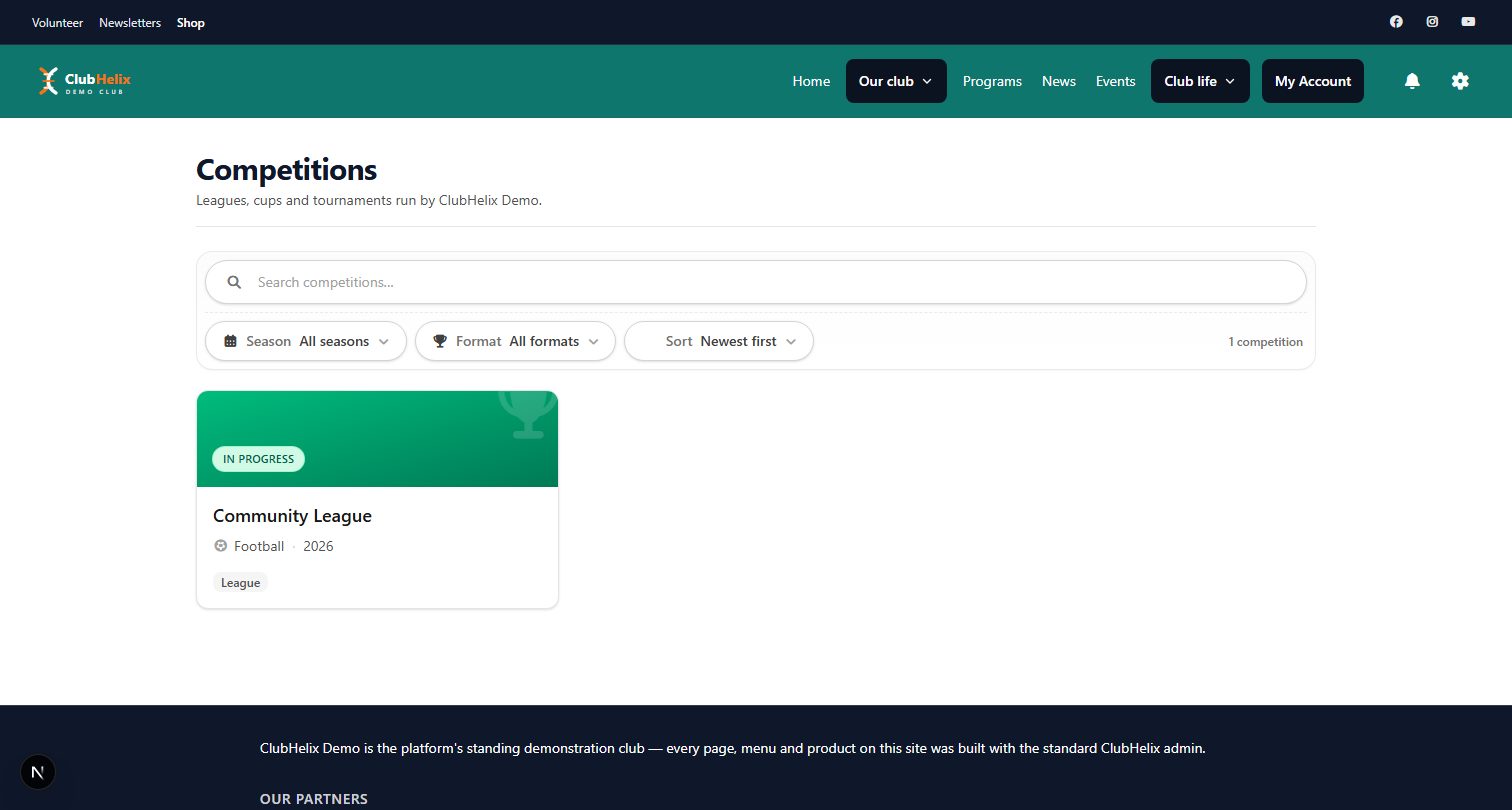
Publishing the draw is its own job — teams, pools, fields, times, and live-updated results if you're keeping a ladder. This is exactly what a competition management system exists for: build the draw once, publish it to your club website, and let results and ladders update live from the ground instead of via a whiteboard photo on a group chat.
Step 4 — Station planning
Think of the venue as a set of stations, each with an owner, a kit and a one-page brief. If every station runs itself, the coordinator's day is walking, watching and solving.
| Station | Crew | Kit and notes |
|---|---|---|
| Control desk | 2 + coordinator | Master schedule, PA/siren, results entry, lost property, lost kids procedure |
| Each field/court | 1 field marshal | Game balls, scoreboard/flip scores, rules one-pager, whistle, next-teams-up list |
| First aid | 1–2 qualified | Kit, ice, incident report forms, defibrillator location known to all marshals |
| Canteen/BBQ | 4–6 per shift | Your biggest revenue centre — quantities maths, short shifts, card reader |
| Gate/welcome | 2 | Program handout, venue map, entry/parking flow, wristbands if ticketed |
| Setup/pack-down | 6–8 | Field marking, goals, gazebos, signage, bins — most understaffed station at every carnival; roster it explicitly |
| Umpires/referees | Per format | Book association officials early, or brief senior players — pay in canteen vouchers at minimum |
| Media | 1–2 | Photos for the club site and socials; if you're streaming the finals, see our livestreaming guide |
For the barbecue, steal the operational playbook from our Bunnings sausage sizzle guide — the quantity maths, short shifts and card-reader advice transplant straight to a carnival barbecue.
Volunteer maths: a 16-team, 4-field junior carnival comfortably consumes 35–45 volunteer shifts across the day. Recruit by station and shift with specific asks, not a "helpers needed!" post — and if you run events like this more than once a year, a proper volunteer roster with self-service sign-up pays for itself immediately.
Step 5 — Money, entries and communication
- Entries. For invitational carnivals, open entries 6–8 weeks out with a per-team fee (modest for juniors, higher for seniors) collected at registration — online, not "bring cash on the day." Publishing the event with online payment on your club events page means the entry list, the money and the contact emails all exist in one place from day one.
- Revenue plan. Entry fees usually cover officials, trophies and venue. Profit lives in the canteen, the barbecue, the coffee cart (invite one — they'll pay a pitch fee or a cut) and a simple raffle. A well-run carnival canteen can out-earn a month of ordinary home games in a single day.
- The pre-day pack. Email every team a week out: schedule, pools, venue map with parking, rules variations, wet-weather policy and contingency rules, canteen menu, first-aid location. Half the questions at the control desk are answered by the pack nobody read — so also publish it as a page on the club site and QR-link it from the printed program.
- On-day comms. PA for announcements, a phone number for team managers, and one WhatsApp/SMS broadcast channel for schedule changes. Never rely on the PA alone; the far fields can't hear it.
On the money side, Australian clubs typically charge $50–$150 a team for junior carnival entries, and a well-run canteen and barbecue clears $1,500–$4,000 on a big day — treat the food operation as seriously as the draw.

The gala day checklist
8+ weeks out — lock date and venue (plus wet-weather plan); pick format; set entry fee and budget; open entries online; book officials and first aid; notify the ground owner and your association and check insurance cover for visiting teams.
4–6 weeks — chase entries with a deadline; draft the draw once numbers firm up; order trophies/medals and any equipment; recruit station owners (one named person per station); book the coffee cart; start the volunteer roster.
2 weeks — close entries; publish the final draw and pre-day pack; confirm officials, first aid, canteen order quantities; print programs, station briefs, results sheets, signage.
Final week — walk the venue with station owners; test PA and siren; charge everything; float and card readers ready; brief marshals (one meeting or a short video); pre-day pack re-sent with "read this" subject line.
On the day — stations set 90 minutes before first game; marshals briefed 45 minutes out; welcome announcement 10 minutes before round 1; run the siren, protect the buffer, keep results flowing to the control desk; presentations within 20 minutes of the last final (never let the crowd drain first); thank-yous from the PA — volunteers, officials, sponsors, visiting clubs.
After — results and photos on the club news page within 48 hours; thank-you email to every team and volunteer; finance reconciliation; 30-minute debrief with station owners, written up and filed for next year's organiser. The debrief file is the difference between organising this carnival every year and re-inventing it every year.
Frequently asked questions
How long should games be at a short-format carnival?
Short enough that the schedule maths works, long enough to be a real game — typically 8–15 minutes total per game depending on the sport and age group, plus an honest 3–5 minute changeover in every slot. Run all fields off one central siren so the venue stays synchronised, and pre-announce that games shorten (rather than get cut) if the day falls behind.
How many teams can we fit in a one-day carnival?
Work it backwards from field-hours: each field gives you about 60 ÷ slot-length games per hour, and a round robin pool of 4 needs 3 rounds. As a guide, 4 fields × 6 hours with 16-minute slots yields ~90 game-slots — comfortably a 16-team pool stage plus finals in one age group, or two age groups on shorter games. If the maths doesn't fit, cut pool sizes before you cut changeover time; changeovers don't compress.
How many volunteers does a carnival need?
A 16-team, 4-field junior carnival typically needs 35–45 volunteer shifts: control desk, a marshal per field, first aid, gate, a canteen crew in short shifts, setup and pack-down crews, and officials. Recruit by named station and specific shift times rather than general calls for help, and give every station owner a one-page brief so the coordinator isn't the venue's only brain.
What's the best format for a junior carnival?
Pools of 4–5 playing short-format round robins, with short cross-over finals for the older grades and a stations/festival format for the youngest. That guarantees every team a fistful of games (the thing families drove for), keeps one siren in charge of the clock, and still delivers a trophy moment at the end of the day.
Run the whole carnival from one place: ClubHelix competitions handles the draw, results and live ladders, and the events page takes team entries and payments online. Streaming the finals? Read our guide to livestreaming local sport.


