
What this guide answers
- How much money does a Bunnings sausage sizzle raise?
Most clubs report somewhere between $1,000 and $3,000 profit for a weekend day at a reasonably busy store, driven mainly by foot traffic, weather and whether ingredients were donated or bought at retail.
- How many sausages do we need for a sausage sizzle?
Ask your store contact what comparable groups sold — that's your best estimate.
- Do we need a permit or food licence for a sausage sizzle?
It depends on your state and council. Many councils require a temporary food stall notification even for one-off charity barbecues, and some states have streamlined registration for low-risk community fundraisers.
- How long should sausage sizzle volunteer shifts be?
Two to three hours. ".
The Bunnings sausage sizzle is Australia's most democratic fundraiser: a gazebo, a hotplate, a queue of hungry hardware shoppers, and a club bank account that's $1,500–$3,000 healthier by dinnertime. It's also deceptively easy to do badly — clubs run out of bread at 11am, discover at 7am that nobody bought ice, or burn out three volunteers doing nine-hour shifts because nobody made a roster.
This guide is the full playbook: getting the booking, the quantities maths, the equipment checklist, a roster template that keeps everyone fresh, food-safety pointers with links to the official rules, and the small selling tricks that add hundreds of dollars to the day.
Getting a booking
Bunnings runs its community sausage sizzle program through the local store. The process:
- Apply through your local store — most stores take applications via the Bunnings website's community involvement page or at the service desk. You'll need your club's details, incorporation status and public liability insurance certificate (stores require it, and your club should have it anyway).
- Apply early and be flexible. Weekend slots at busy stores are booked out months ahead — many clubs apply six to twelve months in advance. Take a weekday or a quieter store for your first go; the practice run is worth it.
- Confirm the store's rules when offered a date. Stores provide the gazebo spot and typically specify the setup (what you sell, pricing conventions, where the barbecue goes). Prices are set so every community group charges the same — you're not competing on price, only on cheerfulness.
- Ask what's supplied. Most stores provide the marquee/site and some equipment expectations; the club brings the barbecue (or hires one), gas, food and people. Get the specifics in writing from your store contact.
Can't get a Bunnings slot? The same playbook works at markets, election-day polling booths (book through the venue, not the electoral commission), swap meets and your own home games.
The quantities maths
The eternal question: how many sausages? The honest answer is "it depends on the store's foot traffic" — so ask your store contact what similar groups sold. As a planning baseline, clubs at a reasonably busy store on a weekend day commonly sell 700–1,000+ sausages; quieter stores or weekdays might be 300–500.
Work everything back from your sausage estimate. For 800 sausages:
| Item | Ratio | Quantity for 800 sales |
|---|---|---|
| Sausages | 1 per sale (thin BBQ sausages) | 800 (about 55–60 kg) — buy in bulk from a wholesaler or butcher |
| Bread | 1 slice per sale + wastage | ~40 loaves (22 slices/loaf usable) — sliced white, always |
| Onions | 1 kg per 25–30 sales | 28–32 kg pre-sliced (slicing on the day will break you) |
| Cooking oil | For onions + hotplate | 4–6 litres |
| Sauce | Tomato ~2/3 of sales, BBQ ~1/3 | 8–10 squeeze bottles of each (or bulk with refills) |
| Napkins/serviettes | 1 per sale | 900+ |
| Drinks (if the store permits) | ~1 per 2–3 sales | 250–350 cans, plus ice — 2 bags per esky, rebuy at lunch |
| Gas | Don't guess | 2 × 9 kg bottles (one running, one backup) |
Three rules save the day:
- Under-buying costs more than over-buying. Unopened bread freezes, sauce keeps, unopened sausages go to the club canteen. Running out at 12:30pm on a day with 400 more customers is unrecoverable revenue.
- Arrange a top-up runner. One volunteer with a car and a phone is your supply chain: more bread and ice at 11am has rescued a thousand sizzles.
- Track your actuals. Write down what you bought, sold and threw away. Your second sizzle's shopping list should be your first sizzle's data. (This is a good page for the club's records, not someone's glovebox.)

The margin picture: with donated or wholesale ingredients, cost per sausage-in-bread lands around 60–90 cents against a sale price of a few dollars. Ask your local butcher or supermarket about sponsorship or at-cost supply — "proudly supplied by" on a laminated sign is cheap advertising for them and can add hundreds to your margin.
Equipment and setup checklist
- Barbecue with clean hotplate (plus spatulas, tongs ×3, scraper)
- 2 × gas bottles (checked full the day before)
- Tables (2 minimum: cooking + serving), tablecloths
- Eskies with ice for raw sausages and drinks (separate eskies — raw meat gets its own)
- Cash float ($150–$200 in coins and small notes) in a lockable tin, and a card reader — a big share of shoppers carry no cash, and clubs report card acceptance lifting takings noticeably
- Hand-washing setup: water container with tap, soap, paper towel (this is a food-safety requirement, not a nicety)
- Disposable gloves (several boxes), aprons, hats
- Cleaning kit: sanitiser spray, cloths, rubbish bags, bin
- Sunscreen, first-aid kit (burns cream!), fire extinguisher/blanket if required
- Signage: prices, club name and what the funds are for — "Supporting our under-12s to attend the state carnival" sells more sausages than silence
- Thermometer for the esky if your council/state guidance requires temperature records
The roster template
The classic sizzle mistake is three heroes doing 6am–4pm. Ten hours on a hotplate is how you lose volunteers for the season — a real problem when volunteers are your scarcest resource. The fix is short shifts with clear roles.
Roles per shift (5 people is comfortable, 4 is workable):
- Cook — sausages and onions, hotplate management
- Bread + assembly — sausage into bread, hands the sauce decision to the customer
- Cash + card — money only; never touches food (food-safety rule and till-balancing rule)
- Floater/runner — restocks, relieves toilet breaks, ice runs, queue-wrangling at rush
- Shift lead — one designated decision-maker per shift for stock calls and problems
The roster (for a 7am–4pm day):
| Shift | Time | Cook | Assembly | Cash | Floater | Lead |
|---|---|---|---|---|---|---|
| Setup | 6:45–8:00 | — | — | — | 2–3 people: gazebo, tables, gas, first cook-up | Shift 1 lead |
| Shift 1 | 8:00–10:30 | ___ | ___ | ___ | ___ | ___ |
| Shift 2 | 10:30–1:00 (the rush — roster your strongest crew) | ___ | ___ | ___ | ___ | ___ |
| Shift 3 | 1:00–3:30 | ___ | ___ | ___ | ___ | ___ |
| Pack-down | 3:30–4:30 | — | — | — | 2–3 people: clean hotplate, count cash (two people), return gear | Shift 3 lead |
That's roughly 18–20 volunteer slots of 2.5 hours each — far easier to fill than six marathon shifts, and everyone finishes the day still liking the club. Recruit with specific asks ("Can you do cash from 8 to 10:30?") rather than "who can help Saturday?", and always roster one or two reserves.
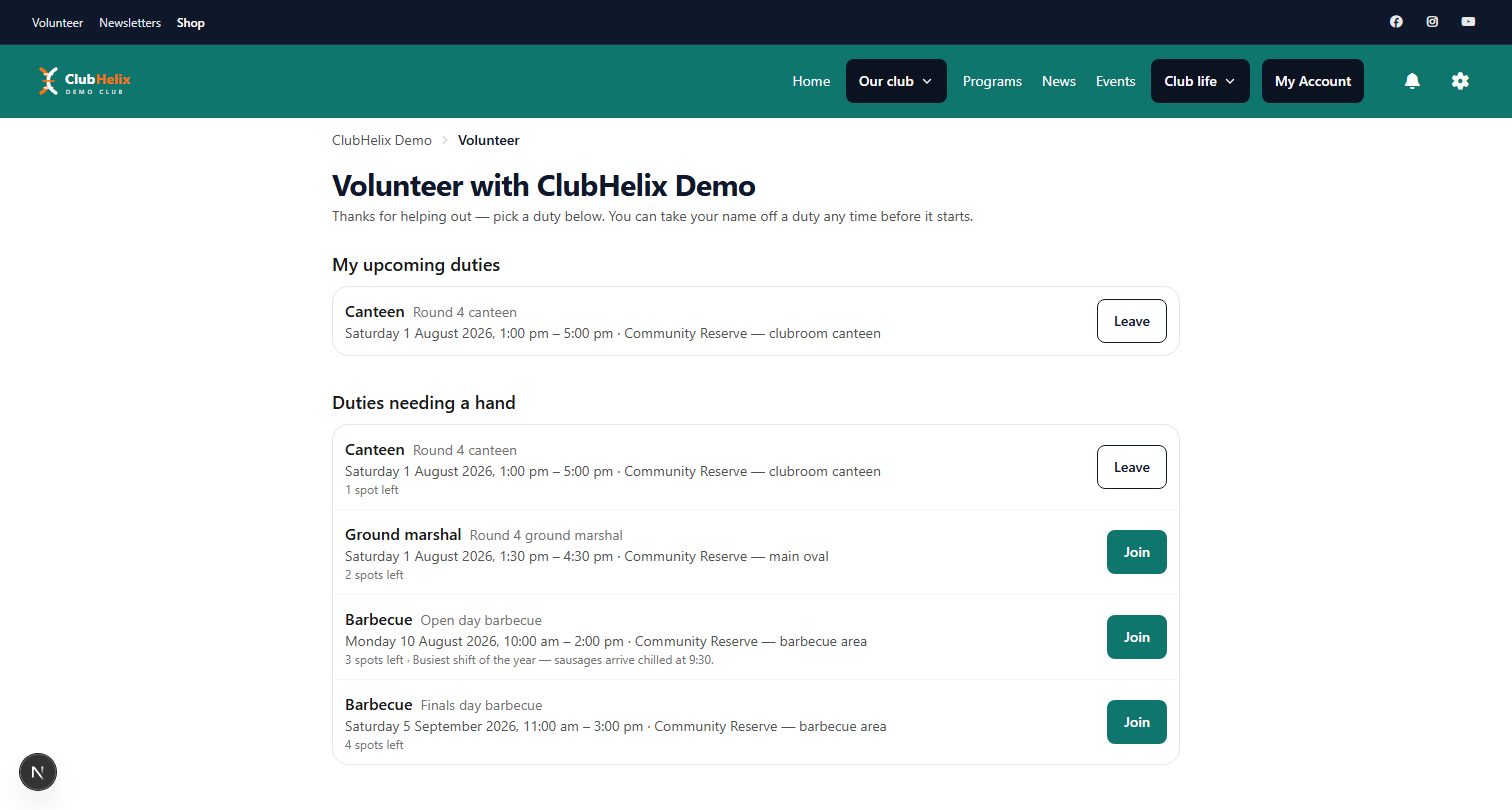
Filling and chasing those 20 slots over a group chat is its own part-time job, which is why clubs that run regular sizzles put the shifts into a proper volunteer rostering system — members see the open slots and claim them, reminders go out automatically, and the club gets a season-long record of who actually showed up (gold for your volunteer awards, and for knowing who to ask first next time).
Food safety: the pointers that matter
Community barbecues are covered by real food-safety rules, and some councils require a temporary food stall notification or permit even for a one-off charity sizzle — check your council's website and your state food authority's guidance before the day:
- Food Standards Australia New Zealand publishes charity/community event guidance: foodstandards.gov.au
- State authorities publish the specific local rules — e.g. the NSW Food Authority, Food Safety Victoria (community group requirements including the state's streamlined registration for low-risk fundraisers), Queensland Health food safety, and SA Health food safety
The practical essentials on the day:
- Keep raw and cooked apart — separate tongs, separate eskies, raw sausages below 5°C until they hit the plate
- Cook thoroughly — sausages cooked through (no pink), onions properly cooked, and hold hot food above 60°C; when in doubt, cook to order rather than stockpiling
- Hands — gloves for food handlers, changed regularly and after any non-food task; hand-washing station actually used
- Money never touches food — the cash role is a separate person, always
- One trained eye — having at least one volunteer with a basic food-handling certificate (cheap online courses exist, some states offer free ones) is somewhere between wise and required depending on your state; it's also a great thing for the club to fund as volunteer development
Squeezing the most from the day
- Signage with a story raises more: name the goal, show the team photo.
- Take card payments. Worth repeating. A simple reader on a stand pays for itself before morning tea.
- Upsell gently: "drink with that?" adds a meaningful margin at almost no effort.
- Photograph the day for your club website and socials — it's community-mindedness made visible, and next year's volunteer recruitment ad.
- Bank the story, not just the cash. "$2,340 raised toward new junior goals" on your news page closes the loop for everyone who helped — and a documented history of successful fundraising is exactly the co-contribution evidence that strengthens a grant application.
- Debrief for ten minutes. What sold, what ran out, what you'd change: written down while it's fresh, filed where the next organiser will find it.
Frequently asked questions
How much money does a Bunnings sausage sizzle raise?
Most clubs report somewhere between $1,000 and $3,000 profit for a weekend day at a reasonably busy store, driven mainly by foot traffic, weather and whether ingredients were donated or bought at retail. Weekdays and quieter stores raise less but are easier to book and staff. Track your own numbers — your second sizzle should be planned from your first sizzle's data, not internet averages.
How many sausages do we need for a sausage sizzle?
Ask your store contact what comparable groups sold — that's your best estimate. As a baseline, plan around 700–1,000 sausages for a busy weekend store and 300–500 for quieter days, then scale bread (1 loaf per ~22 sales), onions (1 kg per 25–30 sales) and sauce to match. Over-buy slightly: unopened surplus keeps or freezes, but running out mid-rush is revenue gone forever.
Do we need a permit or food licence for a sausage sizzle?
It depends on your state and council. Many councils require a temporary food stall notification even for one-off charity barbecues, and some states have streamlined registration for low-risk community fundraisers. Check your local council's website and your state food authority (linked above) a few weeks before the day — the store booking does not cover your food-safety obligations.
How long should sausage sizzle volunteer shifts be?
Two to three hours. Short shifts with defined roles (cook, assembly, cash, floater, lead) keep everyone fresh, keep food-handling and money-handling separated, and make recruiting far easier — "can you do 8 to 10:30?" gets more yeses than "can you help all day?". Roster your strongest crew for the 10:30am–1pm rush and always have a reserve or two on standby.
Stop running rosters through a group chat: ClubHelix volunteer rostering lets members claim shifts themselves and keeps the record for you. Then put the proceeds to work — see our guides to trivia night fundraisers and writing grant applications.


