
What this guide answers
- Who is actually in charge of a scout group?
Two people, on purpose. The group leader is responsible for the program, the leader team and the young people's experience; the group committee chair is responsible for the money, the assets and the group's obligations…
- How do groups keep track of leader screening and qualifications?
With one register the group owns, not a folder on a leader's phone.
- What paperwork does a scout camp need?
Usually four things that must line up before departure — the activity approval from your association for anything above a set grade, notification of the event so insurance arrangements apply, parent consent with the…
- How much should a group charge in subs?
Enough to cover the capitation or registration that leaves immediately, the program, and a genuine contribution to replacing what you own.
- Does a scout group need its own website?
Yes, and mostly for the parents you already have rather than the ones you want.
New Zealand edition. This guide is written for volunteer-run clubs in New Zealand. Where rules differ — grants, tax, incorporation, safeguarding — follow the New Zealand-specific pointers below or check with your national body.
A scout group is really two organisations sharing one name and one hall. On a weeknight, the leader team runs the program — games, badge work, a knot nobody can tie, twenty-two youth members and the one who has to be walked to the toilet block. On a monthly evening in the same hall, a group committee of mostly-parents runs the other organisation: the bank account, the lease, the trailer registration, the fundraising calendar and the fact that the roof has been leaking over the quartermaster's store since autumn.
Groups get into trouble when those two organisations blur. Leaders end up chasing unpaid subs instead of planning next term. The committee starts making program decisions it has no line of sight into. And the compliance load — which per member is heavier than almost any sports club carries — lands on whoever answered the last email. Every adult is screened and the screening expires. Every night away needs permission. Every activity beyond a certain grade needs a qualified adult present. None of that is optional, and none of it survives living in one person's head.
This guide is for group leaders, section leaders and group committee members who want the whole thing to run without heroics. It covers the two-team structure, the age sections and the leak at every transition, leader recruitment and the records that expire, camps and adventurous activities, and the money behind subs, hall hire and the capital repair you have not budgeted for yet. If you run a broader community youth club rather than a chartered scout group, read how to run a youth group instead — it covers the same safety fundamentals without the sections, badge scheme and district structure that shape everything below.
General information only. Screening, activity approvals and record-keeping obligations are set by your association and by law where you operate, and they change. Treat everything here as a way to organise the work, then confirm the specifics with your district or region office and the relevant authority.
The two teams, and who owns what
Write this down once and you will save yourself a year of "I thought you were doing that". The split that works is simple — leaders own the program and the young people, the committee owns the money, the assets and the obligations of the group as an organisation.
| Role | Sits with | Owns | Rhythm |
|---|---|---|---|
| Group leader | Leader team | Overall program quality, leader recruitment and support, the link to district | Weekly |
| Section leaders | Leader team | Term program, youth records, badge progress, camp planning, section comms | Weekly |
| Assistant and helper leaders | Leader team | Running activities, ratios on the night, driving to activities | Weekly |
| Group chair | Committee | Meetings, the relationship between committee and leaders, external liaison | Monthly |
| Group treasurer | Committee | Subs, capitation payments, budget, grant acquittals, the sinking fund | Monthly + season |
| Group secretary | Committee | Minutes, insurance renewals, lease correspondence, the document register | Monthly |
| Quartermaster | Either | Tents, stoves, trailer, the store and its condition register | Seasonal |
| Property or hall coordinator | Committee | Building maintenance, hall hire, working bees, capital projects | Seasonal |
| Fundraising coordinator | Committee | The annual fundraising calendar and the volunteer roster behind it | Seasonal |
Two practical rules keep the line clean. First, no leader should ever have to ask a parent for money — subs chasing belongs to the treasurer and, better still, to an automated reminder rather than a person. Second, the committee sees the shape of the program (how many youth members, how many nights away, what the term needs to buy) but does not design it.
If your group has never written these down, do that before you next recruit. Our volunteer position descriptions template gives you a structure — a half-page per role covering purpose, tasks, time per month and who to ask for help. The single biggest reason nobody volunteers is that the job looks infinite because nobody has ever drawn its edges.
Sections, ages and the leak at every transition
Almost every association runs four to six age sections, each with its own night, its own leader team and its own badge scheme. The structure works beautifully. Its weak point is entirely predictable and entirely fixable — the handover between sections.
Sections are commonly Keas, Cubs, Scouts, Venturers and Rovers, with Keas starting around five and Venturers running through the late teens. Groups sit under a zone or region structure that provides leader training, activity approvals and the safety framework your group operates under. Confirm current age ranges with your zone office rather than assuming — they have shifted more than once in recent years.
Whatever the names, every group loses members at the join between two sections. The child has a leader they love, a friend group and a night that suits the family — and you are asking them to change all three at once, usually during a school holiday when nothing is happening. Plan the transition like a program item rather than a birthday.
| Transition risk | What it looks like | The fix |
|---|---|---|
| Night of the week changes | Clashes with the family's other commitment | Publish the whole group's night schedule at enrolment so families plan once |
| New leader is a stranger | Child refuses to go back after week two | Two visit nights in the term before, with the receiving leader named |
| Skills gap feels enormous | The youngest in the new section, and it shows | A buddy from the older cohort, assigned by name, for the first month |
| Paperwork restarts | Family asked for medical details they already gave you | One record per young person that follows them up through the sections |
| Nobody notices they stopped | Quiet drop-out over the holidays, never followed up | An attendance view per section and a call after two missed nights |
That last row is worth the effort on its own. Keeping attendance and RSVPs per night takes a leader about fifteen seconds and turns "I think we have lost a few" into a list of names somebody can actually ring.
Recruiting leaders, and the records that expire
Adult recruitment is the constraint on everything else. Sections close because there is nobody to run them, not because there are no children. The good news is that your best candidates are already in the car park.
The approach that works is small, specific and time-boxed. Do not ask a parent to "become a leader" — ask them to run one activity next term, drive to one activity, or hold the quartermaster role which happens four times a year. The people who say yes to something small are where next year's section leader comes from. Our guide on how to recruit club volunteers has the full playbook, and it applies almost unchanged here.
The part that is genuinely different from a sports club is what happens after they say yes. Adults in a scout group carry a stack of records, most of them with an expiry date, and the group — not the individual — is the one that gets asked to produce them.
| Record | Why the group holds it | The renewal trap |
|---|---|---|
| Screening or background clearance | You cannot roster an unscreened adult with young people | Multi-year validity means everyone forgets until the week it lapses |
| Safeguarding or youth protection training | Required before an adult takes a role, often refreshed periodically | Refresh cycles are shorter than screening, so they lapse first |
| First aid qualification | Camps and activities usually require a current holder present | Expires on a fixed date and takes weeks to rebook at short notice |
| Activity or leadership qualification | Certain activities can only run with a qualified adult present | Held by one person, so their holiday cancels the activity |
| Driver licence and vehicle cover | Adults transporting youth members in private vehicles | Nobody records it at all until an incident makes it matter |
| Warrant, appointment or registration | Your association's own record that this adult holds this role | Lapses quietly when someone changes sections |
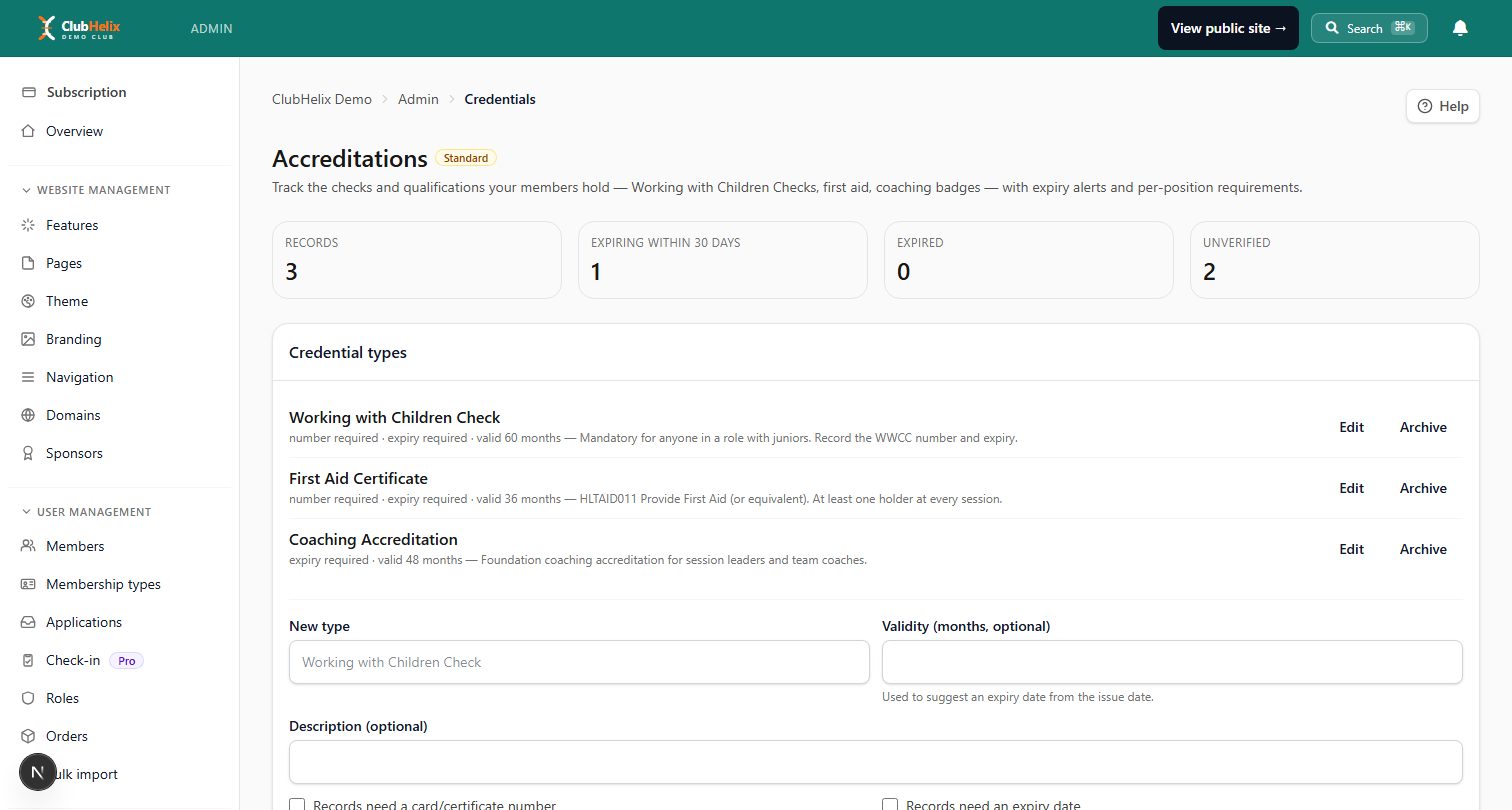
The failure mode is never "we did not know we needed it". It is "the certificate was on someone's phone and they left the group". Keep the evidence and the expiry dates in one place the group owns, with reminders that fire well before the date — ClubHelix tracks accreditations and their expiries per person so the group leader can see, in one screen, who is clear to run Thursday and who is three weeks from lapsing.

Adults working with young people go through a safety check that typically includes police vetting, identity confirmation and referee checks, with a periodic re-check thereafter. Your zone or national office will specify the exact process and how often it repeats, and will usually run the vetting request itself rather than leaving it to the group.
Camps, hikes and adventurous activities
Camp is why young people stay. It is also where the compliance stack is deepest, so build a repeatable process once rather than reinventing it every term.
The permission stack
Four separate permissions usually have to line up, and they have different lead times. Work backwards from the departure date.
- Activity approval — your association grades activities, and anything above a certain grade needs a qualified adult, a specific approval, or both. Start this first; it is the one that can stop the camp.
- Notification of the event — most associations want the camp registered with the district or region before it happens, which is also what triggers your insurance arrangements.
- Parent consent and the activity information — where, when, cost, kit list, transport, who is in charge and how to reach them.
- Health information — medications, allergies, conditions, dietary needs and the consent to seek treatment, collected fresh for this camp rather than pulled from a form filled in three years ago.
Collect three and four with an online form so the information arrives typed, complete and in one list rather than as twenty-two scraps of paper. ClubHelix forms and surveys handle the activity details and health questions, and digital waivers capture the consent itself with a record of who agreed and when — which is exactly what you will be asked for if anything goes wrong.
Ratios and the second adult
Ratios are set by your association and vary by section and activity, so get the number from them rather than from another group's habit. What is universal is the principle beneath it — no adult is ever alone with a young person, and no activity runs on the assumption that the one qualified adult will definitely turn up. Build every camp roster with a named reserve for each critical role, and put the roster where everyone can see it. Volunteer rostering with confirmations beats a group chat where six people say "maybe".
A risk assessment that fits on one page
Long risk assessments do not get read, which makes them worse than short ones. The version that works fits on a page and names a person against every control.
| Hazard | Who is at risk | Controls | Checked by |
|---|---|---|---|
| Camp fire and stoves | All, especially youngest | Designated fire area, water buckets sited, stove use supervised, no fuel in tents | Duty leader |
| Water activity | Participants | Qualified supervisor, headcount in and out, buoyancy aids, defined boundary | Activity leader |
| Bushland or trail walk | Walking party | Route card lodged, two adults per group, first aid kit, agreed turnaround time | Walk leader |
| Food handling | All | Cold chain maintained, allergy list on the kitchen wall, separate preparation for allergen meals | Camp cook |
| Night activity | All | Boundaries marked and walked in daylight, torch per person, headcount at end | Duty leader |
| Severe weather | All | Forecast checked at set times, hard-building fallback identified, cancellation call made by a named person | Camp leader |
Keep the completed assessments. A camp that ran safely last year with a signed page beats a memory of a conversation, and it halves the planning next time.
A weekend camp run sheet
A worked example — adjust the times to your section, but note how much of it is logistics rather than program.
| When | What |
|---|---|
| Six weeks out | Activity approval lodged, site booked, camp leader and duty roster named |
| Four weeks out | Camp details and consent form published to parents, kit list attached |
| Two weeks out | Consents closed, numbers confirmed, catering ordered against the allergy list |
| One week out | Trailer packed and checked, gas bottles filled, first aid kit restocked |
| Friday 1800 | Arrival, headcount, medication handover to the nominated adult |
| Friday 1930 | Tents up, site rules and boundaries walked with every participant |
| Saturday 0730 | Duty patrol on breakfast, weather check, program confirmed |
| Saturday all day | Main activity, with headcounts on departure and return |
| Sunday 1000 | Strike camp, site inspection against the condition you arrived in |
| Sunday 1400 | Departure, headcount, medications returned with a signature |
| The week after | Incident notes filed, gear faults logged, thank-you to the adults who came |
That final row is the one groups skip. Ten minutes of notes while it is fresh is what keeps the gear register honest and stops the same tent going back in the trailer with the same broken pole four camps running.
The hall, the trailer and the quartermaster's store
Most groups hold assets that would make a small sports club nervous — a building, a trailer, tents, stoves, pioneering timber, canoes. They are also the only assets nobody has time to think about until they fail.
Run a written asset register with three columns that matter more than the accountant's version — condition, expected remaining life, and who checks it. Once a year, walk the store with the quartermaster and update it. That single habit is what converts "the roof leaks" into a costed capital item with a date on it, and it is what a grant assessor wants to see when you ask for money.
Hall hire is the income line most groups underuse. A hall sitting empty six days a week can carry its own insurance and rates through weekday playgroups, weekend parties, community classes and other local groups without a scouting connection. The trick is making it bookable without a volunteer fielding calls — published availability, a clear hire fee, conditions of hire, a bond and an online booking. Our guide on how to hire out your clubrooms covers the agreement and the pitfalls, and ClubHelix facility booking puts the calendar on the group's own website so the hall books itself.
Money — subs in, capitation out, and the repair fund
The money shape of a scout group is unlike a sports club's. Subs come in from families, a defined portion leaves immediately as capitation or registration to the district, region or national body, and the group keeps the remainder to run the program and hold the building. That means the number families see is not the number the group spends, and treasurers who forget this run a phantom surplus for a year and a real deficit in the second.
A worked example with illustrative proportions. Take a group of sixty youth members across four sections:
- Subs collected across the year make up roughly 55% of total income
- Hall hire contributes around 25%
- Fundraising and grants make up the remaining 20%
- Of the subs collected, capitation and registration take about a third straight off the top
- Program consumables, badges and camp subsidies take another quarter
- Insurance, utilities, rates and routine maintenance take most of what is left
- The sinking fund — the bit that survives to fix the roof — is whatever discipline you impose before the rest gets spent
Set the sinking-fund contribution first, as a fixed monthly transfer to a separate account, and treat it as a cost rather than a surplus. Groups that do this replace a roof; groups that do not run a raffle in a panic.
Three more habits worth adopting. Offer a quiet, dignified fee-relief pathway decided by two people rather than discussed at a full committee meeting — every group has families for whom subs are the reason a child stops. Charge camps close to cost rather than well under it, and use the relief pathway for the families who need it, rather than under-pricing for everyone and eroding the program budget. And review subs annually against actual costs, even when the answer is no change; groups that skip the review for five years end up making one enormous, unpopular increase instead of five invisible ones.
As a rough guide, annual subs at a community group commonly land somewhere between $150 and $400 per youth member depending on what the group covers, with camps charged separately at $40 to $90 per night. Uniform and badges usually sit outside subs. Check what your branch or zone charges as capitation before you set anything, because that portion is not yours to spend.
Parents, communication and the leader who became a help desk
The quickest way to burn out a section leader is to make them the single point of contact for everything a parent might want to know. The fix is publishing rather than answering — most parent questions are the same eight questions, and a group website answers them at 9pm without anybody's phone buzzing.
Publish the term program with dates and what to bring, the group's night schedule for every section, the kit list, the subs and how to pay them, the camp calendar for the year, who the leaders are, and how to raise a concern. Then use messages for the things that genuinely change — a wet-weather call, a venue change, a late bus. Short and rare beats long and constant. A group newsletter once a term, email broadcasts for the whole group, and a section-level chat for the night-to-night detail is a rhythm that holds up.
One caution specific to youth work: whatever channel you use, adult-to-youth communication should be visible to other adults and parents rather than private. That is a safeguarding principle every association shares, and it is far easier to honour with group and section channels than with a leader's personal phone number.
Running the group from one place
Almost everything above is a record with a date on it — a screening that expires, a consent for a camp, an attendance roll, a hall booking, a term's subs, an incident note. Scattered across phones, inboxes and a spreadsheet on the treasurer's laptop, those records are exactly what fails when the person holding them steps back. ClubHelix keeps them together on the group's own site — accreditations with expiry reminders, digital waivers and consents attached to the activity, volunteer rostering for camp duty, and online subs so no leader ever has to ask a parent for money.
The base tier is free, it is built and hosted by a small team rather than assembled from four separate subscriptions, and pricing is published rather than quoted. If your group's records currently live in six places, create your group's site and move one thing across — the adult records are usually the one that repays the afternoon fastest.
Frequently asked questions
Who is actually in charge of a scout group?
Two people, on purpose. The group leader is responsible for the program, the leader team and the young people's experience; the group committee chair is responsible for the money, the assets and the group's obligations as an organisation. Both answer upward to the district or council structure the group is chartered through. Groups run best when both roles are filled and the boundary between them is written down.
How do groups keep track of leader screening and qualifications?
With one register the group owns, not a folder on a leader's phone. Record the check or qualification, the date it was issued, the date it expires, and who sighted the evidence — then set reminders that fire weeks ahead rather than on the day. The common failure is not ignorance of the requirement; it is a certificate leaving the group when the person holding it does.
What paperwork does a scout camp need?
Usually four things that must line up before departure — the activity approval from your association for anything above a set grade, notification of the event so insurance arrangements apply, parent consent with the activity details, and current health and medication information. Start the activity approval first, because it has the longest lead time and it is the one that can stop the camp.
How much should a group charge in subs?
Enough to cover the capitation or registration that leaves immediately, the program, and a genuine contribution to replacing what you own. Review it annually even when the answer is no change, and pair it with a discreet fee-relief pathway rather than under-pricing for everyone. Groups that avoid small annual reviews eventually have to make one large, unpopular increase.
Does a scout group need its own website?
Yes, and mostly for the parents you already have rather than the ones you want. A site that publishes the term program, the night schedule, kit lists, camp dates and how to pay subs removes the majority of the questions that currently land on a section leader's phone, and it gives new families a way to enrol without anyone being on duty.
Keep reading — how to recruit club volunteers for the adult pipeline, and how to hire out your clubrooms for turning the hall into an income line.
