
What this guide answers
- What does a school parents association actually do?
Three things — it raises money for named projects the school budget will not cover, it builds community between families, and it gives parents a collective voice on matters that affect families across the school.
- How do we get more parents involved?
Ask specific people to do specific, time-boxed things, and catch families at orientation rather than mid-year.
- Who controls the money a parent association raises?
The association does, in its own account under its own name, spent according to its rules and its members' decisions — but usually on projects agreed with the school, since the school owns the grounds and equipment the…
- How often should a parents association meet?
Monthly during the school year is the common rhythm, with a shorter agenda than most committees run.
- Does a parents association need its own website?
It needs its own home for tickets, forms, rosters and money, and its own contact list — because relying on school channels for everything means the association has no way to reach families directly and no records that…
Most committees are made of people who chose the thing. Sports club committees are full of players; a choir's committee sings. A school parent body is different — its members joined a school, not an association, and the association happens to be attached. That single fact explains almost everything about how these groups behave, why they are hard to recruit for, and why the good ones look so different from the struggling ones.
It also explains the strangest structural feature of the job. Your entire membership is on a clock. A family arrives, spends six or seven years at the school, and leaves permanently — taking the knowledge of how the disco runs, where the urn is kept, and the password to the account nobody else has logged into. No sports club faces a total roll-over every few years as a design feature rather than a crisis. Handled badly, the association reinvents itself from scratch every three years and gets steadily worse. Handled well, it becomes one of the most useful things at the school.
This guide is for anyone on a parent association committee — chair, treasurer, secretary, or the person who said yes to "just helping with the fete". It covers what the association is actually for, how to work with the school without either side stepping on the other, building a fundraising calendar that does not exhaust the same eleven people, recruiting at the school gate, and the handover discipline that makes the six-year clock survivable.
General information only. Parent bodies sit inside education systems whose rules on constitution, money handling, insurance, volunteer screening and what the association may fundraise for differ by jurisdiction and often by individual school. Use this as a way to organise the work, then check the specifics with your school's leadership and the relevant education authority.
Three jobs, and the ones that are not yours
A parent association that tries to be everything becomes a complaints channel with a raffle attached. The healthy version does exactly three things.
- Raise money for things the school budget will not stretch to — and, crucially, for named things rather than a general fund. Parents give to a shade sail, a set of instruments or a library refurbishment. They do not give to "the association's general account".
- Build community between families. The welcome morning for new parents, the trivia night, the class contact list. This is not a lesser job than fundraising; it is what makes fundraising possible in year three.
- Give parents a collective voice on things that genuinely affect families across the school — uniform, drop-off, the canteen menu, the calendar of events.
Just as importantly, four things are not the association's job, and saying so out loud early saves enormous pain later. It does not set curriculum or staffing. It does not handle an individual family's complaint about a teacher — that goes through the school's own process, every time, without exception. It does not direct how the school spends its own budget. And it is not a substitute for the school's formal governance body, where one exists, even when the same people sit on both.
Write those two lists into the association's rules and read them at the first meeting of each year. New committee members frequently arrive with a personal grievance and a theory that the association is the lever; a five-minute framing at meeting one prevents a year of it.
Working with the school — governance, approvals and boundaries
The association operates on premises it does not own, under an insurance arrangement it usually does not hold, using a name and logo it does not control. That is not a complaint; it is the job description. The associations that thrive treat the relationship as a formal partnership and write it down.
Get the boundary in writing
A one-page understanding with the school's leadership, reviewed each year, prevents almost every recurring argument. Six clauses cover it.
| Clause | What it settles |
|---|---|
| Purpose and scope | What the association exists to do, and the matters it will not take up |
| Approvals | Which activities need the school's sign-off before they are announced, and who signs |
| Spending | How a funded project is proposed, agreed, purchased and installed, and who owns it after |
| Facilities | Which spaces the association may use, when, and what condition they are returned in |
| Communications | How the association reaches families, what goes through school channels, and who approves |
| Data and privacy | What family information the association may hold, and what stays with the school |
That last row is the one most groups get wrong. A school generally cannot hand over a full family contact list to a volunteer committee, and it should not. The workable answer is that the association collects its own contacts from parents who opt in — at orientation, at the first event, on its own site — and the school promotes the association through its channels rather than exporting a list.
The approval rhythm
Every proposal needs a route, and the route should be boring. A simple one that works: the committee agrees a proposal, the chair sends it to the school's principal or head teacher as a single-page summary, and the answer comes back before anything is announced to families. Nothing goes out to the school community without that step — not a date, not a poster, not a group post.
Keep the paper trail with your meeting records rather than in the chair's inbox. Minuted decisions, dated documents and a searchable history of what was agreed are exactly what a new committee needs in three years, and a proper governance and meetings record keeps them together instead of scattered across four people's laptops.
When the relationship is strained
Sometimes it is. The usual causes are a project the school did not want, an announcement that went out before approval, or an individual grievance that leaked into association business. The repair is almost always structural rather than personal — reset the approval route, restate the two lists above, and give the school a standing five minutes at each meeting rather than leaving it to hallway conversations. If a personality genuinely cannot work with the school, the association's interests come before any one volunteer's.
The fundraising calendar that does not exhaust everyone
The classic failure is not raising too little. It is running eleven small events a year, each requiring the same twenty people, and finishing the year with a modest total and a burnt-out committee. Fundraising is a calendar problem before it is an ideas problem.
The shape that holds up across a whole year is one big event, two medium ones, and a couple of low-effort ongoing lines. Everything else gets said no to.
| Slot | Example | Volunteers needed | Effort | Typical return |
|---|---|---|---|---|
| The big one | Fete, fair or gala day | 40 to 80 | Very high | Very high |
| Medium one | Trivia or quiz night for adults | 8 to 12 | Medium | High |
| Medium two | Disco, movie night or family picnic | 10 to 15 | Medium | Medium |
| Ongoing | Second-hand uniform shop | 2 to 3 regulars | Low | Steady |
| Ongoing | Canteen or lunch-order day | Roster | Medium | Steady |
| Seasonal small | Mother's Day and Father's Day stalls | 6 to 8 | Low | Low to medium |
| Once a year | A single direct ask for a named project | 2 | Very low | Surprisingly high |
Two rules make the calendar work. First, no more than one financial ask per family per term — an ask being anything where a parent takes out a wallet. Families that feel constantly hit up stop reading your messages, and the message they miss will be the one that mattered. Second, name the target before you start. "We are raising for two shade sails over the junior playground" reliably outperforms a general fundraising drive in most committees' experience, which is reason enough to build the year around one named target.

The direct ask deserves its own note, because committees are shy of it. Once a year, with the school's agreement, tell families exactly what you are raising for, what it costs, what you have, and how to contribute — then make giving take fifteen seconds on a phone. Donations with a visible progress total and no login requirement will frequently do more than a whole term of sausage sizzles, and cost nobody a Saturday. Run it alongside the events rather than instead of them; the events are what build the community that gives.
For the events themselves, club fundraising ideas has a long list worth stealing from, and club trivia night ideas covers the format that most reliably clears real money for the least volunteer effort. If your association runs a canteen, how to run a club canteen covers rosters, pricing and food handling.
Sausage sizzles at hardware stores are close to a fixed feature of the school fundraising year, and worth booking a year ahead — see Bunnings sausage sizzle tips for the logistics. Beyond that, check what your state education department allows a P and C or P and F to fundraise for and what needs departmental approval, and look at community grant rounds run by councils, state governments and local members, several of which fund exactly the shade, playground and equipment projects parent bodies chase.
Recruiting at the school gate
Parent volunteers are not scarce; parent volunteers who have been asked properly are. Almost nobody reads a newsletter line saying "the association needs help" and acts on it. Almost everybody responds to a specific person asking for a specific thing with a defined end.
Three tactics do most of the work.
Catch families at orientation, not a month into the school year. New parents are at their most willing in the weeks before their child starts and in the first fortnight. Have a sign-up at every orientation and welcome event that asks for interests and availability rather than commitment — one form, ten seconds, no meeting attached. Forms and surveys collect that straight into a list you can actually roster from.
Publish micro-roles with hours attached. People say yes to defined work and no to open-ended membership.
| Role | Time cost | Attends meetings? |
|---|---|---|
| Class parent | 20 minutes a term, plus messages | No |
| Uniform shop shift | 45 minutes, once a term | No |
| Event set-up crew | 90 minutes, on the day | No |
| Bake stall coordinator | 3 hours, once a year | No |
| Grant writer | 4 hours, twice a year, from home | No |
| Treasurer | 3 hours a month | Yes |
| Chair | 5 hours a month | Yes |
Use the class parent layer. One volunteer per class who passes on messages and organises the class social is worth more than any newsletter. They are also your recruitment pipeline: today's class parent is next year's event coordinator and the year after's secretary. Our guide on how to recruit club volunteers covers the ask itself, and volunteer rostering turns the willing-list into named shifts with reminders, which is the step where most groups lose people.
One caution on screening. Volunteering in a school usually attracts screening requirements that go beyond what a community club faces, and they differ for a parent helping at a stall versus one supervising children. Ask the school what it requires, per role, before you roster anyone — and keep the evidence and expiry dates in one place rather than relying on people to remember.
Money — floats, cash and two signatures
Parent bodies handle an unusual amount of cash for their size, from stalls and canteens and door takings, and a lot of it moves through car boots and kitchen drawers on the way to a bank. Three controls prevent almost every problem.
- Two people count, both sign, before the money leaves the venue. Not later that evening at home. The count sheet is the record.
- Two signatures or approvals on every payment out, with no exceptions for small amounts, and no reimbursement without a receipt.
- The association's money is the association's, in its own account under its own name, never mingled with school accounts or a volunteer's personal account. Where the school holds funds on the association's behalf, get the arrangement in writing including how the association requests a payment.
Report the numbers to every meeting in the same format so trends are visible — opening balance, income by line, expenses by line, closing balance, and money committed but not yet spent. Our club treasurer report template works unchanged for a parent body. Where you can, move money off cash entirely; card payment and online orders for events, uniform and lunch days remove the count-sheet risk and the trip to the bank, and a club shop with online payment turns the second-hand uniform table into something a single volunteer can run in an hour a week.
Finally, keep a project ledger separate from the general account: money raised for the shade sail is spent on the shade sail. Nothing corrodes trust faster than families discovering that the fete proceeds went into general funds, and nothing rebuilds it faster than a published line saying what was raised and exactly what it bought.
Handover, when every family leaves after six years
Here is the structural problem stated plainly: in a primary school, no volunteer can serve more than about seven years, and most serve two or three. The institution's memory therefore has to live outside its people, or it does not exist.
Five habits make the clock survivable.
Recruit deputies, not successors. Every officer role has a named second who does part of the job during the year. Handover then becomes a formality instead of an event, and the panic at the annual meeting disappears. Our committee handover checklist covers what actually needs to change hands.
Keep a house file, not a folder on a laptop. One place holding the constitution or rules, the agreement with the school, insurance details, the last three years of accounts, event run sheets, supplier contacts, the grant applications you have submitted, and the passwords. If it lives in a personal account, it is already lost.
Write run sheets while the event is fresh. The week after the fete, not the week before the next one. A two-page sheet per event — timeline, stalls, suppliers, permits, what went wrong — is the single most valuable document a parent association owns. It is the difference between the fete getting better every year and being reinvented every year.
Own your digital identity as an association. The association's email address, its website, its social accounts and its payment setup should be in the association's name, with at least two current officers holding access, and a documented step for adding and removing people. Groups that skip this end up locked out of their own history by a parent who left in 2023, and the recovery is genuinely painful.
Do an annual review of the rules, not a rewrite. Ten minutes at one meeting a year: are the roles as described, do the quorum numbers still work, is the financial delegation still sensible? Small annual corrections beat a constitutional crisis in year six.
Communicating without becoming a second school newsletter
Families already receive a lot from the school. The association's communications succeed by being rarer and more specific — a short monthly note, an event announcement with a single clear action, and an occasional thank-you that names people. Anything more and you compete with the school for attention and both of you lose.
Practical rhythm: one association email a month through your own list, an event page per event with details and tickets in one place, and a class-parent layer for the day-to-day. Email broadcasts sent from the association's own address keep the list yours rather than the school's, and events with ticketing mean the trivia night sells tables without anyone maintaining a spreadsheet of who has paid. Keep the tone warm and short, and always end with what you want the reader to do.
One home for the association's year
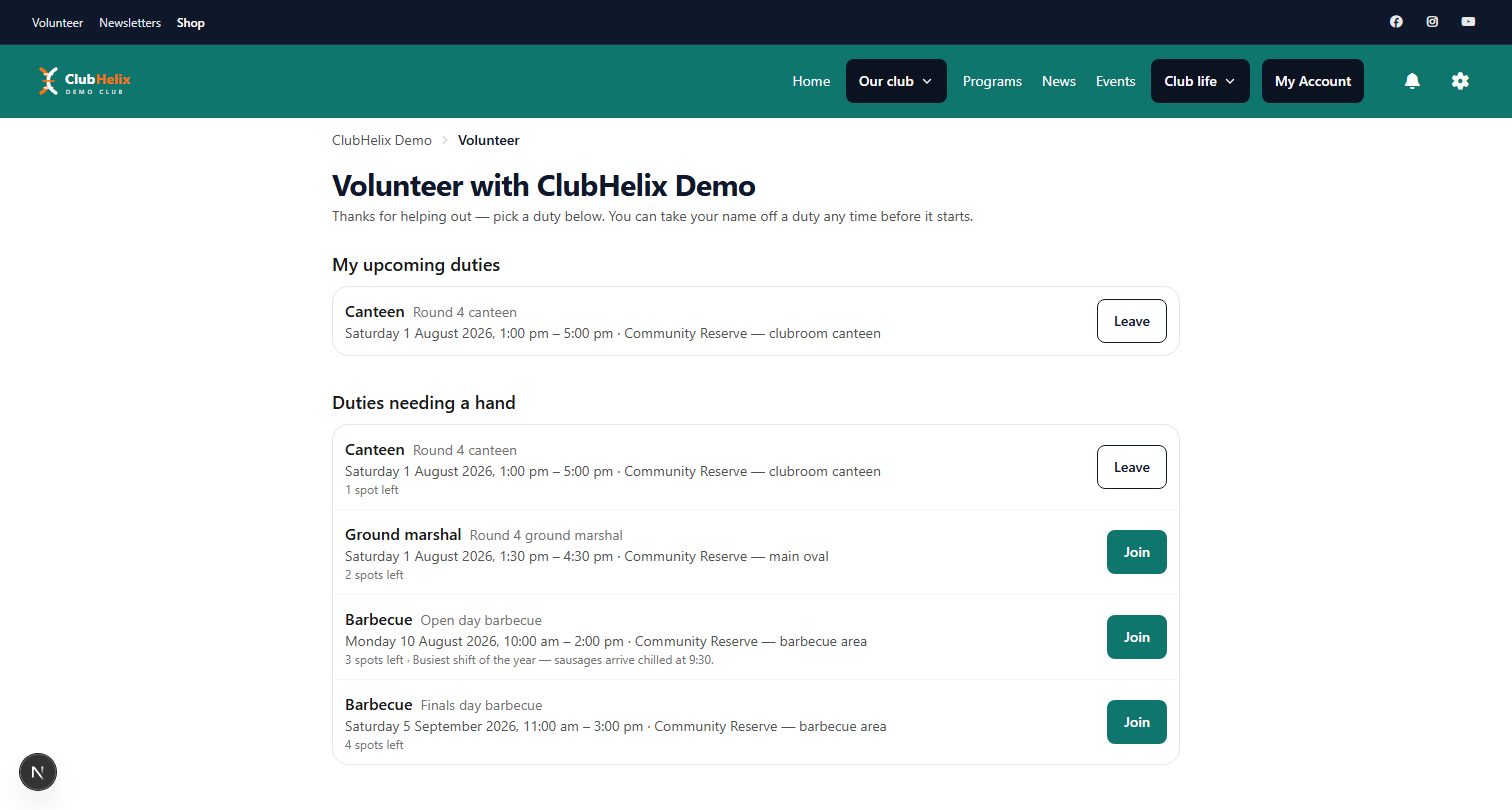
The work above is mostly records with a shelf life — a volunteer list, a roster, event tickets, a uniform shop, a fundraising total, minutes and the agreement with the school. When those live across four inboxes and two personal accounts, the six-year clock quietly deletes them. A single site the association owns changes that: volunteer rostering with reminders, events and ticketing for the disco and the trivia night, forms for sign-ups and orders, and broadcasts from an address that outlives whoever is chair.
There is a free tier to start on, pricing is published rather than negotiated, and setting up takes an evening rather than a project. If you are the person currently holding the association's history in your personal inbox, start the association's site and put it somewhere your successor can reach.
Frequently asked questions
What does a school parents association actually do?
Three things — it raises money for named projects the school budget will not cover, it builds community between families, and it gives parents a collective voice on matters that affect families across the school. It does not set curriculum or staffing, does not handle individual complaints about staff, and does not direct the school's own budget. Being explicit about both lists at the first meeting of the year prevents most of the friction these groups experience.
How do we get more parents involved?
Ask specific people to do specific, time-boxed things, and catch families at orientation rather than mid-year. Publish micro-roles with the hours attached and make clear that most of them do not require attending meetings. A class-parent layer is the highest-leverage structure available — it spreads the load across dozens of people and doubles as the pipeline for future committee roles.
Who controls the money a parent association raises?
The association does, in its own account under its own name, spent according to its rules and its members' decisions — but usually on projects agreed with the school, since the school owns the grounds and equipment the money buys. Where the school holds funds on the association's behalf, get the arrangement in writing, including how the association requests a payment. Keep project money tracked separately from general funds and publish what each campaign bought.
How often should a parents association meet?
Monthly during the school year is the common rhythm, with a shorter agenda than most committees run. An hour, a fixed structure, and a hard finish time will do more for attendance than any amount of encouragement. Publish the dates for the whole year in advance so families can plan around them, and keep minutes somewhere a new member can read back through.
Does a parents association need its own website?
It needs its own home for tickets, forms, rosters and money, and its own contact list — because relying on school channels for everything means the association has no way to reach families directly and no records that survive a change of committee. A simple site with events, forms and online payment removes most of the administrative load and, more importantly, outlives the families currently running it.
Keep reading — committee handover checklist for the six-year clock, and club fundraising ideas for filling the calendar.

