
What this guide answers
- How much does it cost to run a rowing club?
The fleet dominates: racing shells, blades, riggers and a coaching launch cost far more than most club sports' entire equipment budgets, and they depreciate.
- How does regatta entry work?
The regatta secretary collects crew nominations for each event and grade, confirms every seat is available, and submits entries through the state association before a hard closing date, paying entry fees per crew.
- How do rowing clubs allocate seats in crews?
The captain (or captain of boats) sets crews from declared availability, squad standard and — where seats are contested — seat racing or erg scores.
- Why does rowing training start so early?
Flat water, empty rivers and free daylight before work — dawn is simply the best water of the day.
Ireland edition. This guide is written for volunteer-run clubs in Ireland. Where rules differ — grants, tax, incorporation, safeguarding — follow the Ireland-specific pointers below or check with your national body.
Rowing clubs run on two scarce resources: daylight and boats. The daylight problem shapes the culture — training happens at 5:30am because that's when the water is flat and the river is empty — and the boat problem shapes the finances, because a rowing club's fleet is worth more than most clubs' entire balance sheets. Between them sits the committee, allocating seats, entering regattas, fixing riggers and keeping the shed roof watertight.
If you're taking on a rowing club — as captain, secretary or the person who accidentally said yes at the AGM — this guide covers the whole job: club structure, membership and fees, crew and seat allocation, regatta entry, boat and shed maintenance, and the online presence that holds a club of before-dawn people together.
Getting set up and affiliated
Affiliation registers your rowers for insurance purposes, makes crews eligible for sanctioned regattas, and connects the club to coaching accreditation and safety frameworks — including the on-water safety rules (navigation patterns, lighting for pre-dawn rows, coach-to-crew ratios for juniors) that every member must know before they're allowed off the pontoon.
Rowing clubs affiliate to the national governing body, which runs the regatta calendar and the ranking system deciding crew eligibility. Your local waterway authority sets the navigation rules for your stretch of water, and those sit on top of the governing body's safety requirements.
Founding a new club is a bigger lift in rowing than most sports because of the shed-and-fleet problem: you need water access, somewhere to rack boats, and boats. Many new clubs start by hiring rack space or second-hand shells from an established neighbour. The legal groundwork — a formal structure, a constitution and a bank account — is the same as any club.
Our guide on how to start a sports club in Ireland walks through it.
Committee and the captain of boats
Alongside the standard president–secretary–treasurer trio, rowing clubs traditionally appoint a captain (or captain of boats) — the senior rower responsible for crews, boat allocation and the training program — and that role carries real authority: who rows in which shell, which crews get the good boats, and who has earned a seat in the eight. Supporting roles worth formalising:
- Boat steward / maintenance officer — owns the fleet: hull repairs, riggers, seats and wheels, blades, and the maintenance log for every shell.
- Regatta secretary — the entry deadline machine: collects crew nominations, submits regatta entry on time, pays entry fees, organises boat transport.
- Learn-to-row coordinator — runs beginner programs, the club's main recruitment engine.
- Coxswain coordinator (bigger clubs) — recruits and develops coxswains, who are permanently in short supply.
Our club committee roles guide covers the generic positions; the captain and regatta secretary are where rowing-specific competence matters most.
Membership, fees and what a fleet really costs
Rowing is equipment-heavy, and fees should be set with the fleet's true cost in view: a new racing eight costs as much as a car, blades and riggers wear, and every shell depreciates toward its eventual life as a learn-to-row boat. A typical fee structure:
| Fee | Notes |
|---|---|
| Annual membership | Club costs plus the affiliation component passed to the state body |
| Racing fee | For members racing regattas — often covers a share of entries and transport |
| Learn-to-row course fee | Term-based, includes boat use and coaching |
| Boat/rack levies | Private boat owners pay rack space; some clubs levy toward fleet renewal |
Collect it online at renewal time with self-serve registration and payment — instalments matter here because rowing fees are chunky — and put a small fleet-replacement margin into every racing member's fee. The clubs that never do this are the ones launching 30-year-old eights and wondering why crews leave.
Crews and seat allocation
Seat allocation is rowing's defining management problem. Boats need exact numbers — a coxed four with three available rowers goes nowhere — so one person's Tuesday-night absence cancels training for four or eight others. The captain's weekly job is matching available rowers to available shells across squads: seniors, masters, juniors, and the learn-to-row graduates in between.
What makes it manageable:
- Availability declared in advance. Crews confirm availability for the week's sessions before the crew list is set, not by text at 5:10am. Selection (including seat racing when crews are contested) should be transparent enough that missing out doesn't feel personal.
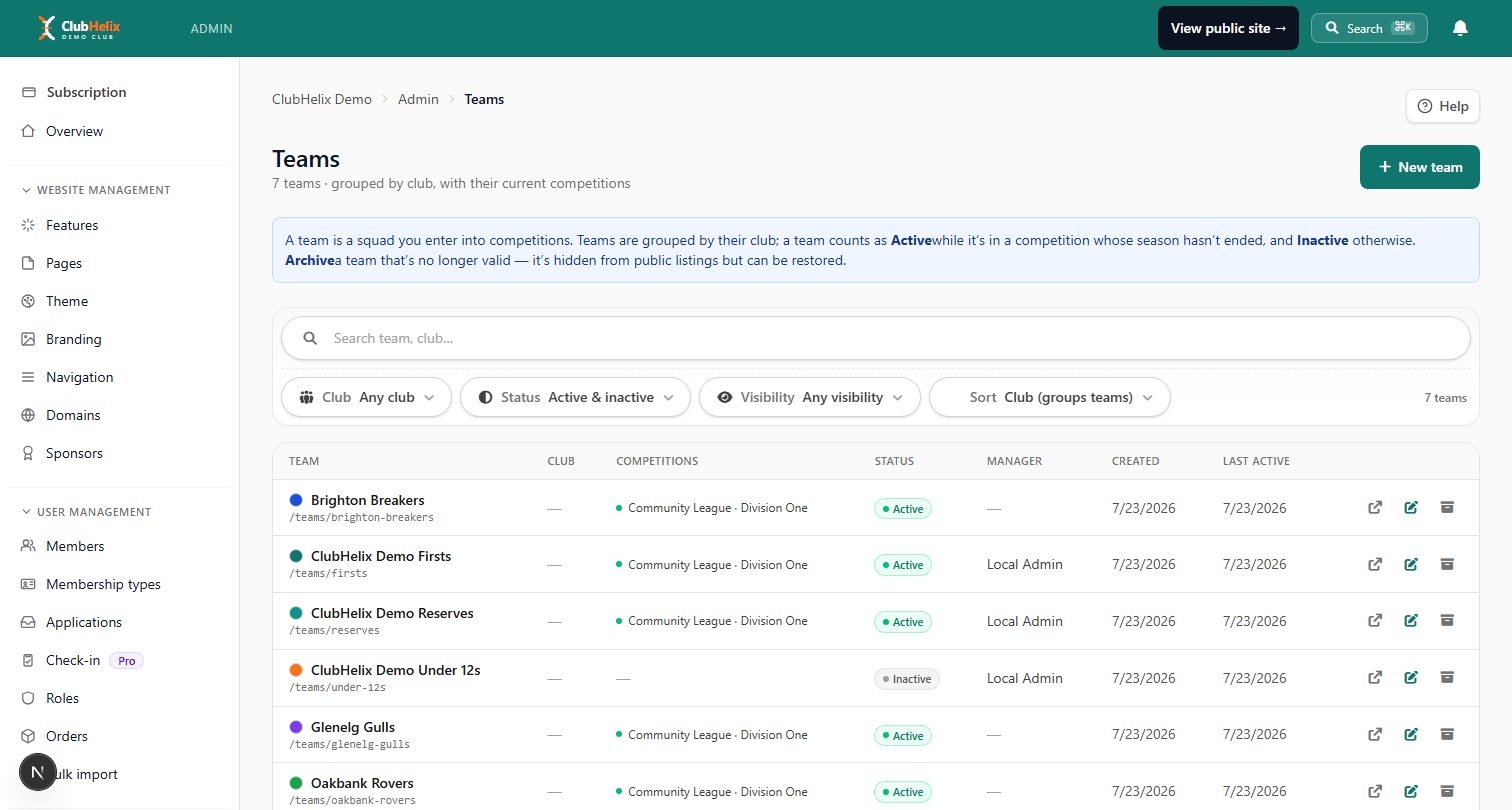
- Crew lists somewhere everyone can see. Publishing squads, crews and seatings through proper team management — rather than a photo of a whiteboard — means every rower knows their boat, seat and session time, and the captain can see gaps before they become cancelled rows.
- Boat allocation follows crew status. Racing crews get racing shells; training and learn-to-row crews get the stable fleet. Write the allocation policy down — it's the fairest way to end the pontoon argument.
Regatta entry and race day logistics
The season revolves around regattas, and regatta entry is unforgiving: entries close on fixed dates, crews are entered by event and grade, and late changes cost money or seats. The regatta secretary's cycle for each regatta: publish the regatta and its events to the club, collect crew nominations with availability confirmed, enter through the association's system before the deadline, then run the logistics — trailer loading night, tie-down, travel, rigging on arrival, marshalling times for every crew.
Treat each regatta as an event page on the club website with its own timeline: entries close date, boat-loading time, draw and race times once published, and who's towing. An events calendar with RSVPs turns the regatta secretary's group-message barrage into a page every crew checks themselves. And boat loading is a genuine all-hands task — roster it like a duty, not a favour, using the patterns from our volunteer recruitment guide.

The shed: boats, maintenance and working bees
The shed is the club's soul and its biggest liability. Fleet discipline looks like this:
- An equipment register for every shell, set of blades and launch — purchase date, condition, repairs, and who's allowed to row it. Our club equipment register template is a ready starting point.
- A damage book that people actually use. Rowers report every knock, cracked rigger and slipped seat the day it happens, without blame attached — hidden damage is what writes off hulls.
- Scheduled maintenance windows. Riggers checked and bolts tightened each month; hull repairs and re-gelling in the off-season; the coaching launch and its motor serviced before winter, because rescue capability is a safety requirement, not a luxury.
- Working bees for the shed itself — racking, pontoon, ramp and roof. A well-run working bee twice a year keeps the maintenance backlog from becoming a grant application.
Culture: the 5am problem
Rowing's early-morning culture is self-selecting — it builds ferocious commitment in the members who stay, and quietly filters out everyone else. Don't fight the dawn sessions, but don't let them be the only door in: masters crews at civilised hours, social rows, erg sessions on winter evenings, and a genuinely beginner-friendly learn-to-row program give people more than one way to belong. The clubs that grow are the ones where a learn-to-row graduate can see their pathway to a racing seat written down.
Your rowing club website
A rowing club website earns its keep twice over. Outward-facing, it recruits: learn-to-row dates with online enrolment, honest information about what membership costs and what the commitment looks like, photos that show ordinary people in boats and not just the A-crew medalling. Inward-facing, it's the operational noticeboard — session times, crew lists, regatta pages, working-bee rosters and news — available at 5am, which is when your members are actually looking.
ClubHelix covers the full sweep for a rowing club: a fast club website on your own domain, online membership with instalments, team and crew management, an events calendar for regattas with RSVPs, duty rosters for boat loading and working bees, and email and push notifications for the things that change at dawn. See it configured for the sport in our rowing club management software, or start free — there's a free tier, and the pricing page lists the rest.
Frequently asked questions
How much does it cost to run a rowing club?
The fleet dominates: racing shells, blades, riggers and a coaching launch cost far more than most club sports' entire equipment budgets, and they depreciate. Sustainable clubs build a fleet-replacement margin into racing fees and keep a maintenance log so small repairs never become write-offs.
How does regatta entry work?
The regatta secretary collects crew nominations for each event and grade, confirms every seat is available, and submits entries through the state association before a hard closing date, paying entry fees per crew. After the draw is published, the club organises boat transport, rigging and marshalling times for each crew.
How do rowing clubs allocate seats in crews?
The captain (or captain of boats) sets crews from declared availability, squad standard and — where seats are contested — seat racing or erg scores. Publishing crew lists and the allocation policy openly is the best protection against the perception of favouritism.
Why does rowing training start so early?
Flat water, empty rivers and free daylight before work — dawn is simply the best water of the day. Good clubs keep the early sessions but add masters, social and evening erg options so early starts are a choice, not a membership test.


