
What this guide answers
- How do I start a GAA club?
New GAA clubs are formed through the county board, so contact yours first — they approve new clubs and guide you through catchment, name and affiliation.
- Does a sports club in Ireland have to register as a company or charity?
Not automatically — most community clubs operate as unincorporated associations under their constitution.
- What committee does a new Irish sports club need?
At minimum a chairperson, secretary and treasurer, and in practice a registrar, PRO and — wherever juniors are involved — a trained children's officer.
- How long does it take to start a sports club in Ireland?
Most new clubs take three to six months from first meeting to first affiliated season — enough time to form the committee, adopt a constitution, affiliate, arrange insurance and vetting, and run a proper registration…
Ireland is one of the most club-dense countries on earth. Nearly every parish has its GAA club, most towns have soccer, rugby, athletics or camogie alongside it, and the local club is often the true centre of community life — the place where generations of the same families play, volunteer and gather. Starting a new club in that landscape is absolutely doable, but it works differently from starting a business: you're building a voluntary, community-owned organisation, and the structures around Irish sport are set up to help you do exactly that.
This guide covers the full journey — the founding committee, your constitution, affiliating with your sport's governing body, insurance and Garda vetting, money and funding, and getting your first members registered. Whether you want to start a GAA club, a soccer club in a new estate, or a running group that's outgrown its group chat, the steps are broadly the same.
Test the idea against the parish
Before anything formal, answer the question every county board, league secretary and grant assessor will ask: why does this club need to exist? Strong answers sound like: the nearest club is a 40-minute drive; the existing club has no capacity for another junior intake; nobody offers this sport locally; a growing town has outgrown one club.
The GAA tradition illustrates something worth copying whatever your sport: clubs there are rooted in a defined place — historically the parish — and that local identity is precisely what makes people show up to fundraise, coach and cut the grass for decades. Give your new club a clear geographic identity and a name people recognise as theirs.
Then gauge real demand. Talk to schools, community groups and local social media pages; aim for evidence of at least a team or two's worth of committed players (plus their parents, for juniors) before you commit to formation.
Form your sports club committee
An Irish sports club committee follows a well-worn shape, and governing bodies generally expect these officers before they'll affiliate you:
| Role | What they do |
|---|---|
| Chairperson | Leads meetings, sets direction, public face of the club |
| Secretary | Correspondence, minutes, affiliation paperwork, fixtures liaison |
| Treasurer | Bank account, budget, fees, financial reporting to members |
| Registrar / membership officer | Member records and registrations |
| Children's officer | Safeguarding lead — mandatory wherever juniors are involved |
| PRO (public relations officer) | Notes for local media, social media, the club website |
Recruit five to eight people for the founding committee — enough to share the load, small enough to decide things. Our guide to committee roles and responsibilities goes deeper on each job, and how to recruit club volunteers helps once you're up and running.
Hold a formal founding meeting, elect the officers, and minute everything — the bank, your governing body and any funding application will want those minutes.
Write a constitution and choose a structure
Your constitution is the club's rulebook: name, purpose, who can be a member, how the committee is elected, how money is handled, how an AGM works, and what happens if the club winds up. Most national governing bodies publish a model constitution for new clubs — start from that rather than a blank page, because affiliation usually requires their clauses anyway.
Structurally, most Irish community clubs operate as unincorporated associations governed by their constitution, and that's fine for the early years. Two formal registers matter as you grow:
- Incorporation. Some clubs eventually incorporate as a company limited by guarantee, giving the club its own legal identity — useful when taking on a lease, employing a coach, or borrowing for a clubhouse. Company registration in Ireland is handled through the Companies Registration Office at cro.ie.
- Charity registration. Some sporting and community organisations fall within the scope of charity regulation, and registered charities have ongoing reporting duties. The Charities Regulator at charitiesregulator.ie explains who must register and what it involves.
This is general information, not legal or financial advice — check the current requirements with the official bodies linked above, and with your national governing body, before you formalise your structure.
Affiliate with your governing body
In Irish sport, affiliation is the key that unlocks nearly everything: entry to leagues and championships, insurance schemes, coaching courses, safeguarding frameworks and grant eligibility. If you want to start a GAA club, your first serious conversation is with your county board — new clubs are formed with the county's approval, and they'll guide you through catchment, name, colours and the paperwork. For soccer, rugby, athletics and other sports, contact the relevant league, branch or county body for your area; each has its own new-club process, but all will want your committee list, constitution and grounds arrangement.
Your Local Sports Partnership is also worth an early visit — they exist to support community sport, and they're a good source of advice, training and small grants for new clubs.
Insurance, Garda vetting and safeguarding
Never run a session uninsured. Affiliation usually brings access to your governing body's group insurance scheme, which is generally the simplest and cheapest cover a new club can get; otherwise, use a broker familiar with amateur sport. Check exactly what's covered — public liability at minimum, plus player injury cover where relevant.
If children will be involved (and in most Irish clubs they will), safeguarding is a legal and cultural cornerstone, not a formality. Relevant coaches and volunteers must be vetted through the Garda vetting process — your governing body will run this for affiliated clubs — and you'll need a trained children's officer, safeguarding training for coaches, and a code of behaviour that players, parents and mentors sign. Build all of it in before your first junior session.
Money, fundraising and facilities
Open a club bank account with two signatories as soon as your founding meeting has minutes. Budget honestly for year one: affiliation and insurance, pitch or hall hire, equipment and first-aid kit, coaching courses, and a contingency. Set membership fees by working backwards from those costs.
Irish clubs are world-class fundraisers, and you'll lean on the classics: club lottos, race nights, table quizzes, bag-packing, church-gate collections and local business sponsorship. A well-run club raffle or lotto can become a steady weekly income once your community grows.
For grounds, few new clubs own anything. Typical starting arrangements are council pitches and halls, school facilities, or sharing with an established club at off-peak times. Get any arrangement in writing, even informally.

Get set up online before you launch
New Irish clubs live or die on their first registration window, and the difference between "message us to join" and a proper join page is enormous. Before launch night, set up a simple club website — who you are, where and when you train, fees, contacts — and online registration so a parent can register and pay in two minutes at the kitchen table, with the membership form, payment and any consents handled in one flow.
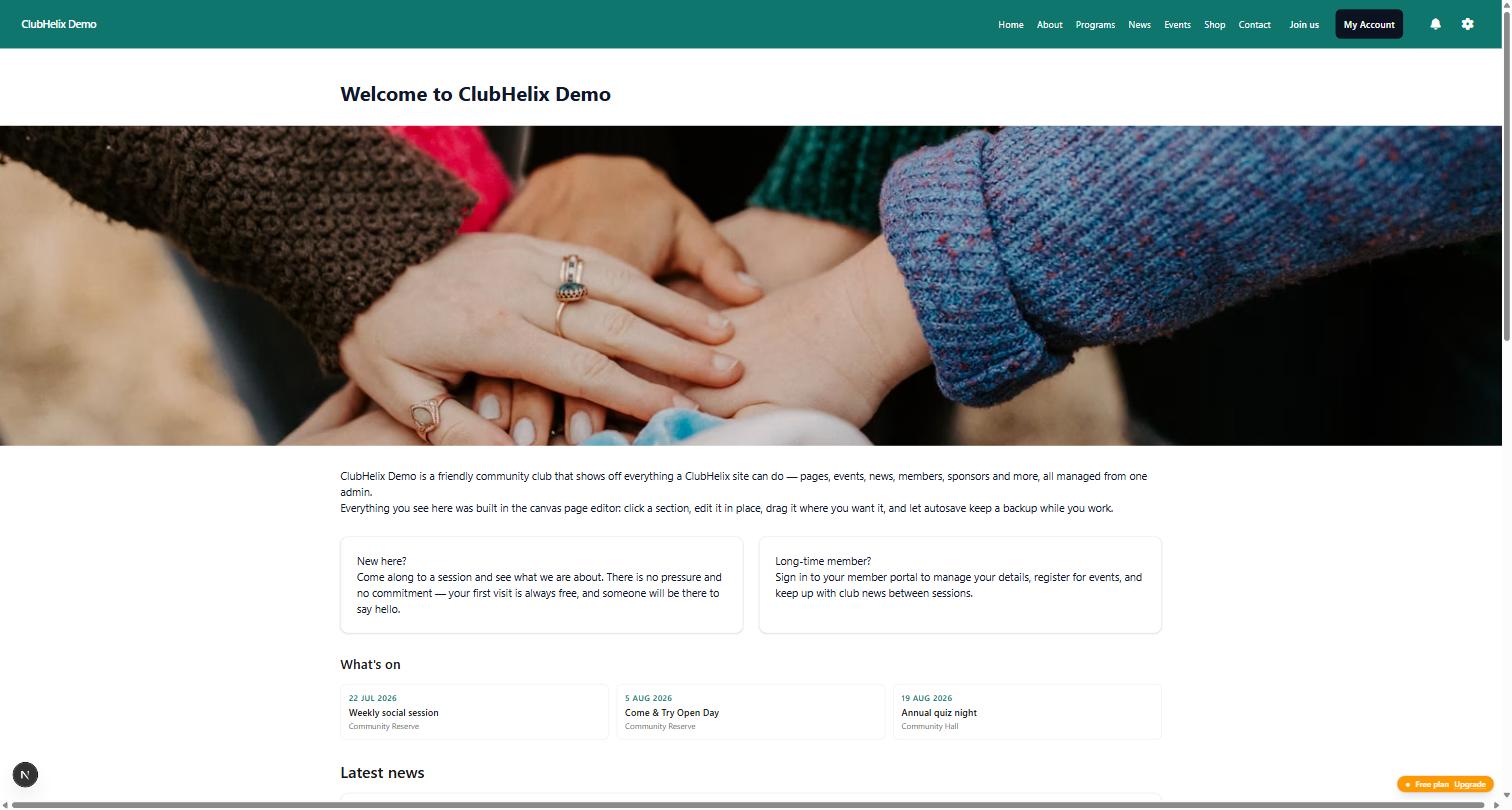
Once members arrive, email broadcasts mean training changes and club news reach every household reliably — no more hoping the message got forwarded around three different group chats.
Launch and your first season
Announce the club four to six weeks ahead: posters in schools and shops, the parish newsletter where there is one, local Facebook groups and a launch story for local media (that's the PRO's first job). Run an open registration evening or a family fun day with a barbecue, have QR codes to the registration page on every table, and sign people up on the spot.
Then run a deliberately simple first season: one or two teams or groups, a realistic training schedule, and committee meetings monthly. Finish with an AGM that reports on the year, thanks the volunteers publicly and elects the committee properly — that's the moment a start-up becomes a real club.
ClubHelix was built for exactly this kind of volunteer-run club: a professional club website, online registration and payments, membership records and club email in one place, with a free tier to get started — create your club or browse club website templates to see what yours could look like.
Frequently asked questions
How do I start a GAA club?
New GAA clubs are formed through the county board, so contact yours first — they approve new clubs and guide you through catchment, name and affiliation. You'll need a committee, a constitution based on the association's model, vetted volunteers and evidence of local demand.
Does a sports club in Ireland have to register as a company or charity?
Not automatically — most community clubs operate as unincorporated associations under their constitution. Incorporation through the CRO or registration with the Charities Regulator applies in specific circumstances, so check the official guidance at cro.ie and charitiesregulator.ie for your situation.
What committee does a new Irish sports club need?
At minimum a chairperson, secretary and treasurer, and in practice a registrar, PRO and — wherever juniors are involved — a trained children's officer. Governing bodies generally require these officers before affiliation.
How long does it take to start a sports club in Ireland?
Most new clubs take three to six months from first meeting to first affiliated season — enough time to form the committee, adopt a constitution, affiliate, arrange insurance and vetting, and run a proper registration drive.

