
What this guide answers
- How long does a powerlifting meet take to run?
Work it out rather than guessing. Multiply lifters per flight by three attempts, allow about 90 seconds per attempt including loading, and add changeover time between lifts.
- How many volunteers does a meet need?
Fifteen to twenty across the day for a single platform, including three referees, a jury or technical official, three to five spotters and loaders, table and scoreboard crew, weigh-in and kit-check officials, first…
- What gets checked at weigh-in?
Bodyweight and division, opening attempts for all three lifts, rack heights and any foot blocks, and the lifter's equipment against the federation's approved list — belt, singlet, shirt, socks, sleeves or wraps.
- How should a club handle multiple federations?
Be explicit rather than neutral. Tell members which federation the club affiliates to, what that means for testing, rulebooks and approved equipment, and where their totals will count.
- Does a small powerlifting club need its own website?
Yes, mostly for three jobs — taking meet entries and payment, publishing start lists and results the same day, and holding club records where anyone can see them.
New Zealand edition. This guide is written for volunteer-run clubs in New Zealand. Where rules differ — grants, tax, incorporation, safeguarding — follow the New Zealand-specific pointers below or check with your national body.
A powerlifting club is a training group for eleven months of the year and an event company for one weekend. Everything the club is judged on happens in that weekend: whether the weigh-in ran on time, whether the attempt cards were collected before the deadline, whether the spotters knew what to do when a squat went forward, and whether anyone could find the results before Monday.
The sport itself is beautifully simple to explain and unforgiving to administer. Three lifts, three attempts each, ascending bar weight, and a scoring order that has to be rebuilt every single time a lifter changes an attempt. Nobody remembers the club that programmed a good sixteen-week block. Everybody remembers the meet that finished four hours late because flights were built badly and the loading crew had never been briefed.
This guide is written for the committee or coach running a community powerlifting club — one platform, a mix of novices and provincially ranked lifters, and an annual meet that is the club's showpiece. It covers meet-day flow from weigh-in to final attempt, the officials and volunteers you genuinely need, kit and equipment checks against your federation's rules, and the ordinary business of keeping a club healthy in the months when nobody is competing.
The training year, planned backwards from the platform
Powerlifting clubs run on blocks, and the calendar is the club's real product. Most members are working towards a date, so the club's job is to publish the dates early enough that coaches can program back from them and members can plan leave, weddings and exams around them.
A workable annual shape for a single-platform club:
| Period | What the club is doing | Admin that has to happen |
|---|---|---|
| Off-season block | General strength, technique rebuilds, new intake | Renewals, coach accreditation, equipment audit |
| Pre-competition block | Specific work, opener planning | Meet sanction applied for, venue booked |
| Meet build-up (8 weeks) | Peaking, mock meet, kit checks | Entries open, volunteer roster, officials confirmed |
| Meet week | Taper, weigh-in planning, travel | Start list, flights, equipment transport |
| Recovery block | Deload, review, socials | Results published, debrief, thank-yous |
Two habits separate clubs that grow from clubs that plateau. The first is the in-house mock meet: a full dress rehearsal six to eight weeks out, with real commands, real attempt cards and real timing, run for novices who have never competed. It converts nervous training members into entrants better than any amount of encouragement, and it is where your trainee referees and loaders learn their jobs with nothing at stake.
The second is publishing the calendar somewhere permanent. A pinned message in a chat group is not a calendar — it is invisible to the person who joined last week. Put dates on the club website where new members, parents and visiting lifters can all see them.
Powerlifting here is split across more than one federation, some drug-tested and internationally affiliated, some not, each with its own rulebook, approved-equipment list and qualifying route. Decide which body your club affiliates to before you plan a meet, and tell members plainly which competitions their totals will count towards. Regional structures usually run the local calendar and the referee courses.
Meet day, from weigh-in to the final deadlift
This is where the club is made or unmade. Your federation's rulebook governs the detail; what follows is the shape of the day and the arithmetic that decides whether it finishes on time.
Weigh-in
Weigh-in opens a set period before the session lifts — commonly two hours — in a private room, conducted by officials under your federation's protocol. It is not just a number on a scale. In the same few minutes you collect the lifter's opening attempts for all three lifts, their rack heights for squat and bench, their foot-block requirement, and confirmation of their division and weight class.
Rack heights are the most commonly botched part of the whole day. Get them written down, checked against the actual rack numbering in the venue, and handed to the loading crew as a printed sheet — not read off a phone in the middle of a flight. A lifter who walks out to a rack set three notches wrong loses the attempt and the club loses ten minutes.
Have a scale available the evening before and again an hour before weigh-in opens for lifters cutting weight, and have a clear, calm policy about what happens if someone misses their class. Write it into the entry terms so nobody negotiates it at 7am.
Building flights
A flight is a group of lifters who complete all three attempts at one lift before the next group starts. Flights are the lever you have over the length of the day.
| Element | Assumption (illustrative) | Time |
|---|---|---|
| Attempts per lifter, per lift | 3 | |
| Lifters per flight | 12 | |
| Attempts per round of one lift | 36 | |
| Time per attempt including loading | 90 seconds | 54 min |
| Changeover between lifts (racks, bar, rest) | 15 min | |
| One flight, all three lifts | about 3 h 30 m | |
| Two flights plus weigh-in, breaks, awards | an 8-hour day |
That table is the most useful thing on this page. It tells you that fourteen entries in a flight instead of twelve adds roughly twenty minutes to every round — an hour across the day — and that a meet with 40 entries and one platform is a very long day for a volunteer crew, not a marketing opportunity. Cap entries at what your platform and your people can actually deliver, and open a second day before you open a third flight.
Order lifters within a flight by opening attempt, lightest first, and group by division only where your federation requires it. Publish the start list the night before if you can, or first thing on the morning — lifters and their coaches plan warm-ups off it.
Attempts and the clock
Each lifter has a set time from being called to starting the lift, and a deadline for submitting the next attempt after the previous one. Those two rules are the entire rhythm of a meet, and enforcing them is a job, not an afterthought. Put someone on the table whose only responsibility is collecting attempt changes before the cut-off and telling the announcer when the round order has shifted.
The bar only ever goes up in weight within a round, which means a late attempt change ripples through the loading order. If the table crew is also doing the scoreboard, this is where the day derails.
Scoring and results
Whether you use a purpose-built meet scoring package or a well-built spreadsheet, decide two things in advance: who owns it, and what happens if it stops working. Have printed attempt cards and a paper score sheet as a backup, and a person nominated to keep them current. A meet has been saved by a clipboard more than once.
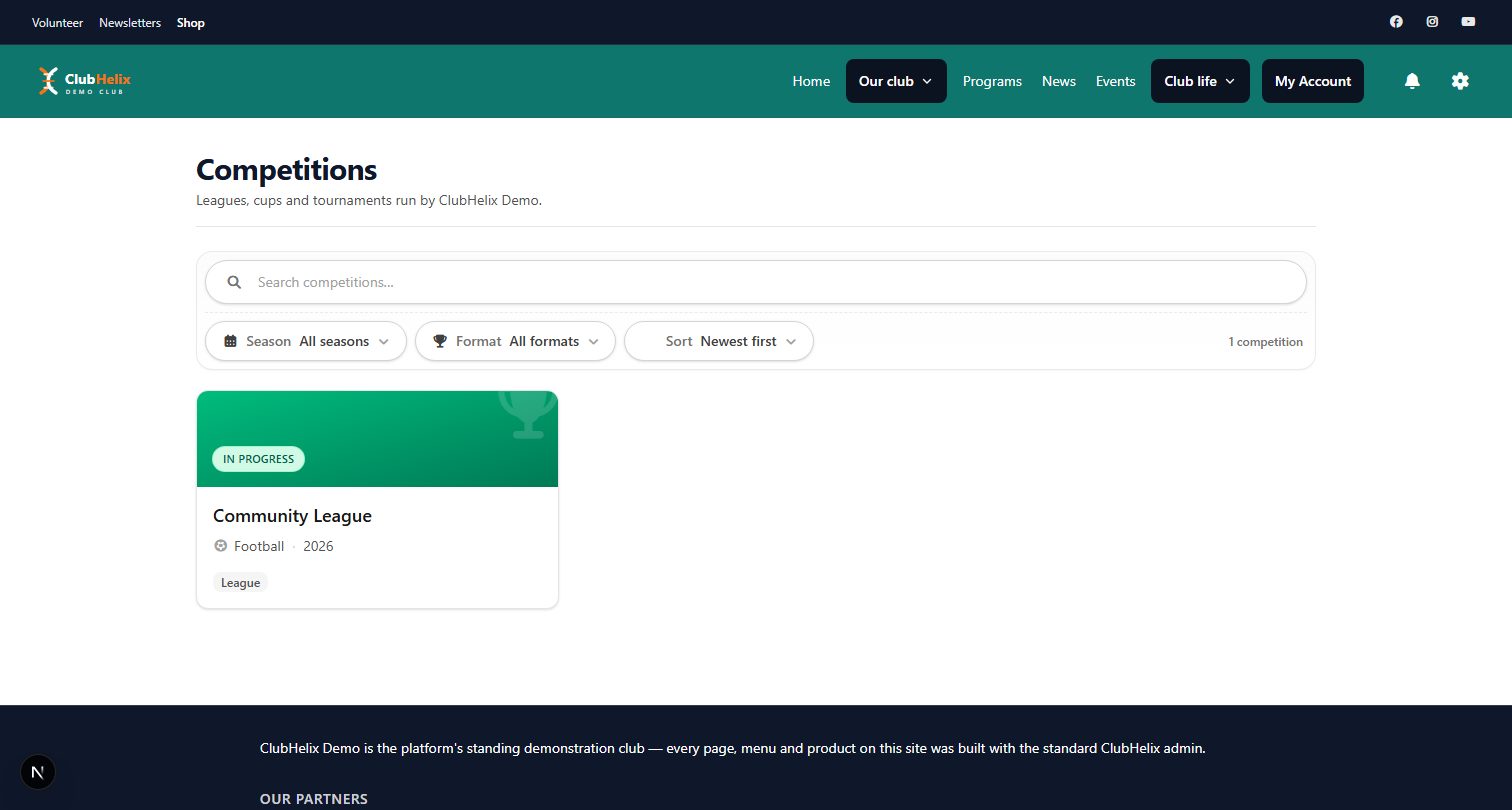
Publish results the same day. Lifters share them, families who could not attend read them, and a club that reliably publishes results within hours builds a reputation that fills the next meet. Put them on your own website rather than only in a chat group — competition fixtures, entries and results can carry the entry list, the divisions and the final placings on a public page your members can link anyone to.

Referees, spotters and the roster that holds it together
A meet needs certified referees and a much larger group of trained volunteers, and the second group is the one clubs under-plan. Here is a realistic single-platform roster.
| Role | How many | Shift pattern | Must know |
|---|---|---|---|
| Referees (chief plus two) | 3 | Rotate between rounds | Certified under your federation, commands and standards |
| Jury or technical official | 1-3 | Whole day | Rulebook, appeals process |
| Chief marshal | 1 | Whole day | Calls lifters, manages the on-deck order |
| Spotters and loaders | 3-5 | Rotate each flight | Loading calls, plate order, spotting protocol |
| Table crew (attempt cards) | 2 | Rotate each lift | Attempt deadlines, round order |
| Scoreboard and announcer | 1-2 | Rotate each lift | Scoring system, running order |
| Weigh-in officials | 2 | Two-hour block | Protocol, privacy, rack heights |
| Kit and equipment check | 2 | Weigh-in only | The approved-equipment list |
| First aid | 1 | Whole day | Current qualification, location of kit |
| Front of house and canteen | 2-3 | Split shifts | Entry, spectators, food safety basics |
| Results and publishing | 1 | End of each lift | Where results go and who approves them |
That is fifteen to twenty people across the day, and roughly half need a briefing before they start.
Spotters and loaders deserve a real rehearsal. Run a thirty-minute session the week before, and again for fifteen minutes on the morning: who takes which side, how you take a failed squat, when you touch the bar and when you absolutely do not, who calls the loading, and what the plate order is. Spotting is a skill and a trust exercise — a lifter who does not trust the crew will not take a genuine third attempt, and the whole point of the day is the third attempt.
Roster by name and by shift, send a reminder the day before, and give every volunteer a printed card with their role, their times and who to ask. Our volunteer roster template has a structure you can adapt, and volunteer rostering will send the reminders for you. If your problem is finding the bodies in the first place, how to recruit club volunteers is the more useful read.
Feed your volunteers, give the referees somewhere to sit that is not the platform, and thank them publicly at the awards. Referees are the scarcest resource in the sport — a club that treats them well gets its meet dates approved and its panel filled next year.
Equipment checks and the rules that catch people out
Two categories of equipment matter on meet day, and both get clubs into trouble.
The club's equipment is what your federation inspects before it will sanction the meet:
- A calibrated plate set and competition bars, with the bar and collar weights confirmed and posted for the loading crew.
- Squat stands or a monolift, and a competition-specification bench, both set up and tested with weight before the doors open.
- Foot blocks for lifters who need them, chalk, and a clear rule on ammonia if your federation and venue permit it at all.
- Calibrated scales with current certification, and a private weigh-in space.
- A loading chart printed and taped to the platform edge, so the crew is never doing mental arithmetic under time pressure.
The lifters' equipment is checked at weigh-in, and this is where novices get caught. Belt width and thickness, singlet, the shirt underneath, socks that cover the shin for deadlift, knee sleeves versus knee wraps, wrist wraps, and approved-brand lists that differ between federations and change between years. Publish your federation's current approved list with the entry information, remind entrants two weeks out, and staff a kit-check station at weigh-in. A lifter who drove three hours and cannot lift in their belt will remember your meet for the wrong reason.
Keep a maintenance register for the club's kit — purchase date, cost, calibration date, expected replacement — and inspect after every meet, not before the next one. The club equipment register template covers the columns, and the register doubles as the evidence a grant assessor wants when you ask for a new plate set.
Anti-doping deserves a plain word. If your federation is a signatory to the international code, testing and education are run by the relevant national anti-doping organisation and apply to your members, including at club level. Point your lifters at the official education resources and the current prohibited list, remind them that supplements are their own responsibility, and never let the club be the source of advice on this — direct them to the authority.
What a meet costs, and what it should return
Meets are not a fundraiser and should not be run as one, but they should not lose money either. Build the budget from these lines:
| Cost line | Notes |
|---|---|
| Venue hire | Usually the largest single item, plus a bond |
| Sanction and affiliation fees | Per meet, set by your federation |
| Officials costs | Travel and meals at minimum, sometimes a fee |
| Equipment transport and hire | Truck hire, calibrated plates if you are borrowing a set |
| Medals, trophies and awards | Order early, allow for divisions you did not expect |
| Scoring, printing, signage | Attempt cards, start lists, scoreboard display |
| First aid provision | A qualified person on site all day |
| Catering for volunteers | Not optional |
| Insurance and permits | Check what affiliation covers and what the venue requires |
Against those, you have entry fees, spectator entry, canteen takings, a merchandise table and sponsorship. Local strength-equipment suppliers, physiotherapy practices and cafes are natural sponsors for a meet — they can see exactly who is in the room. How to get sponsors for a sports club covers making the ask properly, and the club budget template will hold the numbers.
As an illustration only, entry fees for a local meet often sit around NZ$80-$140 depending on federation and level. Community trusts and gaming trusts are the realistic route to capital items such as a calibrated plate set or a competition bench, and they generally prefer a clear quote and a two-year plan to a general appeal. Sharing a calibrated set between two or three neighbouring clubs is common and sensible.
Between meets — the club part of the club
Powerlifting has a retention shape that catches committees out: people join for a meet, compete, and vanish. The fix is to make the club worth belonging to when nothing is scheduled.
- Run a novice night once a quarter. Commands, attempt selection and a mock third attempt, aimed at people who have never entered.
- Track club records properly. By division and weight class, on a page anyone can see, updated after every meet. It is the cheapest motivation in the sport.
- Keep a coaching pathway. Members who are past their peak often make excellent referees, spotters and coaches, and a club that offers them a role keeps them for twenty years.
- Have a social calendar that is not lifting. A meal after the meet does more for retention than the meet did.
- Ask why people leave. A two-question exit note at non-renewal tells you more than a year of speculation, and how to retain club members turns the answers into action.
Plan the year around a southern-hemisphere calendar. The domestic championship season sits mid-year, so club and regional qualifiers cluster through the cooler months, and the summer holiday period is your dead zone — venues close, half the squad travels, and it is a poor time to schedule a meet. Use it for a mock meet and referee training instead.
Running the meet from your own website
The administrative weight of a powerlifting club sits in three places — entries, the volunteer roster, and results — and all three are usually held together by one exhausted person with a spreadsheet and a phone. That is the part ClubHelix takes over. Competition entries, divisions and results live on your club site so lifters enter and pay online and spectators find the start list without asking. Volunteer rostering fills the shifts and sends the reminders. Online membership and payments means squad fees and meet entries land in the same place, reconciled, without a treasurer chasing transfers.
Most committees have a working site with a meet entry page live in an afternoon, and there is a free tier to sit on until the meet actually needs the bigger features. The pricing is published rather than quoted, and the whole thing is built for volunteer committees rather than adapted from software written for professional sport — start your club site before your next entry list opens.
Frequently asked questions
How long does a powerlifting meet take to run?
Work it out rather than guessing. Multiply lifters per flight by three attempts, allow about 90 seconds per attempt including loading, and add changeover time between lifts. A flight of twelve takes roughly three and a half hours for all three lifts, so two flights plus weigh-in, breaks and awards is a full eight-hour day on one platform.
How many volunteers does a meet need?
Fifteen to twenty across the day for a single platform, including three referees, a jury or technical official, three to five spotters and loaders, table and scoreboard crew, weigh-in and kit-check officials, first aid, and front of house. Roster them by name and shift, and brief the loading crew before the first lift rather than during it.
What gets checked at weigh-in?
Bodyweight and division, opening attempts for all three lifts, rack heights and any foot blocks, and the lifter's equipment against the federation's approved list — belt, singlet, shirt, socks, sleeves or wraps. Publish the current approved list with your entry information, because kit failures at weigh-in are the most avoidable disappointment in the sport.
How should a club handle multiple federations?
Be explicit rather than neutral. Tell members which federation the club affiliates to, what that means for testing, rulebooks and approved equipment, and where their totals will count. Lifters can and do compete across federations, but the coaching implications differ — gear that is legal at one meet may not be at the next.
Does a small powerlifting club need its own website?
Yes, mostly for three jobs — taking meet entries and payment, publishing start lists and results the same day, and holding club records where anyone can see them. Those are exactly the tasks that otherwise consume one volunteer's entire weekend, and a chat group cannot do any of them for someone who has not joined yet.
Keep reading — how to run a weightlifting club for the platform-booking side of strength sport, and how to organise a sports carnival for running a bigger event day.


