
What this guide answers
- How do you start a pickleball club?
Gather a founding group, incorporate as an association, affiliate with the state/national body for insurance and credibility, then secure regular court time — indoor stadium slots or shared tennis/netball courts marked…
- How many pickleball courts fit on a tennis court?
Multiple pickleball courts fit within one tennis court's area, depending on run-off space — which is why shared and converted tennis courts are the most common home for new clubs.
- How should a pickleball club structure sessions as it grows?
Cap session numbers and take bookings online, then split into graded skill bands past roughly thirty regulars.
- Do pickleball clubs need a website if everyone uses a group chat?
Yes — chat only reaches people already in the club. A website captures "pickleball near me" searches, explains the first-visit experience, and lets newcomers book and pay for a session without knowing a member first.
New Zealand edition. This guide is written for volunteer-run clubs in New Zealand. Where rules differ — grants, tax, incorporation, safeguarding — follow the New Zealand-specific pointers below or check with your national body.
Pickleball clubs have a problem most committees would kill for: too many people want to play. The sport's growth has been extraordinary, and the typical club story is the same everywhere — a handful of players marking out a court in a community hall, then twenty players, then a waitlist, then the scramble for court time, session structure and some way to manage it all that isn't a sprawling group chat.
Running a pickleball club is therefore less about drumming up interest and more about managing demand: finding and sharing court space, running sessions that mix beginners with experienced players fairly, and building just enough structure (membership, booking, communication) that growth doesn't burn out the three people who started it. Here's how to do it.
Getting set up
If you're at the "start a pickleball club" stage, the sequence is the same as any community sports club: a small founding group, a formal structure with a simple constitution, a bank account, and insurance. Affiliating upward is worth doing early: it typically brings insurance options, sanctioned tournaments, coaching and officiating pathways, and credibility when you ask a venue for court time.
Most clubs register as an incorporated society and affiliate with the sport's regional and national bodies — our guide on how to start a sports club in New Zealand walks through the sequence.
That last point matters more than it sounds. Pickleball clubs rarely own facilities — you'll be hiring stadium courts, sharing tennis or netball courts, or using school gyms. Venues and councils take an incorporated, affiliated, insured club far more seriously than "a group that plays on Tuesdays".
Courts: sharing, marking and the sound question
Almost every pickleball club starts on someone else's lines. The three usual arrangements:
- Indoor stadium or hall hire. Badminton courts convert beautifully — a pickleball court is close to badminton's footprint, and many halls already have usable lines. Portable nets go up in minutes. The catch is competing with established sports for peak-hour bookings, so lock in recurring slots each term.
- Shared tennis or netball courts. One tennis court hosts multiple pickleball courts. Temporary line tape works for occasional sessions; if you have a regular arrangement, ask the venue about painting permanent pickleball lines in a contrasting colour. Councils resurfacing courts are often happy to add dual lines if a club asks at the right time — so ask early and in writing.
- Dedicated courts. The end goal. Councils are increasingly converting underused courts, and a club with strong session attendance records and a membership list has a real case. Keep attendance data — it's your best advocacy tool.
One pickleball-specific issue to manage proactively: noise. The paddle-pop sound carries, and neighbour complaints have derailed outdoor venues elsewhere. Choose outdoor sites with some buffer from houses, keep sensible session hours, and consider quieter-rated paddles for early sessions. Being ahead of the issue keeps the council on side.
Sessions: the heart of a pickleball club
Pickleball's social magic is that sessions, not teams, are the unit of club life. Most members come to "Tuesday night pickleball", not to a fixed team. That makes session design your core product:
| Session type | Format | Who it's for |
|---|---|---|
| Open play | Paddle-stacking rotation — winners stay or all off, next four on | The social core of the club |
| Graded play | Courts split by skill band, players rotate within a band | Keeps beginners safe and strong players challenged |
| Beginner intro | Coached basics, loan paddles, first sessions free or cheap | Your recruitment funnel |
| Round robin / club night | Organised fixtures, scores recorded, ladder over a term | Members who want competition |
| Tournaments | Occasional brackets, often doubles, with grading divisions | Showcase days and fundraising |
Two hard-won lessons from growing clubs. First, grade your sessions once you pass about thirty regulars — mixed-ability open play stops being fun for everyone at the same time. Keep it simple: self-rated bands with a convener who quietly adjusts. Second, cap and book sessions. Overcrowded courts with long waits between games is the number one complaint in growing clubs. Publishing each session with a capacity and letting members book a spot online solves it — ClubHelix facility and session booking handles capacity, member pricing and casual visitor payments on your club website.
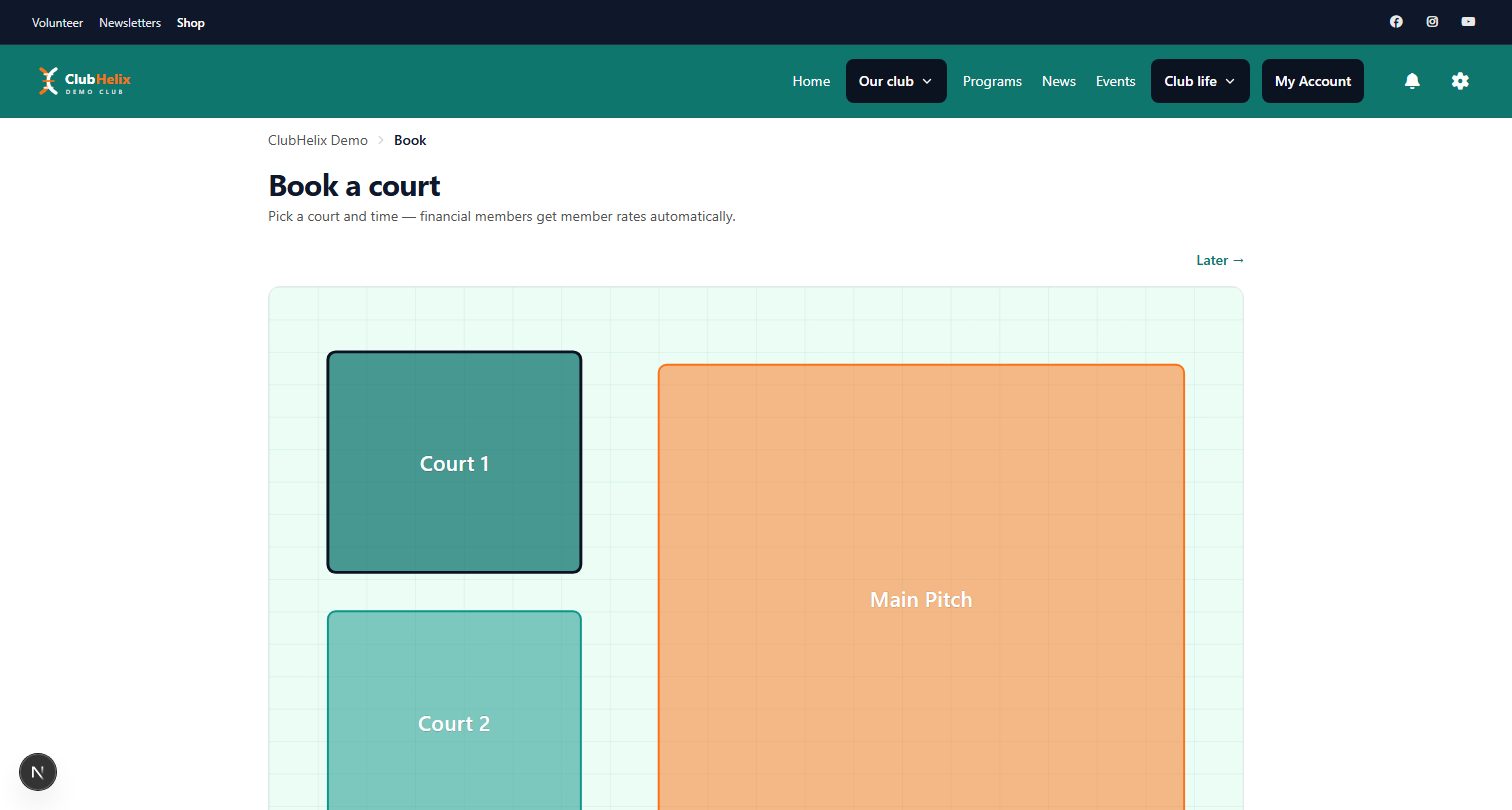
Two of our guides go deeper on the mechanics. How to share a facility between bookings is the session model — a capacity per court, a price per place and a grid that shows places left, which does more to stop overcrowding than any rule you publish. How to set up online court booking is for the day you have dedicated courts and members want to book one for themselves.
Paddle demos and gear
Pickleball has a low entry cost, and smart clubs exploit that. Keep a tub of loan paddles and balls at every session so a first-timer needs nothing but shoes. Run paddle demo days once or twice a year — local retailers or paddle brands will often bring demo stock, members get to try before they buy, and the club can negotiate a small commission or a raffle prize for hosting. A modest club shop selling balls, grips and club shirts adds income and identity; club-colour shirts on court is free marketing every time you host visitors.
Committee and volunteers
Keep the committee lean — president, secretary, treasurer — and put your best people into session conveners, the volunteers who set up nets, run the rotation and welcome newcomers at each regular session. A club with five reliable conveners is more robust than one with a big committee and no one holding the Tuesday session together. Rotate the net set-up/pack-down duty formally rather than letting the same two people do it forever; a published roster (see how to recruit club volunteers) makes the ask visible and fair.
Membership and money
Pickleball clubs typically blend two models: an annual membership (covering insurance, affiliation and member session rates) plus per-session fees that cover venue hire. Casual visitors pay a higher session rate, capped at a few visits before they're asked to join. This keeps the barrier to trying the sport near zero while making membership clearly worthwhile.
Collect all of it online. Growing clubs drown in cash tins and bank-transfer reconciliation faster than any other admin task. Online registration with card payment for memberships, and online session booking for the per-session fees, means the treasurer watches a dashboard instead of counting coins in a sports hall at 9pm. For setting fee levels, how much should club membership cost has a framework.
On the expense side the big lines are venue hire, insurance/affiliation, balls (they crack — budget more than you think), nets and loan paddles. Fundraising is rarely urgent given the demand, but a come-and-try day doubling as a sausage sizzle, or a social tournament with entry fees and a raffle, tops up the kit fund — ideas in club fundraising ideas.
Growing without breaking
The fastest-growing sport in the country brings a specific risk: growing past your structure. The pattern to avoid is the group chat with 180 members where session announcements, banter, and "is anyone bringing nets?" scroll past each other until nobody knows what's on.
- Publish sessions as real events with times, venues, capacity and booking — not chat messages. A club events calendar that members can RSVP to gives you attendance data and gives newcomers a way in that doesn't require being added to a chat by a friend.
- Separate announcements from banter. Club chat is great for community; announcements need their own channel that people actually see, whether that's email or push notifications.
- Welcome deliberately. Assign someone at every session to spot first-timers, hand them a loan paddle and introduce them to a court of patient players. Clubs that do this convert visitors at a dramatically higher rate — more in how to run a come-and-try day.

Your pickleball club website
Because pickleball is new to most people, your website carries more weight than an established sport's. Searchers aren't just looking for your club — they're looking for "pickleball near me", "what is pickleball" and "how do I start". A good pickleball club website answers all three: where and when sessions run, what a first visit looks like (loan paddles! no experience needed!), what it costs, and a big obvious "book your first session" button.
If the club currently lives only in a chat app and a social media page, you're invisible to that search traffic and dependent on word of mouth. See the ClubHelix pickleball club management software page for what a purpose-built setup looks like, and how to set up a club website for free if budget is the blocker.
ClubHelix was built for exactly this stage of club life: a professional website with session booking and capacity limits, online membership and renewals, an events calendar, club chat and email built in — so the club scales without the founders becoming full-time administrators. There's a free tier to start on: create your club site or compare plans on pricing.
Frequently asked questions
How do you start a pickleball club?
Gather a founding group, incorporate as an association, affiliate with the state/national body for insurance and credibility, then secure regular court time — indoor stadium slots or shared tennis/netball courts marked with pickleball lines. Publish a weekly session, bring loan paddles, and growth usually takes care of itself.
How many pickleball courts fit on a tennis court?
Multiple pickleball courts fit within one tennis court's area, depending on run-off space — which is why shared and converted tennis courts are the most common home for new clubs. Temporary tape works for casual use; painted dual lines are worth requesting for regular arrangements.
How should a pickleball club structure sessions as it grows?
Cap session numbers and take bookings online, then split into graded skill bands past roughly thirty regulars. Open paddle-rotation play stays at the heart of the club, with beginner intro sessions feeding new players in and an optional ladder or round robin for competitive members.
Do pickleball clubs need a website if everyone uses a group chat?
Yes — chat only reaches people already in the club. A website captures "pickleball near me" searches, explains the first-visit experience, and lets newcomers book and pay for a session without knowing a member first.

