
What this guide answers
- What's the most important thing to get right when running a tennis club?
Court utilisation. Well-maintained, well-lit courts that are easy to book — by members and casual hirers alike — drive membership, coaching, competition and income.
- How should a tennis club handle court bookings?
Online, self-service, from any phone — with member and casual pricing, payment collected up front for casual hire, and automatic blocks for coaching, pennant and club sessions.
- What membership categories should a tennis club offer?
Most clubs run full/senior, midweek, junior, family and a night-competition-only category, plus a social non-playing tier.
- Does a small tennis club really need a website?
Yes — it's where prospective members check membership prices, parents find junior programs, and casuals book courts.
Tennis clubs are unusual among community sports clubs because the asset comes first. A footy club can train on any oval; a tennis club lives or dies by its courts — how well they're maintained, how easy they are to book, and how many hours a week they're actually being used. Get court utilisation right and almost everything else (membership, coaching, competition, money) follows.
This guide covers how to run a tennis club as a volunteer committee: affiliation and setup, looking after the courts, membership categories and fees, coaching and juniors, pennant and club competition, and the online side — because in 2026, "how do I book a court?" and "how do I join?" are questions your website should answer at 9pm on a Tuesday without a volunteer lifting a finger.
Getting set up and affiliated
Affiliation typically gets you access to sanctioned team competition, coach accreditation pathways, insurance arrangements and junior development programs.
Most tennis clubs affiliate with their state association through the national governing body, and most are incorporated associations under state legislation. If you're starting from scratch rather than taking over an existing club, read our guide on how to start a sports club first — incorporation, a constitution and a bank account come before your first ball is hit.
Your relationship with the land matters more in tennis than most sports. The lease usually spells out who pays for resurfacing, fencing and lighting. Know your lease. A court resurface is the single biggest expense most tennis clubs ever face, and the clubs that handle it well are the ones that started a sinking fund a decade early.
Many clubs lease their courts from the local council, often on long peppercorn terms that quietly transfer every maintenance obligation to the club.
Courts: your biggest asset and biggest cost
Everything about your courts affects the member experience:
-
Surface. Synthetic grass, hard court (acrylic/cushioned) and porous clay-style surfaces all have different maintenance rhythms and lifespans. Whatever you have, schedule the maintenance — brushing and sand top-ups for synthetic grass, crack sealing and repainting for hard courts, watering and rolling for clay.
-
Lighting. Court lights transform a club. Night competition and after-work social tennis are where time-poor adults actually play. LED upgrades cut running costs and are a favourite target for local sports infrastructure grants — see grants for sports clubs.
-
Access. PIN gates or smart locks beat physical keys. Whoever books the court should get the access they need without hunting down a committee member.
Tennis court booking that runs itself
Court booking is the workflow that most clearly separates well-run tennis clubs from frustrating ones. If booking a court means texting the secretary or writing on a sheet in the clubhouse window, you're leaving court hours — and casual income — on the table.
A good online tennis court booking setup lets members book a court from their phone, shows visitors which times are open for casual hire, takes payment for non-member bookings up front, and blocks out coaching, pennant and club sessions automatically so nobody double-books over Saturday competition. ClubHelix includes facility and court booking built into your club website, so the same site that answers "how do I join?" also answers "is court 3 free tonight?"
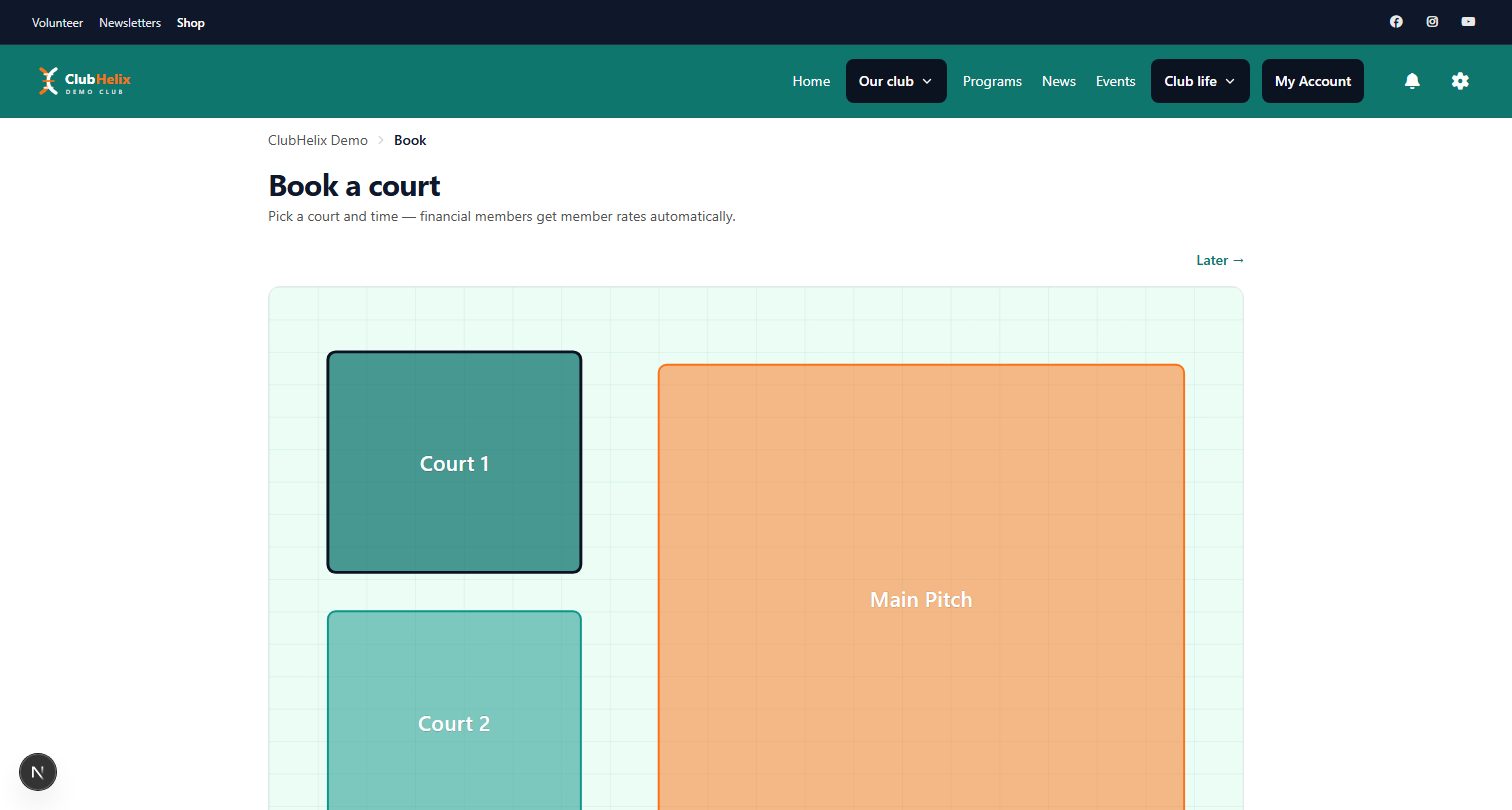
Setting it up is a handful of decisions rather than a project: slot length, who counts as a member, what a visitor pays, how far ahead people can book and what happens when they cancel. We've written those up in how to set up online court booking. And if your social sessions sell places on a court rather than the court itself, sharing a facility between bookings covers the capacity side — a price per place and a grid that shows how many are left.
Committee and volunteers
A tennis club committee is standard in shape — president, secretary, treasurer — but two portfolios deserve special attention:
- Court/facilities coordinator — owns the maintenance schedule, liaises with council, and keeps the sinking-fund conversation alive at committee meetings.
- Competition/pennant secretary — enters teams, manages selection and fill-ins, and is the contact point with the association. In season this is a genuinely weekly job, so don't bolt it onto the club secretary's role.
Beyond the committee, the jobs that need bodies are working bees (court sweeping, garden beds, clubhouse cleaning), Saturday afternoon tea rosters, and junior competition supervision. The trick is to slice roles small — see how to recruit club volunteers for the playbook.
Membership and fees
Tennis suits a layered membership structure better than almost any sport, because people use the club in very different ways. A typical set of categories:
| Category | Who it suits | Usually includes |
|---|---|---|
| Full / senior | Regular players, pennant players | All court access, competition eligibility, voting rights |
| Midweek | Daytime social players | Court access on weekdays, midweek comps |
| Junior | School-age players | Junior coaching pathway, junior comp, restricted booking times |
| Family | Households with several players | Bundled pricing across the above |
| Night comp only | Adults who only play one league night | Entry to that competition, no general court access |
| Social / non-playing | Ex-players, parents, supporters | Clubhouse and social events, no court booking |
Price the gaps deliberately: the jump from "night comp only" to full membership should feel like an upgrade worth making. For how to think about the numbers, read how much should club membership cost.
Take it all online. Paper forms and bank-transfer chasing are where treasurer hours disappear; online registration with card payment, automatic renewals and a live members list means your registrar's job becomes checking a dashboard, not reconciling a spreadsheet.
Coaching and the junior pathway
Most clubs don't employ a coach — they partner with an accredited coaching professional who runs their business at your courts. Put the arrangement in writing: which courts and times the coach has, what they pay (flat court hire, a per-term fee, or a revenue share), and what they give back (free come-and-try sessions, a discounted intro program for new junior members, help on open days).
The junior pathway is your membership pipeline: modified-ball beginner programs feed into junior squads, junior squads feed into junior Saturday comp, and junior comp players become your pennant side in a decade. Track the handover points — the biggest leak is usually between "finished the beginner program" and "joined the club as a junior member". A follow-up email to every graduating family, with a join link, plugs it. Our guide on how to increase junior participation goes deeper.
The season: pennant, club champs and social tennis
A healthy tennis club runs three layers of play:
-
Pennant / association competition. Weekend and midweek teams entered through your association. The pennant secretary's weekly rhythm: confirm availability, pick teams, publish selection, arrange fill-ins, submit results. Publish teams and fixtures on your club site rather than in a private chat thread, so new players can actually find them — ClubHelix competition and fixture tools handle fixtures, results and ladders on your own website.
-
Club championships. An annual singles/doubles knockout builds identity and gives your honour board fresh names. Run it over a defined window with a published draw and deadlines per round, or it will drift into March.
-
Social play and night comp. Organised social sessions (mixed doubles round robins, cardio-style group sessions, twilight tennis with a barbecue) are what keep non-competitive members renewing. Give each a fixed weekly slot so it becomes habit.

Communication and the club website
Tennis clubs juggle several audiences — pennant players, midweek social players, junior parents, casual court hirers — and each needs different information. A weekly rhythm that works: selections and fixtures published mid-week, a short club-wide email fortnightly or monthly, and urgent notices (washed-out courts, comp cancellations) by SMS or push notification rather than an email nobody reads at 7am Saturday.
Your tennis club website is the front door for every one of those audiences plus the most important one: people who haven't joined yet. It should answer, without a phone call — where the courts are, how to book one, what membership costs, how juniors start, and how to contact the coach. If your current site can't do that (or nobody knows the password to update it), see how to build a sports club website and the ClubHelix tennis club management software page for what a modern setup looks like.
Money and fundraising
Tennis club income is pleasantly diverse: membership fees, court hire from casuals, coaching arrangement fees, night comp entry, canteen/bar takings and sponsorship. The cost side is dominated by court maintenance, utilities (lights), insurance and affiliation.
Three practical habits:
- Run a sinking fund for resurfacing. Divide the expected resurface cost by years of surface life remaining and treat that as an annual expense now, not a crisis later.
- Charge properly for casual court hire. Online booking with payment up front turns idle daytime courts into steady income with zero volunteer effort.
- Court-side sponsorship. Fence signage on a busy court complex is genuinely valuable to local businesses — see how to get sponsors for a sports club.
Budget it all annually — the club budget template is a good starting point.
Bringing it together online
Most of the work above — memberships, court bookings, comp fixtures, event RSVPs, club emails — is admin, and admin is exactly what tennis club management software should absorb. ClubHelix gives your club a professional website with court booking, online registration and renewals, competition fixtures and ladders, events and email built in, with a free tier to start on — see pricing or create your club site in an afternoon.
Frequently asked questions
What's the most important thing to get right when running a tennis club?
Court utilisation. Well-maintained, well-lit courts that are easy to book — by members and casual hirers alike — drive membership, coaching, competition and income. Most other problems trace back to courts that are hard to access or hard to book.
How should a tennis club handle court bookings?
Online, self-service, from any phone — with member and casual pricing, payment collected up front for casual hire, and automatic blocks for coaching, pennant and club sessions. Paper sheets and text-the-secretary systems waste court hours and volunteer time.
What membership categories should a tennis club offer?
Most clubs run full/senior, midweek, junior, family and a night-competition-only category, plus a social non-playing tier. The layered structure works because members use a tennis club in very different ways — price the gap so upgrading to full membership is attractive.
Does a small tennis club really need a website?
Yes — it's where prospective members check membership prices, parents find junior programs, and casuals book courts. A club site with online registration and court booking replaces the phone calls and paperwork that burn out volunteers.


