
What this guide answers
- How do you run a gaming club night that suits both video gamers and board gamers?
Zone the room and rotate the anchor activity. Give consoles their own loud corner, board games a bright and quiet set of tables, and PCs the heavy-power end of the hall, then schedule one briefed anchor activity a…
- What do you need to check about a venue before booking a gaming club night?
Tables and chairs, lighting you can vary, storage on site, level load-in access with parking, kitchen facilities, noise tolerance late in the evening, and — most overlooked — how many electrical circuits the outlets…
- How should a club manage shared gaming equipment?
Keep a register with an asset ID, serial number, purchase details, ownership, condition, inspection date and loan status for every item.
- How do you enforce a code of conduct in a mixed-age club?
Split the code into people, content and space, publish a numbered consequence ladder, and require two committee members for any decision beyond a quiet word.
- How much should a community gaming club charge?
Work backwards from venue hire. Take your annual fixed cost, divide it by an honest average attendance rather than your best night, and set a membership plus small door fee that clears it with margin for the equipment…
South Africa edition. This guide is written for volunteer-run clubs in South Africa. Where rules differ — grants, tax, incorporation, safeguarding — follow the South Africa-specific pointers below or check with your national body.
Twenty to seven on a Friday. Six trestle tables are up, a projector is displaying the wrong input, two people are running an extension lead somewhere it should not go, and a fourteen-year-old is standing in the doorway holding a deck box, waiting for someone to tell him where to sit. At the far table, three members in their sixties are setting up a wargame that will take four hours. In the corner, four teenagers want the console on and want it loud.
That is the actual problem a gaming club solves. Not games — games look after themselves. The problem is that four incompatible audiences share one room, one power supply and one three-hour window, and that your membership spans from thirteen to sixty with everything in between. A club that programs for only one of those groups is a club that will slowly become that one group.
This guide is for the person setting up or steadying a broad-church community gaming club: video games across console and PC, board games, card games, and the social membership around them. It covers programming a night that works for all of them, the unglamorous venue-power-and-screens layer, running an equipment library without losing half of it, and writing a code of conduct that your volunteers will genuinely enforce. If your club is heading towards competitive team play, how to run an esports club picks up where this one stops.
Know who actually turns up
Before you plan anything, name your segments. Most community gaming clubs have four or five, and each wants something physically different from the same room.
| Segment | Wants | Needs from the room | Noise |
|---|---|---|---|
| Console players | Couch multiplayer, tournaments | Screens, seating, power, controllers | Loud |
| PC and LAN players | Their own rig, low latency, a squad | Heavy power, wired network, desk depth | Medium |
| Board gamers | A four-hour game and a flat surface | Big tables, bright light, chairs, quiet | Quiet |
| Card game players | Regular opponents, a small league | Small tables, space to spread, storage | Medium |
| Social and lapsed | Company, a cup of tea, a short game | A place to sit that is not a screen | Quiet |
The incompatibilities are obvious once written down: the console corner is loud, the board game table needs quiet and light, and the LAN row eats power and space. You are not going to reconcile those with goodwill. You reconcile them with zones and a schedule.
Add one more space that clubs rarely plan and always need: a decompression corner — a few chairs away from every screen, with nothing happening. Teenagers who need ten minutes out, neurodivergent members who find the noise level hard after two hours, and parents waiting for a pickup all use it. It costs you three chairs and buys you retention you will never be able to measure.
Programming a night that works for everybody
The pattern that holds a broad membership together is anchor plus drift. One scheduled anchor activity per night that is briefed, timed and finished on schedule, and everything else free-form around it. The anchor gives newcomers something to join without knowing anybody; the drift gives regulars the freedom that made them regulars.
Rotate the anchor so no segment ever waits more than a month:
| Week | Anchor | Runs for | Who it pulls in |
|---|---|---|---|
| Week 1 | Console tournament, short set | 60-75 min | Console players, teens, drop-ins |
| Week 2 | Learn-to-play board game hour | 60 min | Newcomers, social members |
| Week 3 | Card game league round | 90 min | Card players, competitive types |
| Week 4 | Bring-a-game or retro night | Free-form | Everyone, especially lapsed |
Then run the same shape every week so nobody has to think:
| Time | What happens | Who |
|---|---|---|
| 17:30 | Setup crew in — tables out, zones marked with signs, power run | 3 volunteers |
| 18:00 | Kit out of storage, consoles on, library table opened | Kit officer |
| 18:15 | Doors open, greeter on the door, sign-in, name labels for newcomers | Greeter |
| 18:30 | Learn-to-play table starts a short game for anyone new | Host |
| 19:15 | Anchor activity briefed and started | Anchor host |
| 20:30 | Break — announcements, two minutes maximum, then food | President |
| 20:45 | Second block — free play, tournament finals | — |
| 22:00 | Last game called | Host |
| 22:10 | Pack-down, kit checked back in, everybody stacks a chair | Everyone |
Three details do the heavy lifting. A greeter on the door — one named person whose entire job is to catch anybody arriving alone, learn their name, and physically walk them to a table. A learn-to-play table every single week, with three short games that teach in five minutes, because a newcomer who watches for two hours never comes back. And the two-minute announcement rule, because the fastest way to lose a room of gamers is a committee member with a microphone and an agenda.
Publish the schedule where people can see it without joining a chat group. A public events list on your own site, with each night listed and members marking themselves as coming, tells your setup crew whether to put out six tables or twelve — RSVPs and attendance turn that from a guess into a number, and events let you take ticket money for the bigger nights.

Venue, power and screens
The venue decides what kind of club you can be. Score candidates on the things that actually bite rather than the things that look nice in a photograph.
| What to check | Why it matters |
|---|---|
| Tables and chairs | Included, or you are transporting trestles every week |
| Lighting | Board gamers need bright, screens need dimmable — you want both zones |
| Power outlets | Number, spread and which circuits they sit on |
| Storage on site | The difference between a two-person setup and a five-person one |
| Load-in access | Level access and parking near the door, or your kit officer will quit |
| Kitchen or urn | Tea, coffee and a warm room hold the social membership |
| Noise tolerance | Neighbouring hires, curfews, whether you can be loud at nine |
| Booking stability | A regular weekly slot beats a cheaper venue you get bumped from |
Power is the constraint people underestimate. As an illustrative example, a gaming PC with a monitor can draw somewhere between 300 and 500 watts under load; six such setups plus a switch, a projector and an urn can push past 3,000 watts. A single general-purpose circuit in an older community hall may be rated around 2,400 watts. Two consequences follow: spread heavy loads across outlets on different circuits rather than clustering them on the nearest wall, and never daisy-chain power boards to get there. Ask the venue which outlets are on which circuit before your first night, and if you cannot get a straight answer, ask them to have it checked by a qualified electrician. This is general guidance — the venue's own rules and local electrical requirements always win.
Electrical safety expectations vary by venue, and scheduled power outages are the bigger operational problem — a night that ends abruptly at half past eight is a night members stop attending. Check the local schedule against your club night, ask the venue whether it has backup power, and keep a plan for switching to tabletop and handheld play when the screens go dark.
Screens and network. Two or three large screens on stands will serve a console zone better than one projector, because a projector needs darkness and darkness kills the board game tables. For LAN nights, bring your own switch and cabling and do not rely on venue wireless — it will be shared with whoever else is in the building. Label every cable at both ends; the club that labels cables packs down in twenty minutes and the club that does not takes an hour.
The equipment library
Sooner or later your club owns things: consoles, controllers, a switch, screens, a shelf of board games, a bin of cables, an urn. Without a register, all of it slowly becomes somebody's personal property or disappears entirely.
Keep one list, and keep these fields against every item.
| Field | Why it earns its place |
|---|---|
| Asset ID and item | So the loan record points at a specific controller |
| Serial number | Insurance and theft claims need it |
| Purchase date, cost | Depreciation, replacement planning, grant acquittals |
| Ownership | Club-owned, donated, or a member's — this causes disputes |
| Condition and notes | The drift-free record of what is already broken |
| Inspection date | Electrical testing and safety checks |
| Storage location | Which crate, which cupboard |
| Loan status | Out with whom, since when, due back when |
Then write three rules and put them on the lending sheet. Members borrow, not guests — a lending policy needs a member record behind it. Two weeks, then it comes back regardless of whether anybody is waiting, because open-ended loans never return. Condition photos at both ends, taken by the kit officer, which ends every argument before it starts.
Two more habits worth building. Mark member-owned items that regularly appear at the club with a coloured sticker and record whose they are, because a bring-your-own culture and a club library merge within a year otherwise. And retire equipment deliberately — a console two generations old that nobody has switched on for six months should be raffled off or sold to fund something people will use. The club equipment register template is a workable starting structure, and does our club need insurance is worth reading once your library is worth more than a few hundred in kit.
A code of conduct that gets enforced
Most clubs have a code of conduct. Fewer have one anybody has ever applied, and a code that has never been applied is decoration. Three things separate the two.
Write it in three parts, not one.
- People. How members treat each other — harassment, slurs, unwanted contact, pile-ons, and the specific expectation that a competitive game does not license abuse.
- Content. What is on screens and tables in a shared, mixed-age room. In a room with under-eighteens in it, the default sits at what is appropriate for the youngest person present, and anything else belongs at a separate session with its own entry rules.
- Space. Care of equipment and the venue, packing down, food and drink rules, and the club's alcohol position.
Publish a ladder, and name who applies each rung.
| Step | What it is | Who does it | Recorded |
|---|---|---|---|
| 1 | Quiet word during the night | Any committee member or host | Mentally |
| 2 | Formal warning, given privately | Two committee members together | Written, dated |
| 3 | Asked to leave for the evening | Two committee members together | Written, dated |
| 4 | Suspension for a set period | Committee decision | Minuted |
| 5 | Membership ended, with appeal rights | Committee decision | Minuted |
Make two people responsible for every decision above a quiet word. The two-person rule protects the volunteer as much as the member, removes the "he had it in for me" problem, and stops one exhausted host making a call at ten o'clock they will regret. Keep the log in one place that survives committee turnover rather than in the president's phone.
For a club spanning teenagers and adults, add the mixed-age layer explicitly: at least two adults present whenever under-eighteens attend, no member of the committee alone with a young person, a clear photography and clipping policy with an opt-out, and a named contact for concerns who is not the person running the night. Collect agreement to the code at sign-up rather than pinning it to a wall — a short form at joining, re-agreed annually, gives you a dated record for every member. How to run a youth group covers the wider duty-of-care picture if a large part of your membership is school age.
Alcohol is the other line to draw early. Community and school halls frequently prohibit it, and selling any requires the appropriate licence. With under-eighteens attending, most clubs run the main night dry and hold any social with drinks separately at a licensed venue. Confirm the position with the venue and the relevant authority before advertising anything. General information only.
The door, the subs and the money
Gaming club finances are small and unforgiving: venue hire is fixed and arrives whether twelve people come or forty.
Most clubs run one of three models, and the third is usually the answer.
- Door fee only. Simple, welcoming to drop-ins, and impossible to budget against.
- Annual membership only. Predictable, but it discourages the curious visitor who becomes next year's treasurer.
- Membership plus a small door fee, with the first two visits free. Predictable base income, a low barrier to trying it, and a clean answer to "am I a member?"
A worked example of the arithmetic, using illustrative figures: if a hall costs the equivalent of two and a half hours of a part-time wage per night and you run 44 nights a year, that is your entire fixed cost. Divide it by an honest average attendance — not your best night — and you have the per-head number your door fee has to beat. Anything above it funds the equipment library, and the library is what makes the club feel like a club rather than a room booking.
Two income lines are worth adding once you are stable. A snack and drink table run at a small margin, which pays for itself and gives shy members a job. And an annual games auction or bring-and-buy, where members sell games they have finished with and the club takes a small cut — it is popular, it costs nothing to run, and it recycles shelf space.
For venue hire in South Africa, community halls, school halls, church halls and sports club function rooms are the usual options, and school halls often come with existing security arrangements that matter for an evening event. Ask about backup power specifically, and about the security arrangement for members arriving and leaving after dark — both shape which venue is actually workable.
Growing without breaking what people came for
Every successful gaming club hits the same wall: the night gets busy, the room gets loud, the board gamers stop coming, and nobody can work out what changed. Three responses, in order of preference.
Cap the night and add a second one. Two nights of thirty is a healthier club than one night of sixty, and the second night can carry a different flavour — a quieter tabletop night, a family-friendly early session, an adults-only late one.
Split by interest, not by ability. A card league that meets on its own night still belongs to the same club, shares the same membership and shows up in the same accounts. Sections keep specialists happy without fragmenting your organisation.
Move rooms only when you have the volunteers. A bigger venue is more setup, more cost and more moderation load. If your committee is four people and two of them are the same person's parents, a bigger room will break you.
Watch the founder bottleneck as well. Clubs like this are usually started by one person who owns the kit, holds the keys, knows the venue manager and runs the schedule. Write down what they do, split it into a kit officer, a venue liaison, a night host and a treasurer, and hand the pieces over while everybody is still enjoying it — committee handover checklist is the practical version of that conversation, and how to run a club with no time is worth a read if this is all currently one person.
One place for the roster, the register and the room
The admin behind a good gaming night is small but relentless: who is coming so you know how many tables to put out, who has paid, who agreed to the code of conduct, who has the projector this week, and what happened at the last committee meeting. Spread across a chat group, a spreadsheet and one person's memory, it quietly becomes a job. On one club site it becomes a glance — nights listed as events with RSVPs, attendance marked on the door, membership and code agreement collected through a form at sign-up, and club channels that belong to your members rather than to whoever still has an invite link.
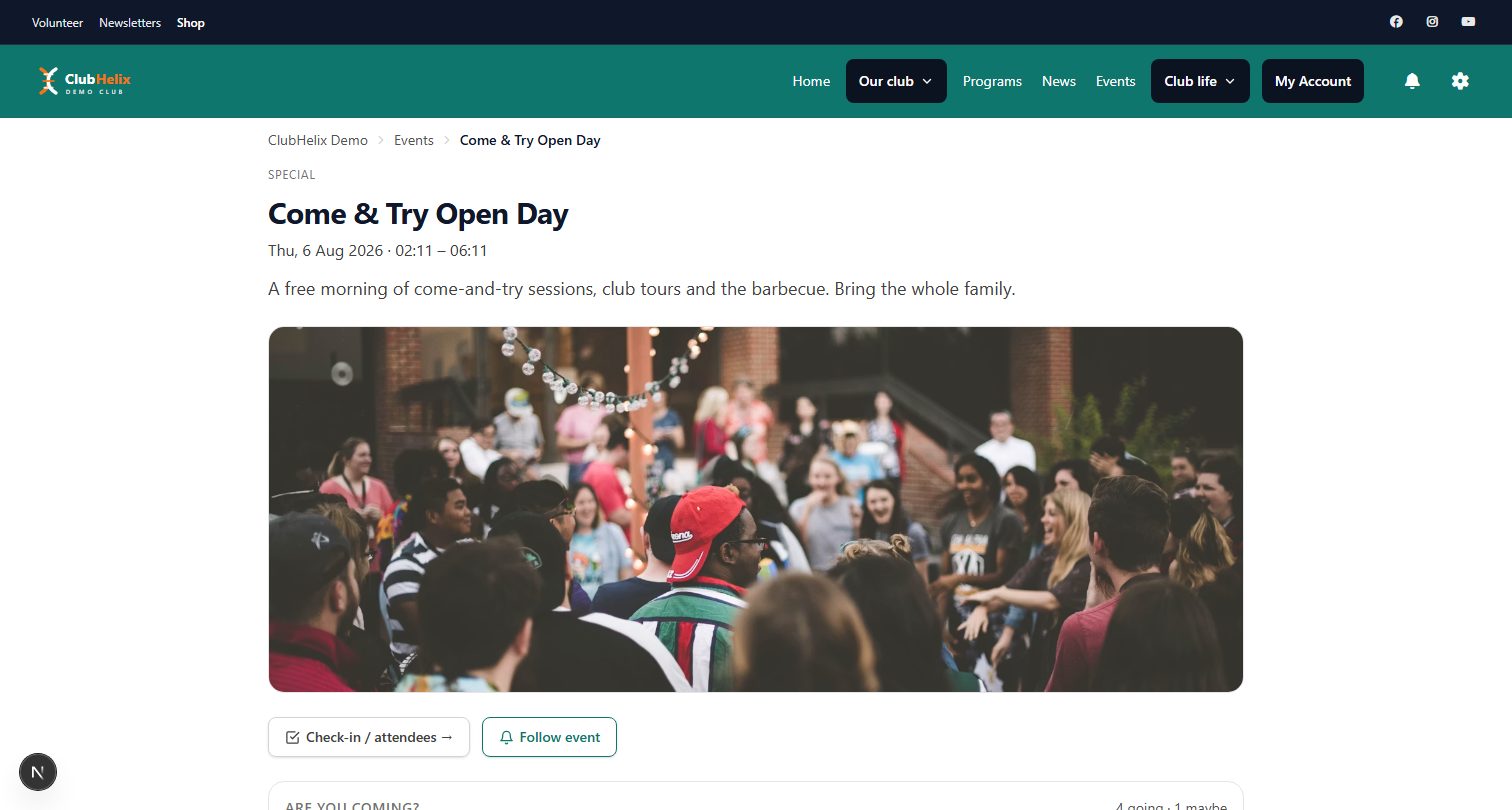
ClubHelix is made for volunteer-run community groups exactly this size — a free tier that carries a small club comfortably, honest pricing if you grow past it, and a proper website instead of a social media page nobody can find. Give your club a home online and get started in an evening, somewhere between putting the tables away and locking the hall.
Frequently asked questions
How do you run a gaming club night that suits both video gamers and board gamers?
Zone the room and rotate the anchor activity. Give consoles their own loud corner, board games a bright and quiet set of tables, and PCs the heavy-power end of the hall, then schedule one briefed anchor activity a night and rotate which segment it serves week to week. Add a learn-to-play table every week so newcomers always have a way in.
What do you need to check about a venue before booking a gaming club night?
Tables and chairs, lighting you can vary, storage on site, level load-in access with parking, kitchen facilities, noise tolerance late in the evening, and — most overlooked — how many electrical circuits the outlets sit on. Ask which outlets share a circuit before you plan a heavy setup, and follow the venue's rules on equipment testing.
How should a club manage shared gaming equipment?
Keep a register with an asset ID, serial number, purchase details, ownership, condition, inspection date and loan status for every item. Lend only to members, cap loans at a fixed period, photograph condition at both ends, and retire equipment nobody uses so the money goes into things people actually play.
How do you enforce a code of conduct in a mixed-age club?
Split the code into people, content and space, publish a numbered consequence ladder, and require two committee members for any decision beyond a quiet word. Keep a written log that survives committee turnover, set content expectations to suit the youngest person in the room, and collect agreement to the code at sign-up so every member has a dated record.
How much should a community gaming club charge?
Work backwards from venue hire. Take your annual fixed cost, divide it by an honest average attendance rather than your best night, and set a membership plus small door fee that clears it with margin for the equipment library. Making the first visit or two free costs very little and converts far more visitors than a discount ever will.
Keep reading — how to run an esports club if competitive squads are forming, and how to start a social club for the wider community-club playbook.


