
What this guide answers
- How does a disc golf club make money if the course is free?
Through membership that buys competition and belonging rather than access, league entry fees, disc and merchandise sales, one or two tournaments a year, basket and hole sponsorship, and grants for course infrastructure.
- Who is responsible for maintaining a disc golf course?
It depends entirely on the agreement with the landowner, which is why having that agreement in writing matters so much.
- How do you run a fair disc golf doubles league?
Use random draw partners with an A-pool and B-pool split so every less experienced player is paired with a stronger one, publish the format and the start time weekly, and add a handicap based on each player's recent…
- How do you calculate a disc golf handicap?
8 and round to the nearest throw. Require a minimum number of recorded rounds before someone is eligible for handicap prizes, and cap the maximum handicap so no one can win purely on adjustment.
- Does a disc golf club need a website?
Yes, because the course itself is anonymous. A site gives you a permanent home for the course map, league times, membership prices, results and the season pointscore, and it is what people find when they search for the…
On a Saturday morning there are four groups waiting on the first tee. Three of them have never heard of your club. They are playing on baskets your members installed, past tee signs your treasurer paid for, on land the club does not own, and they will walk off after eighteen holes without giving you a cent. That is not a failure. That is disc golf working exactly as intended — and it is also the strategic problem at the centre of every disc golf club.
Almost every other club in community sport controls access to something. A tennis club has a gate. A bowls club has a green. You have a public park with your equipment bolted into it, permanently open, free to everyone. So a disc golf club cannot sell access. It sells three things instead: competition, course care and belonging. Get those right and a healthy proportion of the people on your course will choose to pay for something they could keep getting for nothing.
This guide is for the committee running that balancing act — the landowner relationship and the maintenance obligations that come with it, the weekly doubles league that is the club's heartbeat, a handicap system that keeps beginners coming back, and the conversion path that turns a Saturday-morning stranger into a member who renews.
Why anyone pays to join a free course
Start by writing down what a membership actually buys, because if the committee cannot answer that in one sentence, the sign-up page never will either. What a membership is worth usually breaks down like this.
| What you sell | What it means in practice |
|---|---|
| Competition | Weekly league with a published pointscore, a tag chase, a club championship and a handicap that gives everyone a real chance |
| Course care | Members fund and do the maintenance — new chains, tee signage, clearing after storms |
| Belonging | A club name on a disc, a shirt, results with your name in them, people who notice when you miss a week |
| Voice | A say in course design, hole placement and where the next basket goes |
| Discounts | Cheaper league entry, discounted discs, priority entry to the club tournament |
Notice that none of that is access. Members are buying a better version of a thing they already get free, which means your pricing needs to sit low enough that joining is an easy yes and your league needs to be genuinely good. A club that charges a serious annual fee and runs a scrappy league every third week has the value equation backwards.
Most clubs affiliate through their state association to the national body, which handles sanctioned events, national rankings and the tournament calendar, and which usually connects you to public liability cover that councils will ask about before renewing a course agreement. Community clubs are typically incorporated associations under state legislation — incorporation is what lets the club hold an agreement over the course rather than a member holding it personally.
The landowner relationship is the club
Your baskets sit on land somebody else controls, and the agreement covering them is the single most important document your club holds. Clubs lose courses over complaints, insurance gaps and unanswered emails far more often than they lose them over money.
Most courses sit on council reserve land under a licence, a memorandum of understanding or an informal permission granted years ago by a parks officer who has since moved on. If yours is informal, fixing that is your most valuable off-season project — a written agreement survives staff turnover, an informal one does not.
Whatever form the agreement takes, aim to have these things written down and reviewed annually:
- Who owns the equipment and who is responsible for removing it if the agreement ends.
- Maintenance obligations — mowing, path clearing, tree work, rubbish, and who does what.
- Insurance — the cover the club holds, the certificate provided to the landowner, and the renewal date.
- Signage — what may be installed, where, and to whose standard.
- Incident handling — how a member of the public reports a near-miss or damage, and who responds.
- Course changes — the process for moving a basket, adding a hole or felling a branch.
Then be the easiest tenant the parks team has. Log incidents properly, respond to complaints the same week, and send a short annual report — rounds played, working bees held, volunteer hours contributed, events run. That report is what your parks contact takes to their manager when someone asks why discs are flying near a walking track.

Baskets, tee pads and signage: a maintenance system, not a working bee
Course equipment fails slowly and then embarrassingly. A schedule beats enthusiasm, and it also gives you the volunteer jobs that people who will never join a committee are happy to do.
| Asset | Check | Frequency |
|---|---|---|
| Baskets | Chains straight and complete, band undamaged, bolts tight, sleeve firm in the ground | Monthly, and after any storm |
| Tee pads | Surface intact, edges not lifting, no slip hazard, weeds cleared | Quarterly |
| Tee signs | Legible, correct distance and par, hole map still accurate, club contact and website visible | Twice a year |
| Fairway sightlines | Low branches, regrowth blocking the landing zone, blind shots over paths | Seasonally, plus after growth flushes |
| Safety zones | Distance to paths, playgrounds, car parks and neighbouring properties; warning signage | Annually and after every reported near-miss |
| Out-of-bounds and mando markers | Present, visible, matching the published scorecard | Before each season and before events |
| Bins and litter | Emptied or reported, plus a rubbish sweep of the fairways | Weekly if you can |
Keep an asset register alongside it: each basket numbered, install date, last chain replacement, expected life, replacement cost. That register is what turns "we need money for baskets" into a fundable request with numbers attached — the club equipment register template has a structure you can copy. Set aside a fixed amount per member per year for equipment replacement and treat it as an expense, not a surplus.
Run two big working bees a year and keep them short, scheduled and social — two hours, published tasks, a barbecue afterwards, tools listed in advance so people bring what is needed. How to organise a working bee covers the run sheet, the safety briefing and the follow-up. Between those, a small "course crew" of three or four people doing monthly checks does more good than one heroic weekend a year.
Tee signage deserves its own thought, because it is the only marketing that reaches players at the moment they are enjoying themselves. Every sign should carry the hole map and distance, and the club name and web address. One sign at hole one should carry a scannable code that opens your join page or your league calendar — that single sign is the highest-converting thing most disc golf clubs own, and how to use a QR code for your club website explains how to do it without printing a dead link.
League night: formats, scoring and a handicap that keeps beginners
Weekly doubles is the engine of the club. It is low commitment, it pairs a beginner with an experienced player automatically, and it produces the results and the pointscore that make membership feel like something.
| Format | How it works | Pace | Suits |
|---|---|---|---|
| Random draw doubles | Partners drawn on the night, often A-pool with B-pool | Fast | Weekly league, mixed abilities |
| Best shot | Both throw, play the better lie | Fast | Beginners, big fields |
| Alternate shot | Partners alternate throws | Medium | Experienced pairs |
| Worst shot | Both throw, play the worse lie | Slow | Small, keen fields |
| Singles handicap | Individual scores adjusted by handicap | Medium | Club championship rounds |
| Match play | Hole-by-hole rather than total strokes | Medium | Finals and knockout nights |
Random draw doubles with an A-pool and B-pool split is the default for a reason: it guarantees every newer player spends two hours with someone who can teach them, which is the fastest development pathway the sport has.
A handicap worked in ten minutes
Handicaps are what stop your league becoming the same four players sharing the trophies. A simple system that clubs can actually maintain:
- Record every league round as a raw score against course par.
- Take each player's best five of their last ten rounds and average them.
- Handicap = (average − par) × 0.8, rounded to the nearest whole throw.
- Cap the handicap so nobody can win on adjustment alone, and require a minimum of five recorded rounds before a player is eligible for handicap prizes.
An illustrative example on a par 54 course:
| Player | Average of best five | Raw calculation | Handicap | Raw round | Net score |
|---|---|---|---|---|---|
| A | 52 | (52 − 54) × 0.8 | 0 | 51 | 51 |
| B | 58 | (58 − 54) × 0.8 | 3 | 57 | 54 |
| C | 64 | (64 − 54) × 0.8 | 8 | 62 | 54 |
| D | 71 | (71 − 54) × 0.8 | 14 | 66 | 52 |
Player D, who is nowhere near the best player, wins the night — and comes back next week. That is the entire point.
Run scoring one way and one way only. Nominate a scorer per card, collect the cards at the end, and publish the results the same night with the pointscore updated. Half the value of a league is that the results exist somewhere public by the time people get home. Where you also run a tag chase — numbered tags that change hands based on results — publish the current tag holders on the same page, because a tag chase nobody can look up quietly dies.
A note on money on the night: ace pots, cash payouts and prize pools are treated differently depending on where your club sits, and some arrangements fall under gambling or tax rules. Treat this as general information, check the rules that apply in your jurisdiction, and if you want the fun without the complication, run prizes as discs and club credit rather than cash.
Turning casual players into paying members
This is the discipline that separates clubs that grow from clubs that plateau. You cannot convert people you never meet, so build a funnel that starts on the course itself.
| Stage | Where it happens | The ask |
|---|---|---|
| Stranger | Hole one, tee sign with a scannable code | Look at the course map and the league times |
| Visitor | League night, first round free | Give us your email at check-in |
| Casual player | Pays league entry a few weeks running | Join and league entry drops |
| Member | Tag, shirt, discounted discs, club events | Renew, and bring someone |
| Contributor | Working bee, running a card, event day | Take a small named job |
Four things make it work in practice. Make the first league night free and say so on the sign. Take an email address at check-in with a phone rather than a clipboard, so the list is usable. Send one message a week — results, next week's format, one course note — because weekly contact is what makes a casual player start thinking of themselves as part of a club. And price membership so that a regular league player saves money by joining: if entry is cheaper for members, the maths does the persuading for you.
Publish a members-only layer of value too — the club championship, the tag chase, discounted club discs, priority entry to your tournament. None of it excludes anyone from the course, which keeps you on the right side of the public-land agreement, and all of it makes membership mean something. How to grow club membership goes deeper on retention, and how much should club membership cost helps with the number itself.
Set the annual fee in dollars from your equipment register rather than by copying the club down the road. An annual membership that funds one basket replacement a year, with league entry priced a little lower for members, is a number you can explain at the AGM and defend when someone asks what their money did.
Money beyond memberships
Disc golf clubs have four reliable income lines beyond subscriptions, and one of them is unusually good.
- Discs. Every player needs plastic and most buy more than they need. A club that stocks a small range of stamped club discs and sells them at league night, at events and through an online shop turns a hobby into working capital. Stamped discs also travel — every one is a moving advertisement for your course.
- Tournaments. One well-run event a year, with entries taken and paid online, can fund a season of maintenance. Cap the field to what your course can handle, publish the schedule and the payout structure in advance, and recruit a volunteer per hole for the safety-critical spots.
- Sponsorship. Basket sponsorship is the natural product — a plate on the basket, a logo on the tee sign, a named hole. It is tangible, it is cheap to deliver and it lasts for years. How to get sponsors for a sports club has the approach and the pack.
- Grants and in-kind support. Course infrastructure — baskets, tee pads, signage, path work — is exactly the kind of capital item community funding programs exist for, and your landowner is often willing to be a partner on the application.
Local council community grants and state government sport and recreation infrastructure programs are the two most common sources for course work, and both usually want a written landowner agreement, quotes and evidence of community benefit. Start with grants for sports clubs and build the application into your calendar rather than reacting to a deadline.
Being findable when your course is your shopfront
Every week people play your course and go home having no idea a club exists. Meanwhile people search for the sport and their town and find a forum post from four years ago. Fixing both is mostly a matter of having one page that answers the obvious questions and keeping it current: where the course starts, how long a round takes, what league night is and when, what it costs, and how to join.
Publish the course itself properly — a hole-by-hole layout with distances and pars, the parking spot, and a note about which holes cross paths. Publish results and the running pointscore the night they happen, so the league has visible momentum. And keep an events page for the tournament, the working bees and the club championship, so a casual player who is curious has somewhere to look other than a chat group they cannot see.
Getting the club off the clipboard
The admin of a disc golf club is small but relentless: memberships and renewals, weekly league entries and scores, the pointscore and handicaps, the tag chase, the equipment register, working-bee sign-ups and one tournament a year. ClubHelix runs that from a club website you control — event pages that take entries and payment for league nights, the club championship and the tournament, news posts that put the night's results and the running pointscore on your site before people get home, online registration and payments for memberships, and a club shop for stamped discs and merchandise that funds the next set of chains.
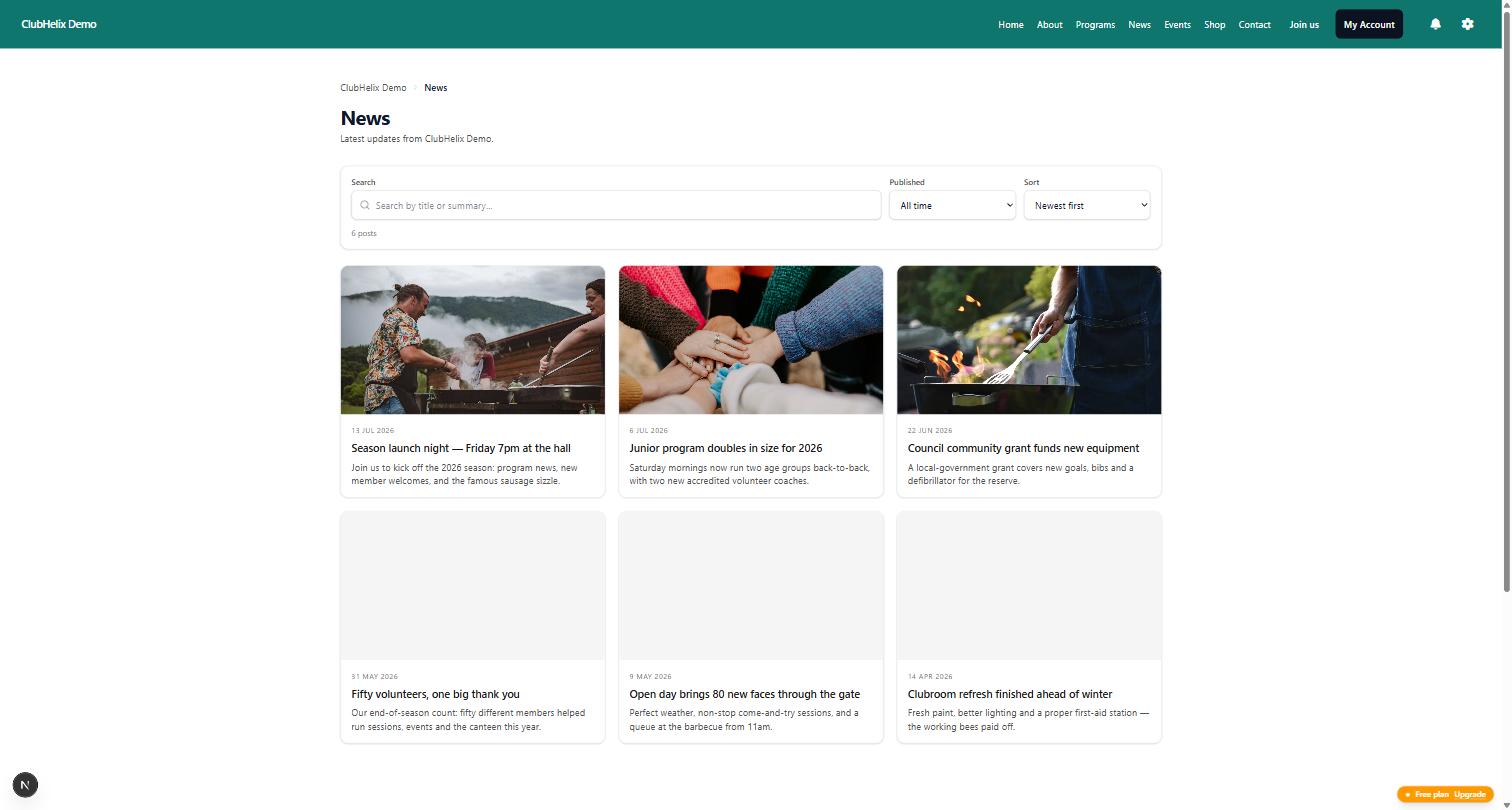
You can begin on the free tier and still have a members list, a league night taking entries and a tag chase running by your next doubles night, with what each paid tier adds laid out on the pricing page so the committee can vote on a real number. Set up your club site, then point the code on your hole-one sign straight at the join page — that sign is already doing your recruiting, so it may as well land somewhere that takes a payment. Our disc golf club management software page shows the whole setup for a course and its league nights, and the golf club management software page shows it arranged for the stick-and-ball version of the sport.
Frequently asked questions
How does a disc golf club make money if the course is free?
Through membership that buys competition and belonging rather than access, league entry fees, disc and merchandise sales, one or two tournaments a year, basket and hole sponsorship, and grants for course infrastructure. The key move is making membership visibly cheaper for anyone who plays league regularly, so joining is the rational choice rather than a donation.
Who is responsible for maintaining a disc golf course?
It depends entirely on the agreement with the landowner, which is why having that agreement in writing matters so much. Typically the landowner mows and manages trees while the club maintains baskets, tee pads, signage and course furniture — but the split should be documented and reviewed annually rather than assumed.
How do you run a fair disc golf doubles league?
Use random draw partners with an A-pool and B-pool split so every less experienced player is paired with a stronger one, publish the format and the start time weekly, and add a handicap based on each player's recent rounds so newer players can genuinely win. Publish results and the running pointscore the same night.
How do you calculate a disc golf handicap?
A workable club method is to average a player's best five of their last ten recorded rounds, subtract course par, multiply by around 0.8 and round to the nearest throw. Require a minimum number of recorded rounds before someone is eligible for handicap prizes, and cap the maximum handicap so no one can win purely on adjustment.
Does a disc golf club need a website?
Yes, because the course itself is anonymous. A site gives you a permanent home for the course map, league times, membership prices, results and the season pointscore, and it is what people find when they search for the sport in your area. It also survives committee turnover, which a chat group does not.
Keep reading: how to organise a working bee for the course-crew side of things, and how to run an ultimate frisbee club if your club shares volunteers with the other disc sport in town.


