
What this guide answers
- Do you need to audition to join a community choir?
It depends entirely on the choir, which is why every choir should say so plainly on its website.
- How much should choir subs be?
Enough to cover weekly hall hire, the musical director and the accompanist across the term, divided by a realistic number of paying members rather than your best-ever attendance.
- Does a choir need a licence to perform copyright music?
Public performance of copyright works generally requires a licence, but very often the venue already holds one that covers your concert — so the first step is always to ask the venue in writing exactly what its licence…
- How do you fix a choir that is short of tenors?
Recruit for the part, not for the choir. A specific invitation — naming the part, promising no audition, and offering three rehearsals with no obligation — converts far better than a general call for members.
- What does a choir committee actually need to do each week?
Very little, if the systems are right. Someone marks the register, someone answers the enquiries that came in through the website, and the librarian hands out anything new.
Tuesday, seven o'clock, a hall with a piano that is nearly in tune. Forty-one names on the roll, twenty-eight people in the room, and nineteen of them are sopranos. The musical director wants to run the second movement, but a third of the altos have not seen it yet because the folders were in someone's boot last week. The treasurer is standing by the door with a receipt book, because eleven people have still not paid their subs for the term.
None of that is a crisis. That is a community choir in its ordinary state. What separates the choirs that grow from the ones that quietly fold after a bad year is almost never talent — it is whether the unglamorous things happen reliably. Whether the register is taken and read. Whether the music is in hands before the rehearsal that needs it. Whether somebody worked out, before the venue deposit went out, how many seats had to sell for the concert to break even.
This guide is for the committee of a non-professional adult choir that runs its own affairs — community and chamber choirs, gospel and show choirs, male voice and women's choirs, workplace choirs and singing groups attached to a hall or a church. It covers rehearsal attendance and part balance, the door policy question that everyone avoids, the three quite separate permissions sitting behind the music on your stands, the money, and putting on a concert that pays for itself.
Decide what kind of choir you are, out loud
Most trouble in a community choir comes from members holding different, unspoken ideas of what they joined. One person came for the singing; another came for a Tuesday night out; a third wants to be pushed. You cannot satisfy all three equally, and pretending otherwise is what makes rehearsals feel disappointing to everyone.
Pick a position and publish it in one sentence on your website and your join form.
| Model | Door policy | Rehearsal feel | What it demands of the committee |
|---|---|---|---|
| Open community choir | Anyone, no audition | Teach by ear or by part, repeat often | Great learning resources, patience with turnover |
| Placed community choir | Everyone in, voice check to seat | Confident, mixed reading ability | An honest voice-check process nobody dreads |
| Auditioned chamber choir | Selective, re-auditioned | Fast, high expectation of preparation | A defensible audition standard and a waiting list |
| Themed or repertoire-led | Usually open, style-specific | Driven by one genre and its habits | Programming discipline so you do not drift |
The second column is the one people search for before they contact you. "Do I need to audition?" is the single most common question a choir gets, and a website that answers it plainly converts far better than one that leaves it ambiguous — ambiguity reads as "probably not for me".
Size follows from the model. A chamber choir of twenty-four is a different organisation from a community choir of ninety, and not only musically. At ninety you need section leaders, a second person on the door, a bigger hall, and a real system for subs. Somewhere around fifty, informal administration stops working and the committee starts doing data entry instead of singing.
Rehearsal discipline — attendance, part balance and who you let in
The rehearsal is the product. Members do not renew because of the concert; they renew because of forty Tuesdays. Treat the weekly night as the thing you manage most carefully.
Take the register, every week, and actually read it
A choir register is not bureaucracy — it is your early warning system. Someone who has missed three in a row has usually not decided to leave yet, and a short message at week three ("we missed you, we are on bar 60 of the second piece, here is the learning track") brings people back in a way that a message at week eight never does.
Record four things each week: who was there, which part they sing, who sent apologies, and total heads per part. That last number is what makes the next section possible. Doing this on paper means it is never analysed; doing it on a phone at the start of rehearsal means the pattern is visible by half-term. Digital attendance tracking that any section leader can mark takes about thirty seconds a week and gives the committee a retention dashboard nobody had to build.
Set out the attendance expectation before the term starts, in writing, and keep it humane. A reasonable version reads like this — members are asked to attend at least three-quarters of rehearsals in the lead-up to a concert, must attend the final two rehearsals and the call before a performance, and should tell their section leader when they cannot make it. State what happens if someone falls short — usually "sing from the back", "sit this concert out", or a conversation, not expulsion. What matters is that it is written down before it is needed, not invented in week nine about one particular person.
Part balance is a number, not a feeling
Every mixed choir in the world is short of tenors and long on sopranos. Knowing that is useless; knowing your actual weekly numbers is not.
| Part | Illustrative healthy share of a mixed choir | What it feels like when short |
|---|---|---|
| Soprano | Around a quarter to a third | Rarely short — more often overweighted and too bright |
| Alto | Around a quarter | Harmony sounds hollow, inner lines vanish |
| Tenor | Around a fifth, and usually your gap | The whole texture thins; basses over-sing to compensate |
| Bass | Around a fifth to a quarter | No foundation, and the choir drifts flat |
Those proportions are a rough guide, not a rule — plenty of fine choirs sit outside them deliberately, and voice-only choirs balance differently again. The discipline is to write your own numbers on the committee agenda every month, because balance changes silently. Six altos leaving over two terms will not feel like anything until the day a piece stops working.
When you are short of a part, recruit for the part rather than for the choir. "We are looking for tenors and basses — no audition, come and try three rehearsals" gets a response that "join our choir" never does, because it is a specific invitation rather than a general one. Run a targeted come-and-try night for that part alone, and pair every new low voice with an experienced one for their first month.
Audition, voice placement or open door
There is a middle path most community choirs should take. Not an audition, and not nothing — a voice placement, framed exactly as what it is.
A placement takes ten minutes in a side room with the musical director and one other person. It is announced as "so we can seat you correctly", and it genuinely is. You establish comfortable range, whether the singer reads music or learns by ear, any previous choral experience, and whether they would like to be next to a confident singer or prefer the back row. Nobody is turned away. The output is a line on their member record, not a verdict.
If you do run a selective audition, be rigorous about the human side. Publish the requirements — usually a prepared piece, a range check and a short sight-reading test. Give results privately within a couple of days, never as a list. Offer everyone who misses out a genuine alternative if you have one, and tell them when they can audition again. A choir that handles rejection gracefully keeps those people as audience members and, often, as members two years later.
Store placement results on the member record itself, alongside contact details and emergency contact. When your section leader changes — and it will — the new one should be able to pull a seating plan on day one rather than asking sixty people what part they sing.

The music — buying, hiring and the permissions behind it
This is the part of choir administration that people get wrong most often, usually with good intentions. It helps to see that there are three separate permissions involved, and having one does not give you the others.
One — the right to perform the work in public. Copyright works performed to an audience generally need a performing-right licence. Crucially, that licence is very often held by the venue, not by you, which is why the first thing to do about any concert is to ask the venue in writing what its licence covers and whether it covers a ticketed event by a hiring group.
Two — the right to have copies in your singers' hands. Buying a set, hiring a set and photocopying are three different things, and only the first two are generally available to you. This is the permission choirs most often assume they have.
Three — the right to stage a work dramatically, with costume, movement and character. Staged rights sit outside ordinary concert arrangements and go back to the publisher. If your show choir is doing more than standing and singing, ask about this early rather than at the dress rehearsal.
Recording your concert, streaming it, or putting a rehearsal clip online is a further permission again. Assume nothing carries over.
Buy, hire or borrow
| Source | Suits | Watch out for |
|---|---|---|
| Buy a set outright | Repertoire you will sing for years | Storage, and the cost per copy times ninety |
| Hire a set | Large works you will perform once | Return dates, late fees, and erasing every pencil mark |
| Publisher digital set | Newer works, choirs that learn at home | Per-singer licensing terms — read what sharing is permitted |
| Public domain edition | Older repertoire | Edition quality varies wildly, and modern editions are their own copyright |
| Commissioned or local | New work, choirs with a composer | Get the terms in writing, including future performances |
Two habits save the most grief. First, order hire sets eight weeks before the rehearsal that needs them, not three — the four rehearsals you lose waiting for parts are four rehearsals you never get back, and the temptation to photocopy in the meantime is exactly the trap. Second, number your folders and log who has which one. A choir of sixty loses roughly a folder a term to a house move, and a numbered set with a name against each number turns that from a mystery into a phone call.
Start with the venue. Most established halls, churches and council-run performance spaces already hold a blanket performing-right licence, and the hire agreement usually says so — get it in writing before you announce. Where the venue does not hold one, or where you are performing outdoors or in a space hired for the night, the licence is yours to arrange, and the national performing-right and mechanical-rights bodies are the place to ask. Choirs affiliated to a state or national choral association can usually get plain-English guidance from them too, which is worth more than an afternoon of searching. Treat all of this as general information — confirm your own position with the venue and the relevant licensing body before tickets go on sale, and again if you plan to record or stream.
Money — subs, the concert float and the things that always cost more
A community choir has a simple financial shape and one dangerous feature — most costs land months before any income. The hall deposit, the hire set, the conductor's retainer and the poster print run all happen before a single ticket sells.
Build the budget as two separate ledgers. The running budget is funded by subs and covers weekly hall hire, the musical director, the accompanist, insurance, affiliation and admin. The concert budget is funded by tickets, program sales and any sponsorship, and covers the venue, hire music, printing, and anything technical. Keep them apart on paper, even in one bank account, so a concert that loses money does not silently eat next term's rehearsal hall.
Three habits worth adopting:
- Charge subs by term, not by year. Term billing matches how people actually decide to keep singing, and it removes the awkward mid-year refund conversation when someone moves away.
- Collect online, not at the door. The receipt book on the trestle table costs your treasurer more hours than any other single thing. Online joining and renewals with card payment turn subs collection into a list you check rather than an evening you spend.
- Hold a concert float. Roughly one concert's worth of fixed costs, sitting untouched. It is what lets you book the good hall in February for a November concert without gambling the choir on it.
For a broader look at setting the number, see how much should club membership cost.
Community choir subs in Australia commonly sit somewhere around $120 to $250 per term for a weekly rehearsal, with concession rates for students, pensioners and healthcare card holders — and most choirs quietly waive fees for anyone who asks, which is easier if you have a written hardship line rather than case-by-case awkwardness. On the funding side, local council community grants and state arts and community programs both fund the things choirs actually need — venue hire, a conductor's fees for an outreach project, risers, a keyboard — and many are open to unincorporated groups with an auspicing arrangement. Our guide to grants for sports clubs covers how those rounds work; the same logic applies to community arts funding. Incorporation as an association also unlocks a lot of grant programs, so it is worth doing early.
Putting on a concert that pays for itself
Work out the break-even house before you book anything. It is one line of arithmetic and it changes decisions.
Add your fixed concert costs — venue hire, technical staff, hire music, printing, licensing where it falls to you, and the accompanist or instrumentalists. Divide by your average net ticket price after any booking or card fees. That number is how many seats must sell. If it is more than about half the room, the concert is fragile and you should either cut a cost, raise the price, or find a sponsor before you commit.
A worked example, using illustrative numbers only. A choir hires a hall for 400, pays 350 for two instrumentalists, 180 for hire music and 120 for printing — 1,050 of fixed cost. At an average net ticket of 18, it needs 59 seats sold to break even in a 220-seat hall. That is comfortable. Move to a 600-seat venue at four times the hire cost and the break-even jumps past 150, which is a different kind of evening entirely.
The parts of a concert that are actually admin
- Date and venue. Book first, program second. Good halls with a decent piano go six to twelve months out, and the date decides everything downstream. Check it against local competing events and school holidays before you sign.
- Tickets. Sell online from the day you announce, not three weeks out. Offer a concession rate and a family or group rate, and let members sell to their own networks with a link rather than a paper allocation. Built-in event ticketing keeps the money, the guest list and the door in one place, and means your front-of-house team has a live list on a phone instead of a printed spreadsheet.
- The program. It is a document and a revenue line. Sell advertising to the businesses your members already use, list every singer by name — people buy programs to see their own name — and set a hard copy deadline two weeks out so somebody is not proofreading at midnight.
- Front of house. Roster it properly: two on the door, two selling programs, one on interval refreshments, one floating. See how to recruit club volunteers for how to slice those jobs small enough that people say yes.
- The run sheet. One page, times down the left, from get-in to lock-up. Who has the keys, who has the float, when the choir is called, when the doors open, when the interval bell goes, who counts the cash and who returns the hire music.
Season shape matters more than choirs expect. With the long summer at the end of the year, the December window is crowded with carol services, outdoor community events and end-of-year functions, and it is also when half your choir is away. Many choirs run two concert cycles — one in the middle of the year, when nights are cold and audiences are looking for something to do, and one in the last weeks of the year aimed squarely at the festive audience. The mid-year concert is usually the better artistic one and the festive one is usually the better earner. Outdoor summer performances are worth doing but plan for heat, glare on the music and a wind contingency for loose pages.
The musical director, the accompanist and the committee
Almost every community choir pays its musical director, and a good many pay an accompanist too. Both relationships work better in writing, however friendly they are. A one-page agreement covering rehearsal and concert dates, fee and payment timing, notice period, who chooses repertoire and what happens if a rehearsal is cancelled will prevent most of the arguments these relationships produce — and the musical director should not sit on the committee vote that sets their own fee.
Beyond president, secretary and treasurer, a choir needs two roles other clubs do not. A librarian orders, numbers, distributes, collects and returns the music, and their absence is felt within one term. A membership secretary owns the roll, the register and the welcome of new singers. Section leaders sit outside the committee but are the backbone of a large choir — give each a written half-page of what they do, and rotate anyone showing signs of wear. Club committee roles and responsibilities covers the standard positions, and the committee handover checklist covers the annual change of hands where most choirs lose their institutional memory.
Keeping singers through the flat term
The dangerous period is the six weeks after a concert. The goal has gone, the new music is unfamiliar, and attendance drifts. Announce the next project at the concert itself so there is a date to come back for, make the first rehearsal afterwards deliberately enjoyable, and use the flat weeks for the things that need calm — voice placements, a workshop day, a sectional-heavy week where people actually improve.
New singers need a routine of their own: a buddy in their section for a month, a folder ready with their name on it, and a message the day after their first rehearsal from an actual person. That message is worth more than any recruitment campaign. Our guide to retaining club members goes further into the pattern.
Running the choir from one place
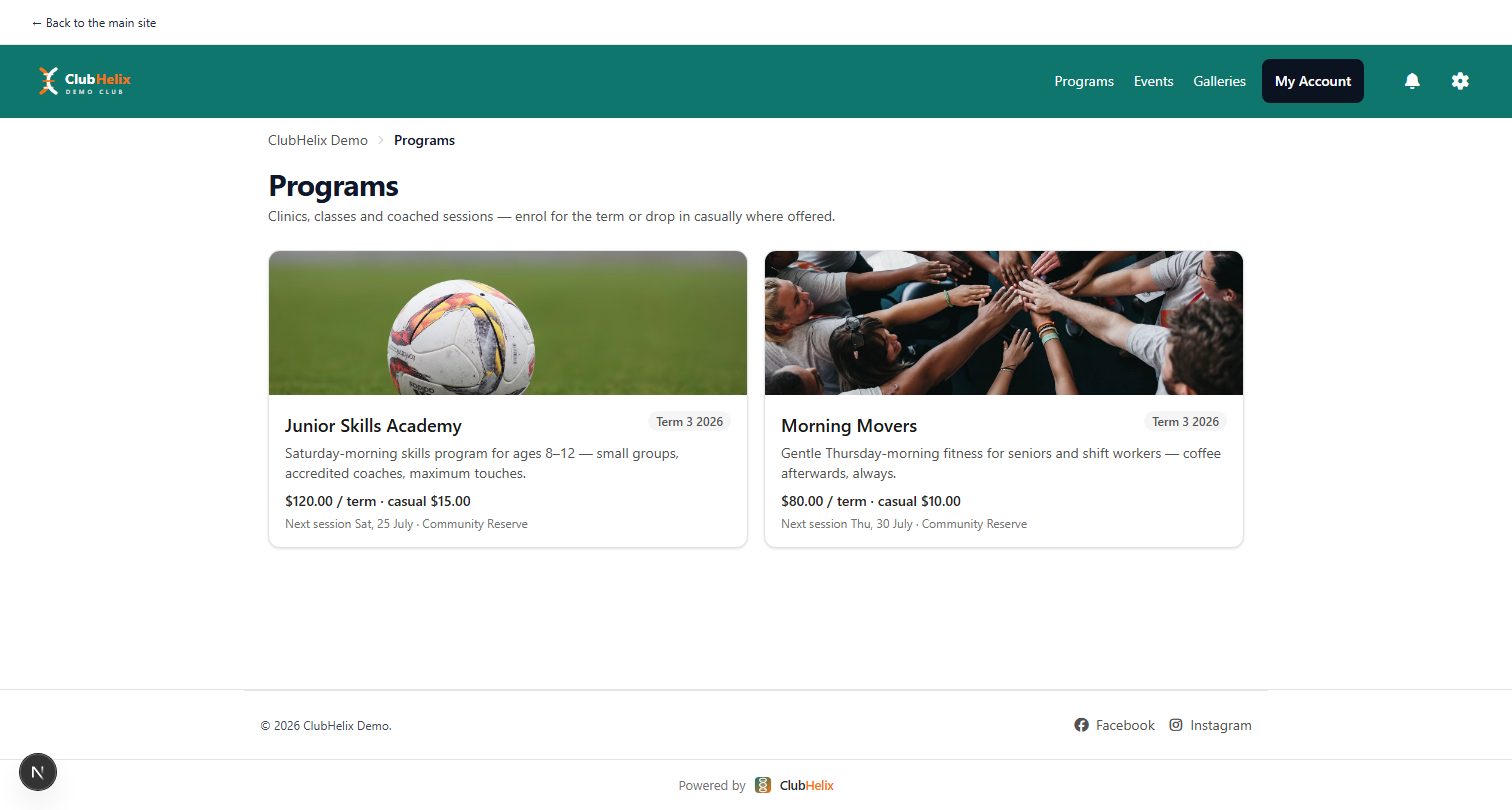
Nearly everything in this guide is administration wearing a musical hat — the roll, the register, the term subs, the concert tickets, the front-of-house roster, the weekly email that tells people which pieces are being run. ClubHelix puts those on one site your committee actually controls: term-based enrolment for choir seasons and workshops, online joining and renewals so subs collect themselves, attendance tracking any section leader can mark from a phone, and event ticketing that sells concert seats from your own pages. There is a performing arts solutions page if you want to see how it fits together for a choir.
It is free to start — build your choir's site, open your join form and put your next concert on sale in an afternoon, and only move up a tier if you outgrow the free one. The pricing is published in full with no setup fee, and you can create your choir's site today and have the term's subs collecting themselves by next Tuesday's rehearsal.
Frequently asked questions
Do you need to audition to join a community choir?
It depends entirely on the choir, which is why every choir should say so plainly on its website. Many community choirs are genuinely open to anyone and hold only a short voice placement so they can seat you in the right part. Chamber and competitive choirs usually do audition. If you are running a choir, answer this question in one sentence on your join page — ambiguity costs you more members than a clear "yes, we audition" ever would.
How much should choir subs be?
Enough to cover weekly hall hire, the musical director and the accompanist across the term, divided by a realistic number of paying members rather than your best-ever attendance. Charge by term rather than annually, offer a concession rate, and keep a hardship waiver so cost never quietly removes someone. Collect it online at the start of term instead of chasing cash at the door.
Does a choir need a licence to perform copyright music?
Public performance of copyright works generally requires a licence, but very often the venue already holds one that covers your concert — so the first step is always to ask the venue in writing exactly what its licence covers. Copies for your singers, and any staged or recorded use, are separate permissions again. This is general information rather than advice, so confirm your own position with the venue and the relevant licensing body before you announce a concert.
How do you fix a choir that is short of tenors?
Recruit for the part, not for the choir. A specific invitation — naming the part, promising no audition, and offering three rehearsals with no obligation — converts far better than a general call for members. Pair every new low voice with an experienced singer for their first month, and keep an eye on the monthly part-balance numbers so you see the gap opening rather than discovering it in a rehearsal.
What does a choir committee actually need to do each week?
Very little, if the systems are right. Someone marks the register, someone answers the enquiries that came in through the website, and the librarian hands out anything new. The heavy work is seasonal — subs at the start of term, tickets and rosters before a concert, and the handover after the annual meeting. Choirs get into trouble when those seasonal jobs are done from memory each year rather than from a written routine.
Keep reading — how to run a community band covers the instrument and library side in depth, and how to promote a club event covers filling the hall.

