
What this guide answers
- Should our society audition, or take everyone?
Decide per ensemble and say so publicly, because the ambiguity is what costs you members.
- Who pays the conductor, and how much?
Most student music societies pay their musical director an honorarium rather than a salary — commonly a few hundred dollars per concert cycle, sometimes nothing where the director is a student or a staff member…
- Do we need permission to run workshops in schools or take under-18 members?
Often yes, and the requirement comes from the vetting scheme where you are rather than from your own judgement.
- How do we stop the sheet music disappearing every year?
Treat the library as an asset with an owner rather than a pile with a custodian.
- Our whole cello section graduates in the same year. What now?
Recruit instruments, not members. Publish the specific gaps on your website and your fair stall — "we need three cellos, a bassoon and tenors" — and ask your current members to name people they know who play those…
A university music society is sixty voices in a lecture theatre with terrible acoustics, a hire set of orchestral parts that has to go back in eight weeks, a timpani living in a corridor because nobody could find a store room, and a concert date in week ten that somebody booked without checking the exam timetable. The committee running all of it is four students, two of whom also play in the orchestra, and none of whom has ever negotiated a hall fee.
Music societies fail in ways other societies do not. A debating society that has a flat term loses momentum. A music society that has a flat term loses $1,400 on a hall it could not fill, gets invoiced for a set of parts it returned three weeks late, and discovers in September that the librarian graduated with forty folders still in her flat. The costs are fixed, they land months before any ticket income, the rehearsal room is the scarcest resource on campus, and the whole product exists on one night.
None of that is unmanageable — it is just unforgiving of vagueness. This guide walks the year the way a music committee actually lives it: booking the room before anything else, auditioning without frightening people off, running a score library and an instrument inventory that survive a graduation, pricing a concert so it cannot lose money, sorting the rights to the music you are performing, and handing the lot to the next committee in one afternoon.
The year is built backwards from one date
Everything a music society does hangs off the concert date, and the concert date hangs off the hall. Book the venue first — before you choose repertoire, before auditions, before you have a committee photo. Good halls with a decent piano and a technician are booked six to twelve months ahead, and the three or four dates that suit a student audience (a Friday or Saturday late in term, before exams, not in the week of a major campus event) go first.
Then work backwards. Repertoire is chosen once you know the hall and the likely forces. Hire sets are ordered from the repertoire. Rehearsals are counted back from the concert. Ticket sales open when the program is fixed, not when someone remembers.
| When | What has to happen | What usually goes wrong |
|---|---|---|
| 6–12 months out | Concert hall booked and deposit paid; recurring rehearsal slot requested for every week of term | The only good Saturday is gone by the time anyone asks |
| 8–10 weeks out | Repertoire locked, hire sets ordered, musical director confirmed in writing | The set arrives four days before the first rehearsal |
| Weeks 1–2 of term | Club fair stall, auditions, first rehearsal, subs open | Auditions and the fair run the same afternoon, both thinly staffed |
| Week 3 | Parts allocated and folders numbered, sectionals scheduled, section leaders named | Two viola parts are missing from the set and nobody counted |
| Weeks 4–8 | Weekly rehearsal, one sectional per section, tickets on sale, program advertising sold | Tickets go on sale eleven days before the concert |
| Concert week | Dress rehearsal, piano tuned, get-in, programs printed, front-of-house roster filled | Nobody booked the tuner and the piano is a semitone flat |
| The week after | Hire sets returned with pencil markings erased, invoices paid, surplus banked, thank-yous sent | The set goes back late and the library invoices the overrun |
| Exam period | Nothing at all — deliberately | A rehearsal is scheduled anyway and eleven people turn up |
| Late in the year | AGM and elections, inventory count, librarian handover, next year's hall provisionally held | The score boxes are already in a graduate's flat |
Two of those rows carry more risk than the rest. The hire-set order date is the one that quietly ruins a term: order eight weeks out and the parts arrive before rehearsals start; order three weeks out and your first four rehearsals are read from photocopies you were not entitled to make. The exam period is not a slow patch you can push through — treat it as a hard stop, schedule nothing, and resume with a deliberate re-launch rehearsal that people are told about twice.
One ensemble, or a federation of them?
The first structural decision is whether your society is an ensemble or runs ensembles. A single chamber choir with 28 members is a society with one product. A music society with a symphony orchestra, a concert band, a chamber choir and two a cappella groups is really four or five semi-autonomous groups sharing a bank account, a store room and an affiliation.
Both work, but they need different governance. The single-ensemble society can run on a normal committee. The multi-ensemble society needs an ensemble manager per group — the person who takes the register, chases the missing second horn, books the sectional and represents that ensemble at committee — plus a rule about how shared money is split. The usual fair split is that each ensemble carries its own direct costs (its hire sets, its concert hall, its conductor) out of its own subs and ticket income, while shared costs (insurance, storage, stands, the website, instrument servicing) come off the top in proportion to headcount.
Music committees also need two roles that no other society has, and they are the two that matter most:
| Role | The thing only they can do | Realistic load |
|---|---|---|
| President | The relationship with the department, the venue and the musical director | 3–5 hours a week |
| Secretary | Affiliation, minutes, notices, the records folder | 2–3 hours a week |
| Treasurer | Subs, the hall deposit, hire invoices, grant acquittals | 2–4 hours, with brutal spikes |
| Librarian | Hire sets in and out, part allocation, folder numbering, erasing markings, the owned catalogue | 1 hour weekly, 6–8 in concert week |
| Quartermaster / stage manager | Instruments, stands, risers, transport, the get-in and the get-out | 1–2 hours, huge spikes |
| Ensemble manager (one per group) | The register, the sectional schedule, the seating plan | 2–3 hours a week |
| Publicity officer | Ticket sales, the concert program, posters, the notice everyone forgot | 2–3 hours a week |
| Social secretary | The post-concert night out, which is most of your retention | 1–2 hours a week |
The musical director or conductor is not a committee role. They are contracted or paid an honorarium, they should not vote on the budget that pays them, and their dates and fee belong in a short written agreement rather than a chat message. More on that below. For the general shape of a student committee, our committee roles guide covers the standard positions; the librarian and quartermaster are the music-specific additions.
Auditions, placement and the instrument gap
Decide your door policy per ensemble before the club fair, and publish it on the sign-up page in one sentence. There are only three honest options: open to all, open with a placement audition ("we will hear you so we can seat you, not to decide whether you are in"), and genuinely selective. Ambiguity here costs you more members than selectivity does — a nervous second-year who cannot tell which one you are will simply not come.
An audition day that runs well looks like this. Six- to eight-minute slots, booked online so nobody queues for forty minutes; a room with a tuned piano; two people on the panel, one of them the musical director; and a fixed ask — one prepared piece of two to three minutes, one or two scales, eight bars of sight-reading, and for singers a quick range check. Anything longer tests stamina, not ability. Record the outcome the same day: instrument or voice part, comfortable range, years of experience, ensemble placed in, and any access needs for seating or lighting.
Results go out within 48 hours, individually, by email — never as a public list of who missed out. If someone is not right for the chamber choir, the same message should offer them a place in the large choir. That single sentence is the difference between losing a member and gaining one for three years.
Then there is the problem unique to instrumental societies: you do not recruit members, you recruit instruments. A first-year intake of forty gets you fourteen violinists, nine flutes, six singers and no bassoon, no viola and no tenors. Publish the gap. "We need two violas, a bassoon, a bass trombone and tenors" converts far better on a fair stall or a notice board than "join our orchestra", because it turns a general invitation into a personal one. Keep the gap list updated on your website and hand it to next year's committee with the audition records — because if those records live in the musical director's notebook, and the musical director is a postgraduate who submits in June, they leave with the notebook.
Keep the audition and placement data on the member record, as custom fields, in the society's own system. That way the incoming ensemble manager can pull a seating plan on day one instead of asking sixty people what part they sing.
Rehearsal rooms are the constraint everything bends around
A weekly two-hour slot in the same room at the same time is worth more to a music society than any amount of publicity. It is what makes rehearsal a habit rather than a decision. Ask for the recurring booking for the whole term in one request, on the day bookings open, and ask for the same slot next term at the same time.
Rooms suitable for music are scarce for specific reasons: they need to tolerate noise (which rules out anything near a library or an exam venue), they need a tuned piano for most rehearsals, they need chairs that can be moved and stands that can be borrowed, and for anything with percussion they need ground-floor access or a lift that fits a timpani. A room that satisfies three of those four is not a rehearsal room.
Two habits save a term. First, hold a wet-weather alternative — one backup room, booked or at least identified, for the week your usual space is taken for an open day. Second, respect the neighbours: brass and percussion in a building with evening classes will generate a complaint, and one complaint can lose you the slot permanently. Ask facilities where the noise-tolerant rooms are and rehearse there by choice.
Most rehearsal space comes through your student guild, association or union rather than directly from the university, and affiliated clubs generally book at club rates or free. The clubs and societies office is the right first call, but the school of music is the second: departmental rehearsal and practice rooms are often reserved for enrolled music students, and a society with members from every faculty may need a staff sponsor in the school to get after-hours swipe access. Ask early and ask in person. Guild affiliation matters practically here — external halls and campus venues both usually want evidence of public liability cover before they hand over a key, and that cover comes with affiliation. Room hire is also a legitimate line in a guild grant application funded from the student services and amenities fee, so if the only workable space is a paid one, put it in the funding submission rather than absorbing it. Book your recurring slot the day bookings open, which is usually well before O-Week or Market Day, and expect campus rooms to be locked out entirely during the exam period — plan your concert before it, not after. This is general information; your guild's clubs handbook and the university's timetabling office set the actual rules.
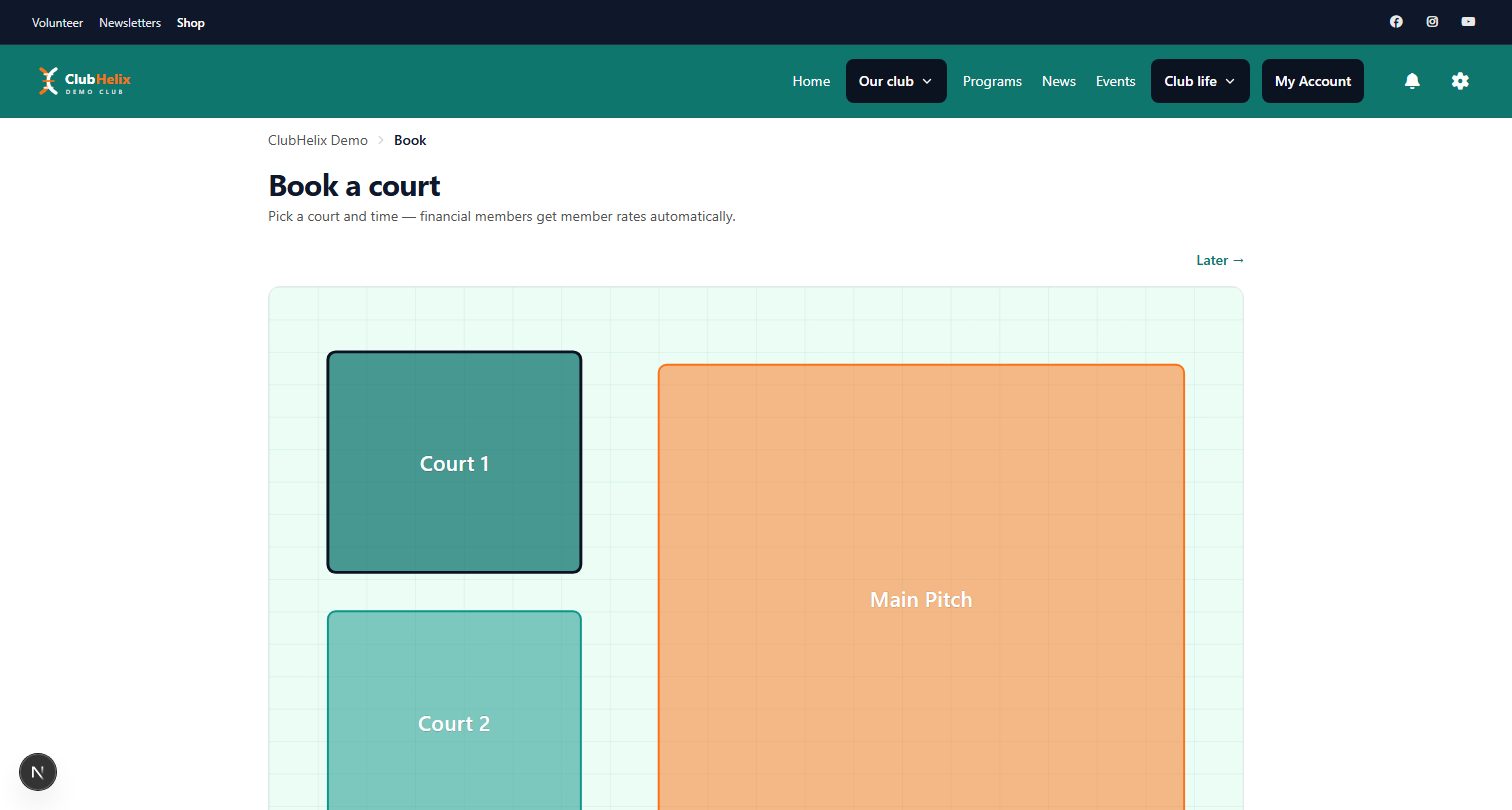
If your society is lucky enough to hold its own space — a band room, a store room with a piano, a rehearsal studio you sublet to other groups — you now have a booking problem of your own, and a shared document will not survive two ensembles wanting Wednesday. A proper facility and room booking system with clash prevention turns that into a two-minute job and gives you a record of who had the room when a chair goes missing. The campus side of the problem is covered in detail in our room bookings guide.
The score library and the instrument inventory
These are the two assets a music society owns, and both of them walk out the door with graduating members every single year.
Hire sets
Most orchestral and choral repertoire is not bought, it is hired: a set of parts arrives from a hire library for a fixed period against a fixed fee, and goes back. Four rules make this painless.
- Order eight to ten weeks out. Popular repertoire around a busy season genuinely runs out.
- Count the parts on the day the box arrives, against the packing list, and email the library the same day if anything is short. Counting on the day you return is how you get charged for a part that was never sent.
- Pencil only, and erase before return. Bowings, cuts and breath marks in pen turn a hire fee into a replacement charge. Build one "erasing rehearsal" into the week after the concert — twelve people with erasers finish sixty parts in forty minutes.
- Return on time. Overdue hire is charged by the week and it is the single most avoidable line in a music society's budget.
Photocopying is where well-meaning committees get into real trouble. Copying a hired or purchased part so more people can read from it is not permitted, and "we are a student society" is not an exception anyone recognises. Budget for the number of copies you actually need, or choose repertoire published under a licence that lets you download and print a set — public-domain editions are a legitimate and free answer for a great deal of the standard repertoire.
The owned catalogue
Everything you own needs a numbered catalogue: title, composer, arranger, number of copies, condition, and where it physically lives. It does not need barcodes. It does need to live in the society's system rather than in the librarian's own files, because the librarian graduates. Number your folders, record the folder number against the member's name when you hand it out, and take a $20 folder bond if your society has a history of losing them.
Instruments and equipment
Keep an asset register with item, serial number, purchase date, price paid and current condition. Then budget for the things nobody warns a treasurer about: a clarinet service at $180, a timpani head at $300, a bow rehair at $90, a set of double bass strings that costs more than a member's annual subs. Around 5% of the replacement value of your instruments per year is a realistic maintenance line.
If members borrow society instruments, use a short written hire agreement with a return date, a bond, and a plain statement of who pays for damage. Personal instruments are covered by the member's own insurance, not yours — say so at sign-up so nobody assumes otherwise. And write down the logistics that only exist in one person's head: percussion moves need a van, two people and ninety minutes each way, and that is a cost, not a favour.
The recurring failure mode is not theft, it is entropy. The score box goes home with someone "just for the summer", the store room key is on a graduate's keyring, and next year's librarian starts from nothing. Fix it structurally: everything physical lives in the society's cupboard, everything recorded lives in the society's system, and the handover checklist includes a physical inventory count with both librarians present.
Subs, funding and who owns the timpani
Music society subs are usually higher than a social society's, and they should be — you have real costs. A choir with no instrument hire might charge $25 a year; an orchestra with hire sets, storage and a paid conductor might charge $60 to $90, or per ensemble for members who play in more than one. Two rules keep that defensible: publish a concession rate and honour it without questions, and never let cost be the reason a good player does not join — a quiet hardship waiver, decided by two committee members, costs you almost nothing and saves your viola section.
Collect subs online at sign-up rather than as cash in a rehearsal. A treasurer holding $900 in an envelope after a fair is a risk to themselves and a reconciliation nightmare, and cash collected at rehearsals is never fully collected. If your society runs term-based ensembles or a beginners' course, a proper program enrolment flow handles the "who is in this term's intake and have they paid" question in one screen. Our membership fees guide works through the pricing logic in detail.
Beyond subs, the main money is your guild's grant rounds, funded from the student services and amenities fee. They are worth far more to a music society than to most clubs because instruments and hire sets are exactly the kind of tangible, durable purchase panels like funding: a $1,200 request for a set of timpani heads and a stand trolley reads better than a $1,200 request for socials. Beyond the guild, the school of music sometimes holds small discretionary funds for student ensembles that support its own students, state and territory arts bodies fund community-facing performance projects, and local councils run community grants that a society playing a free concert in a public hall can be eligible for. Panels want three numbers: how many students take part, how many people attend, and what it costs per head. Keep attendance and ticketing records so you can answer without guessing. GST is very unlikely to apply at typical society turnover, but if you run a large festival or ticketed season, ask the guild's finance staff before setting prices. General information only, not tax advice. Our funding and grants guide covers what selection panels actually reward.
Then there is the question nobody asks until it matters: when your society has $14,000 of instruments in a cupboard, who actually owns them?
Most societies are unincorporated clubs operating under the guild's umbrella, often holding money in a guild sub-account rather than a bank account of their own. That is usually the right answer for the money — it keeps the committee out of personal liability and removes the annual signatory scramble — but it leaves asset ownership genuinely fuzzy, because an unincorporated club is not a legal person and cannot own a timpani in its own name. A society that has accumulated real instruments should either agree in writing with the guild that the guild holds them on the society's behalf, or look at incorporating as an association under its state or territory legislation, which gives the society a legal identity that survives every graduation. Insurance is the other half: guild cover is usually public liability, and instruments are rarely included. Ask specifically about an all-risks or contents policy, including instruments in transit to a concert, and keep the asset register with serial numbers that an insurer will ask for. General information, not legal advice.
Concert economics: the hall fee decides everything
Write the break-even maths down before you announce the concert, not after. Fixed costs are everything you owe whether four people come or four hundred:
| Line | Typical |
|---|---|
| Hall hire, including a technician and a three-hour get-in | $850 |
| Hire set of parts | $190 |
| Musical director honorarium | $300 |
| Piano tuning on the day | $180 |
| Percussion transport (van, two runs) | $140 |
| Programs and posters | $70 |
| Fixed total | $1,730 |
At $18 full and $10 concession, a realistic mix averages around $13 a ticket, so you break even at 133 tickets. In a 300-seat hall that is 44% full — a plan. In a 180-seat hall it is 74% full — a gamble, and you should either find a cheaper venue, reduce the honorarium by agreement, or raise $600 in program advertising and sponsorship before you sign anything.
Three levers move that number more than ticket price does. Program advertising is the most reliable: eight quarter-page ads at $60 is $480, sold by two people in a fortnight, and local music shops, cafés near campus and graduate employers all buy them. Complimentary tickets are a cost, not a courtesy — cap them at fifteen, list who gets them, and count them in the model. And the members-sell-tickets ask works if it is specific: "please sell four tickets each" to a 45-strong ensemble is 180 tickets, which is your break-even and change.
Sell in waves rather than panic-discounting in the last week. An early-bird tier at $14 three weeks out, standard at $18, and a door price at $20 rewards the people who commit early and gives you a real pre-sale figure to plan catering and seating against. Watch one number: if pre-sales are below 60% of your expected audience five days out, that is the moment to push, not the night before. Free RSVPs convert to attendance at roughly 55–70%; paid tickets convert above 90%, which is why even a $5 ticket on a free lunchtime recital tells you whether to set out 40 chairs or 90.
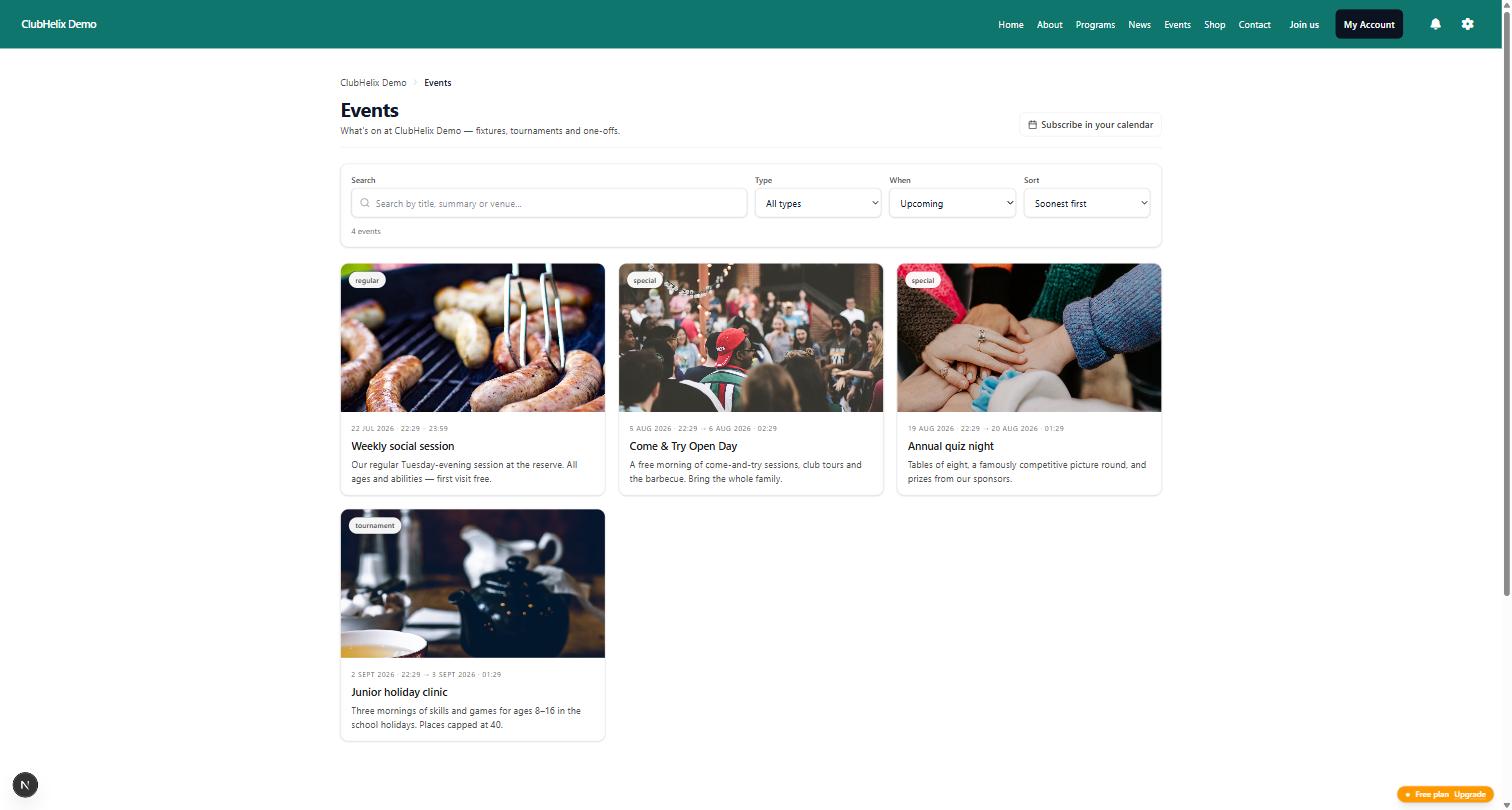
Run the whole thing off one page — date, venue, program, prices, access information and the ticket link in the same place. Every extra hop between a poster and a payment loses people. A society site with events and ticketing built in removes those hops, and the attendance data it produces is the exact evidence your next funding application needs. The pricing mechanics generalise: our ball ticketing guide works through selling against a venue minimum, and the promotion guide covers filling the room.
Rights and licences for the music you perform
Three different permissions get muddled together, and only one of them is usually your problem.
The performing right covers playing or singing a copyright work in public. It is normally licensed by the venue through a blanket licence with a collecting society, so a campus hall or a public concert hall is usually already covered — but you are typically asked to submit a return of works performed (composer, arranger, title, duration) so that money reaches the right writers. Do it: it takes ten minutes and it is how the people who wrote your program get paid. The reproduction right is separate and covers copying, recording or streaming — filming your concert and putting it online is not covered by the venue's performance licence. And grand rights — staged performances of musicals and operas — are licensed directly from the rights holder per performance, months ahead, with a per-performance royalty and conditions about billing and cuts; that is the same territory a drama society works in, and it is not something you can sort out in the week of the show.
In practice, the venue's APRA AMCOS licence covers the performing right for most concerts, and the venue or the promoter files the return of works performed. Ask the venue two questions when you book: are we covered by your licence, and who submits the return? If you are hiring an unlicensed space — a community hall, a church hall, a lecture theatre used as a venue — the licence becomes your responsibility, and a one-off event licence is inexpensive but has to be arranged in advance. Recording or livestreaming needs separate permission on the reproduction side, which is a common trap for societies planning to put a concert video online afterwards. Public-domain repertoire avoids the licensing question for the works themselves, though a modern edition of an old work can still carry its own copyright. General information only, not legal advice — the collecting society and your venue can confirm what applies to your concert.
A concert-day run sheet you can reuse
Print this, put someone's name against every line, and hand it to the stage manager. Times are relative to the downbeat.
| Time | What happens | Who |
|---|---|---|
| −5:00 | Get-in. Van unloaded, percussion and stands in. Count: 62 chairs, 40 stands, 8 stand lights. | Quartermaster |
| −4:30 | Stage set to the plan. Risers up. Conductor's podium and score stand in place. | Quartermaster |
| −4:00 | Piano tuner. Nothing loud on stage while they work. | President |
| −3:30 | Sound and lighting check with the venue technician. Confirm interval length and house lights. | Stage manager |
| −3:00 | Dress rehearsal, running order only — no rehearsing sections you have not fixed by now. | Musical director |
| −1:30 | Break. Food for anyone who has been there since the get-in. Doors staff briefed. | Social secretary |
| −0:45 | Front of house: box office open, float counted, card reader charged and tested, programs stacked. | Publicity officer |
| −0:30 | Doors. Access seating held until ten minutes out. Latecomers admitted only between items. | House manager |
| −0:05 | Tuning. Phones off. Committee member at each exit door. | Ensemble manager |
| +0:00 | Concert. | Everyone |
| +1:45 | Get-out. Every part collected into numbered folders before anyone leaves the stage. | Librarian |
| +2:30 | Venue clear, keys returned, float and takings counted by two people and recorded. | Treasurer |
The kit list that is always forgotten: a box of 40 pencils and erasers, spare strings and reeds, gaffer tape, a spare stand light globe, the float in small notes, a charged card reader, a printed seating plan, the venue contact's mobile number, and the name of the first-aid officer on duty. Add a short event risk assessment if your student association requires one — for a seated concert it is a twenty-minute job, and it is often the condition of releasing the hall.
Debrief within a week, while it is still honest: what the concert actually cost, what it took, what the audience number was against the pre-sale, what broke, and one sentence on the repertoire. Three paragraphs in the minutes are worth more to the next committee than anyone's memory.
Frequently asked questions
Should our society audition, or take everyone?
Decide per ensemble and say so publicly, because the ambiguity is what costs you members. A large choir or a concert band can usually take everyone and place them by section, and that openness is often the single biggest driver of membership. A chamber choir, a competitive a cappella group or a small orchestra generally has to select, simply because balance and standard depend on it. The best structure runs both: an open ensemble anyone can join and a selective one they can audition into next year, so nobody is ever told no with nowhere to go.
Who pays the conductor, and how much?
Most student music societies pay their musical director an honorarium rather than a salary — commonly a few hundred dollars per concert cycle, sometimes nothing where the director is a student or a staff member volunteering. Whatever the figure, write it down before the term starts: the rehearsal dates they are committing to, the concerts covered, the fee, when it is paid, and what happens if they withdraw. A one-page agreement signed by the president is enough, and it prevents the two arguments that actually happen — a director who thought sectionals were included, and a committee that thought the fee was for the year rather than per concert.
Do we need permission to run workshops in schools or take under-18 members?
Often yes, and the requirement comes from the vetting scheme where you are rather than from your own judgement. Music societies drift into this more than most: outreach workshops in schools, a junior section in a community choir, open days aimed at prospective students, and residential tours can all put adults in a position of trust with young people. Start the process well ahead of committing to the activity, because clearances take weeks. This is general information — confirm with your student association or a professional.
That means a working with children check issued by your state or territory, held by each committee member and each adult involved, plus whatever child-safe requirements your guild and university layer on top.
How do we stop the sheet music disappearing every year?
Treat the library as an asset with an owner rather than a pile with a custodian. Number every folder, record the folder number against the member's name when you hand it out, take a small bond if you have a history of losses, and collect every folder on stage at the end of the concert before anyone leaves. Keep the catalogue in the society's own system rather than in the librarian's files, store everything in the society's cupboard rather than anyone's home, and make a physical inventory count part of the handover with both the outgoing and incoming librarian present. The failure is almost never theft — it is one summer with the box at somebody's flat.
Our whole cello section graduates in the same year. What now?
Recruit instruments, not members. Publish the specific gaps on your website and your fair stall — "we need three cellos, a bassoon and tenors" — and ask your current members to name people they know who play those instruments, because a personal ask converts several times better than a poster. Beyond that, build a pipeline deliberately: keep a beginners' or second-ensemble group that feeds the main one, invite promising first-years to a sectional before auditions close, and keep in touch with the local community music scene, where a retired player or a postgraduate is often glad of a seat. Our recruitment fair guide covers converting the sign-ups you get.
What should we do during the exam period?
Nothing, on purpose, and say so in advance. A rehearsal scheduled into an exam block will get eleven people, demoralise the section leaders and teach members that turning up is optional. Schedule the last rehearsal before study break, tell everyone the exact date the program resumes, and send that date again the week before it happens. If you want to keep a thread of contact, one low-commitment social or a single informal playing session with no attendance expectation does the job better than a rehearsal that fails.
Where ClubHelix fits
A music society's fragility is administrative, not musical: the audition records in a departing director's notebook, the score catalogue in a graduate's files, the subs collected as cash, the rehearsal roster in a chat thread, the concert sold through a link somebody set up in their own name. ClubHelix gives the society one home for its website, member records with the custom fields a music society actually needs, online subs, rehearsal and room bookings, term-based ensemble enrolment, ticketed concerts and email to the whole list — owned by the society rather than by whoever created it, so the handover is a permissions change rather than an excavation.
If you want to see what that looks like for a group like yours, start with our university clubs page or the performing arts page, have a look at the ready-made site templates, and check the pricing page — the free tier is for building the site and trying it out, with taking payments online and being found in search on the paid plans. The whole-year view for any student group is in our complete guide to running a student society.
ClubHelix gives your music society one home for concerts and ticketing, rehearsal and room bookings and term-based ensemble enrolment. Start free before you book next year's hall.


