
What this guide answers
- What is a club subcommittee?
A subcommittee is a smaller group appointed by the main committee to handle a defined area of work — facilities, juniors, social events, sponsorship — or to deliver a specific project.
- What should a club subcommittee terms of reference include?
Ten short sections — name, purpose, type and lifespan, membership, what is in and out of scope, the level of delegated authority, the budget and who may authorise spending, the reporting format and frequency, meeting…
- Can people who are not on the committee join a subcommittee?
In most clubs yes, and it is one of the main reasons to form one — a working group is how you use expertise from members who will never stand for election.
- How often should a subcommittee report to the committee?
Once per ordinary committee meeting is the norm for a standing group, with a written one-page report circulated in advance rather than a long verbal update.
- How do you stop a subcommittee from overstepping?
Write the boundary before the work starts. Name the level of delegated authority, list what is explicitly out of scope, put a number on the spending limit, and state which decisions must come back for approval.
New Zealand edition. This guide is written for volunteer-run clubs in New Zealand. Where rules differ — grants, tax, incorporation, safeguarding — follow the New Zealand-specific pointers below or check with your national body.
A club forms a facilities subcommittee in March with four keen people and a genuine problem to solve. By June, two of them have stopped coming. In August the remaining pair order a replacement fridge for the canteen, and at the next committee meeting the treasurer discovers an invoice nobody approved. There is an awkward conversation, the subcommittee quietly dissolves, and for the next three years anyone who suggests forming a working group is told "we tried that, it didn't work".
It did not fail because those volunteers were unreliable. It failed because nobody ever wrote down three things: what the group was for, what it could decide on its own, and how much it could spend. In the absence of that document, a subcommittee has only two available modes — do nothing, or overstep. Both end the same way.
Subcommittees are the single most effective way a small committee scales. They let you pull in expertise the elected committee does not have, give newcomers a low-commitment way in, and take entire categories of work off a main agenda that is already running to ninety minutes. This guide covers when to form one, a terms of reference template you can copy straight into a motion, four levels of delegated authority, how to recruit people who are not on the committee, and how a working group reports back without swallowing the meeting it reports to.
When a subcommittee is the right answer — and when it is not
Half the subcommittees that fail should never have been formed. Before you create one, work out which of four things you actually have.
| What you have | The right structure | Why |
|---|---|---|
| A single defined job with an obvious owner | One person with a written position description | A group adds coordination cost and no capability |
| A one-off project with an end date | A time-limited working group with a sunset date | Urgency and a finish line keep people engaged |
| A permanent function needing ongoing oversight | A standing subcommittee reviewed annually | Continuity matters more than pace |
| A decision the committee is avoiding | Nothing — make the decision | A working group is not a place to park a hard call |
That last row is the one to guard against. Forming a group to "look into" something the committee already has enough information to decide is how clubs manufacture six months of delay and a demoralised set of volunteers who did the work for nothing.
The other honest test is capacity. A subcommittee needs a convenor who will actually convene it. If you cannot name that person before the motion is put, you do not have a subcommittee — you have a good intention with a title.
The terms of reference — a template you can copy
This is the document that makes the difference. It should fit on one page, be adopted by a motion of the main committee, and be attached to the minutes so it survives every future argument about scope. Copy the structure below and fill it in.
1. Name. Ground and Facilities Working Group. Use a name that says what it does, not who is on it.
2. Purpose. Two sentences maximum. What problem does this group exist to solve, and what does success look like? "To plan and deliver the clubroom kitchen upgrade, from scoping to handover, within the approved budget and before the start of next season."
3. Type and lifespan. Standing (reviewed each year at the first committee meeting after the AGM) or time-limited (ends on a stated date or on delivery, whichever comes first). Write the sunset date down. Groups without one never end; they just stop meeting.
4. Membership. Convenor, the committee member who acts as the link, and the number of other members. State whether non-committee members are eligible — they should be — and whether the group can co-opt someone with specific expertise without going back to the committee.
5. Scope — in and out. Two short lists. This is where most disputes get pre-solved. "In scope: kitchen layout, appliance specification, supplier quotes, volunteer labour scheduling. Out of scope: anything affecting the changerooms, any change to canteen pricing, any commitment beyond the approved budget."
6. Authority. The level of delegation, in plain words, plus the spending limit. See the four levels below.
7. Budget. The amount approved, the account it comes from, who can authorise a payment, and whether unspent funds return to the club at the end.
8. Reporting. How often, in what format, to whom. "A one-page written report to each ordinary committee meeting, and immediate notification to the president of any variation over the approved budget."
9. Meetings and records. How often the group meets, what quorum it needs, and who keeps the notes. Even an informal group should keep a short decision list — it is the only defence against relitigating the same conversation in October.
10. Review and dissolution. When the committee will review whether the group should continue, and the words that end it.
A worked example
Here is section six of a real-shaped terms of reference for a junior development working group, so you can see the level of specificity that works:
Authority. The group may schedule and run junior come-and-try sessions, appoint session volunteers from the club's approved volunteer list, and commit expenditure within the approved budget without further reference to the committee. The group may recommend, but not set, junior membership fees. The group may not enter into any agreement with an external coach, school or funding body — those come to the committee for approval, with the group's recommendation attached.
Any reasonable person can read that and know what they may do on a Tuesday night without ringing the president.
Your power to delegate comes from the society's constitution. The Incorporated Societies Act 2022 pushed every society to modernise its rules, and one of the questions worth answering while you are in there is whether the committee may delegate to subcommittees, on what terms, and whether non-members may sit on them. Delegation does not shift the committee's duties under the Act — officers remain accountable for the club's affairs regardless of who did the work. Record every delegation in the minutes with its limits attached.

Four levels of delegated authority
Almost every argument about a subcommittee is really an argument about which of these four levels it was operating at. Name the level explicitly in the terms of reference and the argument disappears.
| Level | The group may… | Comes back to the committee for… |
|---|---|---|
| 1. Advise | Research, consult members, form a view | Every decision, including small ones |
| 2. Recommend | Do all of the above and put a single preferred option | Approval before anything is committed |
| 3. Decide within limits | Act freely inside a stated scope and budget | Anything outside scope, over budget, or novel |
| 4. Decide and report | Run the function and simply report what it did | Only strategy changes and the annual review |
Level three is where most working groups should sit and where clubs most often fail to be explicit. A group told to "sort out the presentation night" and then criticised for booking a venue was almost certainly given level three in spirit and level two on paper.
Set the spending limit in numbers, not adjectives. "Reasonable expenditure" means whatever the person spending it thinks is reasonable. State a per-item cap and a total, and state what happens when a quote comes back over — usually a quick approval by the president and treasurer jointly, minuted at the next meeting, rather than a four-week wait.
As a rough calibration for a community club with an annual turnover in the low hundreds of thousands of dollars, per-item caps of NZ$500 for a social committee, NZ$2,000 for a facilities group mid-project and NZ$250 for a junior program group work as illustrative starting points. Set the total at the approved project budget and require two signatories above the per-item cap. Clubs funded by gaming trust grants should also check whether the grant conditions themselves restrict how and on what the money may be spent.
Recruiting people who are not on the committee
The best reason to form a working group is that it lets you use people who will never stand for election. The parent who project-manages construction for a living will not commit to two years on a committee, but will absolutely give you eight weeks on a clubroom upgrade. The trick is asking properly.
Make the ask specific and finite. "We need help with facilities" gets nothing. "We need someone for six weeks to get three quotes on the kitchen and tell us which one is realistic — about four hours total, ending in September" gets a yes. Every element of that sentence is doing work: the task, the duration, the hours, the end date.
Ask individually, not in a newsletter. A general call-out is how committees confirm that nobody cares. Write down five names, ask each of them directly, and expect two yeses. A newsletter item is the follow-up, not the ask.
Run a skills audit once a year. Add three optional questions to your renewal form — trade or profession, whether they are willing to help with a short project, and what kind of thing interests them. Within one season you have a searchable list of who can weld, who does bookkeeping, who has run a bar, and who knows the council planning process. That is worth more than any recruitment drive. Our guide on how to recruit club volunteers has the wider playbook, and a simple online form or survey collects the answers without anyone retyping a paper slip.
Onboard them like a member of the club, because they are. Give every new working group member the terms of reference, an introduction to who is who, and the access they need. This last one is where clubs get sloppy — a volunteer who needs to see supplier quotes should not be handed the treasurer's login. Role-based access with proper permissions means someone can do the job for eight weeks and cleanly lose access when the group winds up.
Handle screening before, not after. Any group whose work brings members into contact with children needs the same screening as the rest of the club, and the paperwork takes time.
Volunteers working with children generally require safety checking, and clubs affiliated to a national body usually have to follow that body's own vetting policy on top of any statutory requirement. Police vetting requests take time to come back, so start the process the day someone agrees to join a junior working group rather than the week before the program starts. Confirm current requirements with your national sporting organisation and the relevant authority.
Reporting back without hijacking the main meeting
The classic failure is the twenty-minute verbal update. The convenor, understandably proud of the work, narrates the whole month. The committee glazes over, someone asks a question that reopens a settled decision, and forty minutes of an already long meeting are gone.
The fix is a format. Every working group submits the same one-page written report with the agenda papers, at least seventy-two hours before the meeting. It has five headings and nothing else:
- Decisions we made under our delegated authority since the last report — one line each.
- Progress against the plan — on track, at risk, or blocked, in one sentence.
- Money — approved budget, spent to date, committed but not yet spent.
- Decisions we need from you — numbered, each one phrased as a motion the committee could pass tonight.
- Risks or issues you should know about — the things that would embarrass the club if they surfaced elsewhere first.
At the meeting the convenor gets five minutes, and only two of the headings are spoken aloud: the decisions needed, and anything under risks. Everything else was read in advance, and the chair should say so out loud the first few times to establish the habit. Our club committee monthly report pack shows how these fit alongside the treasurer's and registrar's reports.
Three rules keep it working. Reports that arrive late are taken as read and the decisions they request are deferred — once. A committee member who did not read the papers does not get to reopen the discussion in the room. And any question that is really about the group's scope goes back to the terms of reference, not to a debate.
Set escalation triggers so the group knows when not to wait for the next meeting: a variation over the budget cap, anything with a legal, media or safeguarding dimension, the resignation of the convenor, or any change to the finish date. Those go to the president immediately.
The subcommittees most clubs actually need
Resist the temptation to create one for everything. A club with six working groups and eleven committee members has invented a bureaucracy. Most clubs are well served by two or three standing groups and one time-limited project group at a time.
| Group | Standing or time-limited | Typically operates at | Watch out for |
|---|---|---|---|
| Finance and audit | Standing | Level 2 — recommend | Must not become a second treasurer |
| Facilities and grounds | Standing | Level 3 — decide within limits | Scope creep into capital projects |
| Junior development | Standing | Level 3 | Screening and program safety obligations |
| Social and fundraising | Standing | Level 3 | Cash handling and event compliance |
| Selection | Standing, in season | Level 4 — decide and report | Conflicts of interest with parent members |
| Sponsorship | Standing | Level 2 | Competing approaches to the same local businesses |
| A specific project | Time-limited | Level 3 within budget | No sunset date written down |
Note the "watch out for" column. Every one of those is a real failure mode, and every one is preventable with two sentences in the terms of reference.
Winding one up properly
A working group that has delivered should be closed with as much ceremony as it was opened. At the next committee meeting, pass a motion noting the group has completed its purpose and is dissolved. Ask for the final report, the budget reconciliation, and any documents the club needs to keep — quotes, warranties, supplier contacts, photos of the work. Remove access that is no longer needed. Then thank the members by name in the minutes and in the newsletter, specifically, for what they actually did.
That last step is not sentiment. It is recruitment for the next group. People who felt their eight weeks mattered say yes again; people who finished and heard nothing do not. Our guide to volunteer appreciation ideas has more, and volunteer position descriptions will help you write the roles that outlast the group.
Giving a working group its own set of keys
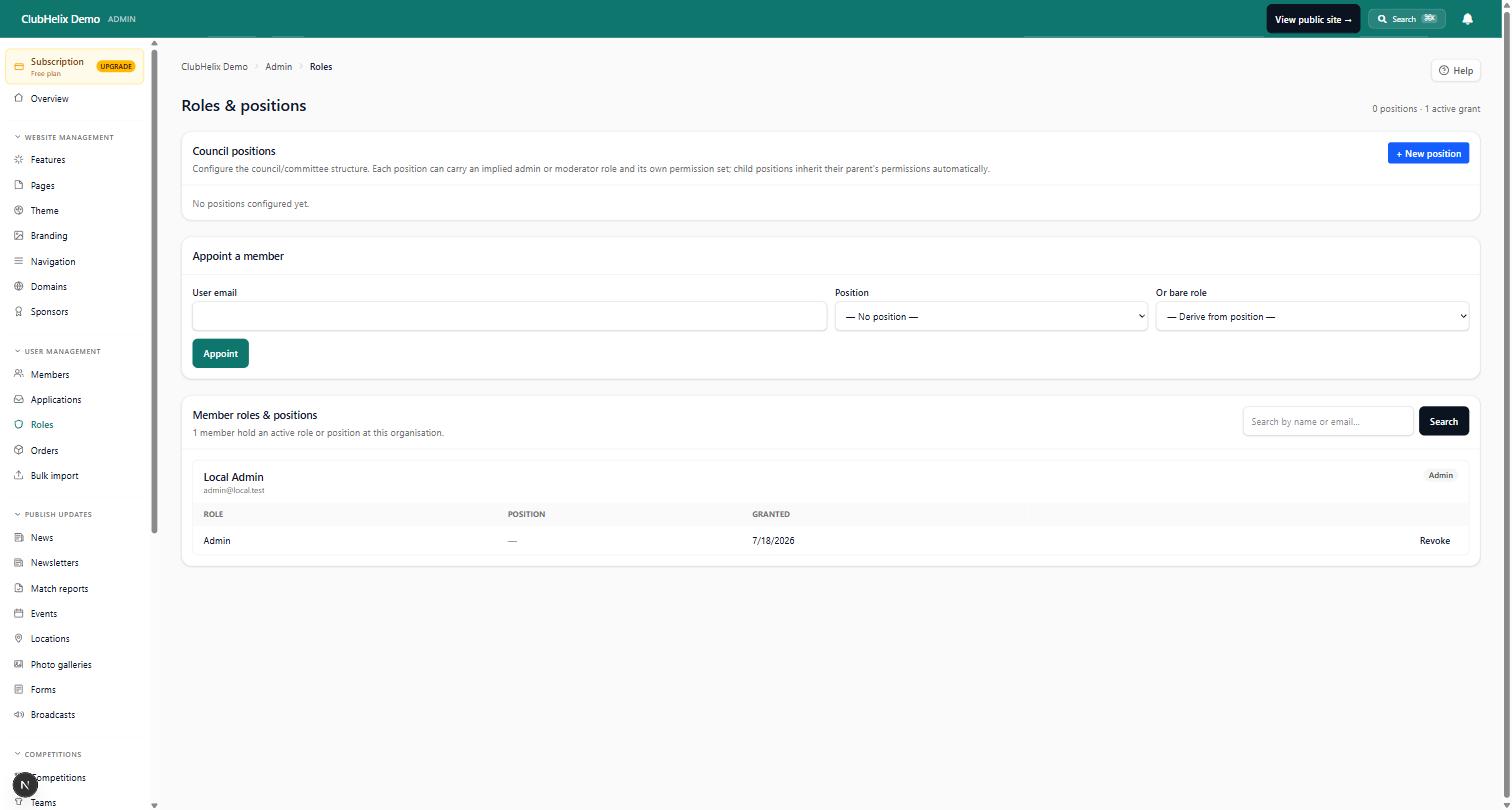
The practical friction in running subcommittees is access and visibility. A group needs the member list for its project but not the payment records; it needs to publish an event but not edit the constitution; it needs its papers where the committee can read them without a mail merge. ClubHelix handles that with roles and permissions you can scope precisely, governance and meetings for agendas, papers and minutes in one place, and volunteer rostering so the working group can fill its own shifts without going through the secretary.
If your club currently runs its working groups on a shared inbox and goodwill, there is a tidier way to do it. ClubHelix is built for community clubs, starts on a genuinely free tier, publishes every price on the pricing page, and you can set your club up and have your first subcommittee working inside it this week.
Frequently asked questions
What is a club subcommittee?
A subcommittee is a smaller group appointed by the main committee to handle a defined area of work — facilities, juniors, social events, sponsorship — or to deliver a specific project. It works under written terms of reference that set its purpose, scope, spending limit and reporting duties. The main committee keeps overall accountability for whatever the subcommittee does, which is exactly why those limits need to be written down rather than assumed.
What should a club subcommittee terms of reference include?
Ten short sections — name, purpose, type and lifespan, membership, what is in and out of scope, the level of delegated authority, the budget and who may authorise spending, the reporting format and frequency, meeting and record-keeping arrangements, and when the group will be reviewed or dissolved. Keep it to one page, adopt it by a motion of the committee, and attach it to the minutes so it survives changes of personnel.
Can people who are not on the committee join a subcommittee?
In most clubs yes, and it is one of the main reasons to form one — a working group is how you use expertise from members who will never stand for election. Check your own rules or governing document for any restriction, and be aware that in some structures a group containing non-office-holders may only advise rather than decide. Screen and onboard those volunteers exactly as you would any other, and give them access scoped to the job.
How often should a subcommittee report to the committee?
Once per ordinary committee meeting is the norm for a standing group, with a written one-page report circulated in advance rather than a long verbal update. Time-limited project groups often report more frequently near a deadline. Agree escalation triggers as well — budget variations, safeguarding or legal issues, a change to the completion date, or the loss of the convenor should go to the president straight away rather than waiting for the next meeting.
How do you stop a subcommittee from overstepping?
Write the boundary before the work starts. Name the level of delegated authority, list what is explicitly out of scope, put a number on the spending limit, and state which decisions must come back for approval. Then hold the line when someone asks for an exception mid-project — grant it by a proper motion if it is warranted, rather than by a text message that nobody can find later.
What if nobody volunteers for a working group?
That is usually a symptom of the ask, not of apathy. Make it specific, short and finite, name the total hours, put an end date on it, and approach five people individually rather than putting a call-out in the newsletter. If it still gets no takers, the honest conclusion is that the club does not have capacity for this project right now — which is far better to know in March than to discover in August with half a kitchen installed.
Keep reading — club committee roles and responsibilities sets out the structure your working groups hang off, and how to run a club with no time is the companion for committees already at capacity.


