
What this guide answers
- What licences are needed to run a clay target club?
Requirements are set state by state — range approval, club obligations and member licensing all sit with your state regulator (typically the police firearms registry), alongside your clay target association's rules.
- How do beginners try clay target shooting before getting a licence?
Most states have supervised visitor or come-and-try provisions that let a newcomer shoot under close supervision at an approved range.
- What does a range officer do at a clay target club?
The range officer controls the firing line — opening and closing the range, enforcing safe handling, managing cease-fires and misfires.
- How do clay target clubs keep track of member licences and accreditations?
Well-run clubs record every member's licence, range officer ticket, coaching accreditation and working-with-children check with expiry dates, and use automated reminders so nothing lapses unnoticed — either a…
USA edition. This guide is written for volunteer-run clubs in the United States. Where rules differ — grants, tax, incorporation, safeguarding — follow the USA-specific pointers below or check with your national body.
Clay target shooting is one of the most welcoming club sports going — a Saturday squad will happily talk a first-timer through their first round of down-the-line, and the handicap systems mean a newcomer can genuinely compete within months. But no club sport carries a heavier duty of care. A clay target club's licence to exist, quite literally, depends on doing safety and compliance properly, every shoot, without exception.
That's the frame for this whole guide: in clay target club management, safety and compliance are not a section of the job — they're the job, and everything else (shoot programs, membership, canteen, the gun club website) is built on top of them. Here's how well-run clubs put it all together.
Safety and compliance come first — always
Firearms law here operates at federal, state and often municipal level simultaneously, and the differences between states are enormous — from what a club must verify before a guest shoots, to storage, to how a range is zoned and permitted. Nothing in this guide replaces the current requirements of federal law, your state's statutes, your local zoning and noise ordinances, or your national association's rulebook. Two club-specific points worth flagging: range liability insurance and a written, enforced range safety plan are the foundation of everything else, and several states give qualifying ranges statutory protection from nuisance claims — worth knowing before a housing development arrives next door. This is general information, not legal advice — check the current requirements with your state regulator, local authority and national association.
Within that frame, the operational safety habits of a good club are consistent everywhere:
- Range officers run the line. Every shoot has a designated range officer with absolute authority over the firing line. Their calls are not negotiable, and the committee backs them every time.
- Standard range rules, posted and enforced. Firearms open and unloaded except on the pad, muzzles downrange, eye and ear protection mandatory, no handling behind the line while the range is live. New members are inducted on these rules before they shoot, not after.
- A written range standing order. What the range officer checks before opening, cease-fire procedure, trap-house access rules, and what happens on a misfire. Written, versioned, and reviewed annually — not oral tradition.
- Incident reporting without exception. Near-misses and equipment failures get recorded, not shrugged off. A simple digital incident reporting workflow — logged on a phone at the range, visible to the committee — builds the paper trail that protects the club, and our incident report form template covers what to capture.
- Insurance in place and current. Association affiliation usually carries insurance arrangements; know exactly what's covered and what the club must hold itself. See does our club need insurance for the general categories, and fold range risks into a proper risk management plan.
Tracking licences, accreditations and expiries
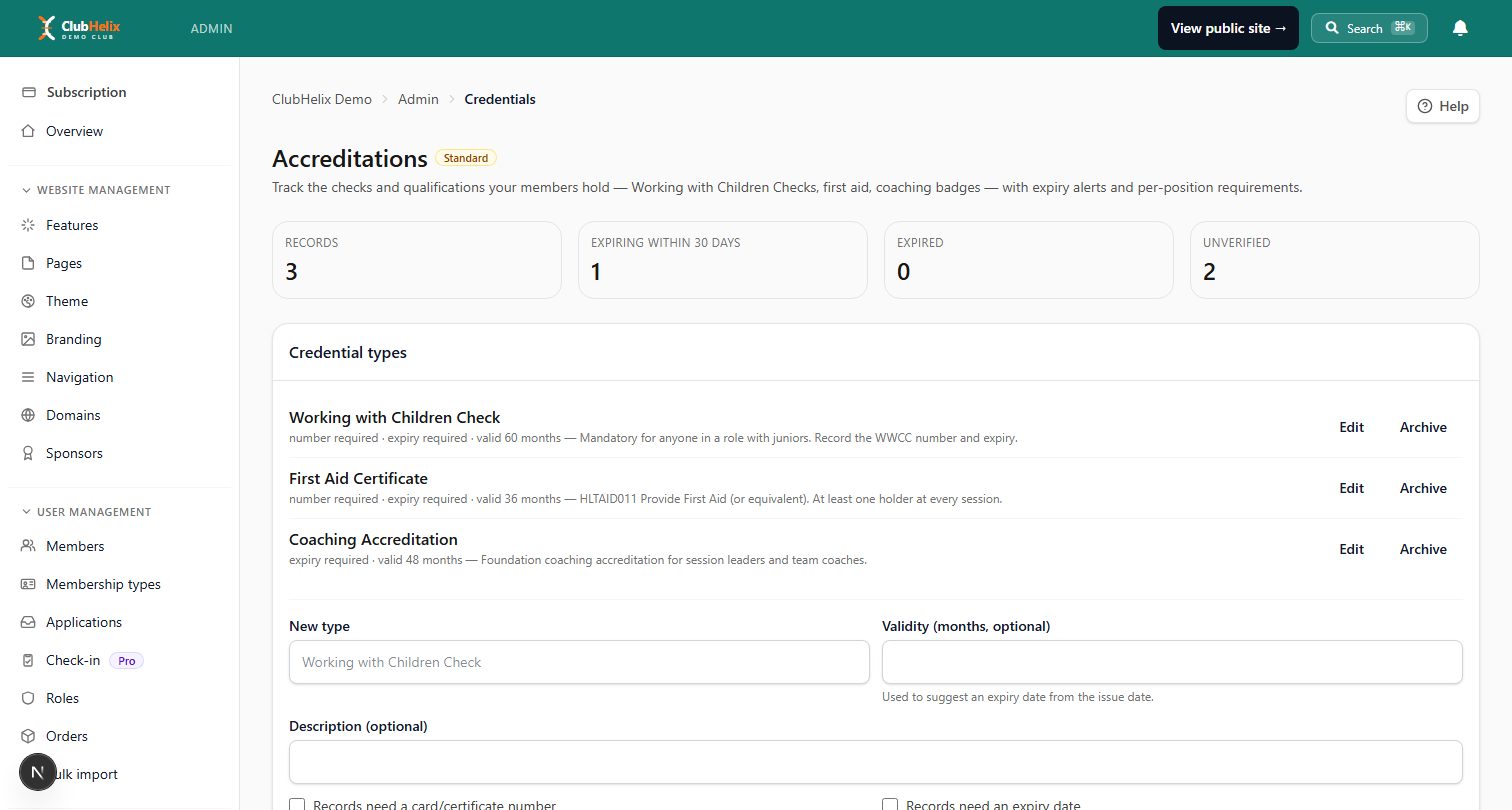
A clay target club committee ends up tracking more credentials than almost any other sport: member firearms licences and their expiry dates, range officer accreditations, coach and referee tickets, and working-with-children checks for anyone involved with juniors. A spreadsheet nobody opens is how expiries get missed.
This is exactly what accreditation and expiry tracking is built for — record each member's credentials once, and the system chases the renewals with automatic reminders before expiry, giving the secretary a live view of who's current. For a club whose compliance obligations are genuinely serious, that's not a convenience; it's a control.
Structure, affiliation and the committee
Clay target clubs are almost always incorporated associations affiliated with a state and national clay target body — affiliation brings the rulebook, sanctioned competitions, handicapping systems, insurance arrangements and the pathway to state and national titles. If you're formalising a new club, the general process is covered in how to incorporate a club; expect the range approval process with your state regulator to be the long pole.
Beyond the standard president, secretary and treasurer, the roles that make a clay target club run:
| Role | What they own |
|---|---|
| Captain / shoot marshal | Shoot programs, squadding, nominations, results |
| Chief range officer | Range officer roster, inductions, range standing orders |
| Handicapper / grader | Grades and handicaps per association rules |
| Armourer / equipment officer | Traps, clays stock, machine maintenance, spares |
| Canteen coordinator | The food — never underestimate the food |
Trap machines deserve a maintenance log like any club asset: throw-count based servicing, spare mainsprings and clutch parts on the shelf, and two people (not one) who know how to fix the auto-trap mid-shoot.
The shoot program — squads, grades and handicaps
A typical club program mixes disciplines and formats across the year: regular club shoots (trap and skeet are the staples at most clubs here, with sporting clays where the ground allows it), monthly registered or championship events, an annual shoot carrying the club's name, and introductory days that feed new membership. Registered targets under your national association's rules matter more here than newcomers expect — plenty of members choose a club specifically because it shoots them.
The mechanics that keep a shoot day pleasant:
- Nominations before the day. Knowing numbers in advance sets the squad list, the clays order and the canteen catering. Taking nominations online through an event page with RSVPs beats a phone tree every time.
- Squadding posted early. Squads of five or six, posted at the clubhouse and on the club's site, so shooters know their detail and the line keeps moving.
- Grades and handicaps applied consistently. The association's grading system is what lets a C-grader win the day off the stick — apply it by the book and review at the intervals the rules set.
- Results out same day. Scores read at presentation, then published with the running season pointscore. Taking nominations through event pages and putting the score sheets up as news posts keeps the shoot calendar, the results and the season pointscore in one place every member can see — and preserves the club's records beyond any one volunteer's laptop.
And then the fourth pillar of every shoot day: the canteen. The bacon-and-egg roll at morning tea is club culture, sponsorship for it is easy to find, and the profit quietly funds the clays.

Membership, newcomers and juniors
Growth in clay target clubs comes almost entirely from come-and-try days and word of mouth — so make the path from visitor to member deliberate. A visitor's first contact should be a friendly one-on-one induction, supervised shooting under the applicable visitor provisions in your state, and a clear explanation of the licensing pathway if they want to continue. Have a printed (and web) one-pager: what joining involves, what it costs, what the club provides, and where the official licensing information lives.
Membership admin itself is standard club fare — annual subs, categories for full, associate, junior and family, and renewals that too often arrive by chasing. Move joining and renewals to online registration and the roster stays current, payments reconcile themselves, and the secretary's February disappears back into their own life. Junior programs, run under the association's junior rules with appropriate supervision ratios and working-with-children checks for coaches, are the club's future — treat the juniors' shoot like the main event, not an afterthought.
Money, the range and the long game
The cost structure of a clay target club is distinctive: clays and trap maintenance scale with every shoot, while the big lumps are machines, range improvements and lead-management obligations on the ground. Nomination fees should cover the clays with margin; subs cover the fixed costs; the annual open and canteen fund the improvements. Grants for safety equipment, machine upgrades or accessibility works are worth pursuing — our grants for sports clubs guide covers where to look and how to write a grant application covers how to win them.
A modern gun club website
Clay target clubs have historically been the least visible clubs on the internet — and it costs them members. A searcher typing "clay target club near me" or "gun club website" should find: where you are, when you shoot, what a come-and-try day involves, the licensing basics with links to the official sources, and a contact that answers. That last page matters more for this sport than any other, because the newcomer's first question is always "am I even allowed to try this?" — and a clear, accurate answer with official links is the difference between a new member and a closed tab.
ClubHelix's clay target club management software gives a volunteer committee the full kit — public website, online membership and payments, shoot calendar with nominations, competition results, accreditation expiry tracking and incident reporting — with a free tier to start on (pricing here). For a sport where the paperwork is genuinely load-bearing, having it all in one system, backed up and visible to the whole committee, is the quiet upgrade that makes everything else easier.
Frequently asked questions
What licences are needed to run a clay target club?
Requirements are set state by state — range approval, club obligations and member licensing all sit with your state regulator (typically the police firearms registry), alongside your clay target association's rules. Always work from the regulator's current published requirements rather than another club's practice.
How do beginners try clay target shooting before getting a licence?
Most states have supervised visitor or come-and-try provisions that let a newcomer shoot under close supervision at an approved range. Check your state regulator's current rules and your association's come-and-try guidelines, and induct every visitor on range safety first.
What does a range officer do at a clay target club?
The range officer controls the firing line — opening and closing the range, enforcing safe handling, managing cease-fires and misfires. Their authority during a shoot is absolute, and every club shoot must have one designated.
How do clay target clubs keep track of member licences and accreditations?
Well-run clubs record every member's licence, range officer ticket, coaching accreditation and working-with-children check with expiry dates, and use automated reminders so nothing lapses unnoticed — either a rigorously maintained register or, more reliably, club software with built-in expiry tracking.

