
What this guide answers
- What ages can do calisthenics?
Effectively all of them — clubs field sections from under-7s through sub-junior, junior, intermediate and senior teams, and many run masters teams for adults.
- How much does calisthenics cost per year?
Costs stack across association registration, club fees, costume levies and hire, competition contributions and concert tickets, varying widely by club and section.
- Is calisthenics a sport or dance?
Both, genuinely — it's an Australian-developed team sport judged in competition, built from dance, gymnastics, apparatus work and theatre.
- How do calisthenics clubs manage costumes?
Usually a mix of club-owned costume stock hired to families per season, commissioned costumes paid by families, and volunteer makers — held together by a costume register recording what the club owns, who holds it and…
Calisthenics is one of Australia's own inventions — a performing-arts sport that blends dance, gymnastics, apparatus work and theatre into team items performed on stage and judged in competition. If you're on a calisthenics club committee, you're running something with no exact parallel in Australian sport: part sporting club, part performance company, with a wardrobe department attached.
That mix is what makes calisthenics club management distinctive. The season is built around competitions and a concert rather than weekend fixtures; the "teams" are age groups who train together all year on the same items; and costumes, music and staging sit alongside the usual club concerns of fees, coaches and committee. This guide walks through how to run a calisthenics club across all of it.
The shape of a calisthenics club
Calisthenics clubs affiliate with their state association, which sits under the national body. Affiliation brings the competition calendar, item rules and judging framework, coach accreditation, and insurance arrangements — and your participants ("pupils" in traditional calisthenics language) register with the association to compete.
Members are organised into sections by age, running from the youngest (often under 7s, affectionately the tinies) through sub-juniors, juniors, intermediates and seniors to masters teams for adults — many clubs proudly field a masters or "ladies" team of mums and former pupils. Each section trains weekly as a team, learns the same items together across the year, and competes as a team. That team structure is the backbone of the club: unlike a class-based activity, every absence affects a formation, which is why attendance culture matters so much in calisthenics.
A typical committee looks like other clubs — president, secretary, treasurer — plus roles unique to the sport: a costume coordinator (genuinely one of the biggest jobs in the club), music/props coordinators, and a team manager per section who wrangles families on competition days. Our guide to committee roles and responsibilities covers the basics; just know that in calisthenics, the costume coordinator deserves flowers annually.
Coaches and cadets
Each section has a coach — responsible for choreographing items, training the team and presenting them in competition — often supported by assistant coaches and cadets, older pupils learning to coach through the association's cadet and coaching accreditation pathway. Home-grown coaching is the norm: today's seniors are next decade's coaches, and clubs that fund cadet courses and mentor their young coaches secure their own future.
The committee's job is to support coaches, not run their items: pay accreditation and music/choreography costs from club funds, keep Working with Children Checks current for every coach, cadet over 18 and regular volunteer (see our WWCC requirements guide), and hold a clear child-safe policy — nearly all pupils are minors, and dressing rooms, photography and travel all need thought-through rules.
This is general information, not legal advice — check current requirements with your state association and child-safety regulator.
Teams, training and attendance
The calisthenics year usually runs February to the end-of-year concert. Sections train weekly (competition-focused teams often more), learning a set of items — think graceful girls, figure march, clubs, rods, free exercise, song and dance, aesthetics, depending on age and the current rules — that they'll perform all season. Choreography is cumulative: a pupil who misses three weeks in first term is learning catch-up choreography in a team formation for months.
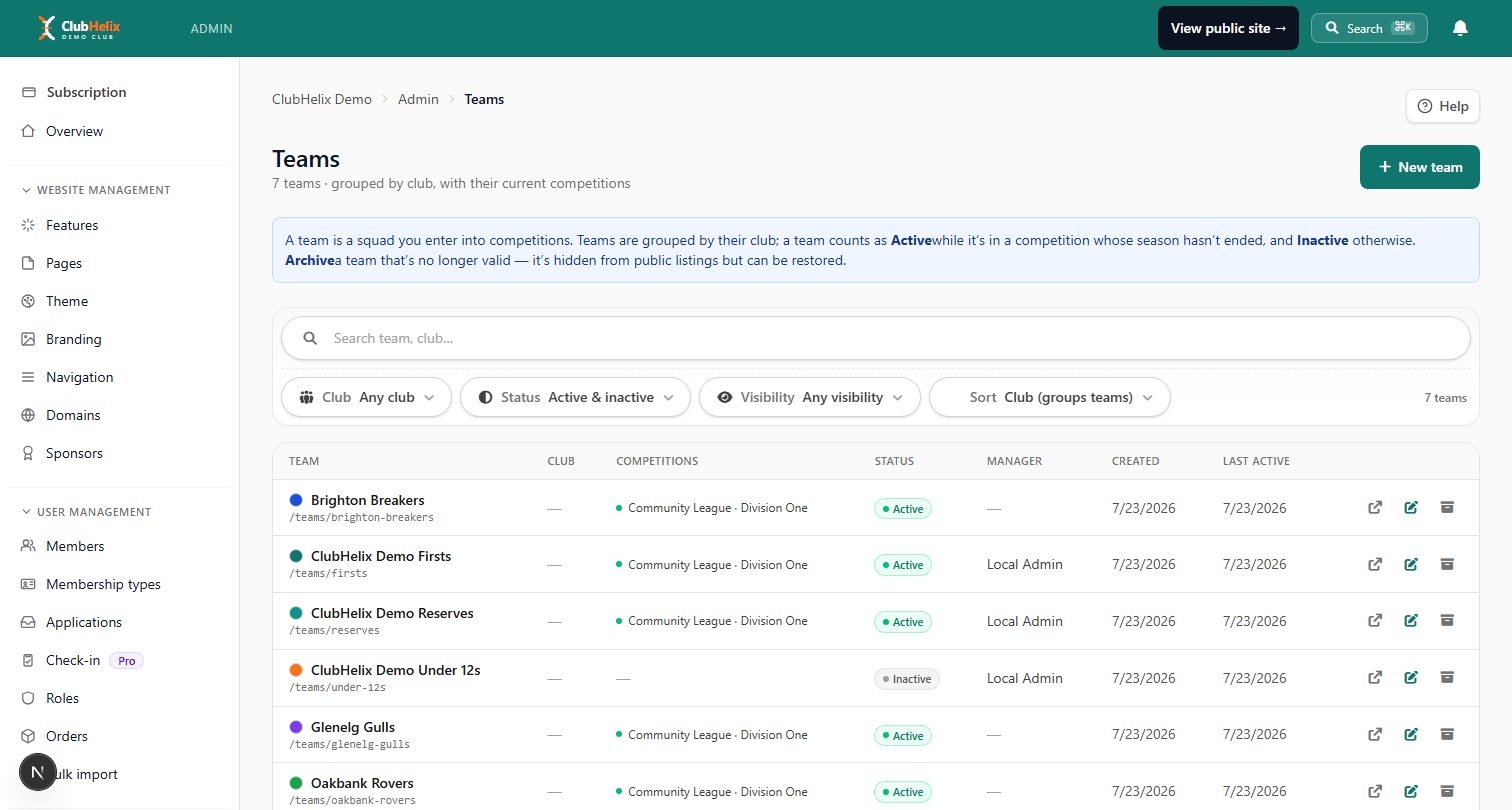
So the two admin systems that matter most are team lists and attendance. Every section needs an accurate list of pupils, family contacts and medical notes that coaches can reach at training and on stage days; and a roll marked every session so the coach and team manager spot slipping attendance before it becomes a formation problem. ClubHelix's team management keeps each section's list, contacts and coaches in one place, and attendance tracking turns the roll into a two-tap job with history the committee can actually see.
Costumes, music and props
No other Australian sport has a wardrobe budget, so let's treat it properly. Each item needs costuming — from club leotards for technical items to themed costumes for song and dance — and a section might need several costumes in a season. Clubs manage this with a mix of club-owned costume stock (hired to families per season and returned cleaned), commissioned costumes from specialist makers paid for by families, and a volunteer sewing brigade that deserves legendary status.
Three practices keep costumes from becoming the club's biggest flashpoint:
- Publish costume costs early — at enrolment, estimate per-section costume costs for the year so no family is ambushed in August.
- Keep a costume register — what the club owns, its condition, which pupil has it, and the hire bond attached. Chasing forty unreturned tutus in December is nobody's dream.
- Centralise payments — collect costume hire and levies through the same online system as fees, not cash in envelopes handed to a coach at training.
Music licensing, props and stage equipment (rods, clubs) round out the production side — budget lines, storage space and a trailer roster all included.

The season: competitions and the concert
Competitions run through the middle and back half of the year — state association competitions and famous eisteddfod stages, with teams performing their items against other clubs' sections and receiving judged placings. For families, competition days are big logistics events: arrival times, hair and makeup standards, costume checklists, music lodged, withdrawals communicated. The team manager who sends one clear, complete stage-day brief per competition is worth their weight in gold; a club system that pushes that brief to every family in the section — and collects RSVPs so the coach knows exactly who'll be on stage — is even better.
The year peaks with the club concert: every section performs, grandparents fill the hall, trophies and years-of-service awards are presented. It's your retention event, your recruitment showcase and often your biggest fundraiser rolled into one. Sell tickets from your own events and ticketing page rather than an external ticketing site, and read our presentation night guide for the awards-night mechanics.
Fees, fundraising and the money
Calisthenics families pay in layers: association registration, club fees (annual or per term), costume levies and hire, competition entry contributions, and concert tickets. The kindest thing a committee can do is publish the full expected cost of a season per section, upfront, and offer instalments — surprise costs, not total costs, are what drive families out. Collect everything online against the pupil's record so the treasurer isn't reconciling envelope cash; our guide on collecting membership fees online shows the model.
On the income side, calisthenics clubs are natural fundraisers — you have an audience twice a year and a community used to buying tickets. Concert raffles, club merchandise through an online club shop (club jackets are practically a uniform), sausage sizzles and community grants all work; our club fundraising ideas guide has a longer list.
Your calisthenics club website
Calisthenics has a discoverability problem: most Australians outside the community have never seen it. Your calisthenics club website has to do double duty — explain the sport to curious families ("like dance meets gymnastics, in teams, on stage") and serve current families with the term calendar, competition dates, section pages and enrolment. Lead with performance photos and a plain-English "what is calisthenics?" section, then make "book a free trial class" the obvious button.
ClubHelix's calisthenics club management software gives your club a professional website with online registration and payments, section/team management, attendance, events and ticketing, a club shop and family messaging in one system — with a free tier to start (see pricing). Most committees have a site live in an evening, and every stage-day brief thereafter reaches every family.
Frequently asked questions
What ages can do calisthenics?
Effectively all of them — clubs field sections from under-7s through sub-junior, junior, intermediate and senior teams, and many run masters teams for adults. Pupils compete with their age section, so nobody is performing against adults as a nine-year-old.
How much does calisthenics cost per year?
Costs stack across association registration, club fees, costume levies and hire, competition contributions and concert tickets, varying widely by club and section. Good clubs publish a full-season estimate per section at enrolment and offer instalment payments.
Is calisthenics a sport or dance?
Both, genuinely — it's an Australian-developed team sport judged in competition, built from dance, gymnastics, apparatus work and theatre. Teams train all year on choreographed items and perform them at competitions and an end-of-year concert.
How do calisthenics clubs manage costumes?
Usually a mix of club-owned costume stock hired to families per season, commissioned costumes paid by families, and volunteer makers — held together by a costume register recording what the club owns, who holds it and the bond attached, with costs published at enrolment.

