
What this guide answers
- How much does it cost to start a dance school?
Starting lean — hired hall, portable speaker, insurance, music licence and a basic website — you can open for a few thousand dollars or less.
- Do I need qualifications to open a dance school?
There is generally no single mandatory licence to teach dance, but three things are non-negotiable everywhere: the child-protection clearance your jurisdiction requires, public liability insurance, and credibility with…
- How many students do I need to be viable?
Model it per class: a class needs enough enrolments to cover its share of hall hire, insurance and your teaching time.
- When should I open enrolments for a term?
Open re-enrolment for existing families in the last two weeks of the previous term, then public enrolment immediately after.
Starting a dance school usually begins the same way: a dancer or teacher with a style they love, a handful of keen students, and a hired hall on a Tuesday afternoon. Turning that into a school — with terms, enrolments, concerts, costumes and a waiting list — is mostly an organisation problem, not a dance problem.
This guide covers the practical side of how to start a dance school: choosing your class structure, finding and hiring studio space, running term enrolment without drowning in messages, and surviving your first concert season.
Decide what kind of dance school you're building
"Dance school" covers everything from a community jazz class to a full-time studio with exams and competition troupes. Getting your shape right early makes every later decision easier:
- Styles. Start with the one or two styles you teach best — ballet, jazz, hip hop, contemporary, tap, cultural dance. It's far better to run two strong classes than five thin ones; add styles as you find teachers.
- Ages. Preschool movement classes, primary-age classes and teen/adult classes have different music, different class lengths and very different parent expectations. Many schools start with primary-age classes (the biggest market) and grow both directions.
- Pathway. Recreational only, or a path into exams, eisteddfods and competition teams? You don't have to decide forever, but be honest in your marketing — parents shopping for a serious exam school and parents wanting Saturday fun are looking for different things.
- Structure. Some dance schools run as small businesses, others as incorporated community groups with a committee — common for cultural dance groups and calisthenics. The admin below applies either way.
Find and hire studio space
Very few new schools start in their own premises. Typical first homes:
- Community halls and church halls — cheap, available after school, but check the floor. Concrete under thin vinyl is hard on growing joints; timber floors are far better, and sprung floors are the gold standard.
- School halls and gyms — good floors and plenty of parking; hire arrangements are usually term-based, which matches your class calendar nicely.
- Existing studios in their off-hours — a gymnastics or martial-arts venue with mirrors and mats can be ideal, and daytime slots are often going cheap.
Look for mirrors (portable mirrors exist but are heavy and fragile), somewhere to mount or place a barre if you teach ballet, a decent sound system or at least good acoustics, a waiting area for parents, and storage — hauling speakers and props in your boot for every class gets old fast.
Lock in your hire agreement for the full term before you open enrolments, and note the cancellation terms. If you grow into your own space later, the same discipline applies in reverse: many established studios earn side income hiring their rooms out, managed with a proper facility booking calendar rather than a message thread.
Set up terms, fees and enrolment
Dance runs on the local school calendar, and fighting that rhythm is futile. A typical structure:
| Decision | Common approach |
|---|---|
| Term length | 8–10 weeks, aligned to the school term |
| Billing | Per term, invoiced before week 1; some schools offer instalments |
| Trials | First class free or a paid casual trial, credited if the student enrols |
| Class caps | A cap per class based on floor space, with a waitlist beyond it |
| Family rules | Sibling discounts and multi-class discounts, stated up front |
| Make-up policy | Written down before you need it — credits, catch-up classes, or neither |
The enrolment process is where new dance schools most often come unstuck. Paper forms and bank-transfer fees mean chasing payments for weeks and never quite knowing who's actually enrolled. Set up online dance class enrolment from day one: parents pick the class, accept your policies, pay the term fee (or a payment plan), and land straight on the roll. It also makes re-enrolment a one-click affair each term instead of a fresh paperwork round.
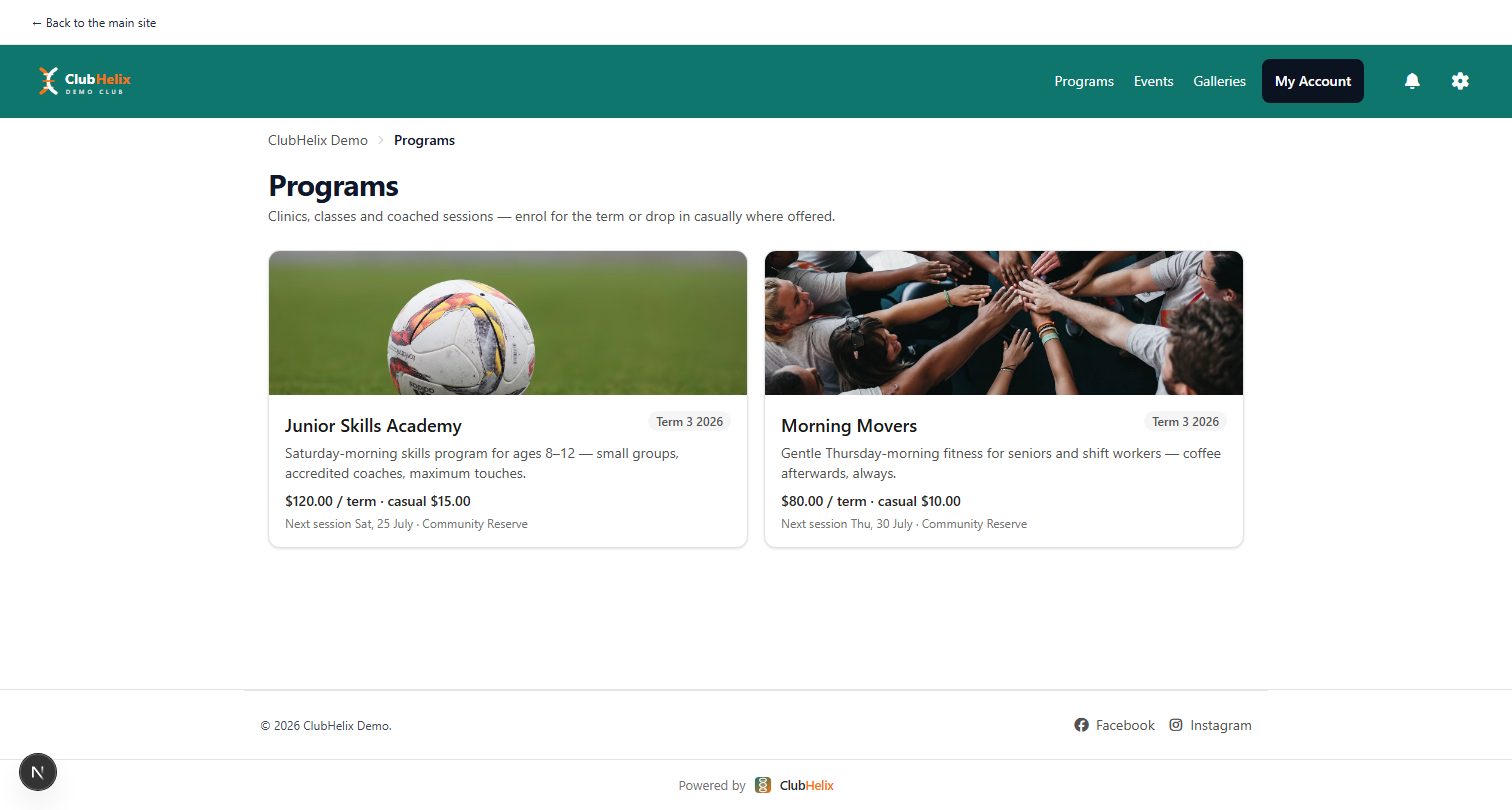
This is exactly what ClubHelix's programs and term enrolment feature handles — classes with capacities, term dates, online payment and automatic waitlists — alongside the school's own website.
If you're planning junior classes, our guide to starting a junior program covers age-banding and parent communication in more depth.
Teachers, safety and the boring essentials
Even a one-teacher school should get these right early:
-
Qualifications and checks. Anyone teaching or assisting with children needs the working-with-children clearance required in your state, and you should record expiry dates somewhere you'll actually see them. Reputable teaching qualifications (or a strong performance background plus mentoring) matter to parents.
-
Insurance. Public liability insurance is non-negotiable before your first class, and personal accident cover is worth having. Dance-specific policies exist through industry bodies and brokers.
-
Child-safe practice. Clear policies on changing rooms, photography, private lessons and communication with students. Our child-safe standards guide is written for sports clubs but applies almost word-for-word to dance schools.
-
Music licensing. Playing recorded music in classes and performances generally requires a licence from the music licensing body OneMusic — check their current class and concert categories, which are priced differently.
-
First aid. At least one adult with a current first-aid certificate at every session, and an incident log for anything beyond a grazed knee.
This is general information, not legal or financial advice — check current requirements with the relevant official bodies in your state.
Concerts and recitals without the chaos
The end-of-year concert is the emotional heart of a dance school — and the single biggest organisational lift of the year. Veterans plan backwards from the concert date:
- Book the theatre early. Good venues for end-of-year concert dates are booked out months ahead. Confirm bump-in times, tech rehearsal slots and what staging, lighting and sound support are included.
- One rehearsal timeline, published once. Parents forgive a demanding schedule; they don't forgive finding out about Saturday's extra rehearsal on Thursday night.
- Tickets. Selling tickets through your own website — with allocated sessions and a per-family cap for popular shows — beats juggling an external ticketing site and keeps the money and the attendee list in one place.
- The run sheet. A minute-by-minute program with every dance, class, music track and side-of-stage marshal. Share it with every helper; tape it to every wall backstage.
- Backstage volunteers. Roughly one supervising adult per young class backstage, with a sign-in/sign-out system for collecting children afterwards.
Promote the concert like the community event it is — our guide to promoting a club event applies directly.

Costume logistics (the part nobody warns you about)
Costumes generate more parent email than everything else combined. Tame them with a system:
- Decide the model per class. Hired costumes, purchased costumes, or a base kit (leotard and tights in school colours) plus a class-specific piece. State the cost cap per class before the year starts.
- Measure once, in class time. Collect sizes in a single measuring week rather than chasing families individually — an online form with size fields per child saves dozens of messages.
- Order absurdly early. Costume suppliers hit peak season exactly when you need them; eight to ten weeks before the concert is not too early.
- Label everything. Every hired piece gets the school's name and a number; every family gets a checklist of what to bring on concert day (and what colour socks — always the socks).
- Photograph each costume on a student for the program and next year's records.
Your dance school website and parent communication
Parents choose dance schools online. Before your first enrolment period, you want a dance school website with your classes, timetable, term dates, fees, teacher bios and enrolment built in — not a social media page where the timetable is buried three scrolls deep. Photos and short videos of real classes (with parent permission) outperform stock imagery every time.
Then keep communication predictable: a short email at the start of each term (dates, fees, what's new), one mid-term update, and concert information in a single, findable place. A school-branded email newsletter that reaches every enrolled family beats hoping everyone saw the social post.
ClubHelix gives dance schools all of this in one place — a professional website, term enrolment with online payment, event ticketing for concerts, and parent email — with a free tier to start and plans that grow with you. See how performing arts groups use it on our performing arts page.
Frequently asked questions
How much does it cost to start a dance school?
Starting lean — hired hall, portable speaker, insurance, music licence and a basic website — you can open for a few thousand dollars or less. The big later costs are your own premises and concert production; most schools grow into those over several years rather than borrowing for them up front.
Do I need qualifications to open a dance school?
There is generally no single mandatory licence to teach dance, but three things are non-negotiable everywhere: the child-protection clearance your jurisdiction requires, public liability insurance, and credibility with parents — which usually means recognised teaching qualifications, exam-syllabus accreditation or a solid professional background.
Here that clearance is the working-with-children check required in your state; check your state regulator's current requirements.
How many students do I need to be viable?
Model it per class: a class needs enough enrolments to cover its share of hall hire, insurance and your teaching time. For most schools that's roughly 8–12 students per class, so two or three healthy classes make a sustainable start.
When should I open enrolments for a term?
Open re-enrolment for existing families in the last two weeks of the previous term, then public enrolment immediately after. Online enrolment with class caps and waitlists means you can fill classes in enrolment week instead of triaging messages all holidays.


