
What this guide answers
- Can we make disclosing medical conditions compulsory?
You can — and should — make answering the question compulsory, which is different from compelling disclosure.
- A parent has told the coach something medical verbally — is that enough?
It is how real clubs work, and it is not enough on its own. " Information that lives in one coach's memory leaves when that coach does, and the relieving coach on the day of the incident never got the conversation.
- How long should we keep medical information after a member leaves?
Two different clocks run. The routine medical answers — conditions, contacts — have no purpose once the member is gone, and holding them is unprotected downside; clear them in the annual clean-out, subject to any…
- Should coaches have members' medical details saved on their own phones?
Saved locally — screenshots, downloaded lists, notes apps — no; accessible through the club's system when needed — yes.
USA edition. This guide is written for volunteer-run clubs in the United States. Where rules differ — grants, tax, incorporation, safeguarding — follow the USA-specific pointers below or check with your national body.
Two scenes, same club. Scene one: an under-14 goes down at training with a suspected anaphylactic reaction, and the coach — phone in hand — cannot reach a parent, does not know about the allergy, and does not know there is an EpiPen in the kid's bag. Scene two: a season later, a parent asks the club, reasonably, who exactly has been able to read the answer their family gave to "please list any medical conditions" — and the honest answer is everyone who ever had the registration spreadsheet, which has been emailed to at least nine people.
Emergency and medical information is where a club's duty of care and its privacy obligations pull against each other, and most clubs resolve the tension badly in both directions at once: they collect too much (walls of medical questions nobody acts on) and protect it too little (a spreadsheet in a coach's downloads folder). Getting it right is not a legal-department project — it is a handful of design decisions about the registration form, made once. One note before the detail: this guide is general information for community clubs, not legal or medical advice — your sport's governing body and local privacy regulator are the authorities on the specifics that bind your club.
The principle: collect what you would act on
The test for every question on a medical form is brutal and clarifying: would the person standing over the injured member at training do something differently because of the answer? If yes, collect it, keep it current, and make it reachable in the moment. If no, do not collect it — every answer you hold is a promise to protect it, and data you would never act on is pure liability with no safety upside.
What passes the test for a typical community club:
- Two emergency contacts — name, relationship, mobile. Two, because the scene-one call that fails is always to the one parent who is in a meeting. For juniors, these are the guardians; for adults, whoever they nominate.
- Conditions relevant to participation — asked as a specific question, not an open one: "Does the member have any medical conditions a first aider should know about during activity — for example asthma, anaphylaxis, epilepsy, diabetes, a heart condition?" This phrasing invites the four answers that change what a responder does, instead of a defensive family medical history.
- Action-critical detail for a disclosed condition — where the reliever or auto-injector is kept, what the action plan is. For diagnosed anaphylaxis or asthma, many schools and sports bodies use standard action-plan documents; accepting an uploaded copy is better than transcribing one.
- Ambulance cover — maybe. In places where ambulance transport is charged to the patient, some clubs record whether the member holds cover; the honest question is whether anyone at your club would act differently. When in doubt, leave it out — responders call the ambulance regardless, as they should.
What fails the test, and clubs should stop asking: government health identifiers or insurance numbers (the hospital will ask the family, not the coach), full medication lists, past surgeries, GP details "just in case", height and weight, and the fully open-ended "any medical information" box that produces either nothing or a paragraph nobody reads until after the incident. If your governing body's registration already collects something for its own insurance purposes, do not duplicate it at club level — one copy of sensitive data is a responsibility; two copies is a leak with extra steps.
Ask at registration, as required fields, once a season — not on paper at the first training session, where the forms end up in the kit bag with the bibs.
Who sees it: the circle is smaller than your club thinks
Here is where scene two goes wrong. Medical answers and emergency contacts are sensitive information — in most privacy regimes, health information sits in the most protected category there is — and the club's obligation is roughly: collect it for a stated purpose, show it only to people who need it for that purpose, and be able to say who those people are.
The need-to-know circle for medical information is genuinely small: the member's own team's coach or manager, the first-aid officer, and whoever administers the register. It is not the whole committee, not every coach at the club, and never a spreadsheet with eleven tabs emailed to a distribution list. Practically:
- Access follows role, enforced by the system. The under-12 Blue team manager sees the under-12 Blues — not the seniors, not the whole junior program. This is precisely what role-based permissions exist for, and it is the structural difference between a member database and the emailed spreadsheet: the spreadsheet grants everything to everyone forever, and cannot be un-granted.
- Exports are the leak. Every download of the register onto a personal laptop is a copy the club no longer controls — the coach who exported the team list in March still holds every medical answer in it after they leave the club in June. Policy: work from the live system; export only for a defined need; delete after use. Say this plainly in your club privacy policy, and mean it.
- Someone owns the register. One named role (usually the registrar or secretary) is accountable for what is collected, who has access, and the annual clean-out of what is no longer needed — including the medical answers of members who have left, which the club has no reason to keep beyond any incident-record obligations.
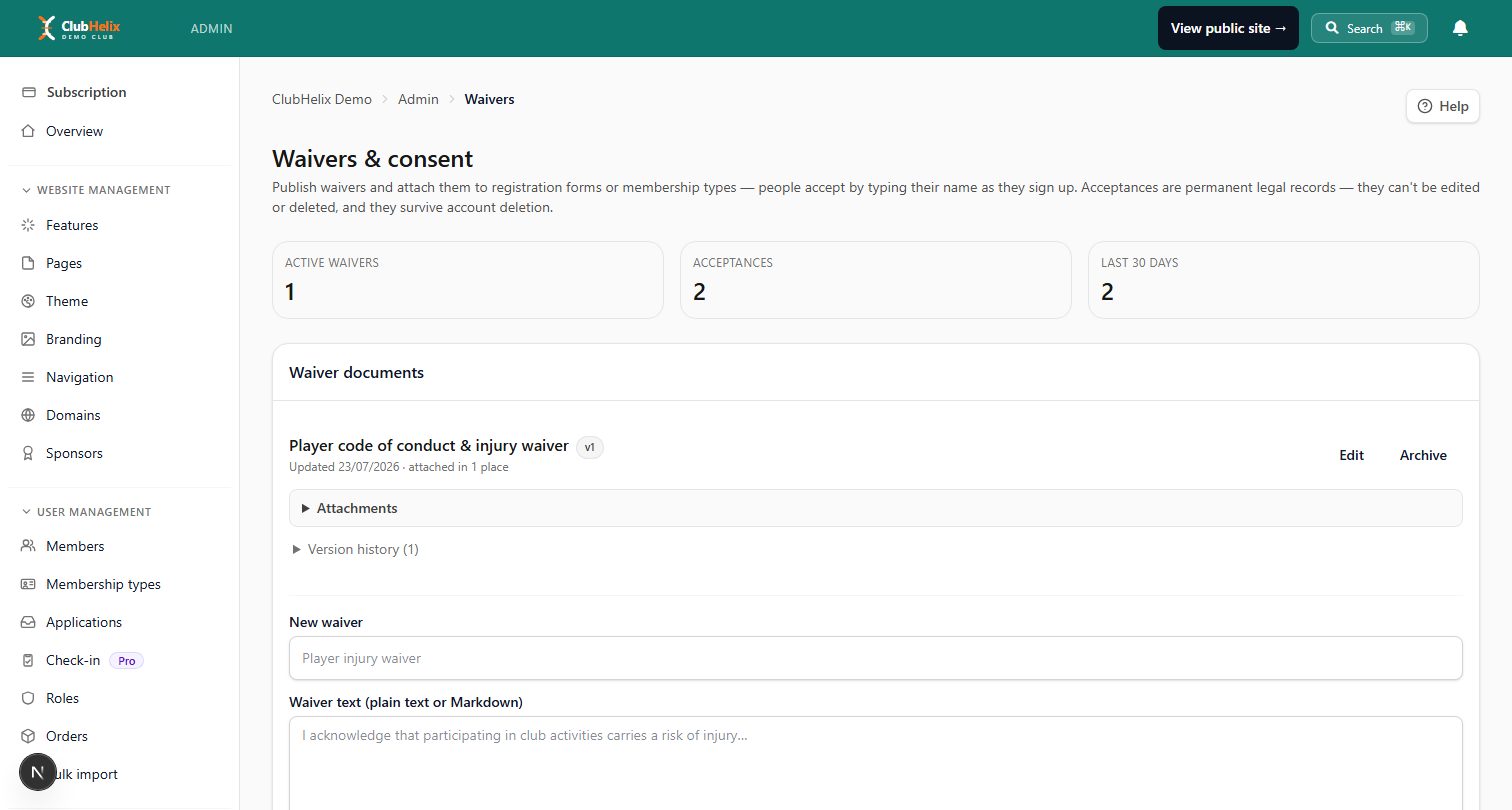
The same discipline covers the related paperwork — consent acknowledgements and participation agreements collected at sign-up belong in the member's record, not a filing cabinet, which is what digital waivers attached to the registration flow are for: signed once, stored against the member, findable in the incident's aftermath.
Match day: reachable in ninety seconds, by the right person
The register protects the data; the incident needs the data. The two requirements meet in one design question: when a member is on the ground, how does the responder reach the emergency contact and the flagged conditions within ninety seconds?
The answer that works for most clubs: the team's coach or manager can open the club system on their phone, at the ground, and see their team's emergency contacts and participation-relevant flags. That single capability retires the printed "medical folder" in the kit bag — which is perpetually stale, readable by whoever opens the bag, and famously in the other car. If your club's grounds have genuinely unreliable coverage, a printed fallback may still be justified: one sheet per team, contacts and flagged conditions only, carried by the team manager, reprinted whenever the register changes, and every copy accounted for and destroyed at season's end. A stale emergency sheet is its own hazard — the contact who changed numbers in April is unreachable in August precisely when it matters.
Afterwards, what happened gets recorded — first aid given, contacts called, outcome — in the club's incident register, which is a governance record with its own retention logic, separate from the member's medical answers. And the incident itself becomes the annual test of the whole system, per your risk management review: did the responder have what they needed, in time, and did anyone have access they shouldn't?
Keep it current by asking annually, not assuming. Conditions appear, contacts change, families move. Renewal season re-confirms every answer — which platforms that pre-fill last season's responses for confirmation make a thirty-second job per family rather than a fresh form. "Current as of this season" is the standard; a two-year-old emergency contact is a coin flip.
Frequently asked questions
Can we make disclosing medical conditions compulsory?
You can — and should — make answering the question compulsory, which is different from compelling disclosure. A required question with "none" as an acceptable answer establishes that every family was specifically asked, which is the club's due diligence; a member who answers "none" inaccurately has made that choice against a clear question. What clubs should not do is gatekeep participation on the content of answers without a proper process — excluding someone over a disclosed condition raises discrimination questions well beyond a registration form, and belongs with your governing body's guidance and medical advice, not a registrar's judgement.
A parent has told the coach something medical verbally — is that enough?
It is how real clubs work, and it is not enough on its own. The verbal heads-up ("she's asthmatic, puffer's in the front pocket") is valuable and should be welcomed — and then the coach or manager's job is one sentence: "brilliant — can you pop that on her registration record so whoever's running training always has it?" Information that lives in one coach's memory leaves when that coach does, and the relieving coach on the day of the incident never got the conversation. The register is the club's memory precisely because personnel are not.
How long should we keep medical information after a member leaves?
Two different clocks run. The routine medical answers — conditions, contacts — have no purpose once the member is gone, and holding them is unprotected downside; clear them in the annual clean-out, subject to any retention rules your jurisdiction or governing body imposes. Records connected to an incident are different: incident reports, and the facts relevant to them, may matter for insurance and liability for years (longer again for juniors, in many places, where limitation periods can run well past their turning 18) — so incident records are retained on their own schedule, and that is one of the questions worth putting specifically to your insurer or governing body rather than guessing.
Should coaches have members' medical details saved on their own phones?
Saved locally — screenshots, downloaded lists, notes apps — no; accessible through the club's system when needed — yes. The distinction is control: information viewed through the platform is governed by the club (access follows the role, and ends with it), while a screenshot is a permanent personal copy the club cannot retrieve when the coach moves on. The practical coaching workflow — open the team, tap the member, see the flag and the contacts — is the same either way; the difference is entirely in what happens after the coach stops coaching, which is exactly the moment nobody is thinking about the data.

