
What this guide answers
- What should a club social media policy include?
At minimum — a register of official accounts, who is authorised to post and how access is granted and removed, what the club will and will not publish, how image consent is handled, what members may and may not post…
- Can a club discipline a member for a personal social media post?
Only where the post breaches a standard the member has agreed to — usually the club's code of conduct or a governing body policy that affiliation binds them to — and only through the club's published complaints and…
- Who should have access to the club's social media accounts?
At least two people at the highest access level, granted as individuals through the platform's own role system rather than by sharing one password, with at least one of them a continuing office-bearer.
- How should a club respond to a negative comment?
Hide or remove it if it breaches your published standards, contact the person privately, and log it.
- Do junior teams need their own accounts?
Usually not, and the fewer accounts you run the fewer you can lose control of.
Canada edition. This guide is written for volunteer-run clubs in Canada. Where rules differ — grants, tax, incorporation, safeguarding — follow the Canada-specific pointers below or check with your national body.
Ask a committee who controls the club's Instagram account and you will usually get a name, a pause, and then a slightly worried second name. The handle was created in 2019 by a junior coach who has since moved interstate, the recovery email is a personal address nobody can reach, and the only person who can post is the one member of the committee who happened to be logged in on an old phone. Nobody has done anything wrong. The club simply never wrote down who owns its own voice.
That is the real subject of a club social media policy. Not tone of voice, not posting frequency — control. Who may speak for the club, what they may say, what happens to the accounts when they hand over, and what the club does when a post lands badly or a member posts something the club is then asked to answer for. Get those four right and the creative side takes care of itself.
This guide gives you a policy you can copy and adapt in an evening, an account inventory that solves the password problem, a permissions matrix that stops every post going through one exhausted volunteer, and a response playbook for the day something goes wrong. It is general information rather than legal advice — if a post ever raises questions about defamation, privacy or advertising rules, get proper advice quickly rather than arguing it out in the comments.
Start with an inventory, not a policy
You cannot write rules for accounts you have not listed. Before anything else, build this table and keep it with the club's other handover documents. Clubs that do this exercise routinely turn up an account nobody knew existed, usually a team page set up in a hurry three seasons ago.
| Account | Handle | Purpose | Access held by | Recovery email | Status |
|---|---|---|---|---|---|
| Main page | @yourclub | Club news, results, events | President, comms officer | comms@yourclub.org | Active |
| @yourclub | Photos, stories, juniors | Comms officer | comms@yourclub.org | Active | |
| Juniors page | @yourclubjuniors | Junior fixtures, parent notices | Junior coordinator | Personal address | Migrate recovery |
| Senior team group | Private chat | Team logistics | Team manager | n/a | Not an official account |
| Old committee page | @yourclub2019 | Nothing | Unknown | Unknown | Recover or report |
Three things fall out of the inventory immediately. First, "not an official account" is a real category and worth naming — a team chat run by a manager is not the club speaking, but the code of conduct still applies inside it. Second, every recovery email should be a club address, not a personal one. If you do not have club addresses yet, fix that first with how to get a club email address. Third, an account nobody can access is a liability, not an asset — either recover it or report it as abandoned so it cannot be revived by someone else.
Solving the password problem properly
The instinct is to write the password on a card and pass it around. Resist it. Shared credentials are the reason clubs lose accounts, and they make the audit trail impossible — when six people share one login, nobody is accountable for anything and you cannot remove one person without locking out the rest.
The pattern that works for a volunteer club:
- Use the platform's own role system wherever it exists. Major platforms let a page or business profile be administered by several individual accounts with different permission levels. Each volunteer logs in as themselves, so posts are attributable and removing someone takes thirty seconds.
- Keep at least two people at the highest level of access, and make one of them a continuing officer. Sole administrators leave. A club with only one full admin on a page is one resignation away from a problem.
- Point recovery at a club-controlled inbox and a club-controlled phone number. If the reset email goes to a personal address, the account belongs to that person in practice regardless of what your policy says.
- Turn on two-factor authentication, and record where the second factor lives. Note in the inventory which device or authenticator holds it, so handover includes moving it.
- Where a shared login genuinely cannot be avoided, keep it in a password manager the club pays for, with the vault owned by an office-bearer role, and change the password at every committee changeover as a matter of routine, not suspicion.
Handover is a twenty-minute job that never gets done, so put it on the list that already exists. Our committee handover checklist covers the wider changeover; the social media portion is simply — add the incoming person at the right access level, confirm they can post, remove the outgoing person, update the recovery details, and update the inventory. Do it on the night of the annual general meeting, not "sometime in the off-season".

Who may post what
The second failure mode is the opposite of chaos — a single approver who becomes a bottleneck, so the club posts nothing for six weeks and every team resorts to its own page. A permissions matrix fixes both problems at once.
| Role | May post without approval | Needs sign-off from | Never posts |
|---|---|---|---|
| Comms officer | Results, fixtures, photos, events, member notices | — | Anything about a complaint or incident |
| Junior coordinator | Junior program content on the juniors account | Comms officer for anything club-wide | Images of children without recorded consent |
| Team managers | Team-level logistics in their own team channels | Comms officer for anything public | Selection disputes, injury detail, umpire criticism |
| Coaches | Training and program updates | Comms officer | Commentary on match officials or opposition |
| President | Statements on behalf of the club | — | — |
| Any other member | Nothing on official accounts | — | — |
The rule that saves the most grief is the one in the first row — the person who normally posts everything is explicitly not the person who posts about incidents, complaints or anything involving a named individual. Those go to the president or nowhere. That single line prevents the most common club social media disaster, which is a well-meaning volunteer explaining a disciplinary matter in a comment thread at eleven at night.
The policy — copy, adapt, adopt
Paste this into a document, edit the bracketed parts, and adopt it at a committee meeting so it has a date and a minute reference. Publish it on your club website and link it from the membership form so members have actually seen it.
[Club name] social media policy
1. Purpose. This policy sets out how [Club] uses social media, who may post on the club's behalf, and what the club expects of members when they post about the club. It applies to committee members, coaches, team managers, players, parents, volunteers and life members.
2. Official accounts. The club's official accounts are listed in the club's account register. Only accounts on that register speak for the club. No member may create an account, page or group using the club's name, logo or colours without written committee approval.
3. Authorised posters. The committee appoints authorised posters annually and records them in the minutes. Access is granted to individuals by role and removed when the role ends. Passwords are not shared outside the register arrangements.
4. What we post. Fixtures, results, selections once released, events, member notices, sponsor acknowledgements, club history and photographs consistent with the club's photography and consent policy.
5. What we never post. Personal contact details or addresses; medical or injury detail beyond what the person has agreed to; anything about a complaint, disciplinary matter or incident that is on foot; criticism of match officials, opposition clubs or their supporters; images of a member who has asked not to be photographed; anything a member has told us in confidence.
6. Images and consent. Images are posted only where consent has been recorded, and consent can be withdrawn at any time by contacting [email]. Requests to remove an image are actioned promptly and without argument.
7. Members posting personally. Members are free to use social media personally. When posting about the club, its members, opposition, officials or sponsors, members must not post anything that is abusive, discriminatory, threatening, sexually explicit, or that identifies a child other than their own. Members must not present a personal opinion as the club's position.
8. Team chats and groups. Group chats used for club activity are covered by the club's code of conduct. Adults must not contact a junior member privately about club matters — communication with juniors goes through a parent or guardian, or in a group with another adult present.
9. Comments and moderation. The club moderates comments on its accounts. Comments that breach clause 5 or 7 will be hidden or removed and the member contacted. Repeated breaches are dealt with under the club's complaints and disciplinary procedure.
10. Breaches. A breach of this policy is a breach of the club's code of conduct and is handled under the club's complaints procedure. Serious breaches may be referred to the club's governing body or to an external authority.
Adopted by the committee on [date]. Review date [date].
Clause 7 is the one people argue about, so keep it narrow and behaviour-based. A club cannot police what members think, and it should not try — but it can require that members do not abuse people, do not identify other people's children, and do not pretend to speak for the club. That is defensible and enforceable. Anything broader tends to collapse the first time it is tested. Pair the policy with your player code of conduct so the two documents use the same language and the same consequences.
Two legal lines are worth knowing about in Canada, without turning your policy into a law lecture. Privacy obligations come from federal and provincial statutes depending on the club's activities, and the Office of the Privacy Commissioner publishes guidance for small organisations. Canada's anti-spam legislation is unusually strict and applies to commercial electronic messages rather than to public posts, so it bites on club emails and texts promoting an event more than on a page update. Defamation applies to social posts, so describe conduct rather than naming individuals.
What your affiliation already commits you to
Before you adopt anything, check what you have already agreed to. Affiliation usually brings a code of conduct and a member protection or integrity policy, and those documents frequently contain social media clauses that bind your members whether or not your club has its own policy. Where the two differ, the higher standard applies — and your policy should say so in a line, so nobody has to work out which document wins.
In Canada, provincial and territorial sport organisations publish codes of conduct, and national-level programs set out rules on communication between adults in positions of trust and underage participants — typically requiring open, group or parent-copied communication rather than private messages. Mirror those requirements in clause 8, and reference your sport organisation's code by name in clause 10 so members know which document takes precedence.
Sponsors, alcohol and betting content
Sponsor obligations are the quiet trap in club social media, because a well-meant thank-you post can breach advertising rules the club has never read. The general shape is the same everywhere — restrictions tighten sharply around alcohol, gambling and anything aimed at or likely to reach children — but the detail differs by market, and it is your sponsor's contract and your governing body's policy that bind you.
In Canada, alcohol and gaming advertising are regulated provincially, with liquor and gaming authorities setting rules that vary meaningfully between provinces, and advertising standards codes applying on top. Rules around content that could appeal to people under the legal age are the ones most relevant to a community club. Confirm what your province requires before posting sponsor content, and keep regulated categories entirely off junior-facing accounts.
Practical habits that travel well regardless of where you play. Keep alcohol and betting content off junior-facing accounts entirely, including reshares. Never post a betting promotion alongside a fixture or a team announcement. Do not tag junior teams in sponsor content. Ask any sponsor with regulated products to supply approved creative and approved wording rather than writing your own. And if a sponsorship deal requires a set number of posts, put the schedule in the sponsorship agreement so the comms officer is not improvising against a commitment they have never seen — our guide on how to keep club sponsors happy covers the reporting side.
When a post goes wrong
Something will go wrong. A result posted with the wrong scorer, a photo of a child whose family had opted out, a member firing off an unpleasant comment under the club's fixture post, or a genuine crisis. The difference between a bad hour and a bad month is having decided in advance who handles which.
| Situation | First move | Who decides | Timeframe |
|---|---|---|---|
| Factual error in a club post | Edit or delete, then post the correction | Comms officer | Immediately |
| Image posted without consent | Remove it without discussion, then contact the family | Comms officer | Within the hour |
| Member posts something abusive under a club post | Hide the comment, message the member privately, log it | Comms officer | Same day |
| Member posts something damaging on their own account | Do not reply publicly. Log it and refer to the complaints procedure | President | Same day, in writing |
| A serious allegation appears publicly | Do not comment on substance. Acknowledge, refer, take advice | President | Within a few hours |
| Account compromised or posting content you did not write | Remove access, reset credentials, post a short factual notice | President and comms | Immediately |
Two rules underpin all six rows. Never argue in the comments. A club account replying to criticism gives the criticism a second audience and a permanent screenshot. Move it to a private message or a phone call, and if the substance is serious, into the complaints and disputes process where it will be handled properly. Correct rather than quietly delete. A deleted post that people noticed becomes a story; a visible correction almost never does.
A holding statement you can adapt in ninety seconds:
We are aware of a matter raised online today. The club takes it seriously and is dealing with it through our published complaints process. Out of fairness to everyone involved we will not be commenting on the detail. Anyone with information or concerns can contact [role] at [email].
And an apology, for the times you got it wrong:
Earlier today we posted [what]. That was our mistake — [what was wrong and why it mattered]. We have removed the post and contacted [who] directly. We have changed [the specific thing] so it does not happen again. We are sorry.
Short, specific, no defensiveness, one concrete change. Apologies that explain at length what the club meant to do read as excuses; the version above reads as a club that is running itself properly.
Running the club's voice from the club's own systems
Almost every problem above traces back to the same root cause — the club's public voice lives on platforms the club does not control, accessed by credentials the club does not own. The fix is not to abandon social media, which is where your members already are. It is to make your own site the source and social the amplifier. ClubHelix gives you news and announcements on your own domain that you can link from any platform, roles and permissions so posting rights follow the role rather than a person's phone, an audit log recording who published and changed what, and email broadcasts that reach every member without depending on an algorithm.
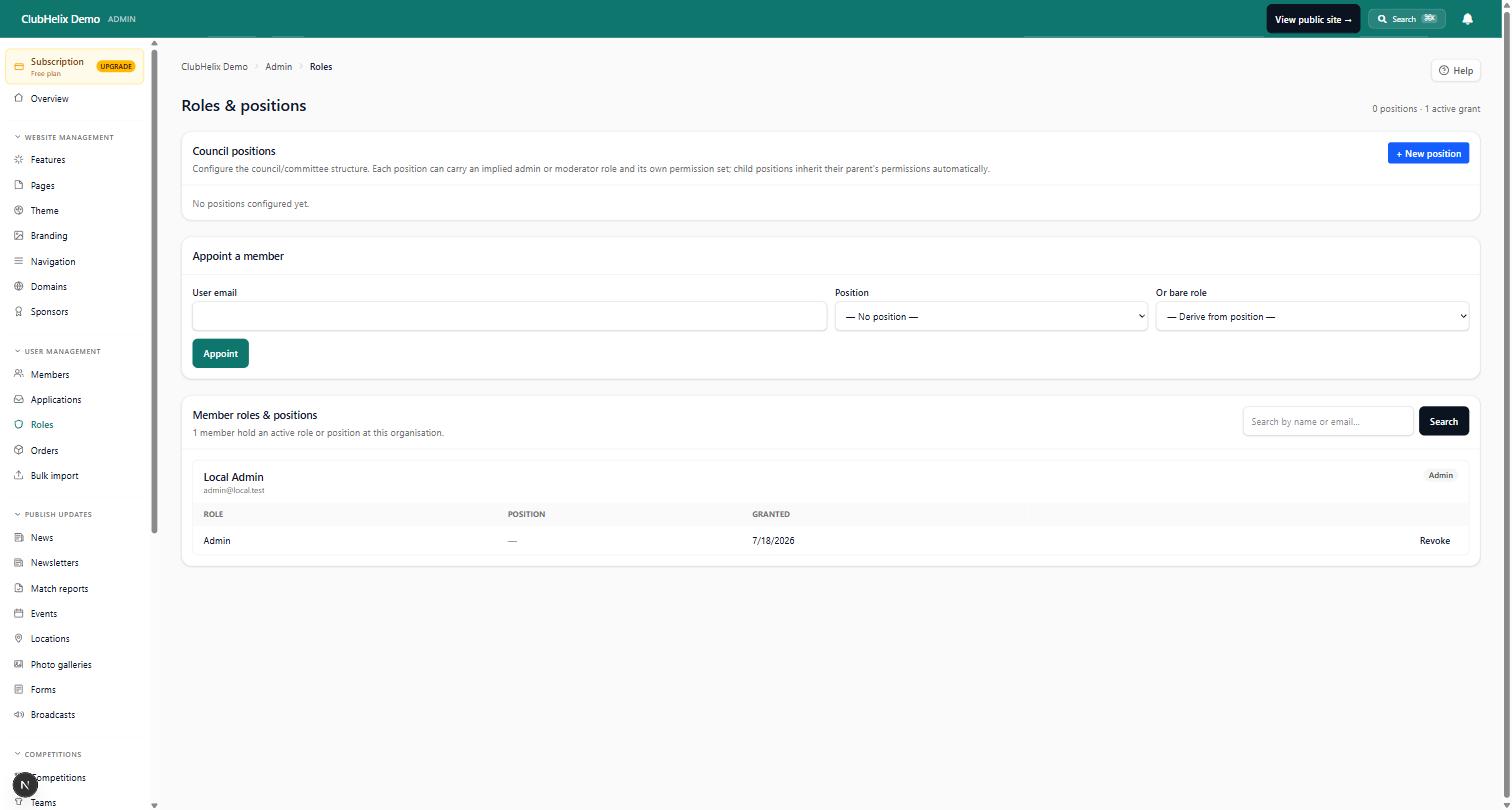
There is a free tier to start on, and the pricing is published on the site rather than hidden behind a quote. If your club's announcements currently exist only inside one volunteer's social account, that is worth changing before the next handover — you can set your club up and publish your first notice the same afternoon.
Frequently asked questions
What should a club social media policy include?
At minimum — a register of official accounts, who is authorised to post and how access is granted and removed, what the club will and will not publish, how image consent is handled, what members may and may not post about the club in a personal capacity, how comments are moderated, and what happens when the policy is breached. Keep the personal-posting clause behaviour-based rather than opinion-based, and give the policy an adoption date and a review date so it does not quietly go stale.
Can a club discipline a member for a personal social media post?
Only where the post breaches a standard the member has agreed to — usually the club's code of conduct or a governing body policy that affiliation binds them to — and only through the club's published complaints and disciplinary procedure. That means abusive, discriminatory or threatening posts, posts identifying someone else's child, or posts falsely presenting a personal view as the club's position. A club cannot fairly sanction a member for an opinion it dislikes, and attempting to usually creates a bigger problem than the post did.
Who should have access to the club's social media accounts?
At least two people at the highest access level, granted as individuals through the platform's own role system rather than by sharing one password, with at least one of them a continuing office-bearer. Recovery email and phone should point to club-controlled contacts, not personal ones, and access should be reviewed and updated at every committee changeover as a matter of routine.
How should a club respond to a negative comment?
Hide or remove it if it breaches your published standards, contact the person privately, and log it. Do not debate it publicly — a reply from the club account gives the comment a second audience and a screenshot that outlives the argument. If the substance is a genuine grievance, direct it into your complaints procedure, which is designed to handle it fairly and leaves a record.
Do junior teams need their own accounts?
Usually not, and the fewer accounts you run the fewer you can lose control of. If a junior program does need its own channel, register it in the club's account inventory, put a second club administrator on it, apply the same image-consent rules, and keep alcohol, gambling and adult-oriented sponsor content off it entirely. An unregistered account run by one parent is the pattern that causes trouble.
Keep reading — how to set up club social media accounts covers getting the accounts right from the start, and club social media ideas is where to go once the governance is sorted.


