
What this guide answers
- How often should a sports club post on social media?
In-season: three to five times a week — a results wrap, a mid-week feature, a fixture preview, and same-day match photos.
- What should a club post when nothing is happening?
Throwbacks from the club archive, volunteer and sponsor spotlights, "meet the committee" features, training photos, merchandise, and countdowns to the next season.
- Should our club be on every platform?
No. Run the one or two platforms your community actually uses — for most community clubs that's Facebook and Instagram — and feed them consistently.
- Who should run the club's social media?
A named media volunteer (or small roster), using a page owned by a club account with at least two committee members as admins.
Every club knows it "should be doing more on socials", and almost every club does it the same way: a burst of enthusiasm in March, sporadic match results until June, then silence. The problem isn't effort — it's that posting without a plan means reinventing the wheel every single week, and no volunteer has time for that.
This guide gives you the plan: what social media is actually for at club level, a weekly content calendar you can run on 30 minutes a week, a big bank of post ideas organised by phase of the season, and the ground rules that keep it safe. It assumes you're a volunteer with a phone, not a marketing department.
What social media is for (and what it isn't)
At community club level, social platforms do two jobs well:
- Discovery. Locals searching for a club, parents asking in community groups, players moving to the area — social is where they first bump into you. Your page is a shopfront: it needs to look alive and point clearly to your website.
- Community feel. Photos, banter, milestones and results give members and families a place to celebrate publicly and tag each other. That feeling is real and it drives retention.
What social media is bad at: being your system of record. Posts vanish down the feed within a day, platforms throttle reach whenever they like, and you don't control the algorithm or the account rules. So the golden rule of club social media is:
Post the moment on social; keep the substance on your website.
Fixtures, fees, registration links, event details and full match reports live on your club website — a news page you control, that search engines index, and that doesn't evaporate after 24 hours. Social posts tease and link back. This also solves the "we posted it on Facebook, why didn't you see it?" argument forever: the website is always the source of truth, social is the megaphone. (If your club site isn't up to that job yet, start with our guide to building a club website.)
Pick your platforms — and only as many as you can feed
For most community clubs the honest answer is Facebook plus Instagram, run from one shared plan. Facebook reaches parents, volunteers and the local community groups where recommendations happen; Instagram reaches players and younger families with photo-first content. Cross-post most things, and don't add a third platform until the first two have been consistently fed for a full season. A dead account with a 2024 header photo does more harm than no account at all.
Locally, the highest-value placements are often not your own page at all: suburb and town community Facebook groups and buy-swap-sell pages are where parents ask "can anyone recommend a club?" — make sure a committee member is in them and ready with your link.
Account hygiene, once, before anything else:
- The page is owned by a club account (a role-based address like
media@on the club's own domain), never one person's personal profile. - At least two current committee members hold admin access at all times.
- Logins are recorded in the committee handover pack, reviewed at every AGM.
The weekly content calendar
Consistency beats brilliance. Here's a repeatable in-season week that takes about 30 minutes total, most of it on the phone you already had at the game:
| Day | Post | Effort |
|---|---|---|
| Monday | Results wrap-up graphic or photo + link to full match reports on the website | 10 min |
| Wednesday | Mid-week feature: player/volunteer spotlight, throwback photo, or sponsor shout-out | 10 min |
| Friday | "This weekend" post: fixtures, venues, who's at home, canteen open | 5 min |
| Saturday/Sunday | 2–3 candid photos from the game or one short video clip, posted same-day | 5 min |
| As needed | Wet-weather calls, ground changes — short, factual, pinned | 2 min |
Three notes on making this stick:
- Batch the thinking, not the posting. Once a month, list the Wednesday features for the next four weeks. The weekly job then becomes pure assembly.
- Same-day photos beat perfect photos. A slightly grainy shot posted Saturday night outperforms a great one posted Thursday. (That said, ten minutes of technique goes a long way — see how to take good club photos.)
- Recruit correspondents. One parent or player per team sends two photos and one line to a shared chat each weekend. The page admin curates; they don't have to attend every game on every ground.

Post ideas by phase of the season
Pre-season (registration time)
This is the phase where social media directly earns the club money — every post should make joining easier:
- "Registrations are open" — with the fee, the dates, and a link straight to your online sign-up (not "DM us for info"; every extra step loses people)
- Come-and-try day countdowns
- "Meet the coaches" series — one photo, three questions each
- New kit or merchandise reveals
- Early-bird deadline reminders (post these more than feels polite; reach means only a fraction of followers see each one)
- "New to [suburb]? Looking for a club?" posts written for people who don't know you exist — these get shared into local community groups
In-season
- Match-day live moments: teams running out, half-time huddles, the winning goal
- Results graphics with a one-line summary per grade
- Live score updates for big games — if your platform has a live match centre, share its link so followers can watch the score tick over without you posting every goal
- Player of the week (rotate across every team, juniors included — their families share these the most)
- Volunteer of the week: canteen legends, line markers, team managers
- Milestone games: 50th, 100th, 250th
- Sponsor spotlights that say something genuine ("their team fixed the clubroom hot water in a day") rather than logo dumps
- Behind-the-scenes: training drills, the 7am line-marking crew, the kit wash pile
Finals and season's end
- Finals fixture announcements and ticket links
- "Road to the final" recap posts
- Team photos before every final
- Presentation night: award winners, life memberships, best dressed
- Season thank-you posts: volunteers, sponsors, supporters — tag generously
Off-season
Don't go dark; two posts a fortnight keeps the page alive:
- Throwback Thursday from the club archives
- AGM and committee vacancy notices (social is a genuine recruitment channel for committee roles)
- Pre-season training announcements
- "Save the date" for season launch
- Player signing/returning announcements if that's your club's culture
Ground rules that keep you safe
Put these in writing before you hand anyone the login:
- Photo consent is collected at registration, and the media volunteer has access to the list of members who opted out. Junior sport especially: no full names with identifiable photos of children unless consent covers it.
- Two-person rule for anything sensitive. Injury news, disciplinary matters, anything about officials or opposition clubs — a second committee member reads it before it's posted. Better yet: don't post those things at all.
- Never argue in the comments. Correct factual errors once, politely; take everything else to private channels. Screenshots outlive deletions.
- The page speaks for the club. No political content, no personal opinions in the club's voice, no public complaints about umpires or governing bodies.
Measure just enough
Once a month, glance at three numbers: follower growth, your best-performing post (do more of that), and clicks through to your website. That last one is the number that matters most — social applause is nice, but website clicks are what turn into registrations. During pre-season, watch which posts drive sign-up link clicks and repeat them shamelessly.
And remember that social reach only ever touches the followers the algorithm chooses that day. For things every member must see — fees, AGMs, wet-weather calls — email and SMS remain the reliable channels; our club communication plan covers which channel to use when, and ClubHelix broadcasts reach your whole member list without an algorithm in the way.
Frequently asked questions
How often should a sports club post on social media?
In-season: three to five times a week — a results wrap, a mid-week feature, a fixture preview, and same-day match photos. Off-season: at least fortnightly so the page never looks abandoned. Consistency matters far more than volume; a sustainable weekly rhythm run all season beats a daily blitz that collapses a month in.
What should a club post when nothing is happening?
Throwbacks from the club archive, volunteer and sponsor spotlights, "meet the committee" features, training photos, merchandise, and countdowns to the next season. Off-season is also the best time for recruitment content — committee vacancies, coaching roles, and "new to the area?" posts aimed at future members rather than current ones.
Should our club be on every platform?
No. Run the one or two platforms your community actually uses — for most community clubs that's Facebook and Instagram — and feed them consistently. A dead account harms credibility more than a missing one. Whatever platforms you choose, keep your website as the permanent source of truth and use social to link back to it.
Who should run the club's social media?
A named media volunteer (or small roster), using a page owned by a club account with at least two committee members as admins. Recruit one correspondent per team to feed photos into a shared chat so one person isn't expected at every ground. Write down the ground rules — consent, tone, what never gets posted — and hand them over with the login.
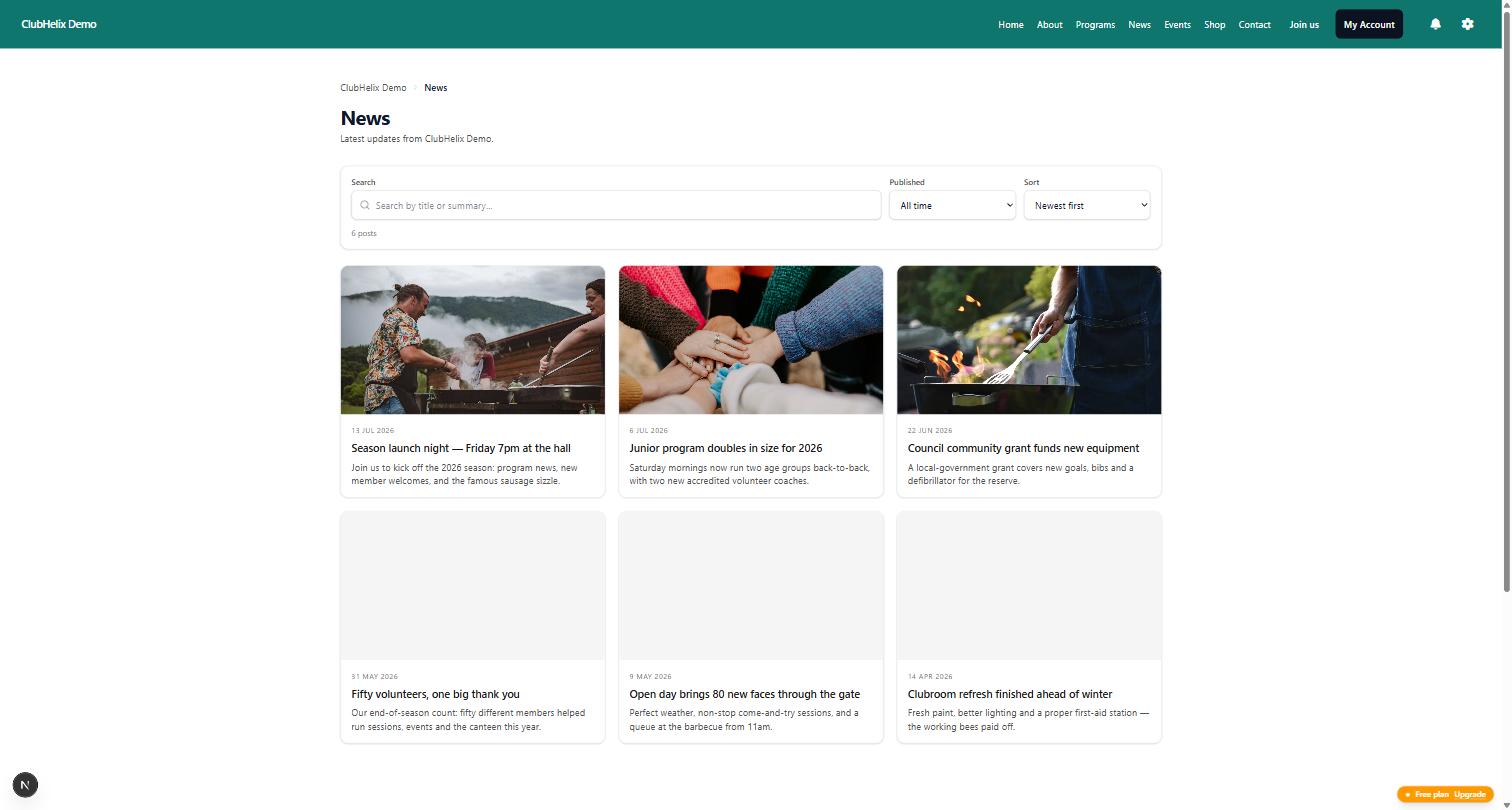
Give your posts somewhere permanent to point: ClubHelix gives every club a news page for full stories, a live match centre for game-day scores, and broadcasts for the messages every member must see.


