
What this guide answers
- What should be on a club annual calendar?
Three layers. The season — first round, finals, training, presentation night and any carnival or tournament.
- When should a club start planning next season?
Before the current one ends. The practical rule is that anything requiring other people's turnaround — competition entries, facility allocations, uniform orders, funding applications — starts four to six months ahead…
- How far ahead should we publish club events to members?
Anything a family would rearrange their weekend for wants two to three months of notice, and ideally a save-the-date at the start of the season.
- Who should own the club calendar?
The secretary usually custodians the document, but each date should be owned by the role that has to act on it — the treasurer owns financial deadlines, the registrar owns registration dates, the facilities coordinator…
- What is the difference between the club calendar and the fixture list?
The fixture list is generated by your competition and changes week to week with postponements and rearrangements, so it belongs with your results and ladders.
USA edition. This guide is written for volunteer-run clubs in the United States. Where rules differ — grants, tax, incorporation, safeguarding — follow the USA-specific pointers below or check with your national body.
Here is the uncomfortable truth about the club year — almost nothing in it is a surprise. The season starts when the competition says it does. The insurance renews on the same date it renewed last year. The AGM has to happen within a set window after the books close. The grant round opens when it always opens. Presentation night is the weekend after the last game, as it has been for two decades.
And yet clubs are ambushed by all of it. The registration form goes live three weeks after the neighbouring club's. The notice for the AGM goes out four days short. Somebody discovers in round two that the certificate of currency expired in the off-season. The funding application is written the night before it closes, which is why it reads like it was.
That gap between "entirely predictable" and "somehow a crisis" is what an annual calendar closes. This guide gives you a month-by-month template you can adapt to your sport in an afternoon, the recurring compliance dates most committees only learn about the hard way, and the part that most clubs skip — publishing the thing so members organise their own lives around your club instead of the other way around.
Start from three anchors, not from January
A club calendar built by starting at the top of the year and filling in months always drifts, because it treats every date as equally movable. Build it from three fixed anchors instead, and roughly forty dates arrange themselves.
Anchor 1 — the first competition round. Set by your association, not by you, and usually confirmed months ahead. Everything to do with players works backwards from it: nominations, registration opening, pre-season training, coach appointments, uniform ordering, ground bookings, team lists.
Anchor 2 — the end of your financial year. This fixes the accounts, any review or audit your rules require, the treasurer's annual report, and the statutory filing your structure demands. It is the anchor clubs most often forget they have.
Anchor 3 — the annual general meeting. Your rules will tie the AGM to a window after the financial year end, and the notice period sits in front of that. The AGM in turn drives nominations for committee positions, life membership decisions, subscription setting for next year and the whole handover cycle.
Write those three dates down first. Then hang each family of tasks off its anchor with a lead time attached, and you have a calendar rather than a list. The pre-season checklist is the detailed version of everything that hangs off anchor one.
The month-by-month template
Because seasons start at different times for different sports, this template runs on a season-relative spine — S is the first competition round, S−4 is four months before it. Map it onto real months once, at the top of your document, and the whole calendar becomes concrete.
| Point in the year | On the field and in the club | Money and compliance | Communications |
|---|---|---|---|
| S−5 | Confirm which teams you are entering; appoint coaches; book grounds and facilities | Set fees for the season; draft the season budget; check insurance renewal date | Sound out last year's members about returning |
| S−4 | Order uniforms and equipment (allow for supplier lead times) | Affiliation renewal; open the funding application you flagged last year | Announce the season dates and fees publicly |
| S−3 | Open online registration; book the come-and-try or open day | Registration payments start landing; reconcile weekly from day one | Registration campaign — email, socials, school flyers |
| S−2 | Pre-season training starts; run the registration day; grade teams | Screening checks and accreditations verified before anyone coaches | Weekly reminders to unrenewed members |
| S−1 | Team lists published; player photos; facility working bee; first aid kits and defibrillator checked | Final fee chasing; confirm certificate of currency is on file | Welcome pack to new members; fixture release |
| S — round 1 | Season opens; canteen and duty rosters live | Match-day float; weekly banking rhythm begins | Match reports and results published weekly |
| S+1 to S+3 | Mid-season review of teams, coaches and volunteers | Budget versus actual at the halfway point; chase outstanding fees | Mid-season member survey; sponsor mid-season report |
| S+4 | Finals preparation; volunteer roster for finals; presentation night booked | Presentation night budget; trophy and award orders | Save-the-date for presentation night and the AGM |
| S+5 — season end | Finals; equipment returned and counted; last working bee | Close the season's books; write off or chase remaining debts | End-of-season thank-you to volunteers and sponsors |
| S+6 | Presentation night; life membership and award decisions | Financial year close; accounts prepared for review | Season wrap-up and photo gallery published |
| S+7 | Committee nominations open; succession conversations | Annual report and financial statements drafted; statutory filing prepared | AGM notice issued with the full required lead time |
| S+8 | AGM; handover of roles; first meeting of the new committee | New signatories lodged; subscriptions set for next year | New committee introduced to members |
That spine works for a winter code, a summer code, a two-season club or a year-round club — a year-round club simply runs two overlapping copies with different anchors. Add your own club-specific rows: a regatta, a carnival, a tournament weekend, a gala day, a quiz night, an annual dinner.
Mapping it to real months, fall sports typically open in late August or September, which puts registration in May and the annual meeting in November or December. Spring sports opening in March or April put registration in December or January. Two seasonal realities belong on the calendar itself — the deep-winter window, when outdoor facilities may be unusable for weeks at a time and gym access is scarce, and the summer holiday gap, when families travel and nothing you send gets read.

The recurring dates most clubs forget
These are the entries that only get added to a club calendar after they have caused a problem once. Put them all on now, each with a reminder set well before the due date.
| Recurring date | Typical rhythm | What goes wrong without it |
|---|---|---|
| Insurance renewal and certificate of currency | Annual, fixed date | A gap in cover, or a venue refusing your booking because the certificate expired |
| Affiliation renewal with your governing body | Annual, before the season | Teams cannot be entered, and players are not covered by association arrangements |
| Annual financial statements and any required review | Annual, after year end | The AGM has to be postponed because the accounts are not ready |
| Statutory filing for your legal structure | Annual, deadline-driven | Late fees, and in the worst case the club's registered status is at risk |
| AGM notice period | Annual, rules-driven | A meeting that is technically invalid, and elections that can be challenged |
| Domain name and website renewal | Annual, easy to miss | The website and every club email address stop working on the same day |
| Facility and permit renewals | Annual or seasonal | You lose your training slot to a club that applied on time |
| Ground and facility allocation applications | Annual, opens months ahead | The same, but harder to fix after the fact |
| Equipment inspections and expiry dates | Quarterly to annual | Defibrillator pads, first aid stock, harnesses, goal anchors and nets all quietly expire |
| Screening check and accreditation expiries | Rolling, per person | A coach who cannot legally take a session on the weekend it matters |
| Funding acquittals and reports | Per grant, hard deadlines | An unacquitted grant can disqualify the club from the next round |
| Committee office holder details updated | After every AGM | Official records and bank signatories point at people who left two years ago |
| Competition nominations and team entries | Annual, hard deadline | A team that trained all summer has nowhere to play |
Two habits make the table work. First, every date gets a reminder date, not just a due date — the reminder is the real entry in the calendar, and it sits far enough ahead that the work can actually be done. Second, the equipment and screening rows get their own registers rather than living as a single calendar line, because they are per-item and per-person. Our equipment register template covers the first, and the risk management guide covers what to do with what the inspections find.
Fill in three of that table's rows before you touch anything else, because they are the ones with penalties attached. An incorporated nonprofit generally files an annual or biennial report with the state, and a tax-exempt organisation files an annual information return with the IRS on a deadline tied to the end of its fiscal year. The third row is funding — municipal recreation grants, community foundation cycles, corporate giving programs and league development funds each open annually, and the clubs that win them are the ones tracking the opening date rather than scrambling at the close.
Work backwards from every fixed date
A date on a calendar is not a plan. What makes the calendar useful is the countdown attached to each anchor event. Two worth writing out in full, because they are the two clubs most often start too late.
Registration opening (T = the day the form goes live).
| When | Task | Owner |
|---|---|---|
| T−6 wks | Fees agreed by the committee; any discounts and family caps decided | Treasurer |
| T−4 wks | Registration form built and tested end to end with a real payment | Registrar |
| T−3 wks | Membership categories, age groups and any waivers finalised | Registrar |
| T−2 wks | Renewal email drafted; last season's member list cleaned | Secretary |
| T−1 wk | Save-the-date to existing members; socials and flyers scheduled | Communications |
| T | Form live; direct link on the home page and in every channel | Registrar |
| T+3 d | Reminder to everyone who has not renewed | Registrar |
| T+2 wks | Second reminder plus a personal call list for long-standing members | Committee |
The AGM (T = meeting day).
| When | Task | Owner |
|---|---|---|
| T−12 wks | Financial year ends; treasurer starts closing the books | Treasurer |
| T−8 wks | Accounts drafted and sent for any review your rules require | Treasurer |
| T−6 wks | Annual report sections requested from each portfolio | Secretary |
| T−5 wks | Nominations for committee positions open; succession conversations happen | President |
| T−4 wks | Notice of meeting issued with the agenda, nomination form and required attachments | Secretary |
| T−2 wks | Nominations close; annual report finalised and published to members | Secretary |
| T−1 wk | Room, catering, voting method and returning officer confirmed | Secretary |
| T | AGM held | President |
| T+2 wks | Statutory filings lodged; signatories changed; access granted and revoked | Secretary |
Presentation night and any major fundraiser deserve the same treatment. So does each funding round — for those, the countdown starts at the round's opening date, because the clubs that win are usually the ones with quotes and letters of support already gathered. The grant application guide sets out what that preparation looks like.
Every date needs an owner, a lead time and a trigger
Three columns turn a calendar from decoration into a system.
- Owner. A role, not a person — "registrar", not "Priya". Roles survive the AGM; people do not. The committee roles guide is a good source for who should own what.
- Lead time. How long the task genuinely takes, including other people's turnaround. Uniform orders and bank signatory changes are the classic underestimates.
- Trigger. What happens on the reminder date — an email to the owner, an agenda item, a task appearing in a list. A date with no trigger is a date nobody sees.
Then wire the calendar into the meeting cycle. Every committee meeting should have a standing item that reads out what is due in the next 60 days, so the calendar is reviewed twelve times a year by the people who have to act on it. That single line, built into the committee meeting agenda, does more for compliance than any amount of good intentions in November.
Publishing it so members plan around you
Most club calendars are a committee document, which means the people whose behaviour you actually want to change never see one. Split it into two layers and publish the outer one properly.
The member-facing calendar carries anything a family would put in their own diary — season start, registration dates, come-and-try days, photo day, working bees, the quiz night, the presentation night, the AGM, breaks and holiday closures. Rule of thumb: if a member would rearrange something to attend, or would be annoyed to miss it, it goes on the public calendar.
The committee calendar carries the rest — renewals, filings, funding rounds, inspections and internal deadlines. Visible to the committee, not on the public site.
Four practical rules for the public one:
- Publish earlier than feels necessary. People commit their weekends months out. A presentation night announced six weeks ahead competes with everything already booked; announced at the start of the season, it wins.
- One source of truth. The calendar on your website is the calendar. Social posts and emails link to it rather than restating dates, because restated dates are how two versions of presentation night start circulating.
- Let people subscribe. A calendar members can add to their phone, plus reminders before the events they have said yes to, beats a PDF nobody opens twice.
- Broadcast changes; do not just edit them. A silently amended date is worse than no calendar, because people trusted the old one. Change the entry, then tell the affected group.
That is also where a club calendar starts paying for itself in volunteer hours — an events calendar with RSVPs and ticketing collects who is coming to the quiz night, an installable web app with push notifications puts the next fortnight in members' pockets, and email broadcasts from your own club address handle the reminders. The communication plan guide covers which message belongs in which channel.
Keeping it alive year after year
Calendars die in their second year. Three habits stop that.
Roll it forward at a fixed meeting. At the first committee meeting after the AGM, the previous year's calendar is copied, the anchors are re-set, and every date is either confirmed, moved or deleted. It takes half an hour, and it is the difference between a living calendar and a document from a committee three handovers ago.
Capture surprises as they happen. Add one line to your meeting agenda — "anything that surprised us this month?" Whatever gets named is missing from the calendar, and gets added while the memory is sharp. That is how the calendar gets genuinely specific to your club rather than generic.
Keep it as club property. In the club's own account, visible to the whole committee, not in a personal calendar or on one laptop. Every handover afterwards is a change of access rather than a rescue mission — the handover checklist explains why that distinction matters so much.
Putting the club year in one place
The reason most clubs run on three calendars and a group chat is that the tools were never joined up. ClubHelix keeps the club year in the club's own account — the events calendar publishes to your website with RSVPs, tickets and reminders attached, broadcasts send the notice and the changes from your own club address, and governance and meetings hold the compliance dates and the action items that come out of reviewing them each month.
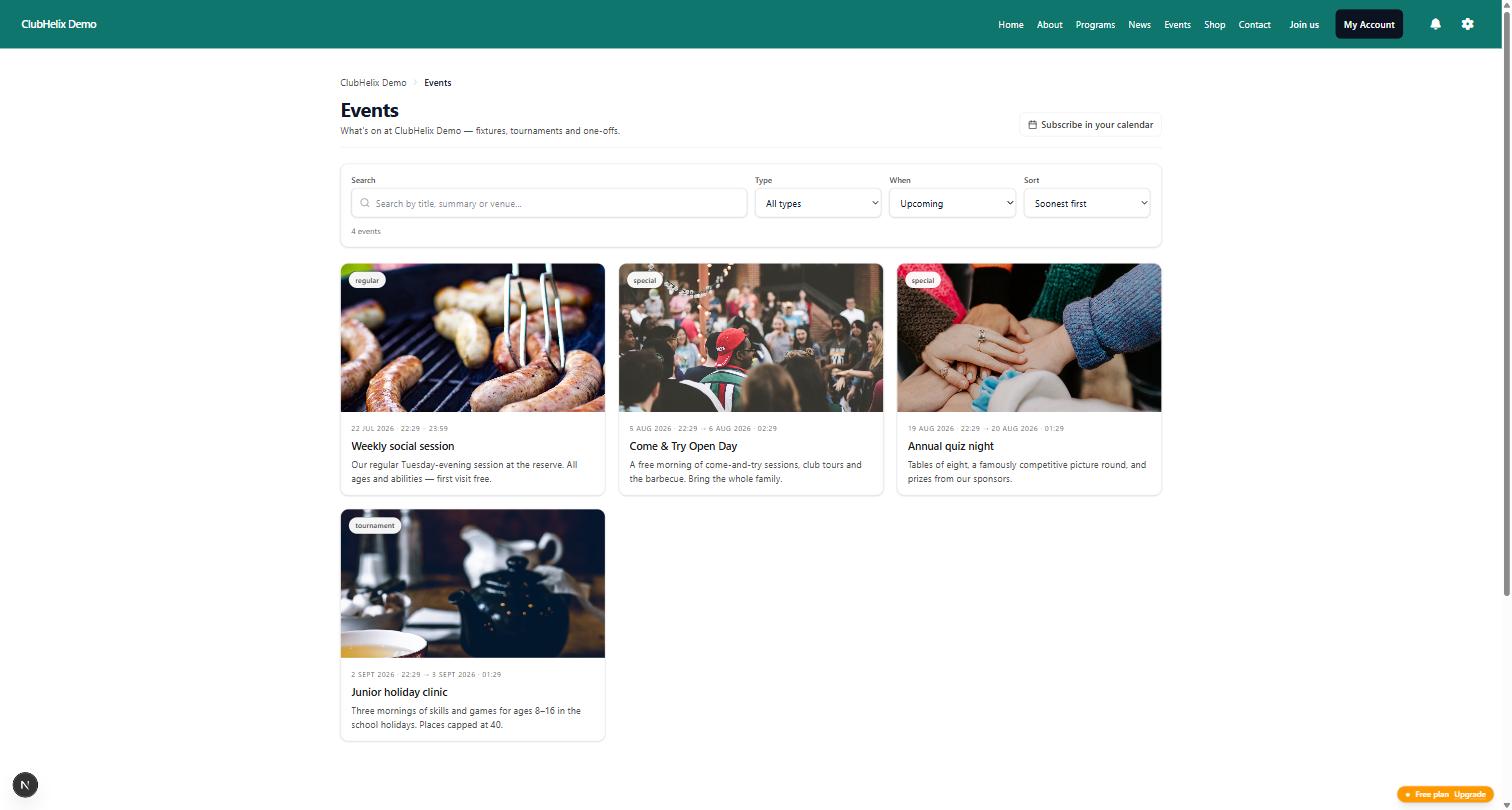
You can have the skeleton of your year on a real, public club calendar in an afternoon. ClubHelix is designed for small volunteer committees first — genuinely free at the smallest tier, with every price published on one page rather than hidden behind a quote. Start your club site whenever you like, with no contract and no sales call.
Frequently asked questions
What should be on a club annual calendar?
Three layers. The season — first round, finals, training, presentation night and any carnival or tournament. The administrative year — financial year end, accounts, the AGM and its notice period, committee nominations and handover. And the recurring obligations — insurance renewal, affiliation, statutory filings, permits, facility allocations, equipment inspections, screening expiries and funding rounds. Each entry needs an owner, a lead time and a reminder date sitting well ahead of the due date.
When should a club start planning next season?
Before the current one ends. The practical rule is that anything requiring other people's turnaround — competition entries, facility allocations, uniform orders, funding applications — starts four to six months ahead of when it is needed. Everything else can start at the first committee meeting after the AGM, when the new committee rolls the calendar forward and re-sets the anchors.
How far ahead should we publish club events to members?
Anything a family would rearrange their weekend for wants two to three months of notice, and ideally a save-the-date at the start of the season. Routine weekly events need a fortnight. The bigger factor is consistency — if the calendar on your website is always current and always the same place, members check it themselves and you spend far less time answering the same question in a group chat.
Who should own the club calendar?
The secretary usually custodians the document, but each date should be owned by the role that has to act on it — the treasurer owns financial deadlines, the registrar owns registration dates, the facilities coordinator owns inspections and permits. Ownership by role rather than by person is what lets the calendar survive a change of committee, and a standing agenda item reviewing the next 60 days is what keeps everyone honest about it.
What is the difference between the club calendar and the fixture list?
The fixture list is generated by your competition and changes week to week with postponements and rearrangements, so it belongs with your results and ladders. The annual calendar is the stable spine — season start and finish, registration windows, social events, compliance dates and the AGM. Keep them separate and publish both, because members use them at completely different moments.
Keep reading — the pre-season checklist turns the front half of this calendar into a task list, and the AGM guide covers the back half in detail.


