
What this guide answers
- What is the most important feature for a volleyball club?
A competition that runs itself from nomination to grand final: paid nominations, a draw, set results that update the ladder, published duty allocations and a finals bracket seeded from the ladder.
- Do we need separate software for social nights and the league?
You should not. Social volleyball needs individual sign-up, payment on the form and a capped night with a waitlist; the league needs teams, fixtures and a ladder.
- Our association runs its competitions on its own platform. Do we still need club software?
Usually, yes. The association platform satisfies affiliation and its own competitions.
- Is free volleyball club software good enough?
For a single team, often. For a club running a multi-team league, the question is what the free product earns on instead — payment fees, fundraising or paid add-ons — and whether it covers ladders and finals at all.
- Can we run beach and indoor seasons at the same time?
Yes, as separate competitions with their own divisions, draws and ladders, on the same member records.
Search for volleyball club management software and the first page is mostly one kind of result: a general sports product with a volleyball landing page. The vocabulary changes from sport to sport, while the product underneath stays the same. That is not necessarily a bad thing, but it means the page tells you very little about whether the product can run a volleyball season, which is a stranger shape than most club software expects.
A volleyball club is often two organisations sharing a name. One is a competition: teams nominate, a draw is built round by round across a handful of courts, duty teams referee and keep score, a ladder decides who plays finals. The other is a social program: individuals sign up for Tuesday night, get put on a team at the door, and pay a casual fee. Indoor and beach seasons can overlap, juniors run on a term calendar, and the committee is usually four volunteers.
This guide is for that committee. It covers what a volleyball club needs covered, how the realistic options differ, and the questions to put to any vendor before moving a season. We are ClubHelix, an all-in-one club platform, so we sell into this category and we will say plainly where we fall short. Vendor observations are current as at October 2026; check anything decision-critical with the vendor directly, because pricing pages move. For the category without the volleyball lens, see how club management software fits together.
What a volleyball club actually needs covered
- Team nominations with the money attached. The draw should only ever be built from teams that have paid. Nominations arriving by text, email and a form at once is how a fixture gets drawn for a team that never committed.
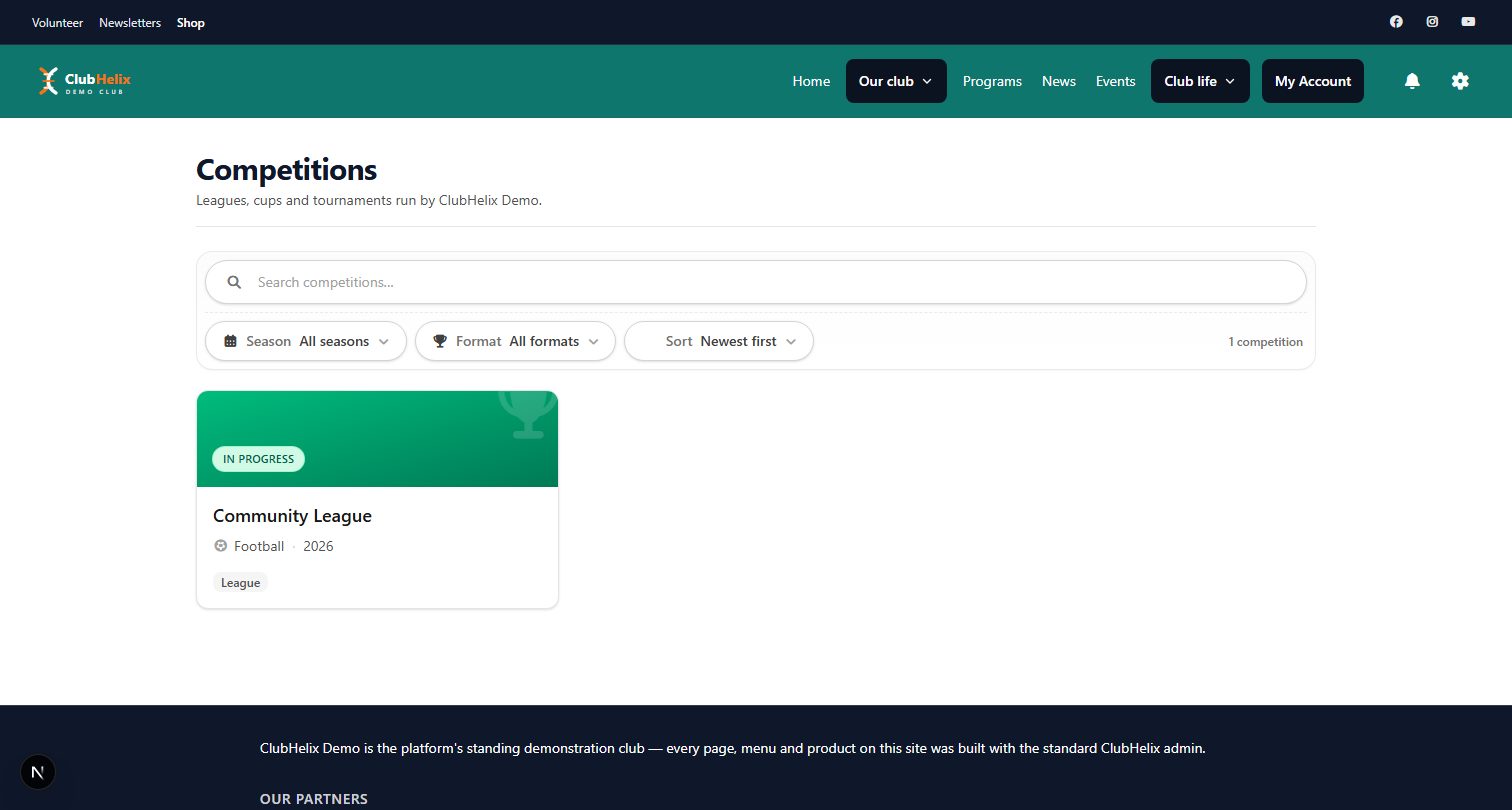
- A draw, results and a ladder that keeps itself. Courts and time slots each round, results entered as sets, standings that recalculate the moment a score goes in, and a public page every captain checks.
- Duty teams and referees. Who has first referee, second referee and the scorebench each round needs to be published with the fixture. Most weekly arguments in volleyball are about duty, and they end when the roster is written down where everyone can see it.
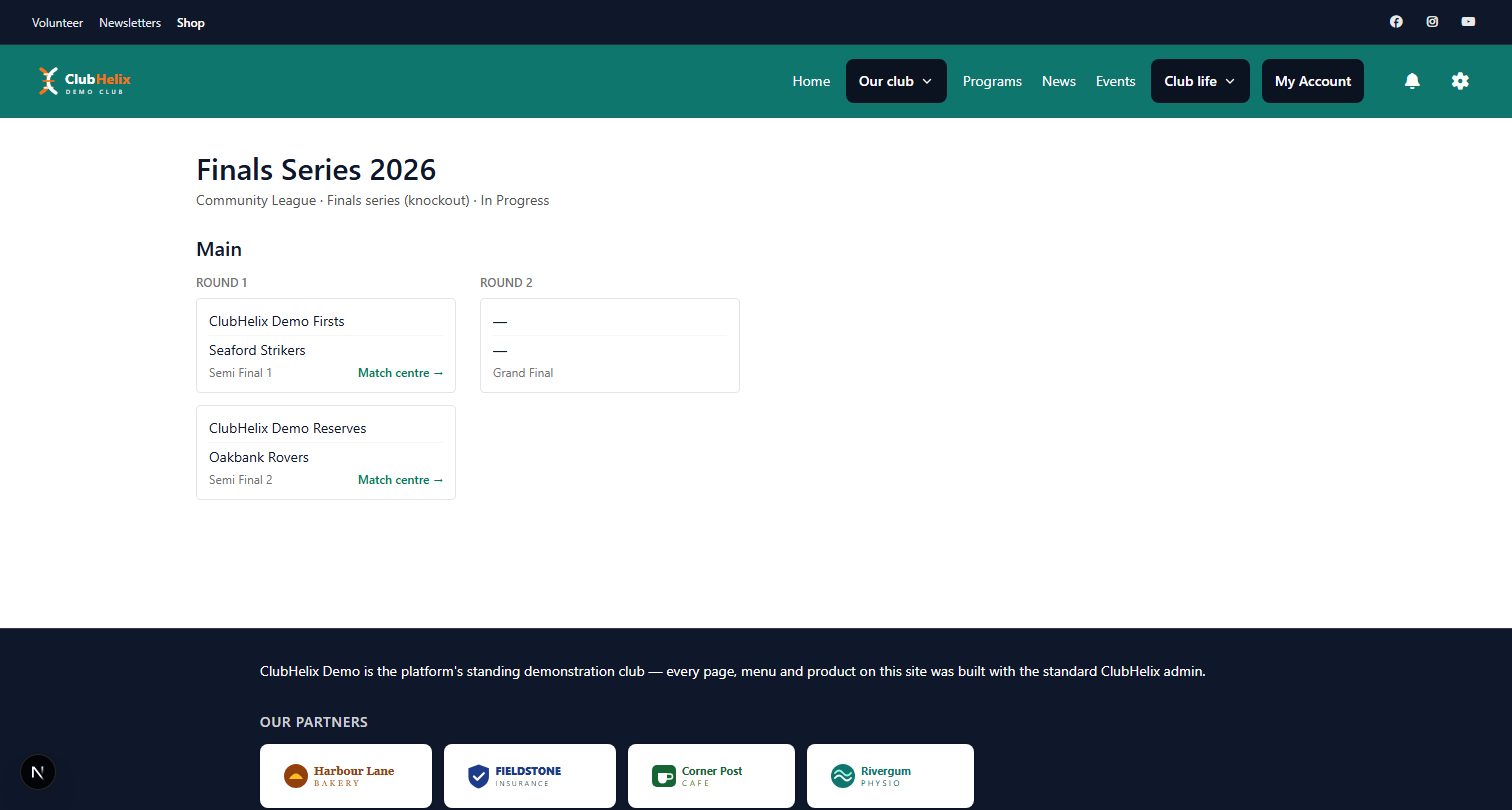
- A finals series seeded from the ladder. Semis, preliminary finals and a grand final, with eligibility settled from an attendance record rather than memory.
- Social sign-up with a cap. Individuals register and pay on their phone, the night fills, and the next person goes on a waitlist rather than turning up to a full hall.
- The website. The ladder, the draw, the venue and a join page in one place that does not go stale between Thursday updates.
A product that covers four of these and leaves two in a spreadsheet will still leave somebody updating the spreadsheet. That is the test to hold each option to.
How the options actually differ
Governing-body competition platforms are built to run registrations and competitions at association scale. PlayHQ is the clearest example in Australia: its own pricing page lists Registration & Competition Management at A$10 per registration for organisations under 2,000, A$8 under 10,000 and A$6 under 50,000, with no mandatory setup fee, and it offers a demo rather than a free trial. It also sells a website product built from PlayHQ data, where fixtures, ladders and results sync in real time and registration hands off to the PlayHQ portal (all checked October 2026). If your association already runs its competitions there, your club works alongside it rather than choosing it. What you still need is your own club website, social nights and communications.
Programmatic multi-sport platforms are the products that publish a page for each sport — the format that currently owns this search. Outcoach sells class, club and court-booking software this way and prices per student per month, from $0.99 monthly or $0.70 billed annually on its Starter plan up to $2.99 or $2.00 on Performance, with a free trial and free access for parents and coaches (checked on its pricing page in October 2026; the currency was not stated on what we read). SportEasy runs the same per-sport model; its pricing page did not load when we checked, so we cannot quote it. Whether the volleyball depth is real — duty rosters, set scores, finals — is the thing to test in a trial, not infer from the landing page.
Free team-organiser apps start from the squad and the event: are you available, here is the session, pay here. Spond is free to use and makes its money on payment processing and fundraising, where the club receives 65% of its Superdraw entries; it now also sells a Club Website as a paid add-on at A$22 a month after a free trial (checked October 2026). TeamSnap offers single teams "$0 to start" and quotes clubs and leagues individually through TeamSnap ONE, with no dollar figure published (checked October 2026). Both are strong at team availability. A league ladder, duty referees and a finals bracket are where you need to look closely.
Spreadsheets and a group chat run more volleyball competitions than any product does. They work until the person who built the sheet steps down, or until two teams dispute a finals spot and there is no record to settle it.
| Product | Built around | Published pricing (as checked) | What to test for volleyball |
|---|---|---|---|
| ClubHelix | Club website, membership and competitions | Free plan; paid plans on the pricing page | Whether you need an app-store app (we do not have one) |
| PlayHQ | Governing-body registrations and comps | A$6–A$10 per registration by organisation size; demo, no free trial | Whether your association already mandates it |
| Outcoach | Classes, clubs and court booking per sport | $0.99–$2.99 per student per month (currency not stated) | Duty rosters, set scoring and finals depth |
| SportEasy | Club and team management per sport | Varies — pricing page unavailable when checked | Ladder and finals support beyond team scheduling |
| Spond | Team events, availability and payments | Free platform; Club Website add-on A$22 a month | League ladder, duty referees and a public competition |
| TeamSnap | Team scheduling, comms and payments | Single teams "$0 to start"; clubs quoted individually | Ladder and finals for a multi-team club competition |
Where ClubHelix fits
ClubHelix is website-and-membership first, with the competition engine on the same record. Captains nominate a team into a competition through their own login, players attach themselves to the team, and the entry fee is paid as part of the nomination, so the draw is built from paid teams. Divisions, published fixtures and ladders that compute themselves are on every plan, including the free one. Results go in as they arrive and the ladder on your public site updates with them. When the home-and-away rounds finish, the finals series builds a ladder-seeded knockout or page-playoff bracket that advances automatically (Standard plan and up).
Match officials gives you an officials register with availability, appointments and confirmations, and rate cards for what each grade and role is paid, so the referee roster is published with the round rather than in a group chat. The live match centre carries live scores and match reports. For the social side, individual sign-up takes payment on the form, waitlists catch the overflow, and broadcasts cover the venue change or the beach washout. Everything sits behind one public website, which the volleyball club management software page walks through from a committee's side.
Our honest gaps. There is no app-store app: ClubHelix installs to the home screen with lock-screen notifications, which most players find enough, but a club that wants its own app-store listing will not get one. There is no video analysis product — match streams can be embedded on the match page on Pro, and that is all. Payments run through Stripe or Square, not direct debit. And if your association mandates its own registration platform, you will run that as well for affiliation. We complement it, not replace it.
The questions that separate the products
Feature grids will not separate these. Ask each vendor directly, and keep the answers in writing.
| Question to ask | Why it matters for volleyball |
|---|---|
| Can a team's entry fee be paid as part of its nomination? | A draw built from unpaid teams is the most common cause of forfeits. |
| Are results entered as sets, with the ladder recalculating instantly? | A ladder someone updates on Thursday is wrong for three days a week. |
| Can duty and referee allocations publish with each round's fixture? | Written-down duty ends the weekly argument about who had the whistle. |
| Does the finals bracket seed itself from the final ladder? | Hand-built finals invite disputes about positions and tie-breaks. |
| Can an individual sign up and pay for a social night without a team? | Social volleyball is individual-first, and a team-only model loses them. |
| Is there a hard cap with an automatic waitlist? | Courts are fixed. A full night that still takes bookings creates a bad night. |
| Can I export members, teams and results at any time? | The day you want to leave is when you find out whether the data was yours. |
The last one is the question vendors are least keen to answer precisely, and the one that matters most in year two.
What it costs, realistically
Model the season, not the month. A club running an indoor league of twenty teams plus a weekly social night is processing team nominations, hundreds of individual social payments and some merchandise every season. That makes the way a product charges — per registration, per student, per month or through payment fees — matter more than the headline price.
The models in this category differ sharply. Per-registration pricing (the governing-body platforms) scales with every player you sign. Per-student pricing scales with your active roster each month. Free apps are free to use and earn on the payments that pass through them. Quote-only pricing means a conversation before you can compare at all. Work out what each model costs for your actual season, not a sample club.
For our part: ClubHelix has a free plan with no time limit, paid plans carry a 14-day free trial and bill on a 28-day cycle, and payments settle directly into the club's own account. Current tiers are on the pricing page.
Moving a volleyball club without losing a season
The moves that go wrong are the ones attempted in the week nominations open. The order that works:
- Load members and last season's teams first, with nothing switched on for players.
- Run the next season's nominations on the new system, so captains are the first people to use it.
- Publish the draw and duty roster from it for round one, and keep the old ladder readable until the new one has a few rounds in it.
- Open social sign-up once the competition is running, with a cap and a waitlist.
- Leave historical results where they are. Bring across what next season needs, not every score since the club began.
Budget a season break, not a weekend.
Frequently asked questions
What is the most important feature for a volleyball club?
A competition that runs itself from nomination to grand final: paid nominations, a draw, set results that update the ladder, published duty allocations and a finals bracket seeded from the ladder. Membership and payments are available almost everywhere. Depth in the competition machinery is where products actually differ.
Do we need separate software for social nights and the league?
You should not. Social volleyball needs individual sign-up, payment on the form and a capped night with a waitlist; the league needs teams, fixtures and a ladder. Running both on one member record means a social player who joins a league team is the same person in both places, not two rows in two systems.
Our association runs its competitions on its own platform. Do we still need club software?
Usually, yes. The association platform satisfies affiliation and its own competitions. Your club still needs its website, social nights, internal comps, communications and shop. Most clubs run both without difficulty — our comparison of a governing-body platform and a club website sets out the split.
Is free volleyball club software good enough?
For a single team, often. For a club running a multi-team league, the question is what the free product earns on instead — payment fees, fundraising or paid add-ons — and whether it covers ladders and finals at all. Our Spond comparison and TeamSnap comparison look at that trade-off in detail, and the compare hub covers the rest.
Can we run beach and indoor seasons at the same time?
Yes, as separate competitions with their own divisions, draws and ladders, on the same member records. The thing to check in any product is whether a player can be on a beach pair and an indoor team in the same month without being registered twice.
For the wider operational job — venue hire, junior pathways, coaching and volunteers — see the complete guide to running a volleyball club, or start on the free plan and set up your next season.

