
What this guide answers
- What is the single most important feature for a badminton club?
Court booking with real rules — member-only windows, per-member caps and a hard capacity limit with a waitlist.
- Do we need software if we only run one club night a week?
Probably not immediately. A single weekly session with a stable group runs fine on a list.
- Can we keep taking cash at the door?
You can, but it is where most clubs lose money without noticing — visitor fees and shuttle sales are the two least-reconciled cash flows in badminton.
- Will we have to move our pennant records?
No, and you generally should not try. Bring across the member list and this season's sides; leave historical results where they are.
- What if our association mandates a different system?
The two coexist. Association-mandated registration satisfies the association; your club still needs its own website, court booking, visitor payments, communications and internal comps.
Search for badminton club software and you will get three different kinds of product wearing the same label, which is why the shortlist is so hard to build. One kind is a court-booking engine that happens to store members. One is a membership database that happens to have a calendar. One is a team-sport platform that assumes you have a fixture list and a field. A badminton club needs all three jobs done at once, and the mismatch is why so many committees end up running a booking system, a spreadsheet and a group chat in parallel.
This guide is written for the committee actually doing that. It covers what a badminton club specifically needs, how the realistic options differ in shape, and the questions worth asking any vendor before you move a season's worth of admin. We are ClubHelix — an all-in-one club platform — so we sell into this category, and we will declare our own limits plainly rather than pretending to be a neutral review site. Product observations below are current as at August 2026; check anything decision-critical directly with the vendor, because positioning and pricing both move. For the category without the badminton lens, see how club management software fits together.
The four jobs a badminton club actually needs covered
Before comparing products, get specific about the work. Badminton clubs are unusual in that their admin is dominated by a resource — the hall — rather than by a season.
- The hall. A fixed number of courts for a fixed window, often hired from a council or a school. Whoever is running club night is managing scarcity in real time.
- The members, and the visitors. Badminton has an unusually high casual-player share. A platform that can only transact with members leaves the visitor money in a cash tin.
- The pennant season. Availability, selection, fixtures and results — four separate jobs that most products collapse into "fixtures".
- The money. Memberships, visitor fees, court hire and shuttles, ideally reconciling to one ledger rather than four.
A product that does three of these well and one badly will still generate a spreadsheet. That is the test.
How the options actually differ
Court-booking-first products — the category that includes tools like Coacha and various venue-booking platforms — start from the resource. They are usually excellent at availability, booking windows, peak pricing and stopping double-bookings, which is genuinely the hardest part of running a badminton club. Where they tend to thin out is the season: pennant availability, selection and a club championship draw are often either absent or bolted on. If your club is essentially a booking operation with a social membership, this shape fits well.
Membership-first products — Wild Apricot, Join It, TidyHQ and similar — start from the member record. They are strong on joining, renewals, dues and communication, and they are mature products with long track records. Court booking is usually the gap: either missing, or present as a simple calendar without the rules (member-only hours, per-member caps, peak pricing) that actually keep a court fair. Clubs on these products commonly run a separate booking tool alongside.
Team-sport platforms — Spond, Pitchero, TeamSnap and the like — start from the squad and the fixture. They are very good at "here is your team, here is your game, are you available", and Spond in particular has built an enormous free user base on exactly that. The mismatch for badminton is that the fundamental unit is a court session, not a match, and casual visitor play does not map onto a squad model at all.
Generic multi-sport club software — products like Springly, SportEasy, Playpass and Checklick market per-sport landing pages including badminton. In practice you are usually getting a general club product with badminton vocabulary applied; whether the court-booking depth is real is the specific thing to test in a trial rather than to infer from the page.
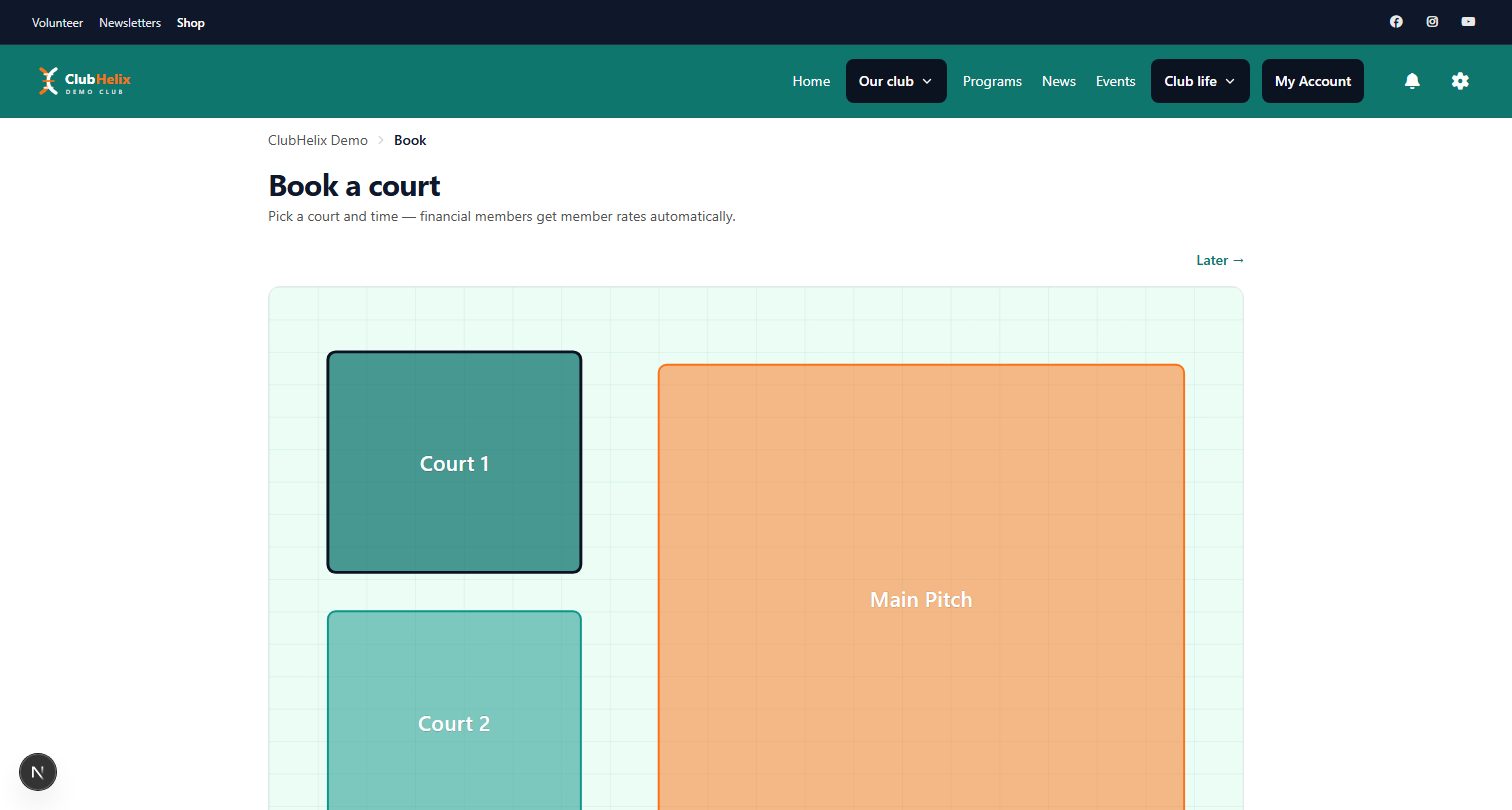
Where ClubHelix sits. We are website-and-membership first, with court booking built onto the same member record rather than beside it — so a visitor can pay a casual fee without a membership, a club night can be capped with a waitlist, and pennant runs as a real competition with ladders and a finals series. Our honest gap: we have no native app-store app (the mobile experience installs from the browser), and if your club's single overwhelming need is sophisticated multi-venue booking with dynamic pricing, a specialist booking platform will go deeper than we do.
The five questions that separate the products
Feature grids will not distinguish these. Ask them directly, and get the answers in writing.
| Question to ask | Why it matters for badminton |
|---|---|
| Can a non-member pay for a session without creating an account? | Casual play is real revenue. An account requirement quietly kills it. |
| Can I cap bookings per member per week? | Without it, the same four players hold Saturday morning permanently. |
| Does a club night support a hard cap and an automatic waitlist? | A hall has a fixed court count. Overbooking is the recurring failure. |
| Who absorbs the payment processing fee — the club or the member? | This changes what joining feels like, and vendors differ sharply. |
| Can I export the full member list, with custom fields, at any time? | The day you want to leave is when you discover whether the list was ever yours. |
The last two are the ones vendors are least keen to answer precisely, and the ones that matter most in year two.
What it costs, realistically
Model the season, not the month. A badminton club with 90 members, weekly club nights, casual visitors and a pennant side is not processing 90 transactions a year — it is processing hundreds of small ones. That makes the transaction fee percentage matter considerably more than the subscription tier, and it makes "who absorbs the fee" a bigger financial question than the headline price.
Published pricing in this category, as at August 2026, ranges from genuinely free (Spond, which monetises through payments and fundraising) through roughly £20–100 per month for the UK club platforms, to per-member sliding scales on the membership products. Several of the sport-specific booking tools do not publish pricing at all and quote on request — which is a legitimate model, but means you cannot compare without a conversation.
For our part: ClubHelix has a free plan with no time limit, paid plans carry a 14-day free trial and bill on a 28-day cycle, and the platform fee is never surcharged to your members — money settles to the club's own account. Current tiers are on the pricing page.
Frequently asked questions
What is the single most important feature for a badminton club?
Court booking with real rules — member-only windows, per-member caps and a hard capacity limit with a waitlist. Almost every other feature in this category is available almost everywhere; booking depth is where products genuinely differ, and it is the thing a badminton committee touches every single week.
Do we need software if we only run one club night a week?
Probably not immediately. A single weekly session with a stable group runs fine on a list. The tipping point is usually the third of these: capped attendance, casual visitors paying money, or a pennant side. At that point the coordination cost exceeds the setup cost.
Can we keep taking cash at the door?
You can, but it is where most clubs lose money without noticing — visitor fees and shuttle sales are the two least-reconciled cash flows in badminton. Moving them online is usually the change that pays for the platform, regardless of which platform you pick.
Will we have to move our pennant records?
No, and you generally should not try. Bring across the member list and this season's sides; leave historical results where they are. Migrations fail when they are scoped as "move everything" rather than "move what next season needs".
What if our association mandates a different system?
The two coexist. Association-mandated registration satisfies the association; your club still needs its own website, court booking, visitor payments, communications and internal comps. Most clubs run both without difficulty.
For the wider operational job — hall hire, beginner pathways, feather versus plastic budgets — see the complete guide to running a badminton club, or look at how the pieces fit on the badminton solutions page.

