
What this guide answers
- What is the best club management software for a small club?
There is no single answer, because small clubs differ by what they are missing.
- How much should a small club expect to pay?
As at July 2026 the published options run from genuinely free through to roughly the cost of a monthly team meal — for example, published annual bands starting around A$112 a year for a club under 100 members, flat…
- Is free club software good enough for a small club?
Sometimes, and it depends on how the free product earns its living.
- How long does it take to switch club software?
Budget 25 to 60 volunteer hours for a small club, spread over a few weeks, with the member-list clean-up as the biggest single block.
- Do we need club software at all, or will a spreadsheet do?
A spreadsheet is fine while one person can hold the whole club in their head and everyone pays by bank transfer.
Somebody on your committee has built the spreadsheet. Eleven products across the top, forty features down the side, and a grid of ticks so uniformly green that it tells you nothing at all. Every vendor has memberships. Every vendor has events. Every vendor has "communications". The spreadsheet was six hours of somebody's life and the meeting still ends with "let's think about it".
The reason that grid fails a small club is that it measures the wrong thing. Under a couple of hundred members, your scarce resource is not capability — it is the Tuesday evening a volunteer has after work, and the tolerance of a treasurer who did not sign up to learn a new system. A product with forty features that takes four hours to configure is worse for you than a product with twelve features that takes twenty minutes, even though it wins the spreadsheet by a mile. Small clubs do not fail because their software lacked a module. They fail because the one person who understood the software moved to Perth.
This guide is written for exactly that club — somewhere between about 30 and 200 members, run by volunteers, with no budget line for software and no appetite for a six-week implementation. It covers what you genuinely need, what the main options cost at two realistic club sizes, and the cost of switching that no quote includes. For the category in general — what the software does and how the pricing models differ — see club management software explained. We are ClubHelix, an all-in-one club platform, so we are in this market and we will declare our bias plainly at the end. Every price below is from public sources, current as at July 2026 — verify before you sign, because pricing pages move.
What a small club actually needs
Here is the honest triage. "Must" means the club is worse off without it today. "Earns its place" means buy it when the specific pain appears, not before. "Noise" means it is real software that real organisations use, and at your size it is a distraction that will slow your rollout down.
| Capability | At 30–200 members | Why |
|---|---|---|
| One member list with paid or unpaid status | Must | Every other job depends on it — insurance, grants, reminders, the AGM |
| A public page that answers cost and times | Must | The most common reason a prospective member never contacts you |
| Online payment collection | Must | Chasing more than about twenty people by bank transfer is a volunteer-hours problem |
| One-to-many email, and ideally SMS | Must | Wet-weather calls, AGM notices, renewal reminders |
| A form you can edit yourself | Must | If changing a question needs a support ticket, you will stop changing questions |
| Screening and accreditation expiry tracking | Must with juniors | Expiry dates are the thing clubs miss; check your governing body's requirements |
| Event registrations and ticketing | Earns its place | Worth it from about two paid events a year |
| Volunteer and canteen rosters | Earns its place | Worth it the moment the roster lives in one person's head |
| Fixtures, ladders and results | Depends | Free if your competition already publishes them; needed if you run your own |
| Attendance or RSVP tracking | Earns its place | Essential for session-based clubs, optional for weekend-fixture clubs |
| Merchandise shop | Earns its place | Only once someone owns the stock and the postage |
| Meeting minutes, incident register, waivers | Earns its place | Governance load rises with juniors and with venue hire |
| Automation workflows and custom integrations | Noise | Real value at scale; at your size it is configuration you will never finish |
| Advanced analytics dashboards | Noise | Five numbers on one page beats twenty charts nobody opens |
If a demo spends more time on the last two rows than the first five, you are being sold to a club you are not. Our guide to the handful of numbers actually worth tracking is the antidote to a dashboard you will never open.
The shortlist, grouped by what these products really are
Products in this market fall into five shapes. Shortlisting one from each shape teaches you more than shortlisting five from one.
Sports-administration platforms. Built around registration, competition and reporting into a governing body. revolutioniseSPORT is the clearest example available to clubs directly, with published annual pricing. GameDay sits here too, though its subscription pricing is not published and comes by quote. If your sport's administration already runs on one of these, you may be inside it whether you shopped for it or not.
Community-group administration. TidyHQ is the standard-bearer — memberships, finances, meetings and communications for clubs and associations that run on committees rather than fixtures. Strong on the paperwork half of club life, thin on the sport half and on the public website.
Website-first club platforms. Pitchero is the long-running example: a hosted club website with membership, payments and team tooling built around it, priced in pounds from a UK base. Strong public face, and the payment side only opens up on paid tiers.
Free, app-first organisers. Spond and Stack Team App both cost nothing to subscribe to for the app and are genuinely useful for the weekly organising loop. Team App's website is an automatic by-product of the app; Spond now sells a Club Website as a paid add-on, from £19 + VAT (A$22) a month after a free trial (checked October 2026). Each earns its money somewhere else — Spond on payment processing, its fundraising product and that add-on, Team App through advertising.
Membership-only tools. membermojo, Join It and similar products do one job — who is a member, who has paid, when do they renew — cheaply and well, and leave the rest of club life to you. For a club whose only real problem is the renewal list, that focus is a feature.
There is a sixth shape, all-in-one club platforms, which is ours, and we will come back to it honestly rather than pretending it is neutral.

What it costs at 50 members and at 150
Published figures only, current as at July 2026. Where pricing is not published we say so — an unpriceable option is not automatically a bad one, but it is a different kind of decision.
| Product | Priced on | Around 50 members | Around 150 members | Watch for |
|---|---|---|---|---|
| revolutioniseSPORT | Member-count band | A$112 a year (to 100) | A$396 a year (to 500) | Payments 2% + A$1.60, or PayPal 2.6% + A$1.63 |
| TidyHQ | Flat plan | Free plan, or Pro US$69 a month | Same | Plus a TidyHQ service fee on payments: 3% + A$0.20 Free, 1% + A$0.20 Pro (Oct 2026) |
| Pitchero | Flat tier | Free (no payments), or Standard £38 a month | Same | Fees 2.42% + 17p on Standard, 1.67% + 15p on Pro |
| membermojo | Member count | Free to 50 members | Paid band; their page lists about £75 a year at 500 | No platform transaction fee; Stripe fees apply |
| Join It | Sliding by members | From US$29 a month | From US$29 a month, sliding upward | Sliding scale by total member count |
| Jersey Watch | Athlete-volume band | From US$29 a month (50–200 band) | Same band | US$19 first month; US background checks included |
| Wild Apricot | Contact count | No free plan; 60-day trial, then US$66 a month at 100 contacts (Oct 2026) | Tiered, rising with contacts; higher tiers not read | Payment processing "for an additional fee", size not stated |
| Spond | Free | No subscription | No subscription; website add-on A$22 a month | Earns on payment processing and its fundraising product |
| Stack Team App | Free, ad-supported | No subscription | No subscription | Members can pay about A$4.49 a year to remove ads |
| GameDay | Quote | Not published | Not published | Ask for the payment terms in the same conversation |
| Squadspot | Setup plus per active member | Not published | Not published | Pin down what counts as an "active" member |
Four honesty notes on that table.
Currency is a real cost, not a footnote. Several of these bill in US dollars or pounds. A US$29 a month plan is not "about thirty dollars" to a club banking locally, and the conversion moves. If your treasurer reconciles by hand, a foreign-currency subscription also means a card fee and a slightly different number every month.
At small scale, transaction fees usually beat subscriptions. An illustrative sum on published rates: a club with 50 members paying $80 each collects $4,000. At 2% + A$1.60 per transaction that is $80 plus $80, so about $160 a year in processing — more than the A$112 annual subscription it sits on. The cheap plan is rarely the cheap total. Model both lines.
Free tiers are free in different ways. One is free because a governing body pays, one because advertising pays, one because the payment flow pays. None of those is dishonest and all of them shape the product. The question is not "is it really free" but "what does whoever pays want the product to do", and whether that aligns with what you want.
Member-count bands step, and clubs sit near thresholds. If you are at 95 members and growing, find out what happens at 101 before you decide, not after a successful registration day. Our guide to what a club website really costs covers the same trap on the hosting and domain side.
The switching cost nobody quotes you
Every quote prices the software. None prices the move. For a small club the move is the larger number, and it is paid in the currency you have least of.
| Task | Illustrative volunteer hours |
|---|---|
| Export, merge and clean the member list | 4–8 |
| Decide fields and rebuild registration forms | 3–6 |
| Payment setup, bank details and test transactions | 2–4 |
| Rebuild website content and navigation | 6–15 |
| Load last season's history and past payments | 2–6 |
| Write and send the change-over comms | 2–3 |
| Train the committee and the two people who will actually use it | 3–5 |
| Run both systems in parallel for one cycle | 4–10 |
That is roughly 26 to 57 hours for a typical small club — a fortnight of somebody's evenings. Three costs sit inside it that no quote mentions.
The data cost. Your list is never as clean as you think. Three spellings of a surname, six members sharing one family email, and a "paid" column that means "paid something at some point". Cleaning is unavoidable and it is the only part you cannot delegate to the vendor, because only your registrar knows which record is real.
The habit cost. Volunteers finally learned the old thing. Every change spends goodwill you will want later. Change once, deliberately, and do not change again for three years.
The memory cost. Whatever you leave behind takes your history with it — old payment records, past committee decisions, last season's photos. Decide before you move what you must keep, and export it while you still have a login.
Two practical rules. Switch in the off-season, never in the six weeks around registration. And pick the person who will own it before you pick the product — a system with an owner beats a better system without one, every time. If your committee is stretched thin already, running a club with no time covers how to sequence a change like this without burning your volunteers.
A two-week trial that tells you something
Demos are theatre. Trials are evidence. Give any shortlisted product two weeks and these six tests, run by the volunteers who will actually use it rather than the committee member who is enthusiastic.
- The registrar test. Import 20 real member records, including the messy ones. Can you fix a duplicate, add a custom field and export the lot again without help?
- The treasurer test. Take one real payment end to end. Where does the money land, when, what fee came off, and can you match it to the member without a spreadsheet?
- The Sunday-night test. Ask someone outside the committee to find, on their phone, what junior membership costs and when training is. Time them.
- The Thursday test. Send a message to one team and one to everybody. Check what actually arrived, and on which device.
- The successor test. Have a second volunteer, given no verbal instructions, complete a routine task. If they cannot, your bus factor is one.
- The exit test. Export everything and open the file. If you cannot get your data out on day fourteen, do not put more of it in.
Score those six honestly and the eleven-column spreadsheet becomes unnecessary.
Putting the whole club in one place
Our declared interest. ClubHelix is the all-in-one shape, built so that a small volunteer committee can run the front door and the back office from the same login. That means a real public website with a canvas page editor and your own domain, member registration and payments that land in the club's account with paid and unpaid status visible at a glance, volunteer and canteen rostering so the roster stops living in one person's head, and reports that produce the five numbers a committee actually reads.
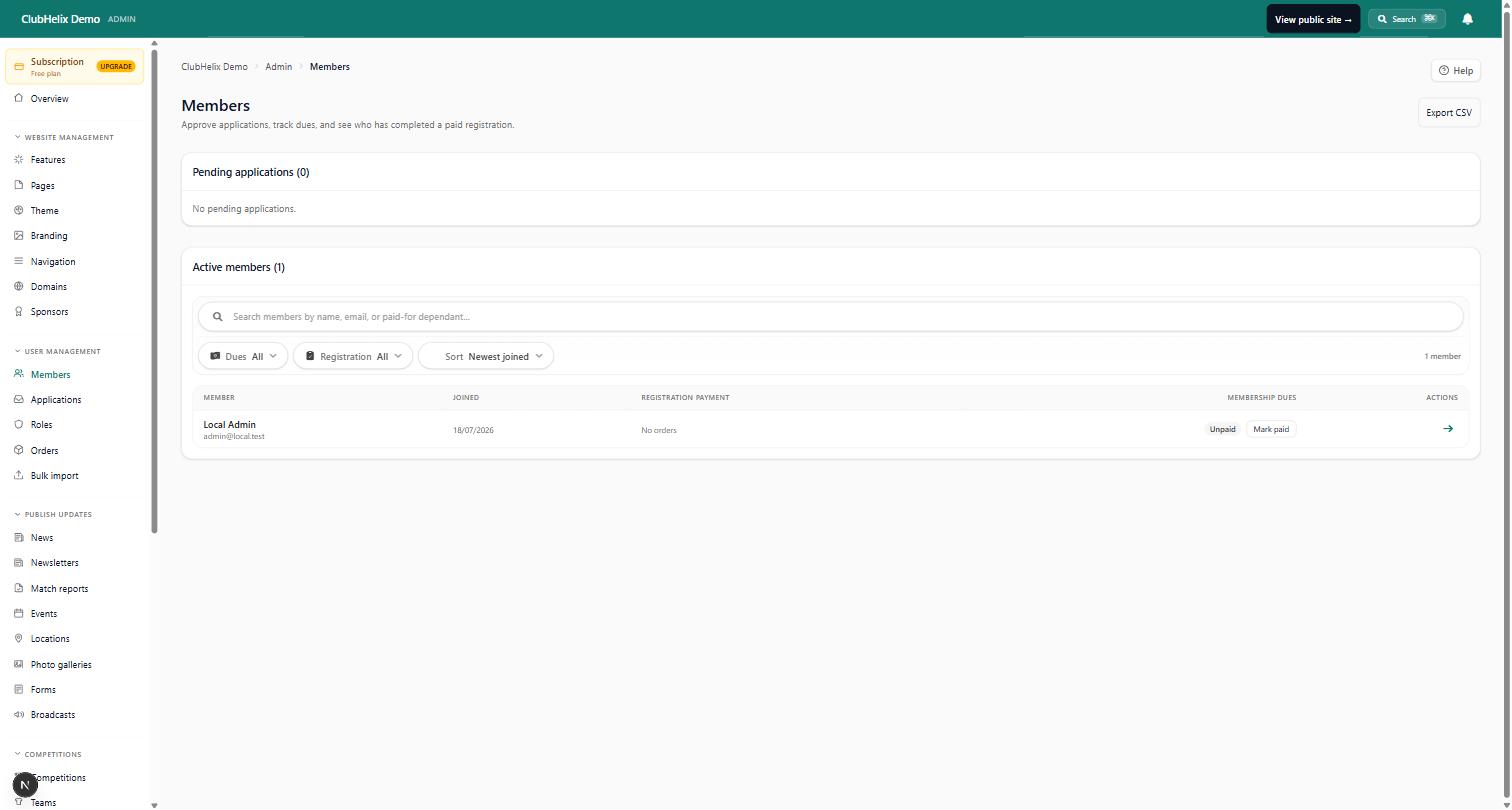
We publish our pricing on a page you can read without booking a call, there is a free tier to build and trial on, the platform is Australian-built and hosted, and a committee can start a club site and have something worth showing at the next meeting. If you would rather not do the setup at all, our done-for-you service exists for exactly that.
The fair limits, because a buyer's guide that only flatters its author is worthless. We ship an installable web app rather than native app-store apps. We have no governing-body distribution deals, so if your sport mandates a registration platform, that stays your system of record and we sit alongside it. We do not do direct-debit collection or video streaming, and our admin, club websites and member accounts are English-only. If your club's only problem is a renewal list, a focused membership tool may genuinely be the better buy, and if your sport's platform already covers you, adding a second system is not automatically progress. Our head-to-head write-ups live under /compare, including the move off spreadsheets.
Frequently asked questions
What is the best club management software for a small club?
There is no single answer, because small clubs differ by what they are missing. If your gap is the public face and online payments, an all-in-one or website-first platform fits. If it is committee paperwork and finances, a community-administration product fits. If it is only "who has paid", a focused membership tool is cheaper and faster. Shortlist one product from each of those shapes rather than five from one, then run the six trial tests above.
How much should a small club expect to pay?
As at July 2026 the published options run from genuinely free through to roughly the cost of a monthly team meal — for example, published annual bands starting around A$112 a year for a club under 100 members, flat plans in the range of US$29 to US$69 a month, and free ad-supported or payment-funded platforms at zero subscription. Add payment processing to whichever you choose; at small volumes that is often the larger line.
Is free club software good enough for a small club?
Sometimes, and it depends on how the free product earns its living. Advertising-funded and payment-funded platforms are perfectly legitimate and many small clubs run happily on them for years. The two things free tiers most often lack are a public website you would be happy to be judged on and control over how your members are marketed to. Decide which of those you care about before the free price tag decides for you.
How long does it take to switch club software?
Budget 25 to 60 volunteer hours for a small club, spread over a few weeks, with the member-list clean-up as the biggest single block. The move itself is usually quick; the data and the retraining are not. Do it in the off-season, name one owner before you start, and run the old and new systems side by side for a single cycle so nothing important falls between them.
Do we need club software at all, or will a spreadsheet do?
A spreadsheet is fine while one person can hold the whole club in their head and everyone pays by bank transfer. It stops being fine at the point where you are chasing payments individually, re-typing the same names into three places, or unable to answer "how many financial members do we have" without an evening's work. That threshold usually arrives somewhere between 40 and 80 members, earlier if you have juniors and the compliance records that come with them.
Next steps for the committee — our membership software comparison goes deeper on renewals and payment models, and the best apps for sports clubs maps the wider landscape by category. Corrections welcome via contact.


