
What this guide answers
- What is the best membership management software?
The one whose renewal model matches how your organisation actually works.
- How do membership platforms charge for payments?
Usually in up to three layers — the processor's own rate, an optional platform fee added by the software, and the subscription itself.
- Should the club or the member pay the transaction fee?
Both are defensible and the important thing is to decide deliberately and publish it.
- Can we get our member list back if we leave?
You should be able to, but check rather than assume. Do a full self-service export during the trial, confirm it includes custom fields, membership history and payment records, and ask separately about uploaded…
- Is a spreadsheet still fine for a small group?
It depends less on size than on what you may be asked to prove.
Open five membership platforms in five browser tabs and read their feature lists side by side. Member database. Online joining. Automated renewals. Payments. Email. Reports. Member portal. The wording changes; the list does not. After twenty minutes you know less than when you started, because a feature list is a claim that a capability exists, not a description of how it behaves.
The divergence is real, though. It just does not live on the marketing page. It lives in three places: renewal night, when four hundred people are supposed to be reminded, charged and reclassified without a volunteer touching each record; the payment screen, where somebody has to decide whether the club or the member absorbs the fee; and the day you leave, when you find out whether the list you have spent six years building is genuinely yours. If you are trying to compare membership management software and coming away with nothing but ticks, that is why. This guide compares the main products on those three axes instead.
We are ClubHelix, an all-in-one club platform, so we sell into this category and we will declare our own limits honestly near the end rather than pretending to be a neutral review site. Pricing and fee figures below are from public sources, current as at July 2026, and we say "not published" where a vendor does not publish. This is general information to help you ask better questions, not financial or legal advice — check anything decision-critical with the vendor and, where money and personal data are involved, with your own adviser.
The feature list everybody shares
Before the differences, the genuine commonality. As at July 2026, essentially every serious product in this category — Wild Apricot, Join It, TidyHQ, membermojo, LoveAdmin, revolutioniseSPORT, Pitchero and ours included — will store members with custom fields, take an online joining form, collect card payments, send email, and show you who has paid. If a shortlisted product cannot do one of those, it is not really in this category.
So stop scoring those. The questions worth asking are narrower and more awkward, and vendors answer them differently because their products genuinely are different underneath.
Renewal night — where the products actually diverge
Three renewal models, and why the choice sticks
Almost every product implements one of three models, and switching between them later is painful because it changes what "financial" means for every existing member.
- Anniversary renewal. Each member's year runs from the day they joined. Smooth cash flow, no annual spike — but your membership count changes daily and your "financial members" number is a moving target that grant forms find hard to swallow.
- Fixed-season renewal. Everybody expires on the same date. Clean reporting, an unambiguous roster, and one enormous night of work each year that the whole club feels.
- Rolling subscription. A recurring charge that continues until cancelled. Best retention by a distance, and the model most likely to generate complaints if a member forgets they are on it — so notice and easy cancellation matter more here than anywhere else.
Sports clubs mostly want fixed-season, because insurance, affiliation and competition eligibility are seasonal. Community and professional associations mostly want anniversary. Products built for one lineage handle the other awkwardly, and that awkwardness is invisible in a demo unless you ask for it specifically.
Pro-rata, and the member who joins in round 14
Every club faces this. Someone wants to join with six weeks of the season left. There are only four sane answers — full price, a published half-year rate, an automatic daily or monthly proration, or a discount code applied by an admin — and products vary wildly in which they support. Automatic proration is the least common and the most requested. A published half-season price with a switchover date is the most robust, because it is a decision the committee makes once rather than a judgement call a volunteer makes forty times.
Ask the demo to do it live. "Show me a member joining today at a pro-rata rate, and show me what their expiry date becomes." The pause before the answer tells you what you need to know.
The lapsed member
This is the single most underrated difference between products. When a membership expires, what actually happens?
- Does the record stay, move to a lapsed list, or vanish from your counts?
- Does the member lose portal access, and on what day?
- Do they keep receiving your newsletters, and should they?
- Are they still counted for billing purposes if you pay per member?
- Can you run a "lapsed last season, not renewed this season" list in one click, which is the single most valuable list in club retention?
- Is there a grace period, and can you set its length?
A product that deletes or hides lapsed members is destroying your best re-engagement list. Our guide on retaining club members explains why that list outperforms almost any recruitment effort, and our renewal reminder templates cover the sequence that goes with it.
Eight questions for any demo
- Which renewal model does this use, and can we run more than one at a time?
- How is pro-rata handled, and can an admin override it?
- What is the reminder sequence, and can we edit the wording and the timing?
- What happens on the day a membership expires?
- Can a family renew everybody in one transaction?
- Can a member update their own details without emailing us?
- Can we change a membership type mid-year without deleting and re-creating the member?
- What does a failed card payment do, and who finds out?

Who wears the payment fee
Three layers, and vendors name them differently
Money moving from a member to your bank account passes through up to three charges. Confusing them is how clubs end up surprised.
- The processor fee — what Stripe, PayPal, Pin Payments or Square charges to move the money.
- The platform fee — an additional percentage or flat amount some membership products add on top of the processor.
- The subscription — what you pay for the software regardless of whether anyone pays you.
A "no transaction fee" claim usually means no platform fee, with the processor's own charge still applying. That is a fair claim, but it is a different claim from "free to take payments".
Published rates, side by side
Public information as at July 2026. Verify current rates before you rely on them.
| Product | Subscription | Payment charging |
|---|---|---|
| revolutioniseSPORT | Published annual bands from A$112 a year to 100 members | Pin Payments 2% + A$1.60 a transaction, or PayPal 2.6% + A$1.63 |
| Pitchero | Free, £38 a month, or £99 a month | 2.42% + 17p on Standard, 1.67% + 15p on Pro; no payments on Free |
| membermojo | Free to 50 members; about £75 a year at 500, £550 a year at 10,000 | No platform transaction fee; Stripe's 1.5% + 20p applies |
| TidyHQ | Free plan, or Pro US$69 a month (also listed A$89, £49, NZ$99) | TidyHQ service fee on payments, 3% + A$0.20 (Free) or 1% + A$0.20 (Pro), plus Stripe (Oct 2026) |
| Join It | From US$29 a month, sliding by member count | Runs on Stripe |
| LoveAdmin | From £20 a month for sports clubs; activity providers from £35 | Usage and transaction-fee based; states it is not viable below £20,000 a year of processing |
| ClubSpark | Free for governing-body registered venues and accredited coaches | Adds 0.8% per Stripe transaction |
| ClubZap | Quote-based, two plans | Transactions from 3.75% + 10c |
| Spond | No subscription for the organiser; Club Website add-on from £19 + VAT a month (Oct 2026) | Earns on payment processing; its fundraising product returns 65% of ticket sales to the club |
| Wild Apricot | No free plan; 60-day trial, then US$66 a month at 100 contacts (Oct 2026); higher tiers not read | Check current terms directly with the vendor |
| GameDay, Squadspot | Not published | Ask for fee terms with the quote |
Absorb or pass on — a worked example
An illustrative sum on a published rate. A club with 300 members charging $150 each, paying 2% + $1.60 a transaction, faces $4.60 per member — 300 × $4.60 = $1,380 a year in processing.
- Absorb it and the club nets $148.40 per member. Simple for the member, quietly funded by the club.
- Pass it on and the member pays $154.60. Revenue is intact, but every fee is visible and somebody will email about it.
- Split it by rounding the fee into the published price — set it at $155 and absorb the difference. Most clubs land here without ever deciding to.
At a 3.75% + 10c rate the same 300 payments cost about $1,718, so the rate difference across a season is real but rarely decisive — a few hundred dollars should not outrank a product that saves your registrar ten hours. Decide the policy at committee and say it plainly on the joining form; our guide to collecting membership fees online covers the wording and the reconciliation side.
Minimum volumes and the small-club trap
One genuinely useful disclosure in this market: at least one UK product states openly that its model does not work below about £20,000 a year of processing volume. That honesty is worth respecting, and it points at a pattern. Payments-first products are built around a flow of money; if your club collects $8,000 a year, you are not their customer even if the sign-up page will accept you. Match the product's economics to your club's, not just its feature list to your wish list.
Data ownership and the exit test
Every vendor will tell you the data is yours. The question is whether you can act on that without asking them. Run these checks during the trial, not during the argument.
- Self-service export. Can an admin export the full member list, including custom fields and payment history, without lodging a request? A support-ticket export is a dependency dressed up as a feature.
- Format. CSV or Excel that opens and makes sense, not a PDF report and not a proprietary archive.
- Completeness. Notes, membership history, expiry dates, and the audit of who changed what — or just names and emails?
- Documents. Waivers, screening records and uploaded files usually live outside the member export. Ask specifically.
- Deletion. When you close the account, what is deleted, what is retained, and for how long? You need this answer to satisfy your own privacy commitments to members.
- Access control. Who inside your club can see what, and can you restrict sensitive fields to the registrar? Most clubs discover too late that every committee member could see everything.
- Hosting. Where does the data physically sit, and does that matter to your governing body or your members?
Privacy obligations differ by jurisdiction and by the kind of organisation you are, so treat this as general information and check your local regulator's guidance for what your club must do with member records — particularly if you hold information about children. What is universal is the practical rule: do the export on day one of the trial. A product you cannot exit is a product you have not really evaluated. Our own approach to hosting, access and backups is set out on our security page if you want a template for the questions.
How the main products genuinely differ in shape
- Wild Apricot is the long-standing association default — deep member-portal workflows, a large integration directory, and pricing that steps by contact count rather than by member. Strong for associations that live in their portal; its website builder is the dated part of the offering.
- Join It is deliberately narrow: memberships, renewals and digital membership cards running on Stripe, with a very polished small surface area. If membership is genuinely your only problem, narrow is an advantage.
- TidyHQ covers the committee side that pure membership tools skip — finances, meetings, communications — on a flat plan rather than a per-member ladder.
- membermojo is built around one question, "who has paid", is free below 50 members, and charges no platform fee on top of the processor. Unbeatable for a small club that wants exactly that and nothing else.
- LoveAdmin is payments-first, with direct-debit depth and payment plans that most competitors lack — genuinely different if instalments matter to your members.
- revolutioniseSPORT is membership inside a sporting hierarchy, with transfers, clearances and governing-body reporting that generalist products do not attempt.
- Pitchero approaches membership from the website end, which is a different centre of gravity again — the member record hangs off the public club site rather than the other way round.
Two of those will be right for your club and five will not, and which two depends almost entirely on whether you are a sports club inside a hierarchy, a community association, or a small group that wants a paid list and nothing more.
One member record, one place
Our declared interest, kept short. ClubHelix treats the member record as the spine of the whole club rather than as a standalone database. Our club membership software takes the registration and the payment and creates the member, so joining, paying and being on the roster are one event, not three. Roles and permissions mean the registrar can see what the registrar needs and the sponsorship coordinator cannot browse everyone's phone numbers. Billing and sponsors keeps the money side in the same system, and reports turns the list into the handful of numbers a committee reads before an AGM.
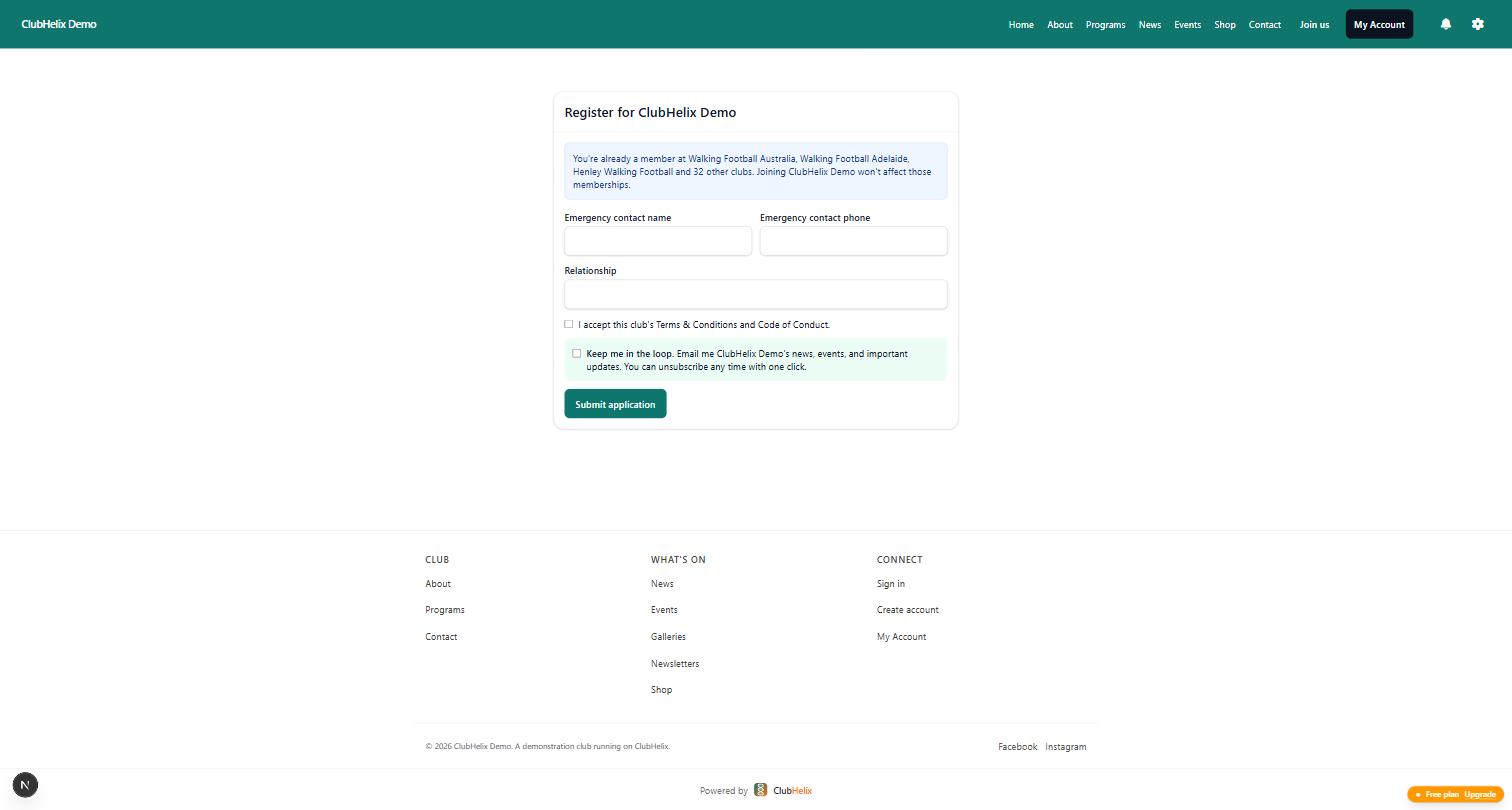
If you have reached the point where the membership spreadsheet, the payment app and the website are three different sources of truth, that is the problem we built for. There is a free tier to trial on, the platform is Australian-built and hosted, pricing is published rather than quoted, and you can set your club up and run the export test on it the same afternoon.
The limits, stated plainly because this article is about honest differences. We collect through Stripe and Square, so if direct debit is how your members expect to pay, a payments-first specialist beats us. We do not currently offer instalment plans. We ship an installable web app rather than native app-store apps, we have no general automation connector, and our admin, club websites and member accounts are English-only. If your club is 40 people and a paid list is all you need, a focused membership tool will be cheaper and simpler — that is a fair outcome. Our fuller head-to-heads sit under /compare. The TidyHQ vs Wild Apricot comparison puts two of the most-shortlisted membership tools side by side, and every comparison we publish is listed on the club software comparisons page.
Frequently asked questions
What is the best membership management software?
The one whose renewal model matches how your organisation actually works. Fixed-season renewal suits clubs whose insurance and competition eligibility run by season; anniversary renewal suits associations where people join year-round; rolling subscriptions retain best but demand clear notice and easy cancellation. Products built for one lineage handle the others awkwardly, so match that first and compare feature grids second.
How do membership platforms charge for payments?
Usually in up to three layers — the processor's own rate, an optional platform fee added by the software, and the subscription itself. Published examples as at July 2026 range from around 1.5% plus a small fixed amount through to 3.75% plus a fixed amount, with some products adding a percentage on top of the processor and others adding none. Always ask for all three numbers together, because comparing subscriptions alone is meaningless.
Should the club or the member pay the transaction fee?
Both are defensible and the important thing is to decide deliberately and publish it. Absorbing the fee is simplest for members and quietly reduces net revenue; passing it on protects revenue but makes every charge visible; rounding it into the published price is the common middle path. Whatever you choose, state it on the joining form so nobody feels surprised at the payment screen.
Can we get our member list back if we leave?
You should be able to, but check rather than assume. Do a full self-service export during the trial, confirm it includes custom fields, membership history and payment records, and ask separately about uploaded documents such as waivers and screening records, which often sit outside the main export. Also ask what is deleted when you close the account, since you need that answer for your own privacy commitments to members.
Is a spreadsheet still fine for a small group?
It depends less on size than on what you may be asked to prove. A spreadsheet records the current state; it rarely records history. If you need to show who held a valid membership on a particular date, when a member consented to what, who edited a record, or that a screening certificate was current at the time someone supervised juniors, a file that is overwritten each season cannot answer any of it. Purpose-built software keeps that history and an audit trail, which is why the switch is usually triggered by an obligation rather than by member numbers.
Keep reading — our honest buyer's guide to the best club management software for small clubs covers the wider shortlist at small scale, and how to collect club membership fees online is the practical companion to the fee section above. Corrections welcome via contact.


