
What this guide answers
- What does "a Tideframe Digital solution" mean?
It means the studio designs ClubHelix, builds it and looks after it.
- Does using ClubHelix mean my club is a Tideframe Digital client?
No. Using ClubHelix makes you a ClubHelix customer.
- Who answers my support requests?
The same team that builds the product. Bug reports, help questions and feature feedback reach the people who write the code, and errors are logged automatically so we often know about a fault before you do.
- Can Tideframe Digital build my club a custom website instead?
It can, where the job genuinely needs it. For most clubs, ClubHelix's built-in website or a done-for-you build is faster and cheaper, and it comes with members, payments and email included.
Ireland edition. This guide is written for volunteer-run clubs in Ireland. Where rules differ — grants, tax, incorporation, safeguarding — follow the Ireland-specific pointers below or check with your national body.
Your club software ends up holding a lot: member names and contact details, children's records, registration payments, committee minutes and years of club history. When a committee picks a platform, most of the discussion is about features and price. Far less of it is about the people who build the thing, and that's the part that decides what happens when something goes wrong at 9 pm on registration night.
This guide covers two things. First, the questions worth asking any club software vendor about who is behind the product. Second, our own answers to those questions: ClubHelix is designed, built and run by Tideframe Digital, a web studio, and we'd rather tell you that plainly than leave you to dig for it.
To be upfront: this article is written by the ClubHelix team, and ClubHelix and Tideframe Digital are the same team. Read it as a vendor describing itself, and check what we say against the product and the open demo.
Why it matters who builds your club software
A club platform isn't a one-off purchase like a set of goalposts. It's a service that changes every week, and its quality depends on how the people running it behave over years. A few examples of where that shows up:
- When something breaks. Does the vendor find out from its own monitoring, or only when a volunteer finally emails in? How long do fixes take, and do they reach every club at once?
- When you want to leave. Can you export your members, payments and content in a usable form, or does the data stay put?
- When the law changes. Privacy rules, payment requirements and email rules for unsubscribing all move. Someone has to keep the software compliant, and you want to know who.
- When the product changes direction. A platform run by a small, focused team behaves differently from one that's a side line inside a much larger company. Neither is automatically better, but you should know which one you're dealing with.
None of this appears on a feature comparison table. All of it decides how the next five years go for your committee.
Seven questions to ask any club software vendor
Take these into any demo or sales call. They work for every platform, including ours.
- Who designs, builds and supports the product? Is it an in-house team, a contractor, or a product bought from someone else and resold?
- How do you find out about bugs? Ask whether errors are logged automatically or only reported by customers.
- Where is our data stored, and how is it backed up? Ask about how often backups run, how long they're kept and whether a single club can be restored.
- How do we get our data out? Ask to see the export, not just hear that one exists.
- What happens to support during the season rush? Registration night and the first round are when clubs need help most.
- How are changes announced? You want to know before a screen your volunteers rely on moves.
- Who owns our website domain and content? It should be your club, not the vendor.
Our longer guide on how to choose club management software puts these questions into a full evaluation process. The rest of this article answers them for ClubHelix.
Meet Tideframe Digital
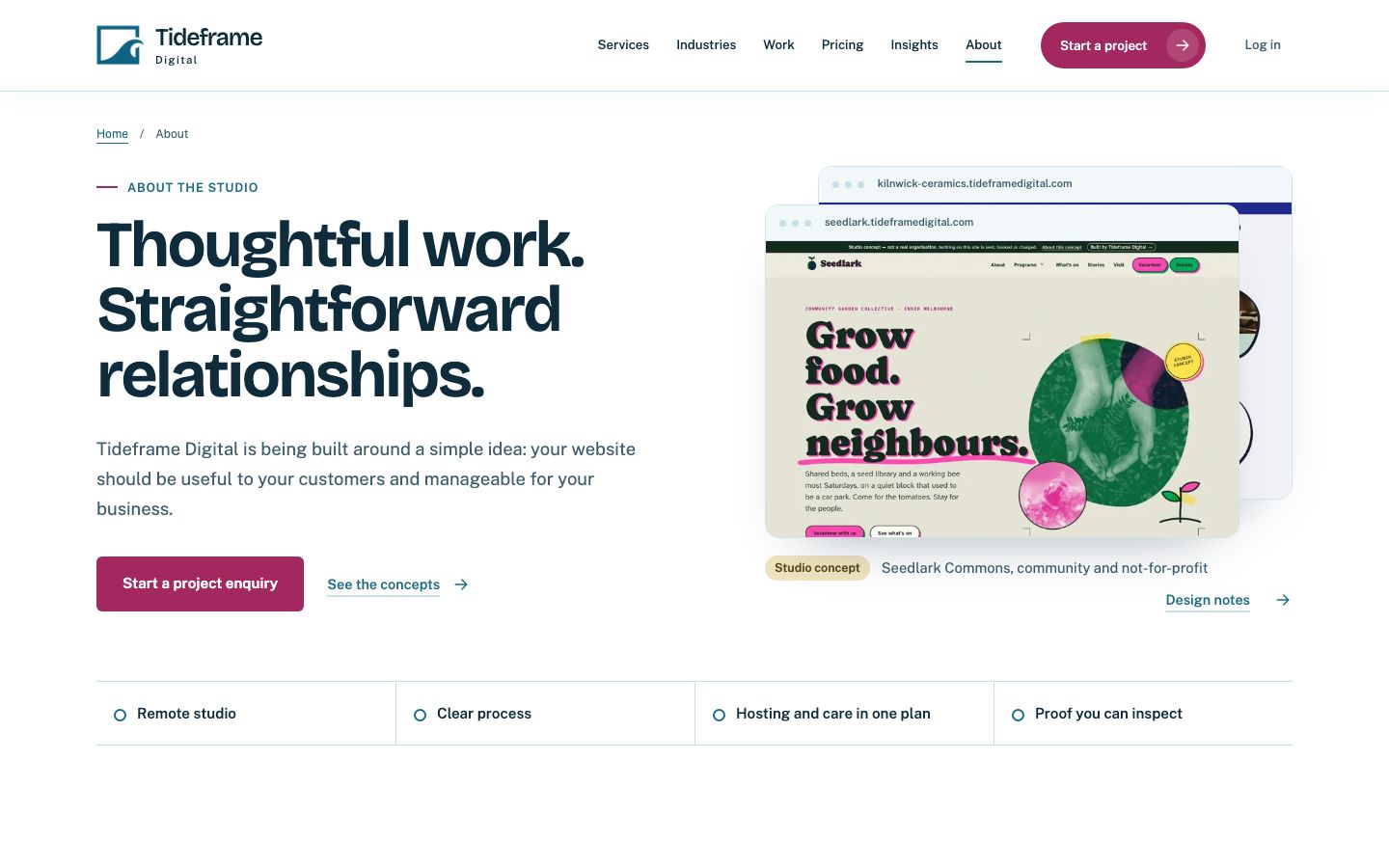
Tideframe Digital is a remote web studio founded by Robert Whittaker, who leads its development. It builds websites for businesses, and it designs, builds and runs ClubHelix. You can read the studio's own description on our Tideframe Digital page.
A few things about how the studio works, in its own terms:
-
It's remote. There is no shopfront or customer-facing office. The studio works with businesses remotely and welcomes suitable international projects.
-
It started with a focus. Tour and activity operators and trades were its first areas of focus, and suitable work from any industry is welcome.
-
Most of its sites run on an established open-source content management system that the business can edit itself. It takes on React and Next.js work where an interaction, an integration or a publishing requirement justifies the extra build and upkeep. ClubHelix is that kind of build.
-
Its starting idea is simple: a website should be useful to the people who visit it and manageable for the business that owns it.
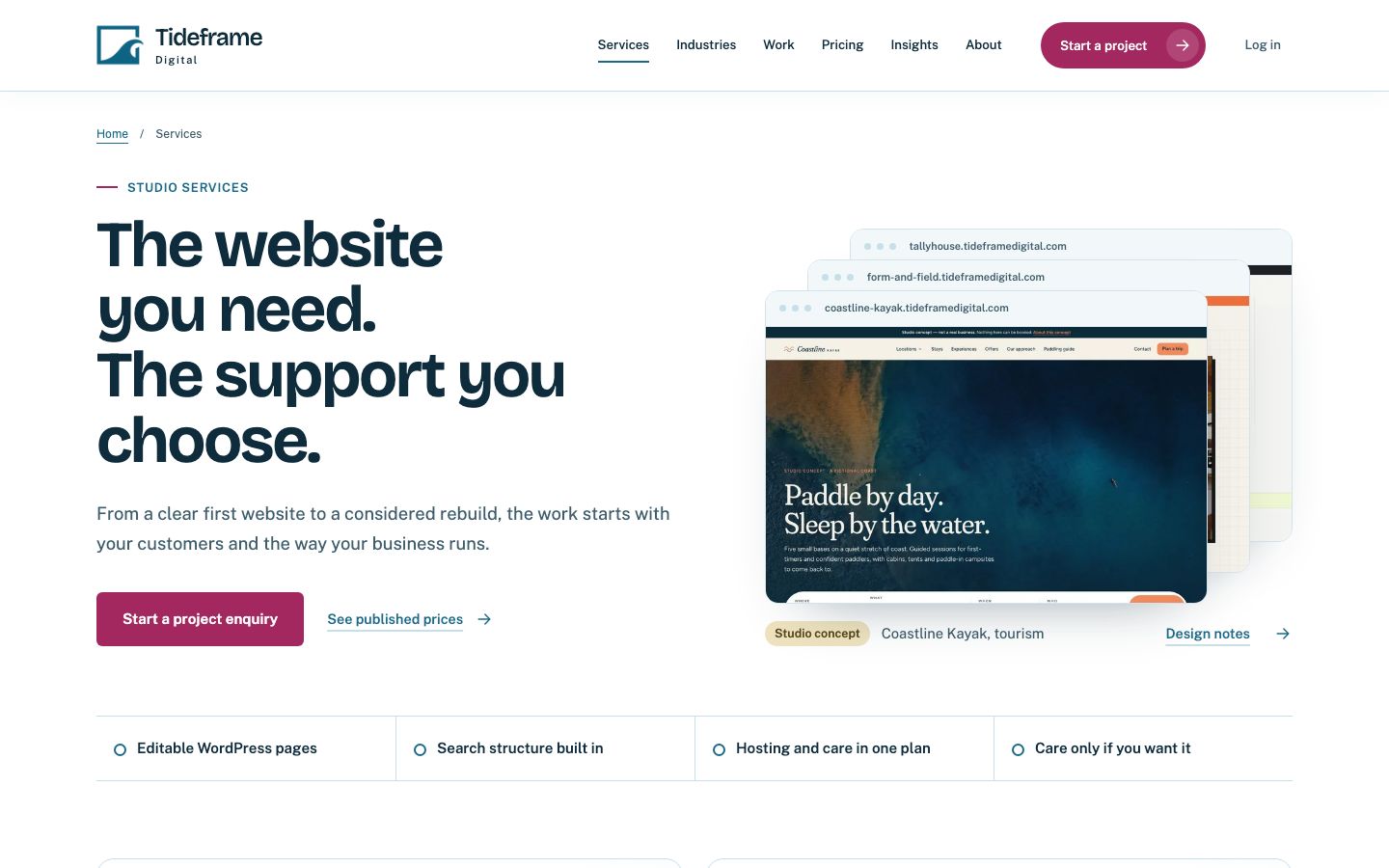
The studio's services fall into four groups:
| Service | What it covers |
|---|---|
| Website design | Discovery and a page plan, design, editable pages, technical SEO, testing, launch, editing guidance and an agreed handover |
| Website care | Optional care after launch: scheduled updates, private staging checks, uptime monitoring and backup oversight |
| Rebuilds | A review of the current site and a URL and redirect plan, so useful pages are not casually lost |
| Custom work | Booking connections, business-system integrations and separate frontends, assessed first, with a clear answer on who maintains each part |
The studio publishes its prices on its pricing page, and a written quote confirms the amount for each project.
What "a Tideframe Digital solution" means for your club
You'll see "A Tideframe Digital solution" in the ClubHelix footer. It means the studio designs ClubHelix, builds it and looks after it. ClubHelix also has its own page on the studio's site: ClubHelix on tideframedigital.com.
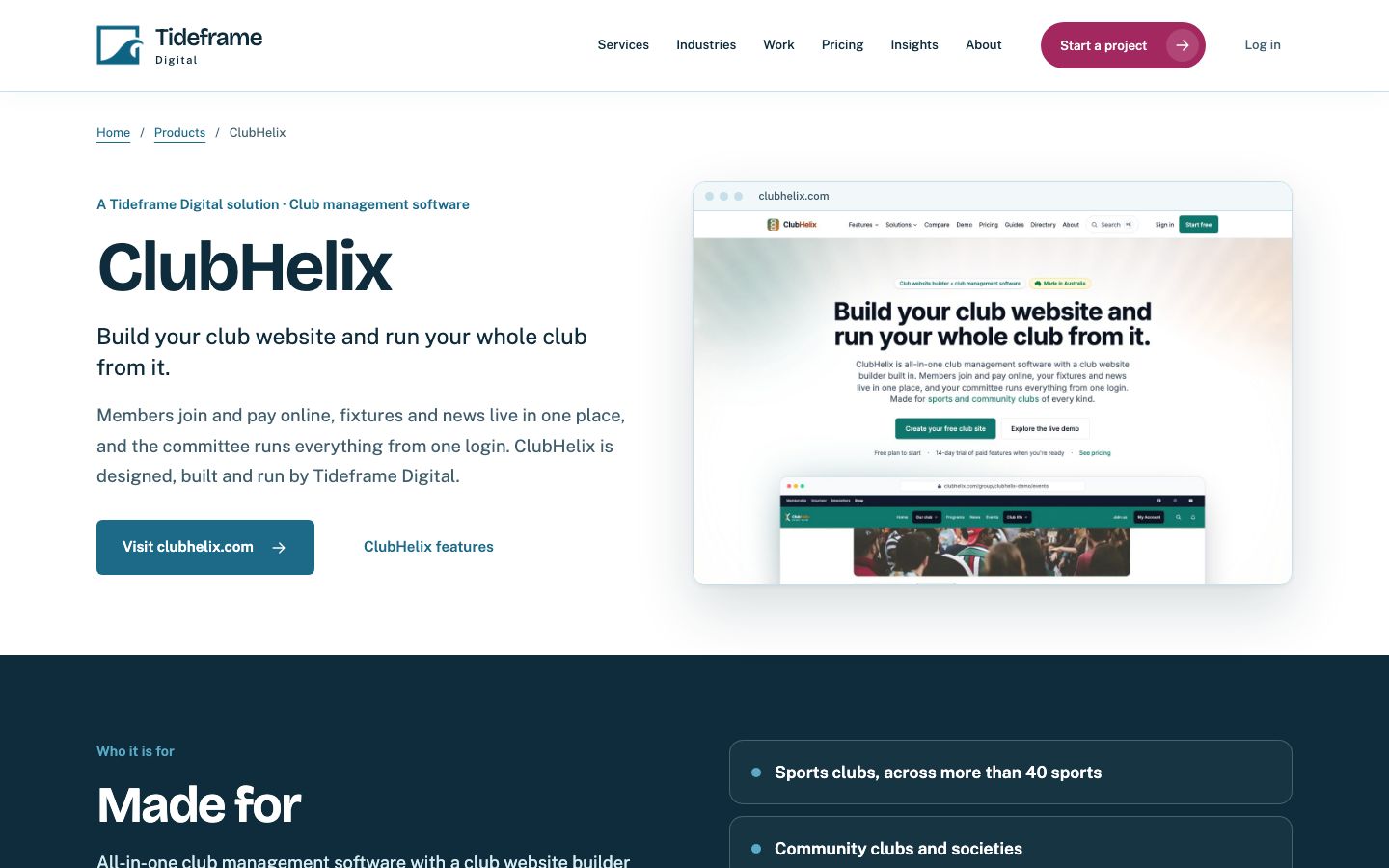
For your club, nothing changes day to day. You sign up, pay and get help through ClubHelix, exactly as before. Your plan and pricing are ClubHelix's. The studio is the team doing the work behind it.
What it does give you is a straight answer to question one on the list above. The people who design the screens your registrar uses are the people who write the code, read the error reports and ship the fixes. Nothing gets lost in a hand-off between a reseller and a distant development team.
How the studio's process shows up in ClubHelix
Every Tideframe Digital project follows the same plain sequence: plan, build, launch, hand over. Here's how each step carries across into how ClubHelix is run.
Plan
A studio project starts by agreeing the audience, the pages and the enquiry journey before any design work. In ClubHelix, the same habit means features start from what a club actually does: a registrar processing renewals, a coach taking attendance, a treasurer reconciling a payment. That's why the admin is arranged around club jobs rather than database tables.
Build
Studio clients review a private preview as their pages take shape. ClubHelix changes go through a test environment before they reach your club, and new behaviour ships with automated tests so the same fault can't quietly return.
Launch
Before a studio site goes live, the agreed pages and forms are tested and a recovery point is prepared. ClubHelix applies that to every release, and to your club's data every day:
- Backups run daily, encrypted and automatic, kept for 30 days, with point-in-time recovery behind them. If something goes wrong for one organisation, we can restore just that organisation on request.
- Bug fixing starts before anyone writes in. Errors are logged automatically the moment they happen, including silent ones such as a button that does nothing, and our team is alerted to new problems and to problems that come back after a fix.
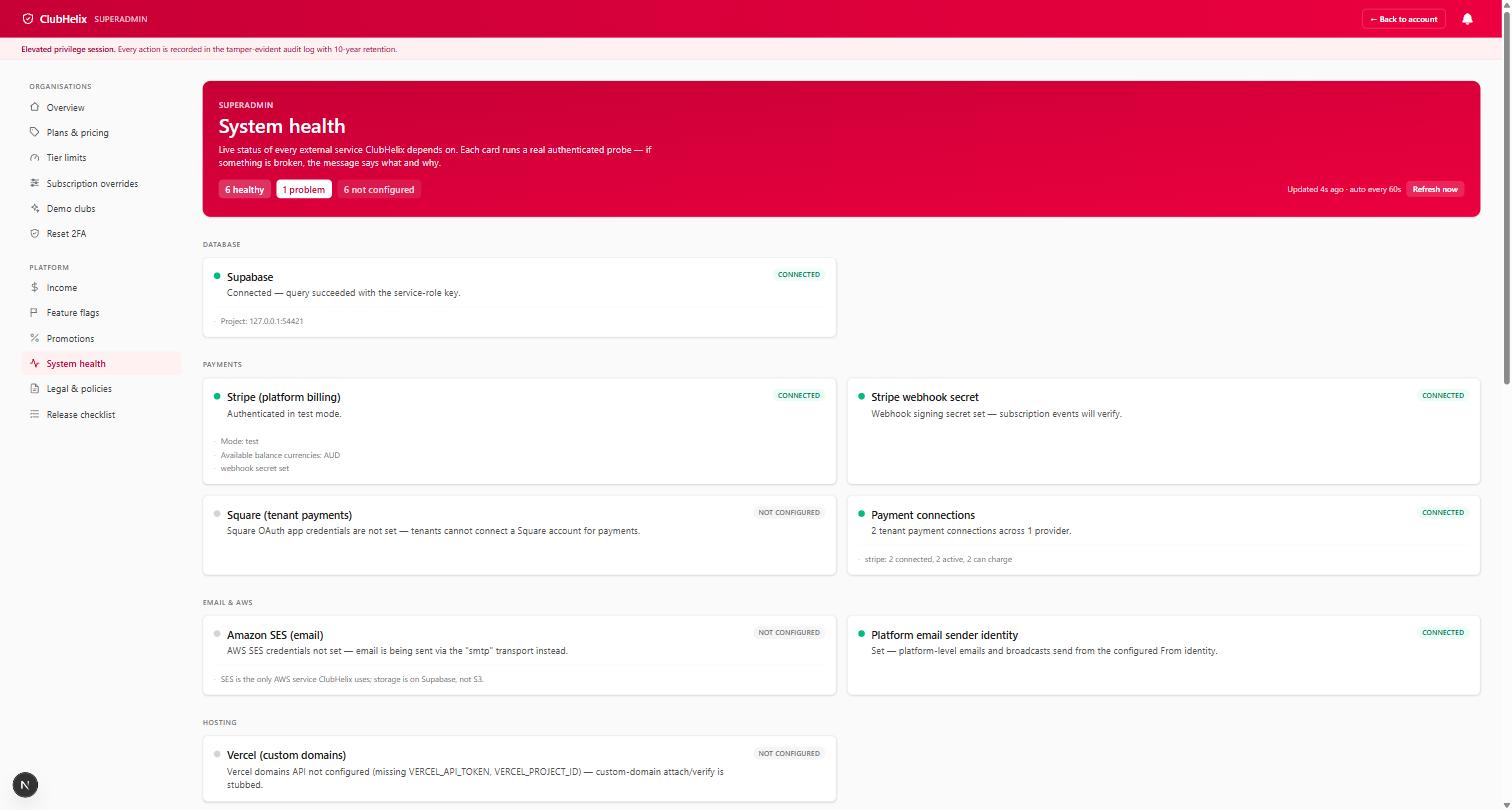
Our security and reliability page sets out the rest: how data is separated between organisations, where it's stored and what we monitor.
Hand over
A studio handover means the business receives records of its accounts, licences, renewals and editing guidance, and owns its domain and content. ClubHelix takes the same position on your data. Administrators can download an export of the organisation's key data whenever they choose, a custom domain stays registered to your club, and your content is yours. If you ever want to leave, you don't need our permission to take your records with you.
Support you can actually reach
A small team that builds its own product is also the team that answers your support request. In ClubHelix you can:
- Report a bug in two sentences. The one-click report joins the error's own ticket, so you don't have to explain technical detail we already have. Our guide on how to report a bug in your club software shows what makes a report quick to act on.
- Ask the Helix Assistant. The Helix Assistant answers "how do I…" questions inside your admin, from the same help articles our team writes.
- Read the help wiki. Every admin page has a help page behind the ? button.
If you'd rather not set your club up yourself, our done-for-you builds mean our team builds and fills your site for you on ClubHelix.
When to talk to the studio directly
Most clubs never need to think about Tideframe Digital at all: ClubHelix covers the website, members, payments and communication in one place, and you can start free.
The studio is worth knowing about in a few situations:
- A sponsor or member business needs a website. Tideframe Digital builds sites for businesses, and tour operators and trades were its first focus.
- Your club runs something closer to a business, such as a venue with functions, a tourism-facing event or a large public program, and needs a bespoke site alongside its club platform.
- You need custom integration work that goes beyond what a platform offers out of the box.
Our guide on whether a club needs a platform or a web studio works through that decision in detail. For anything that fits, start a conversation on tideframedigital.com.
Frequently asked questions
What does "a Tideframe Digital solution" mean?
It means the studio designs ClubHelix, builds it and looks after it. For your club nothing changes. You sign up, pay and get support through ClubHelix.
Does using ClubHelix mean my club is a Tideframe Digital client?
No. Using ClubHelix makes you a ClubHelix customer. You'd only become a studio client if you separately engaged Tideframe Digital for website or custom work, with its own written quote.
Who answers my support requests?
The same team that builds the product. Bug reports, help questions and feature feedback reach the people who write the code, and errors are logged automatically so we often know about a fault before you do.
Can Tideframe Digital build my club a custom website instead?
It can, where the job genuinely needs it. For most clubs, ClubHelix's built-in website or a done-for-you build is faster and cheaper, and it comes with members, payments and email included. Our platform or web studio guide helps you decide which you need.

