
What this guide answers
- How long should choosing club software take?
For most community clubs: two to four weeks of elapsed time, but only a few hours of actual work — one committee conversation to agree the jobs list, a couple of evenings testing shortlisted products against it, and…
- Should we choose the software our governing body provides?
Use what your governing body mandates for the things it mandates — usually competition entry and player registration feeding its database.
- Is it worth paying, or should we start with something free?
Start by understanding what "free" is being paid with — usually higher payment processing margins, advertising, or your members' data.
- What is the single biggest mistake committees make?
Choosing from screenshots and feature lists without any committee member using the product first.
Every club software decision starts the same way. Someone on the committee — usually the newest member, occasionally the only one under forty — is asked to "look into options". They come back three weeks later with a spreadsheet of feature ticks, four browser tabs of pricing pages, and a strong opinion formed mostly by which website looked the most professional. The committee, none of whom have seen any of the products, votes on the recommendation. The club then lives with the result for five years, because switching is painful enough that nobody volunteers to do it twice.
There is nothing wrong with the volunteer in that story. The process is what fails. Feature lists all look the same from the outside — every platform claims registration, payments, a website and email, and every one of those claims is technically true. What separates platforms is how those things work when a real registrar uses them on a real Tuesday night, and a feature list cannot tell you that. Only using the product can.
This guide is the process we would want a committee to run against us. It works for any platform, including ours: start from the jobs your club actually does, ask the small number of questions that genuinely separate products, and refuse to decide on anything you have not personally driven. If you are still working out what club management software covers in the first place, start there and come back.
Start from jobs, not features
Before you open a single pricing page, write down what your club actually needs software to do. Not features — jobs. A feature is "membership database". A job is "on the first Saturday of the season, ninety families need to register and pay in one sitting, mostly on phones, half of them re-registering from last year". The second version is testable; the first is a checkbox.
Most community clubs' jobs fit on one page:
- Registration day. New and returning members sign up and pay online, including families registering several children at once. See online registration for what this looks like when it works.
- The money. Fees come in, someone can see who has paid and who has not, and the treasurer can hand the committee a number that reconciles with the bank.
- The website. Fixtures, news, contact details and sponsors, findable on Google, editable by a volunteer without calling anyone.
- The weekly drumbeat. Training changes, cancellations and newsletters reaching members reliably — not sitting unread in a social media feed's algorithm.
- The committee's memory. Member records, policies, meeting minutes and an audit trail of who changed what that survives the annual handover to a new secretary.
Rank those for your club. A tennis club with court booking at the centre of its life has a different top job than a junior football club drowning in registration paperwork. When you test platforms later, you test your top three jobs first and let the rest be tiebreakers.
The questions that actually separate platforms
Once you are looking at real products, most of the marketing claims wash out — everyone says "easy", everyone says "all-in-one". These questions do not wash out, and platforms answer them very differently.
Who owns your data, and can you leave? Ask for a full member and payment export, today, unassisted, as a spreadsheet. If an admin cannot produce one in the demo, the honest answer is no. The same goes for your website content and your domain name — our guide to club website platforms works through who ends up holding each asset under the different supplier models.
What does it cost over three years, all in? Subscription plus payment processing percentages plus the add-ons you will discover you need. A low sticker price with a high payment margin can cost a mid-sized club more than an honest subscription. Model it on your real numbers: members × fees × the processing rate, plus the plan, times three years. Our pricing publishes every number for exactly this reason, and the free vs paid comparison covers where "free" platforms recover their costs.
Who does the admin — the platform or you? Some products are databases you operate; some do work on your behalf. When a member pays, does the record update itself or does someone reconcile it by hand? When a fixture changes, does the website, the calendar and the notification all follow, or is that three edits?
What happens when something breaks? Every product has bugs — the difference is whether the vendor notices, and whether a volunteer can report one without writing a formal support ticket. This matters more for clubs than for businesses, because your "IT department" is a parent with a phone at training. We have written a whole guide on what good bug reporting looks like, and our own process is documented on the security and trust page.
Is your data safe, and where does it live? Backups, encryption, access control, and — for clubs holding children's details — who can see what. A platform's backup and recovery story should be written down publicly, not answered vaguely in a sales call.
Never buy what you have not driven
Here is the uncomfortable test that sorts the market fastest: try to use each shortlisted product before speaking to anyone.
Much of the club software industry runs on the booked demonstration. You fill in a form, a salesperson emails you, and some days later you watch a screen-share of the product's best angles for forty-five minutes. A guided demo is not useless — but understand what it is. You see the workflows the presenter chose, at the pace the presenter chose, with the questions you did not know to ask left unasked. The parts of the product that would have made your registrar wince are, by design, not on the tour.
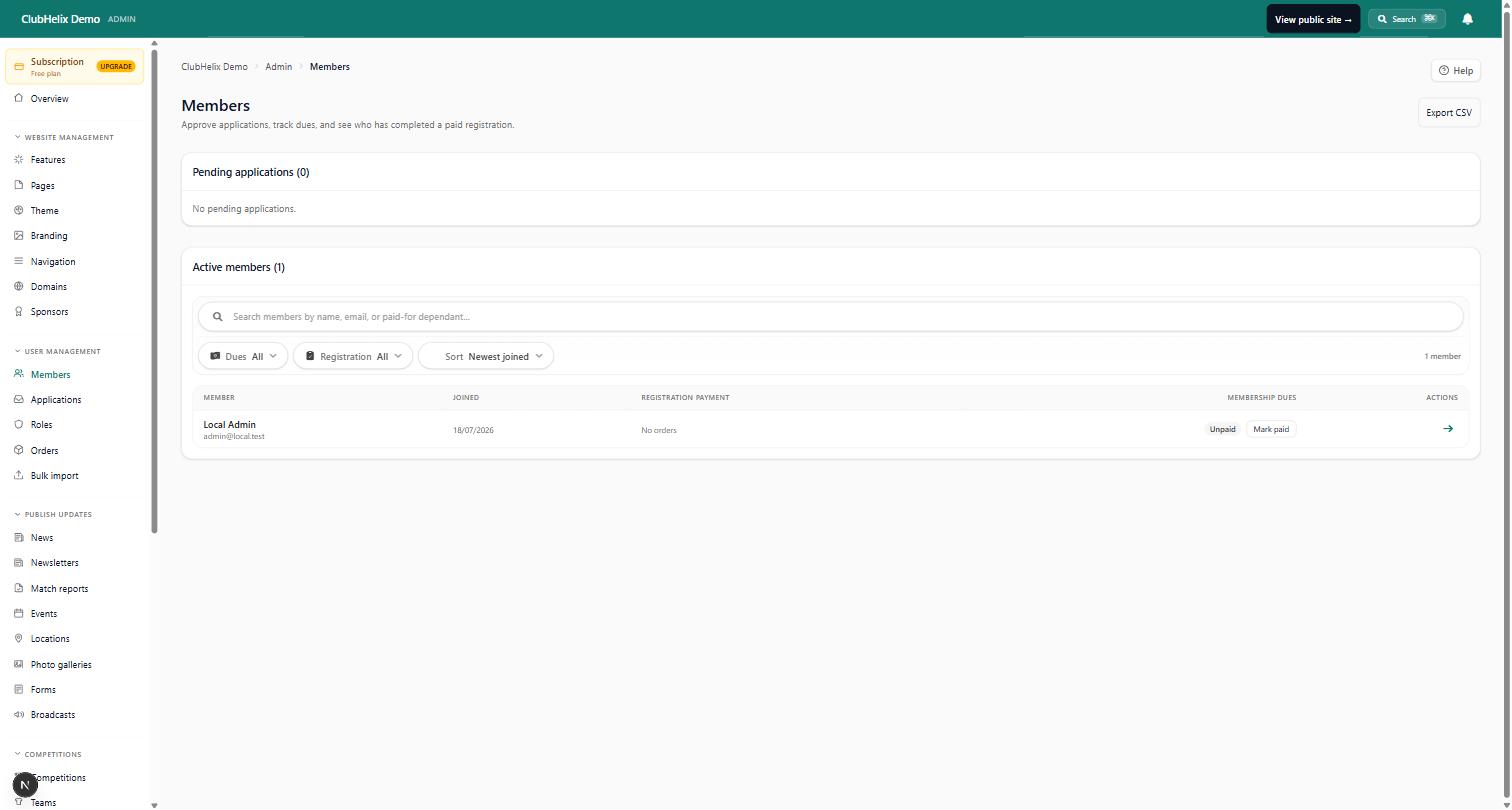
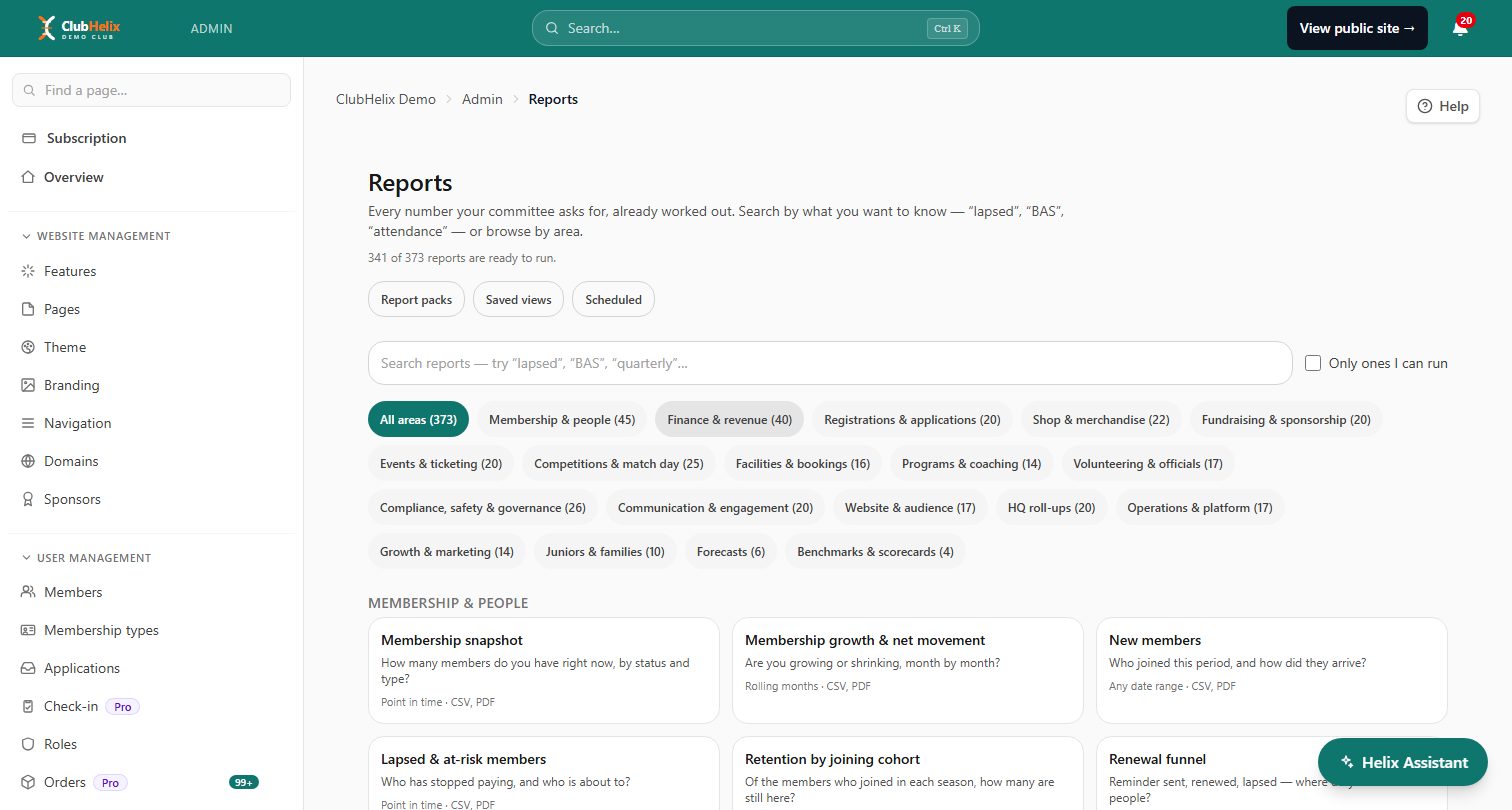
An open demo inverts the power. If you can log into a working club and click anywhere — including the boring screens, the settings, the export buttons — then the vendor has nowhere to hide and you can test your jobs instead of their script. We keep a complete, working demo club open to anyone for exactly this reason: the public site and the entire admin, read-only, no account, no sales call, no email gate. Bring your registration-day scenario and see for yourself. And apply the same standard to everyone on your shortlist: if a product only exists behind a booked call, ask why, and ask what the trial terms are before your committee commits to anything.
When you get access — to any platform — do not wander. Test deliberately. Our club software demo checklist is a full walkthrough of what to check in twenty minutes, and it works on any product, not just ours.
Run the decision like a committee, not a poll
With two or three products shortlisted and driven, the decision itself deserves twenty structured minutes at a committee meeting rather than a show of hands.
Bring the people who will live with it. The registrar, the treasurer and whoever edits the website should each have driven their part of every shortlisted product. A platform the president loves and the registrar dreads is the wrong platform.
Score against your jobs list, in writing. Three columns, your top jobs as rows, a sentence per cell about what you actually observed. Writing "couldn't find the member export" is more useful in February than a vague memory of having liked one of them.
Check the exit before the entrance. Confirm in writing what happens to your data, your domain and your members' payment arrangements if you leave. A vendor confident in its product answers this cheerfully; hesitation is data.
Start small if you can. Most platforms, ours included, have a free tier or entry plan — set up your real club, import a portion of the roster, and run one real workflow before the whole season depends on it. Setting up on a free plan with your actual fixtures and a dozen real members teaches you more than any amount of reading — including this guide.
Decide, minute it, and commit for a season. Software chosen this way deserves a full season before it is re-litigated. The clubs that suffer most are not the ones that chose imperfectly but the ones that switch every eighteen months, re-training volunteers and re-entering members each time.
Frequently asked questions
How long should choosing club software take?
For most community clubs: two to four weeks of elapsed time, but only a few hours of actual work — one committee conversation to agree the jobs list, a couple of evenings testing shortlisted products against it, and one meeting to decide. The process goes wrong when it either collapses into a single volunteer's snap judgement or stretches across an entire off-season of indecision. Time-box it, and schedule the decision meeting before you start looking.
Should we choose the software our governing body provides?
Use what your governing body mandates for the things it mandates — usually competition entry and player registration feeding its database. That does not have to be your club's website, member communication or fundraising platform, and for many clubs it should not be: governing-body tools are built for the sport's administration, not for your club's public face. Many clubs run both happily, with the club platform linking to the governing body's registration where required.
Is it worth paying, or should we start with something free?
Start by understanding what "free" is being paid with — usually higher payment processing margins, advertising, or your members' data. For a small club collecting little or no money online, a free tier is a genuinely good answer, and we offer one. Once real fees flow through the platform, compare total three-year cost rather than subscription price: a paid plan with lower processing costs and an export button is frequently cheaper than a free one without them.
What is the single biggest mistake committees make?
Choosing from screenshots and feature lists without any committee member using the product first. Every other mistake — overbuying, underbuying, missing the exit terms — is survivable and correctable. Committing a season to software nobody drove is the one that produces the five-year regret, because the pain arrives in week one of registration and there is no calm moment to switch until the season ends.


