
What this guide answers
- Our welfare officer is a second-year with no training. Is that a problem?
It is only a problem if the role is defined as helping people directly.
- Someone messaged the society account at 2am saying they were not coping. What should we do?
Reply when you see it, not from a sense of obligation to be awake — and make sure the account's pinned message and contact page already say when it is checked and who to call in the meantime, so nobody is relying on…
- How do we run socials that are not built around drinking without losing the members who come for that?
You are not replacing the drinking events, you are adding a second track with equal effort.
- A member has complained about another member. Can the committee handle it ourselves?
For low-level things — someone talking over people, a joke that landed badly, a persistent monopoliser — yes, and a quiet word from a committee member usually resolves it.
- How do we make an event accessible when we do not control the venue?
Ask before you book rather than after, because the answer changes which room you choose — and that is the whole trick.
Ireland edition. This guide is written for volunteer-run clubs in Ireland. Where rules differ — grants, tax, incorporation, safeguarding — follow the Ireland-specific pointers below or check with your national body.
A society is often the first place a student feels they belong. Ninety people in a room who care about the same obscure thing, a committee that knows your name by week three, a standing Tuesday that gives an otherwise shapeless week a shape. It is also, quite often, the first place a student works out that they do not belong — not because anyone was unkind, but because every event started at nine at night in a licensed venue, the only sign-up asked for a phone number and nothing else, and the person on the door was deep in conversation with their friends.
Almost none of that is deliberate. Welfare and inclusion work in a society is rarely dramatic; it is a hundred small design decisions made weeks earlier. Where you book. What time you start. What it costs, and whether the price is negotiable for the person who cannot pay it. Who greets people in the first fifteen minutes. What the group chat is like at midnight. And whether one person on the committee knows what to do when a member says something serious at the end of an event. Committees that do this well are not kinder than the ones that do not. They have simply written six or seven things down.
This guide is the practical version: what a welfare officer's remit actually is (and the three things it is not), how to make events accessible without a budget, how to program around alcohol rather than on top of it, what to do in the first five minutes of a disclosure, and a one-hour audit you can run at the start of each term. It is general information rather than clinical or legal advice — for anything serious, your student association's welfare and advocacy staff and the university's support services are the people with the training and the mandate.
The welfare officer's real remit
Most societies elect a welfare officer because the affiliation form has a box for one, and then leave the role undefined. That is how you end up with a well-meaning second-year taking 1am messages from someone in crisis, with no training, no supervision and no idea whether they are allowed to tell anyone.
The remit is design and referral. It is not treatment, it is not investigation, and it is not being on call. Write the boundary down and share it with the whole committee, because the pressure to overstep does not come from members — it comes from a committee that assumes "welfare" means "whoever deals with the hard stuff".
| In the remit | Not in the remit |
|---|---|
| Checking the venue and the event listing for access barriers before you book | Counselling, therapy, diagnosis or clinical advice |
| Holding and refreshing the referral card — who to send someone to, for what | Deciding whether someone is "really" struggling |
| Being a named first point of contact who does not gossip | Investigating a complaint or judging who is telling truth |
| Making sure one event a month is genuinely alcohol-free and genuinely good | Mediating a serious dispute between two members |
| Running the inclusion audit and taking the result to a committee meeting | Being available at 2am |
| Writing the short, factual note after an incident | Keeping a secret they were never in a position to keep |
Realistically the role runs at one to two hours a week in term, with spikes around the flagship event and the fortnight before exams, when almost every society sees a cluster of members go quiet. Budget for that in the committee roles guide rather than pretending it is a title with no work attached.
Two structural rules matter more than anything else. Never run it with one person. Two welfare officers, ideally different people in obvious ways, gives members a choice of who to approach and gives each officer someone to debrief with — and a member who wants to talk about something gendered, cultural or religious should not have exactly one option. Never let the president hold it as well. The person who represents the society externally is the worst possible person to receive a complaint about the society.
Give both officers the same three-sentence boundary script and let them use it without apologising: "Thank you for telling me — that took something. I'm not trained for this and I don't want to get it wrong. What I can do is walk you over to the people who are, or sit with you while you make the call." That sentence does more good than a year of good intentions, and it protects a nineteen-year-old from carrying something they were never equipped to carry.
Finally, build a one-page referral card: six to eight services, what each one is for, how to reach them, and their hours. Print it, pin it in the chat, put it on the society's website, and hand it over every year — services get renamed, numbers change, and a card from three committees ago sends people to a service that closed.
Your referral card should open with the college counselling service and the disability support service, which owns the adjustment paperwork and the exam accommodations. Then add the students' union's elected welfare officer — a full-time sabbatical role whose entire job is this, and the single most underused resource on any campus. Societies that build a relationship with the welfare officer in September have somewhere to send people in February. Include the chaplaincy, the student health centre, the Student Assistance Fund for hardship, and Niteline where it operates in your city — a student-run, overnight listening service. Samaritans (116 123) and the Text About It service (text HELLO to 50808) are the standard lines to name for crisis. This is general information; your union's welfare officer can confirm the current local detail.
Accessible events start on the booking form, not the apology
The most common accessibility failure in a society is not a building. It is a committee that books a venue, publishes an event, and then waits to see whether anyone asks for something. By the time somebody asks, the room is booked, the caterer is confirmed and the honest answer is "sorry, not this time" — which is how a member learns to stop asking.
Flip the order. Run the access check before you commit to the room, and publish what you found whether or not anyone asked.
- Getting in. Step-free entry, and specifically which door — not "the building is accessible", but "step-free entry via the north door, which is unlocked until 8pm."
- Getting around. Lift access to the floor, an accessible toilet on the same level, and a route that does not go through a crowded bar.
- Hearing. Is there a hearing loop? Is there a microphone, and will the speaker actually use it? Will the music be loud enough that lip-reading becomes impossible?
- Seeing and reading. Lighting that stays on, slides with real contrast, and no critical information delivered only as a photo of a poster.
- Seating. Enough chairs that standing for two hours is not the entry requirement, and a couple of seats near the door.
- Quiet. A room or corner someone can step into for ten minutes. At a big event this is the single highest-value thing you can arrange, and it usually costs nothing.
- Food. Vegetarian, vegan, halal, gluten-free and nut-free options that are actual meals rather than an apologetic bowl of chips, labelled on the table.
- Timing. A start time that works for people with caring responsibilities, part-time jobs, prayer times or a long commute home.
- Getting home. Late finish plus poor transport equals an event a lot of people will not risk.
Then write three or four honest sentences into the event listing itself, and name a person: "Step-free entry via the north door. Accessible toilet on level 1. Seating for everyone, quiet room next door, vegan and halal options. Music from 9pm. Access questions: Priya, priya@…" An access statement that admits a limitation is far more useful than one that pretends there are none.
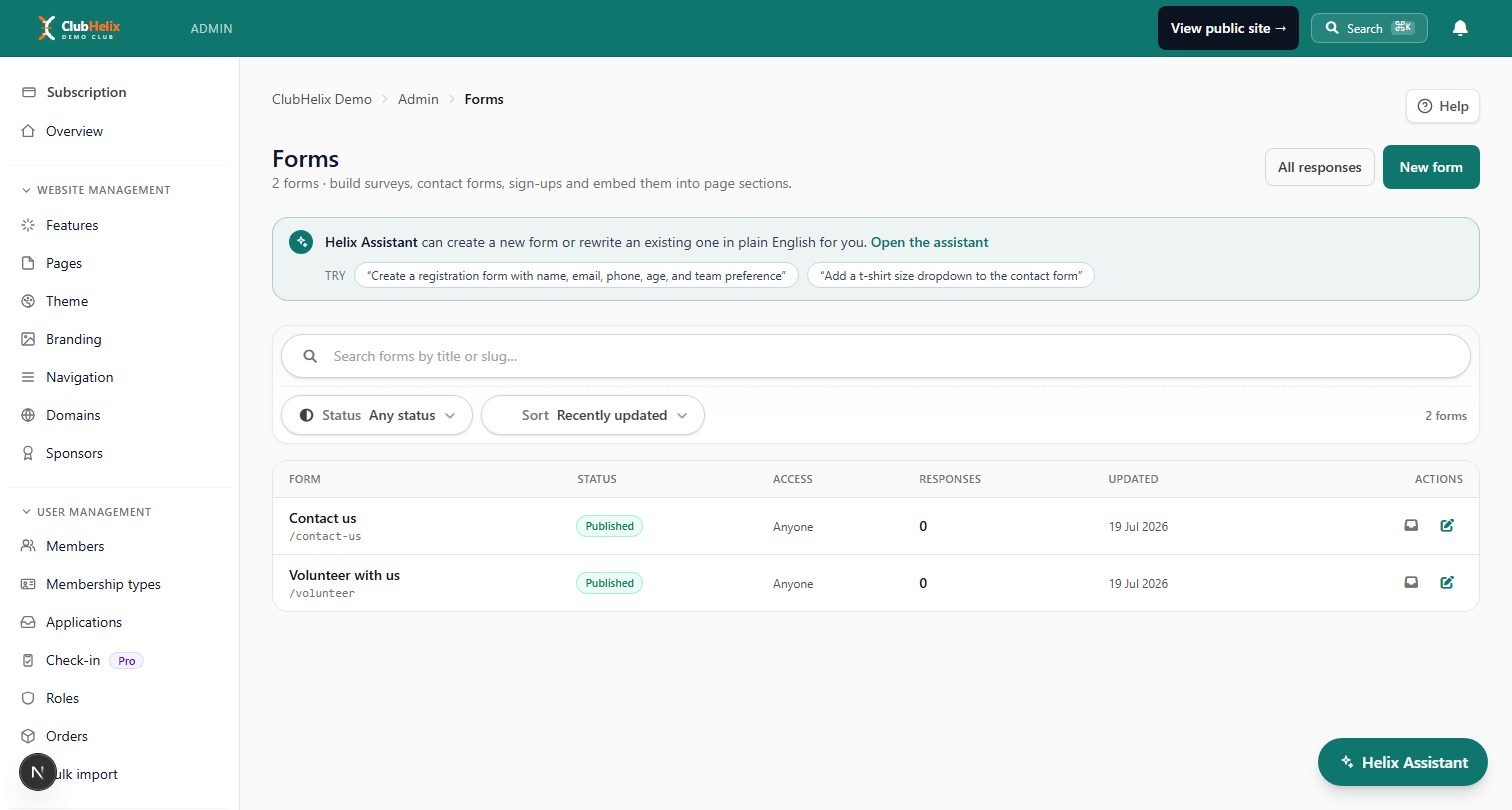
Collect specific needs on the event RSVP rather than the membership form. Access requirements and dietary needs change, they are sensitive, and there is no good reason for a society to hold them permanently on 140 people — ask per event, use them, and let them expire with the event. A form and survey tool built into your own site does this properly: the question sits on the sign-up, the answers reach the two committee members who need them, and nothing lands in a shared spreadsheet that four graduated members can still open. The member records and privacy guide covers how long to keep what.
The Equal Status Acts prohibit discrimination in the provision of goods and services, including on the ground of disability, and impose a duty to do all that is reasonable to accommodate a person with a disability. The Disability Act 2005 adds obligations on public bodies, which includes your institution, and the Irish Sign Language Act 2017 recognises ISL and creates duties for public bodies to provide interpretation for people accessing their services. In practice, expectations reach your society through the students' union's clubs and societies committee: the event approval and room booking process is where access gets asked about, and the answer "we did not think about it" is the one that costs you the room. The cheap version works: check the door, the toilet, the seating and the lighting, publish an access statement with a named contact, and ask the disability support service about interpreters before assuming they are out of reach. This is general information, not legal advice.
The three barriers you can actually remove: time, money and alcohol
Almost every exclusion a society creates comes down to one of three things: when the event is, what it costs, and whether it is built around drinking. All three are committee decisions, which means all three are fixable in an afternoon of planning.
Time
If the whole program happens after 8pm, you have quietly excluded the members with jobs, caring responsibilities, long commutes, religious commitments or a sleep pattern that is not negotiable. Move one thing a fortnight into daylight — a lunch meet-up, a study session, a coffee walk, a Saturday morning. Daytime events also tend to be free, which solves the second barrier at the same time.
Money
A $10 membership and $25 events sounds cheap until you meet the member for whom it is not. Three mechanisms cover almost every case, and none of them require a fund:
- A concession rate, published on the same page as the full rate, with no evidence required. Naming it is the point: it tells people they are expected.
- A quiet hardship allowance — a handful of free or half-price places per major event, issued by the treasurer as a private discount code. Never run an application form for a $15 waiver; the form is the barrier.
- A genuine $0 anchor event every fortnight, so that "the society" is something you can be part of without spending anything.
Write the hardship allowance into the budget as a line item so it is a decision, not a favour. Our membership fees guide works through the pricing, and the social event ideas list is sorted by budget precisely so you can find the free ones.
Alcohol
Drinking is not the problem. Drinking as the default structure is. If four of your five socials a term are at a licensed venue after nine, then the members who do not drink — for faith, health, recovery, medication, cost, age or simple preference — are not choosing to skip an event, they are choosing to skip the society.
Set a floor and hold it: at least one properly good alcohol-free event a month, with the same budget, the same promotion and the same committee turnout as the drinking ones. The reason sober events fail is almost never sobriety; it is that they were designed as the consolation prize. Add three cheap rules. Price soft drinks at or below the cheapest alcoholic option. Roster one committee member as the sober contact at every social, named on the listing, so there is always someone thinking clearly. And never make drinking an entry ritual — no rounds, no shots on arrival, no games that end with someone being cheered into a state they did not choose.
There is a licensing layer as well. Alcohol may only be sold under a licence, the legal age is 18, and a one-off event outside a licensed premises needs the appropriate permission — which is why the union bar or an established licensed venue is nearly always the simplest path, with the licence, the trained staff and the insurance attached. Beyond the law, many institutions participate in the REACT framework for responding to student alcohol use, and accredited institutions restrict drinks-industry sponsorship of societies, alcohol-led promotion and price-driven drinks offers. That constrains the tempting sponsorship deal more than committees realise, so ask your clubs and societies officer before you sign one. Union policies also typically ban initiations outright. Read our event risk assessment guide before you advertise a ticketed night. General information only.
Belonging is built in the first fifteen minutes
Watch any society event from the door and you will see the same thing: the committee clusters, the regulars cluster, and three or four newcomers stand near the wall holding a drink and calculating how long they have to stay before leaving is acceptable. Most of them leave and never come back, and the committee concludes that "people just didn't gel this year".
Fix the first fifteen minutes and you fix most of your retention.
- Roster two greeters whose only job for the first twenty minutes is to talk to anyone standing alone and introduce them to a third person by name. Not the president, who will be pulled away. Rotate the role so it is not one extrovert's burden.
- Run a first-timers table at anything over about thirty people, signposted, with a committee member sitting at it. New people will sit at a table labelled for them long before they will join a laughing circle of strangers.
- Use name badges at the first two events of each term, with an optional line for pronouns. It is a small thing that removes the "I have met you three times and cannot ask your name now" spiral.
- Ban closed committee circles. If four committee members are talking to each other at your own event, one of them is doing the wrong job.
- Introduce, don't point. "Sam, this is Dee, she also does second-year chemistry" beats "there's a group over there".
The group chat needs the same deliberate design, because it is where exclusion happens invisibly and where most committees have no rules at all. Pin a short code of conduct people can actually read. Name three moderators, not one, and make sure at least one is not on the executive. Agree a documented ladder — a quiet word, then a warning, then removal — so nobody is banned by group consensus at midnight. And never take committee decisions in direct messages; if it matters, it goes in a channel where a record exists.
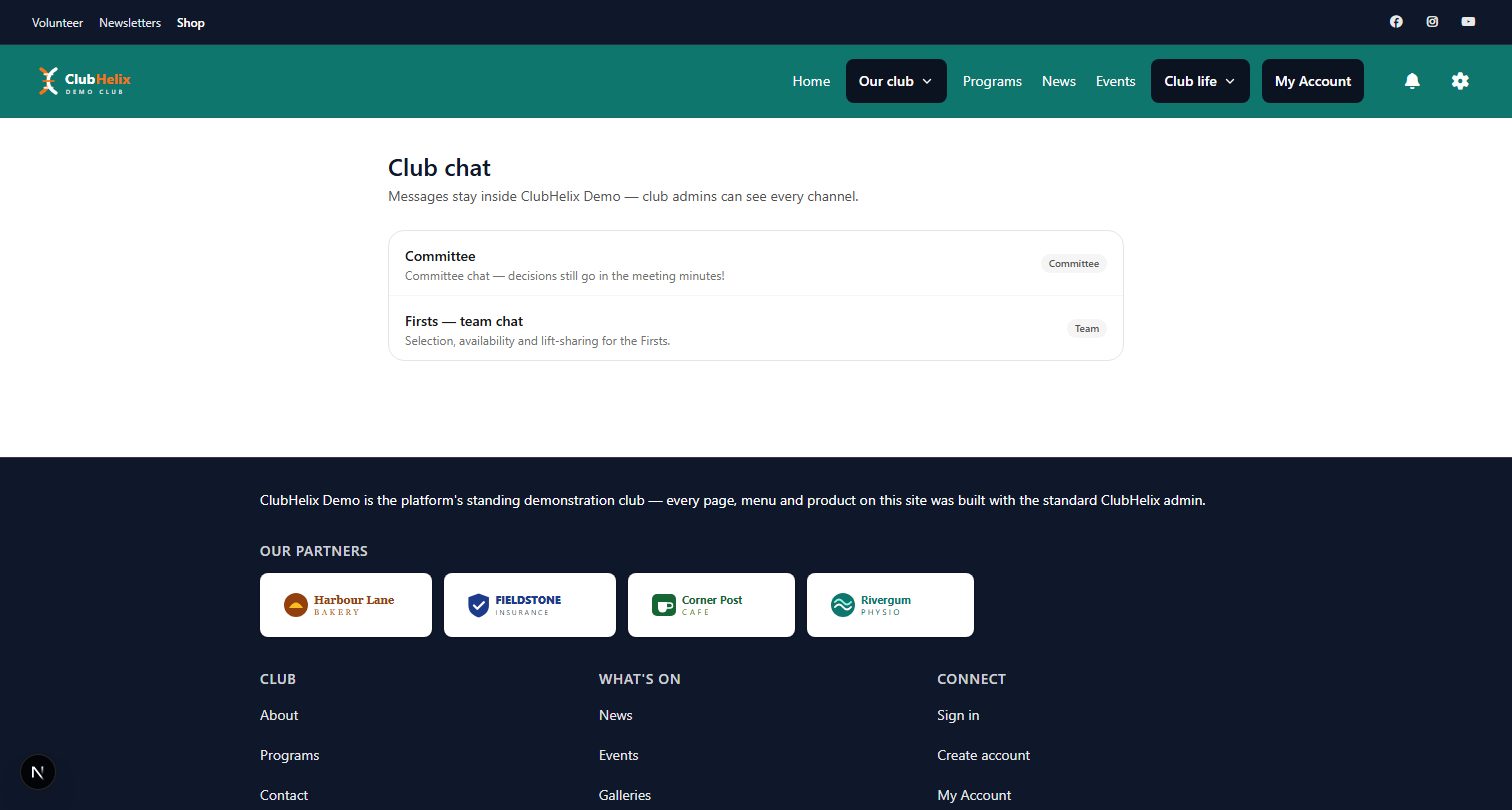
One more rule that saves welfare officers: the society's chat and inbox are checked in the daytime. Say so, in the pinned message and on the contact page, and put the referral card right next to it — "this account is checked most days; if you need someone tonight, here is who to call." Members will accept a clear boundary. They cannot accept an unclear one, and neither can the nineteen-year-old holding the phone. Running chat inside the society's own member app rather than a personal account also means the next committee inherits the channels and the moderation history instead of an orphaned server owned by a graduate.
Societies whose membership turns over completely each year, or whose members are new to the country, need this even more deliberately — the international student society guide goes further into arrival support and language-friendly communication.
When a member tells you something serious
At some point, someone will tell a committee member something heavy: harassment at one of your events, an assault somewhere else, an eating disorder, a suicidal thought, a housing crisis, a member behaving badly towards others. The next five minutes matter more than anything else in this guide.
Do: listen without filling the silence. Thank them. Ask what they want to happen, and take the answer seriously. Offer options rather than instructions — the counselling service, the association's welfare or advocacy staff, the university's reporting route — and offer to go with them or sit with them while they call. Ask whether they want anything to change about how the society runs. Check in a few days later, briefly, without making it the whole relationship.
Do not: promise confidentiality you cannot keep. Say early and plainly: "I'll keep this between us as far as I can, but if I think someone is at serious risk I'll have to tell someone who can help — and I'll tell you first." Do not investigate. Do not interview the other person. Do not arrange a mediation between two members after an allegation of harassment or assault. Do not ban someone by group-chat consensus. Do not brief the rest of the committee "for context". Do not post about it.
Write a short factual note the same night: the date and time, what was said in the person's own words as far as you can recall, what you did, who you told, what you agreed to do next. Not your interpretation, not a character assessment. Store it where two named people can see it and nobody else — an incident record inside the society's own system is far safer than a note in someone's phone, and it survives the handover in a way a personal note never does.
Two situations go straight up and out of the committee, without exception: anything involving a serious risk to someone's safety, and anything where the person complained about is a committee member. In the second case, the president and the welfare officer are conflicted by definition, and trying to handle it in-house is how societies turn a bad incident into a scandal. Hand it to your student association's staff, who have a process, a duty and no friendship with anyone involved.
Your escalation path runs through the institution's own policy and its reporting tool, both shaped by the national framework for ending sexual violence and harassment in Irish higher education, which requires institutions to publish policies, offer anonymous and named reporting options and report on progress. Most institutions now run a disclosure or reporting portal and a named support contact. The students' union's welfare officer supports the student through it independently of the institution, and unresolved complaints can be escalated beyond the institution. For your society the practical point is narrow: refer, support and record — never adjudicate. If the person complained about sits on your committee, hand it to the clubs and societies staff the same week. This is general information, not legal advice.
The one-hour welfare and inclusion audit
Run this in week two of each term, with the whole committee in the room, and put the score in the minutes. It takes an hour, it produces three actions, and it is the single most useful hour a committee spends all year. Score one point per line.
Program (5)
- At least one genuinely alcohol-free event is scheduled this term, with a real budget.
- At least one event a fortnight starts before 6pm.
- At least one event a fortnight costs $0 to attend.
- No event requires drinking to participate; no ritual, round or game does either.
- The term's events are on a public calendar members can see without asking.
Access (5)
- Every published event lists step-free access, toilets, seating and a named access contact.
- Access and dietary needs are collected on the event sign-up, used, and not stored forever.
- Someone has physically walked the route into your usual venue, from the nearest transport stop.
- A quiet space is arranged for events over about fifty people.
- Committee materials — slides, posters, the website — pass a basic contrast and plain-language check.
Money (3)
- A concession rate is published beside every full rate.
- A hardship allowance exists as a budget line and the treasurer can issue it privately.
- Nobody has to explain their finances to a student to get help with a $15 ticket.
People (4)
- Two welfare officers exist, they are not the president, and both are named on the website.
- The referral card was rebuilt this year and is pinned, printed and published.
- A code of conduct exists, is under 400 words, and three named moderators enforce it.
- Greeters are rostered for every event over about twenty people.
Process (3)
- Everyone on the committee knows the three-sentence boundary script.
- Everyone knows the two situations that go straight to your student association.
- Incidents are recorded in the society's own system, visible to two people, and handed over.
Sixteen or more is a society that is doing this properly. Eleven to fifteen is normal and fixable — take the three lowest-scoring lines and assign each one to a named person with a date. Ten or below means the next thing that goes wrong will land on one unprepared student, and that is the risk you are actually managing. Re-score at the end of the year and hand both scores to the incoming committee alongside the rest of the society handover. A short member survey in week six is the cheapest way to check whether your score matches your members' experience — it usually does not, and the gap is the interesting part.
Frequently asked questions
Our welfare officer is a second-year with no training. Is that a problem?
It is only a problem if the role is defined as helping people directly. Defined properly — access checks, the referral card, event design, being a friendly first point of contact — it needs no clinical training at all, just clear boundaries and a good list of phone numbers. Ask your student association whether it runs welfare, mental health first aid, bystander intervention or consent training for committees, because most do and it is usually free. What you must not do is leave one untrained student holding disclosures alone: two officers, a written boundary script and a standing debrief with someone experienced is the minimum safe setup.
Someone messaged the society account at 2am saying they were not coping. What should we do?
Reply when you see it, not from a sense of obligation to be awake — and make sure the account's pinned message and contact page already say when it is checked and who to call in the meantime, so nobody is relying on you overnight. When you do reply, keep it simple: thank them for telling you, ask whether they are safe right now, and give them the two or three numbers from your referral card. If there is any indication of immediate danger, contact emergency services or campus security rather than trying to manage it yourself, and tell the person you are doing it. Afterwards, tell your co-officer, write a two-line note, and check in during daylight hours.
Locally that means campus security, Niteline where it operates, Samaritans on 116 123 or texting HELLO to 50808, and 112 or 999 if someone is in immediate danger.
How do we run socials that are not built around drinking without losing the members who come for that?
You are not replacing the drinking events, you are adding a second track with equal effort. The reason alcohol-free events get a reputation for being dull is that committees give them no budget, no promotion and half a committee, then conclude nobody wanted one. Give the sober event the good venue, the actual food, the same poster and four committee members on the roster, and it will fill. In practice most societies find the alcohol-free events draw a wider crowd than expected, including plenty of people who do drink and simply wanted a Tuesday they could remember.
A member has complained about another member. Can the committee handle it ourselves?
For low-level things — someone talking over people, a joke that landed badly, a persistent monopoliser — yes, and a quiet word from a committee member usually resolves it. For anything involving harassment, discrimination, threats, sexual misconduct or safety, no: a student committee has no training, no procedural fairness, no confidentiality protection and a personal relationship with everyone involved. Support the person, refer them to your student association's staff and the university's reporting route, record what you did, and take any interim step you can that does not require a finding — such as making sure two people are not rostered on the same event. If the person complained about is on your committee, escalate immediately.
How do we make an event accessible when we do not control the venue?
Ask before you book rather than after, because the answer changes which room you choose — and that is the whole trick. Ring the venue with five specific questions (step-free entry and which door, lift access, accessible toilet on the same level, seating, hearing loop or microphone) and write the answers straight into the event listing, including the bits that are bad. Where a venue genuinely cannot be made to work, the honest fix is to move the event, not to publish a listing that implies everyone is welcome and let someone discover otherwise at the door. Our end-to-end event guide has the full booking sequence.
Where ClubHelix fits
Most welfare and inclusion work is about having the right information in the right place at the right moment — access needs attached to the event rather than a group chat, a referral card that survives the handover, a code of conduct people can find, and an incident record only two people can open. ClubHelix gives a society one home for its site, its member records, its events and sign-up forms, its member chat and its incident records, with per-role permissions so the welfare officer sees what they need and nothing more, and the whole lot transfers to next year's committee as a permissions change rather than a shoebox of logins.
If you want to see how the pieces fit for a campus group, our university clubs and societies solution walks through it, and the pricing page includes a free tier for building the site and trying it out, with taking payments online and being found in search on the paid plans.
ClubHelix gives your society sign-up and access-needs forms, member chat with moderation and confidential incident records in one place that belongs to the society, not to whoever set it up. Start free.


