
What this guide answers
- Can we book a room if we are not affiliated yet?
Usually not at student rates, and often not at all. Booking rights are one of the main things affiliation or recognition buys, because your student association's insurance and accountability are what make a booking…
- Our recurring booking was cancelled a week out. What do we do?
Reply the same day and ask two questions: is the cancellation for the whole block or one session, and what alternative can they offer for the same time.
- How far ahead should we book the big one?
Further than feels reasonable. A main theatre, a large hall or a good off-campus function room in the popular weeks is often gone six to twelve months out, and the date drives everything else — tickets, catering, the…
- Nobody can log in to the booking portal — the president who set it up has graduated. Now what?
Email the bookings team from your society's own address, explain the handover, and ask them to reassign the account to the current committee; they deal with this constantly and it is usually a five-minute change on…
- Should we pay for an off-campus venue when campus rooms are free?
Sometimes, yes — but only when the campus room genuinely cannot do the job.
UK edition. This guide is written for volunteer-run clubs in the UK. Where rules differ — grants, tax, incorporation, safeguarding — follow the UK-specific pointers below or check with your national body.
Your society has met in four different rooms in six weeks. One was booked by last year's president on an account nobody can get into, one was a lucky find on the way past, and last Tuesday twenty-five people stood outside a locked door in a building that shuts at six. Somebody suggests the café, half the group drifts off, and the four people who came for the first time do not come back.
Room booking looks like administration and behaves like strategy. The societies that meet in the same room at the same time every week are the ones with regulars, because a fixed slot becomes a habit and a habit survives a bad week. The societies that chase a room every fortnight are the ones with three hundred names on a list and twelve people who actually turn up.
This guide covers the part nobody hands over: which of the several booking systems on your campus you are actually dealing with, how to win a recurring slot and keep it, what to write in a request so it is approved first time, what happens to your bookings in exam season, and how to run a booking sheet when the society has a space of its own.
Campus rooms are not one system
Most committees treat "booking a room" as one task with one email address. On nearly every campus it is four or five separate systems, each with a different owner, lead time, price and mood. Working out which one you need is most of the skill.
| What you want | Who actually controls it | Realistic lead time | What it usually costs | What they ask for |
|---|---|---|---|---|
| Teaching space — tutorial rooms, seminar rooms, lecture theatres | The central room bookings or timetabling team | Released weeks before term, then 5–10 working days per request | Free or near-free to affiliated groups out of teaching hours | Affiliation status, a named responsible person, sometimes a risk assessment |
| Meeting rooms and function space in the student centre | Your student association's activities or venue staff | Diary opens on a fixed date; good slots go within days | Free, a small hire fee, or a minimum bar spend | Affiliation, event details, an alcohol plan if relevant |
| A department's seminar room, lab or studio | The school manager or department administrator | Often a fortnight, sometimes a friendly email on Thursday | Free, if the relationship is good | A staff member willing to vouch for you |
| Specialist venues — theatre, rehearsal room, sports hall, courts | A venue manager with a diary of their own | A term ahead; a year for a main theatre in high season | Real hire fees, technician charges and a deposit | A hire agreement, insurance details, a technical rider |
| Off-campus — function room, community hall, hired studio | The venue | Days to weeks | A hire fee or a spend minimum | A deposit, a contact and often proof of cover |
The practical consequence is small and immediate: find out who owns each category on your campus, and write the five contacts down in one place the whole committee can reach. A society that knows the bookings team wants ten working days, the association diary opens on a fixed date, and the school administrator says yes to a polite Thursday email will book three times as many rooms as a society that emails one generic address and waits.
One trap catches every new committee. A room sitting empty in the timetable app is not a bookable room. Teaching space is allocated to teaching first, and the pool released for student groups appears only after the academic timetable locks — usually a few weeks before term, occasionally after it has already started. Asking in the vacation and being told "nothing is loaded yet" is normal, not a brush-off.
Two organisations hold the keys: the university's central room bookings team for teaching space, and your students' union — usually an activities team plus a venues team — for the union building's meeting rooms and function spaces. Affiliation is the gate for both, because the union's public liability cover is what makes your booking insurable, and an unaffiliated group has none. Affiliated societies typically get teaching rooms free outside teaching hours and union rooms free or at low society rates. Two extra steps catch societies out. If you are hosting an external speaker, the union's external speaker policy usually requires notice well in advance — commonly two to three weeks — and the room will not be confirmed until that clearance comes back. And if you want to serve alcohol somewhere that is not already licensed, that means a temporary event notice, with a statutory minimum notice period of ten working days and practical deadlines that are longer. This is general information; your union's societies handbook governs.
Write the venue down once, then stop explaining it
Half the questions in a society chat are "which room is it again?" and "which door is open?". Every one of those is a person deciding whether to bother. A first-year who cannot find the building does not ask twice — they just do not come.
Keep a short venue entry for every space you use regularly, and link to it from every event rather than retyping it:
- The building name and room code exactly as the booking system writes it — "Hartley 2.14", not "the room upstairs near the vending machine".
- A map pin, because building names mean nothing to anyone in their first semester.
- Which entrance is unlocked after hours, and which entrance is step-free. These are frequently not the same door, and that fact matters enormously to some of your members.
- The nearest accessible toilet and the lift, named specifically.
- The AV situation: what cable or adaptor you need to bring, and whether the room's computer needs a staff login.
- Capacity and layout, so nobody books a 200-seat raked theatre for a discussion circle.
- Who to ring when you are locked out — the campus security number, not the president's mobile at 6:02pm.
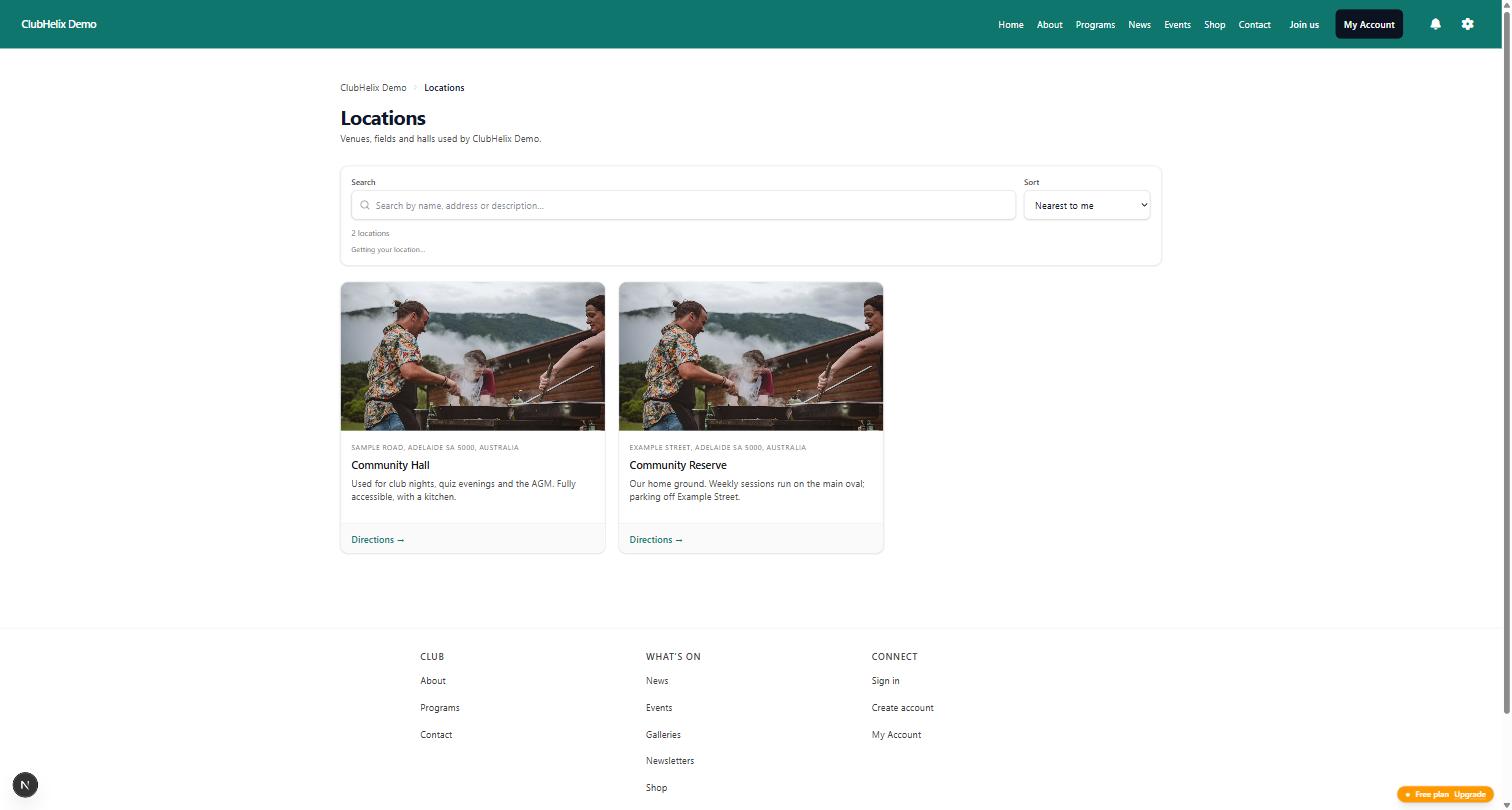
A venue and locations page on your own site does this permanently: one entry per space, with the map, the access note and the security number, linked from every event that happens there. It also survives the committee that wrote it, which a pinned chat message does not.
Win the recurring slot before anybody else asks
The single most valuable date in your society year is not the club fair. It is the day the booking diary opens for next term, and almost no committee writes it down.
Ask the bookings team, in writing, for that date. Put it in the society calendar with a reminder two days earlier, and have the request already drafted so you are submitting within the first hour rather than the first fortnight. A block of twelve identical Tuesday evenings is easy to grant on day one and impossible on day ten.
Then get the request itself right:
Decide the slot before you ask. A mediocre room at a fixed time beats a great room at a moving time, every term. Pick one day and one start time and defend them.
Ask for the block, not the sessions. One request covering "weekly, Tuesdays 18:00–20:00, weeks 1 to 12" is one decision for the person approving it. Twelve separate requests are twelve chances to be refused, and they will not all land in the same room.
Ask for the room you need, not the room that flatters you. A society with 300 names and 25 regulars that requests a 200-seat theatre gets refused and looks careless. Ask for a 40-seat flat room with movable chairs and you will usually get it — and a full small room feels far better than a quarter-full big one.
Name a second preference in the same message. Days and building, not just "anything". It saves a round trip that costs you three days.
Take the unloved slot. Early evenings midweek are the contested band. Late afternoons, Fridays and early mornings are often wide open, and a society that meets at 8am with fifteen committed people is doing better than one that never meets at all.
Do not block-book rooms you intend to release. It is why the diary is full for everyone, and bookings teams notice patterns and start rejecting you.
Finally, record the confirmation reference somewhere the whole committee can see. When a room is double-booked at 6:01pm, the person with the reference number wins the argument. The booking portal account should be attached to a society role address rather than one student's personal email — see our handover checklist for why that single decision saves the next committee a fortnight.
The booking request that gets approved first time
Requests get refused for four boring reasons: they arrive after the deadline, the numbers are vague, they fail to declare food, alcohol or external guests, and they ask for a room four times bigger than the real attendance. Fix all four with one template.
Society:        <name>, affiliated <year>, registration/reference <number>
Contact:        <name>, <committee role>, <mobile>, <society email address>
Event:          <plain-language title — what a stranger would understand>
Date(s):        <single date, or "weekly Tuesdays, weeks 1–12, 11 sessions">
Access times:   <in from 17:30> to <out by 21:00>, including setup and pack-down
Expected:       <number>, based on <last year's attendance / current RSVPs>
Layout:         <as-is / rows / cabaret / cleared floor>
Equipment:      <projector + HDMI, roving mic, whiteboard, piano, sink, wifi guest access>
Food & drink:   <none / cold catering, no alcohol / alcohol served under X>
External guests: <none / speaker name and affiliation / open to the public>
Accessibility:  <step-free access required, hearing loop, quiet space nearby>
Attached:       <risk assessment, insurance note, event approval reference>
Two lines in that template do more work than the rest. Access times should always be wider than the event: say "in from 17:30, out by 21:00" for a 6-to-8 event. Every society that books the exact event hours ends up with a queue in the corridor while somebody hunts for a cable, and then runs over and collects a black mark. Expected attendance should be a real number with a reason attached — "45, based on 51 RSVPs" reads as competence; "about 100?" reads as a society that has not thought about it. If you take RSVPs through your own events pages, that number is simply a fact you can quote.
Unions almost always require an event registration form and a risk assessment before a room is confirmed, commonly at least fourteen days ahead, and the union's insurance covers only activities that have been registered and approved. External speakers are the step societies underestimate: the union's external speaker policy usually requires notice weeks in advance, with details of the speaker and the topic, and the room stays unconfirmed until clearance comes back. Alcohol outside a licensed venue means a temporary event notice with a statutory ten working day minimum, and unions usually impose a longer internal deadline on top. If under-18s will attend — a school outreach session, an open day event — expect a DBS check at the appropriate level, arranged through the union rather than applied for individually, plus safeguarding training. Allow several weeks for all of it. General information only; your union's activities team has the deadlines.
Exam season and the other weeks your room disappears
Every committee that plans a thirteen-week program delivers nine sessions and feels like it failed. The weeks were never there.
The exam reclaim is the big one. For roughly two to four weeks, teaching rooms become exam venues, and recurring bookings inside that window are cancelled in bulk — often automatically, often with a form email, and almost never reinstated afterwards without a fresh request. Assume it will happen and check your booking still exists the week before, every time.
Quiet periods extend the same logic to study spaces, libraries and anywhere near an exam hall. A society meeting is not welcome next door to five hundred people sitting a paper.
Building hours end earlier than you think. Many buildings lock at 18:00 or 21:00 regardless of what your booking says, and out-of-hours access needs a separate approval and sometimes a swipe card issued to a named person. Ask when you book, not on the night.
Vacation closures, open days, graduations and summer conferences take out whole buildings for days at a time, and conference income outranks a society every time.
The first two or three weeks of term are the churn period, when the academic timetable settles and student bookings get moved to make room. This is not personal, but it does mean your first meeting of term is the one most likely to be relocated.
So plan the honest number. A twelve-week term minus a three-week reclaim minus one public holiday is eight or nine sessions. Advertise eight and deliver eight; that reads as a society that knows what it is doing. Keep a plan B space you can reach in an hour — a department room, a café with a back corner, the association's smallest meeting room — and put the exam-period gap on the calendar in advance so it looks deliberate. Some societies run a deliberately different thing in those weeks: a study session, an online quiz, a walk. Attendance is low either way, but the habit survives.
When the society has a space of its own
Some societies graduate to a room they control — a clubroom, a society office, a rehearsal space, a darkroom, a shared storage room with a table in it. That is a genuine asset and a genuine liability, and it needs to be run rather than assumed.
Six things make the difference between a space that works and one that gets taken back:
- A key and access register. Who holds a key or swipe access, when it was issued, and when it comes back. Rebuild this from scratch at every handover, because the alternative is four graduates with keys to a room full of equipment.
- A visible booking sheet with a named responsible person per slot. Not "drama" — a person, with a phone number. When something is broken or left unlocked, "the society" cannot answer for it.
- Clash-proofing that is enforced, not polite. One booking per slot, rejected automatically when it overlaps. Two groups arriving for the same rehearsal slot is how societies stop speaking to each other.
- A condition standard everyone signs up to. Chairs back, bins out, a photo at lock-up. The photo settles every argument about who left it like that.
- A consumables and damage rule. Who replaces the strings, the printer paper, the chair someone stood on. Write it down before it happens, not afterwards.
- A hire policy if you let other groups use the space, covering rate, deposit, who supervises, and what cover the hirer needs.
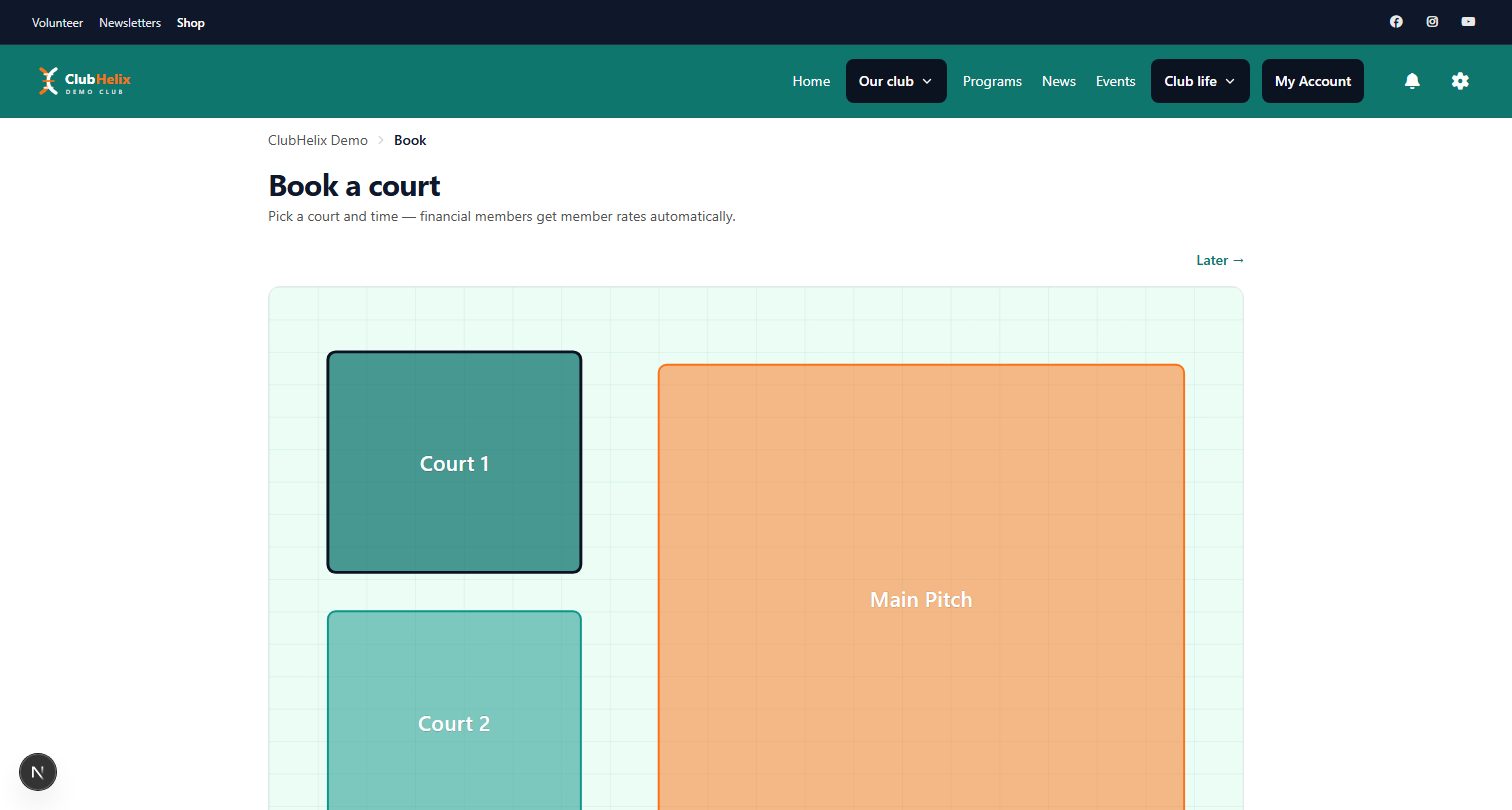
A room and facility booking system does the unglamorous half automatically: slots that cannot double-book, a named holder on every booking, a visible calendar members can see without asking, and a record that survives the committee. If you are letting the space to other groups, our guide on hiring out your clubrooms covers rates, agreements and the conditions worth insisting on, and a music or drama society juggling rehearsal slots will recognise most of it in the music society guide.
One more thing to decide before the first hirer arrives: how they pay. A society letting its room by the hour will meet groups who want to pay on the day — cash to whoever holds the key, or a QR code on the door — and that is fine as long as the booking still records who owes what and someone marks it paid. Taking payment at the venue for club bookings covers when it beats card at booking, what a venue-paid booking must still do, and reconciling the owed list against the takings.
If you charge other societies or outside groups for your space, check with the union first. In most unions society funds are held centrally and you request payments rather than banking them, so hire income has to route through the union's finance process, and some unions simply do not permit societies to let space at all. Get it approved before you advertise a rate. VAT is normally the union's concern rather than yours precisely because the union holds the money, but confirm before pricing anything substantial. Two practical points matter more. Whoever hires your space should carry their own public liability cover, because the union's policy insures your activities rather than a stranger's. And price it properly — £15 an hour with a £50 refundable deposit is a sensible starting point for a plain room; undercharging attracts the hirers who leave it in a state. General information only, not tax advice.
A term of bookings, worked
Here is what a competent term looks like for a 60-member society with 25 regulars, planned in one sitting during the vacation.
| Booking | Where | When requested | Cost |
|---|---|---|---|
| Weekly meeting, Tuesdays 18:00–20:00, ×12 | 40-seat flat teaching room | Hour one of the diary opening | Free out of teaching hours |
| Committee meeting, fortnightly, 45 min | Student centre meeting room, ×6 | Same week | Free at club rate |
| Welcome social, week 2 | Association function room | Eight weeks ahead | Room free, bar minimum applies |
| Flagship night, week 8 | Off-campus function room, 90 people | Twelve weeks ahead, deposit paid | Hire fee + deposit |
| Exam-period study sessions, ×2 | Department seminar room | Emailed the school administrator | Free |
Three of those twelve Tuesdays vanish — two to the exam reclaim, one to a building closure for an open day — so the society advertises nine and delivers nine. The flagship is booked before the term starts because the good off-campus rooms go months ahead, and the deposit is in the term budget as a line item rather than a surprise.
Then there is the twenty-minute check on the night itself. Arrive early and walk it: is the door actually unlocked and is the right door unlocked; do the lights and the projector work with the cable you brought; are the chairs in the layout you asked for; is the step-free route in fact open at this hour; where is the fire exit and the assembly point; who has the security number; where do the bins go; and take a photo at pack-down. That list has saved more society events than any amount of planning, because the failure is almost never the plan — it is a locked side door and a missing adaptor.
For the wider event mechanics, work through the end-to-end event guide, keep the risk assessment proportionate to the actual risk, and read the complete guide to running a society if you are new to the committee.
Frequently asked questions
Can we book a room if we are not affiliated yet?
Usually not at student rates, and often not at all. Booking rights are one of the main things affiliation or recognition buys, because your student association's insurance and accountability are what make a booking issuable to a group rather than an individual. Do not solve it by having a member book a room in their own name for a society event — that puts one student personally on the hook if something goes wrong, and it usually breaches the booking rules anyway. Get affiliated first; our affiliation guide covers the paperwork.
Until the union confirms affiliation, borrow space rather than book it — a friendly department, another society willing to share its slot, or an off-campus venue that will hire to anyone.
Our recurring booking was cancelled a week out. What do we do?
Reply the same day and ask two questions: is the cancellation for the whole block or one session, and what alternative can they offer for the same time. Bookings teams cancel because the room was needed for teaching, an exam or maintenance, and they usually have a replacement if you ask within a day of the notice. Meanwhile, tell your members before they find out at the door — a message the moment you know is the difference between a minor annoyance and twenty people standing in a corridor. Keep a plan B space you can move to in an hour so the meeting still happens.
How far ahead should we book the big one?
Further than feels reasonable. A main theatre, a large hall or a good off-campus function room in the popular weeks is often gone six to twelve months out, and the date drives everything else — tickets, catering, the risk assessment, the acts. Book the venue first and build the event around it, rather than choosing a date and then discovering nothing is available. If a deposit is required, get it approved by the committee in a minuted decision so the treasurer is not personally carrying the risk.
Nobody can log in to the booking portal — the president who set it up has graduated. Now what?
Email the bookings team from your society's own address, explain the handover, and ask them to reassign the account to the current committee; they deal with this constantly and it is usually a five-minute change on their side. While you are there, register a role-based society email address as the account owner so the same thing cannot happen again. Then add "booking portal access" to your handover checklist as an item that is only ticked when the incoming holder has personally logged in.
Should we pay for an off-campus venue when campus rooms are free?
Sometimes, yes — but only when the campus room genuinely cannot do the job. Off-campus makes sense for a ball with a licensed bar, an event bigger than any room you can get, or something that needs to run past the hour the building locks. It rarely makes sense for a regular meeting, because paying for a room every week is the fastest way to spend a term's budget on nothing anyone remembers. Work out the cost per attendee before you commit: a $400 room for 30 people is $13 a head that could have gone into the event itself.
Where ClubHelix fits
Room booking goes wrong in the same three places every year: nobody knows which room, the login belonged to someone who has graduated, and the society's own space is run on goodwill and a group chat. ClubHelix gives a society one home for its venue and location pages, its events with RSVPs and ticketing, and its own room and facility bookings with clash-proofed slots and a named holder on every one — all under committee accounts that change hands with the roles instead of a shared password.
If your society is setting up properly for the first time, the university clubs and societies overview shows what the whole picture looks like, and the ready-made site templates get a venue page and an events calendar live in an evening. Costs, including the free tier for building the site and trying it out, with taking payments online and being found in search on the paid plans, are on the pricing page.
ClubHelix keeps your society's venues, events and room bookings in one place that outlives the committee. Start free before the booking diary opens.


