
What this guide answers
- How many sign-ups should we expect at a club fair?
A first-year society with a small stall and no reputation typically takes 30–60 sign-ups; an established society with a good pitch position, a banner and an activity takes 120–250.
- Should we charge membership at the stall, or let people pay later?
Charge at the stall if your student association allows it — the drop-off between "signed up" and "paid" is the biggest leak in the whole funnel, and it widens every day you leave it.
- Do we need to be affiliated before we can book a stall?
Almost always, yes — and the affiliation deadline usually falls weeks before the fair, before anyone is back on campus and checking email.
- What do we do with the people who signed up but never paid?
Give them three touches and then stop. The welcome email, one reminder 48 hours before the first event, and one final message about four weeks in that says what they have missed and offers a last easy way in.
- Is a paper sign-up sheet ever the right answer?
Only as a backup, never as the plan. If the hall has no signal and both devices are dead, a well-designed slip — block capitals, one letter per box for the email address, and someone reading it back — will save the day.
USA edition. This guide is written for volunteer-run clubs in the United States. Where rules differ — grants, tax, incorporation, safeguarding — follow the USA-specific pointers below or check with your national body.
Your society gets one trestle table, a cloth someone brought from home, and about four hours. Two or three thousand students will walk past it. A couple of hundred will slow down. Somewhere between forty and a hundred and fifty will give you an email address — and one of those addresses belongs to the person who, eight months from now, will be the only candidate for treasurer.
Nearly everything your society does this year traces back to that afternoon: the size of your events, the money in the account, whether anyone nominates at the AGM, whether the society still exists after this committee graduates. And yet the start-of-year club fair is usually the least-planned thing on the calendar. A hand-drawn sign. A clipboard. Three committee members standing behind a table looking at their phones. A paper list that sits in a tote bag for eleven days before anyone types it up, by which time a third of the addresses are unreadable and everyone has forgotten who you were.
This is the version worth reading in the week before the fair: the numbers to plan against, what genuinely makes someone stop, a sign-up flow that survives a flat battery and a hall with no phone signal, the fifteen-second pitch, and the 48-hour follow-up that decides whether a sign-up ever becomes a member.
Start with the number you need, not the number you can get
Before anyone designs a banner, write one number on the run sheet.
Work backwards from the society you want in week eight. Recruitment is a series of brutal halvings: of the people who hand over an email at the fair, roughly half complete a membership, roughly half of those turn up to something, and roughly half of those are still coming by mid-semester. That means a society that wants twenty-five people in a room in week eight is looking for something close to a hundred and fifty sign-ups on fair day.
| Stage | Realistic rate | What 150 sign-ups becomes |
|---|---|---|
| Stopped at your table | 5–10% of everyone who walks past | needs 1,500–3,000 passers-by |
| Gave you contact details | 55–65% of the people who stopped | 150 |
| Completed and paid for membership | 40–55%, or over 70% if they pay on the spot | 60–105 |
| Came to the first event | 50–65% of paid members | 35–65 |
| Still turning up in week eight | about half of first-event attendees | 18–33 |
| Willing to stand for committee | 5–10% of the week-eight core | 2–3 |
Two of those rates are inside your control on the day: whether people stop, and whether they pay before they walk away. Everything below them is decided by what you do in the four weeks afterwards, which is a different guide — growing club membership and what to actually run once they arrive.
Write the two numbers — sign-ups and paid members — at the top of the run sheet, tell everyone on the roster what they are, and count the running total at each shift change. A stall that knows it is at 61 of 150 at two o'clock behaves completely differently from a stall that finds out on Sunday.
Book the stall before you plan the stall
Stall allocation happens weeks before the fair, usually through the students' organisation that affiliates clubs on your campus, and usually only for societies whose affiliation for the coming year is already complete. Societies miss the fair every year not because they were disorganised on the day but because nobody filled in a form while the campus was empty. Put the deadline in the handover pack so the incoming committee inherits it.
When you book, get answers to six questions in writing:
- How big is the table, and is there a wall or backdrop behind it?
- Is there power at the pitch?
- Is there usable phone signal or wifi inside the venue? Ask them to check, not guess.
- Can you run an activity or play sound in front of the table?
- Can you hand out food or drink?
- Where is your pitch relative to the entrance, the exit and the food?
Two of those answers change the whole plan. No power means every device runs on battery for four hours. No signal means a QR code pointing at a live web form is a coin toss — and you need the offline fallback described below, ready rather than improvised.
Tables at the involvement fair or org fair are booked through the student activities or campus involvement office, typically through an online form weeks before the semester, and only registered student organisations get one. Re-registration usually has to be complete first, and some campuses require your faculty or staff adviser to be named on the form. Student government's activity fee allocations often reference member counts, so record them properly on the day.
What actually makes someone stop
A student walking a crowded fair gives each stall about three seconds. In three seconds they can read roughly six words and register one moving thing. Design for that and nothing else.
Say what you do, not what you are called. "Latin Dance Society" tells a passer-by nothing they can act on. "Salsa, Wednesdays 7pm, no partner needed, first class free" tells them everything they need to decide. Your name goes on the banner; the offer goes at eye level in the largest type you can afford.
Get above the table. Anything lying flat is invisible from six people back. You need one vertical element — a pull-up banner, a sheet taped to the wall, even a person holding a sign — that carries the offer at head height.
Have something happening. The stalls with a crowd around them are almost always the ones running an activity: a game in progress, a two-minute demonstration, an instrument, a taste of something. It turns passive walkers into people who have already spent thirty seconds with you, and thirty seconds is the whole battle.
Stand in front of the table, not behind it. The table is a counter and counters keep people out. Two people out front, one behind on sign-ups and payments.
Choose freebies that keep working. Free food attracts people who want free food. Stickers and pin badges end up on laptops and water bottles and advertise you for a year; anything printed with the join link keeps earning after the fair. If you have a small budget, spend it on the banner before the giveaways.
Reliably ineffective: a laptop playing a slideshow, a printed page of paragraphs, a logo with no words about what you actually do, and a committee sitting down.
The fifteen-second pitch
Write the pitch out, and make every person on the roster say it aloud once before their shift starts. Three sentences, ending in a question:
"Hi — we're the [Society]. We [do the thing] every [day] at [time] in [place], and the first one is free. Our first event is [date] — want me to send you the details?"
That last sentence does the work. It is answerable with "yes", and the answer to "yes" is your phone with the sign-up form already open.
Brief the roster on the three replies you will hear all day:
- "I'll look you up later." This almost always means no. "No problem — thirty seconds now and you'll get one email with the details. Scan this and you're done."
- "How much is it?" Know the number and know exactly what it buys. "I think it's about..." costs you the sign-up. If your fees are still undecided a week out, settle them — how to set society membership fees will take you twenty minutes.
- "Do I need experience?" The answer is always a version of "no", followed by a specific example: "Half the people at our first session last year had never played."
Also brief them on what nobody may promise: no free tickets to the ball, no guaranteed spot in a team, no committee positions, no refunds invented on the spot.
Set the sign-up page up the week before
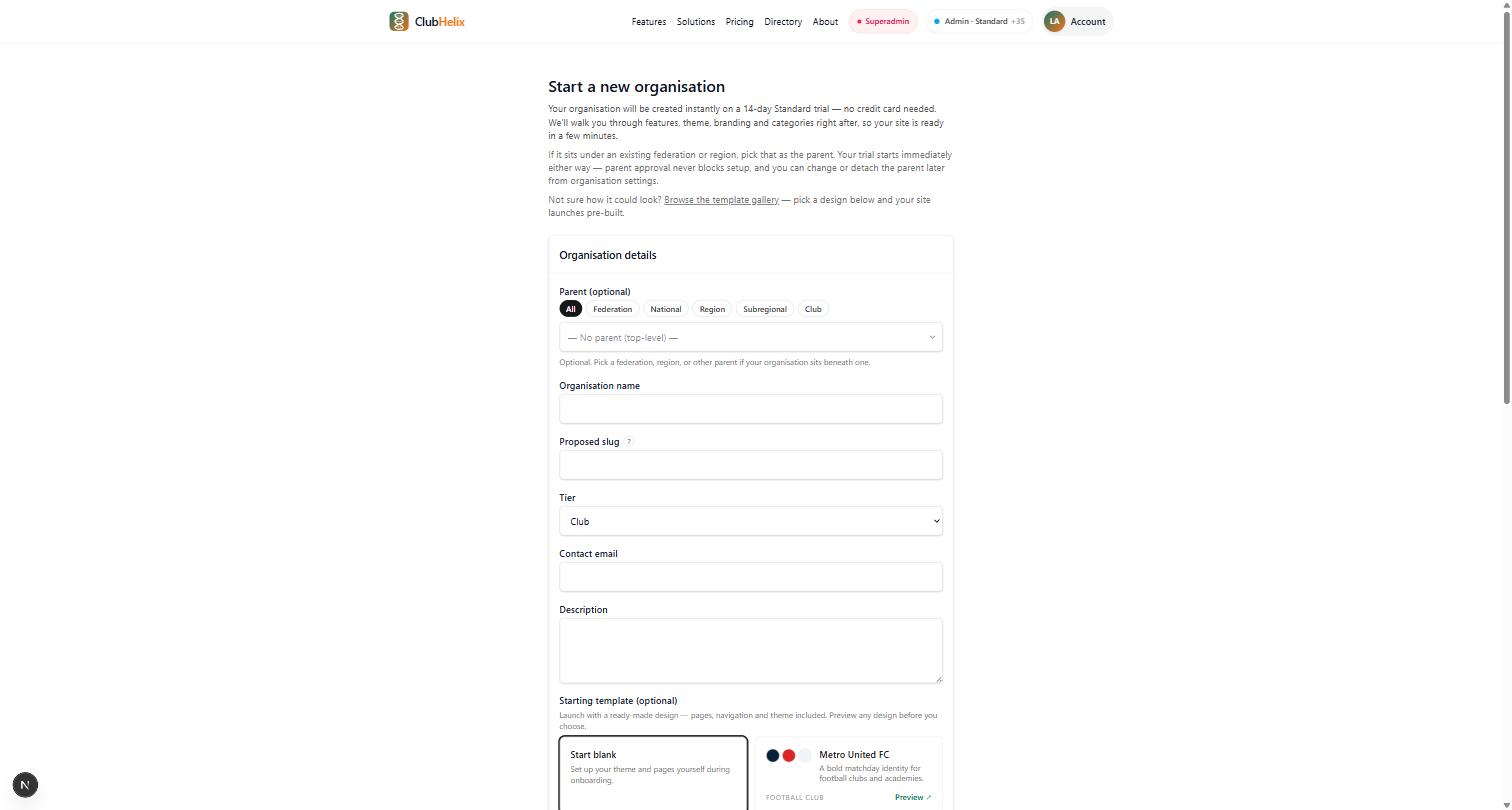
Whatever your society's entry on the student association's directory looks like, it is a listing, not a sign-up flow. What the fair needs is one link that does four things at once: explains the society in a paragraph, collects the details you need, takes the membership payment, and puts the person on your list without anyone retyping anything.
If your society does not have its own site yet, that is an evening's work the week before the fair — a name, a colour, a template, a join page — and it changes the day from "collect emails, chase later" into "members by the time they walk away". Our guide to building a student society website walks the whole thing.
Capture sign-ups without a paper list
The clipboard is the most expensive habit at a club fair. It fails in four predictable ways.
Handwriting. On a busy sheet somewhere between one in ten and one in six email addresses is unusable — a name with an ambiguous vowel, a domain that could be two things, a full stop that is either a full stop or a stray pen mark. You will not find out which ones until the bounces come back.
Delay. Typing 120 rows is two hours nobody has in week one. In practice the list gets typed in week three, by which time the people on it have joined three other societies and forgotten yours.
No payment. Every day between "wrote my name down" and "paid" costs conversions. The gap is where your 55% becomes 35%.
No consent record. You have paper with addresses on it and no reliable record of what each person agreed to receive — which matters more than committees expect.
The replacement is a QR code pointing at your own sign-up form, printed large and printed several times:
- Print it at A4 or bigger, in three places — on the backdrop, flat on the table, and on the back of every flyer. One small code taped to a corner will be blocked by an elbow all afternoon.
- Test it on two different phones over the phone network, not the campus wifi, two days out — then test it again standing in the hall on the morning.
- Keep the form to five fields. Name, email, one field that helps you segment (course or year), one about what they want from the society, and a consent tick. Every extra field costs sign-ups from people standing up in a noisy room.
- Ask which email they actually check, and if you ever want an alumni list, ask for one they will still have after graduation.
- Have two devices with the form already open for people who cannot or will not scan, plus a charged power bank. Devices die at 2pm, every year.
- Design the paper fallback for legibility, not speed — block capitals, one letter per box for the email, and one committee member who reads each address back before the person leaves.
- Take the money at the moment of sign-up. This is the single biggest lever on the whole day. A form that ends in payment converts far better than any amount of chasing, because you are asking while they are still enthusiastic and standing in front of you.
Self-serve joining is exactly what online registration and payment is for: the member fills in their own details, pays, and lands on your roster with a receipt, without a committee member typing a single row. Afterwards the same site installs to a phone home screen as a member app straight from the browser — events, push notifications and their membership card — which is a better thing to leave someone holding than a flyer.
One caveat before you print anything with a payment link on it: what you may charge, and whose account the money is allowed to land in, is decided by your student association rather than by your committee. Ask, in writing, well before the fair.
Dues at this level usually sit around $5–$25 a year, and many campuses require registered organisations to hold funds in a university account rather than an outside bank account — which changes how you can accept payment at a table. Sales tax treatment of dues varies by state and rarely bites at this scale. Ask the activities office what payment methods are permitted before you print a QR code. General information only — check with your activities office.
The 48 hours after the fair
The list you collected has a half-life measured in days. By Thursday, half the people on it will not be able to name your society unprompted. The follow-up is not admin you get to when the week calms down; it is the second half of the recruitment.
Send the welcome email the same night. Not the next week. It is fifteen minutes and it is worth more than the last hour of the stall. Five things go in it: who you are in one sentence, the date and place of the first event, the join link for anyone who has not paid, one sentence on what to expect if they have never come before, and a human name to reply to.
Subject: You signed up at the fair — here's the first one
Hi [name],
Thanks for stopping by our stall today. We're [Society] — we [do the thing] every [day] at [time] in [place].
First event: [day, date], [time], [place]. Nothing to bring, no experience needed, and you don't have to know anyone — a lot of people come on their own the first time.
[If you haven't joined yet, you can do it here — it takes a minute.]
Any questions, just reply to this. — [Name], [Role]
Split the list in two. People who paid get "here's your first event". People who signed up but did not pay get the same thing plus one clear line about joining. Sending both groups the same email wastes your best moment.
Send once more, 48 hours before the first event. Short, one link, the room number. That reminder typically lifts attendance by a third.
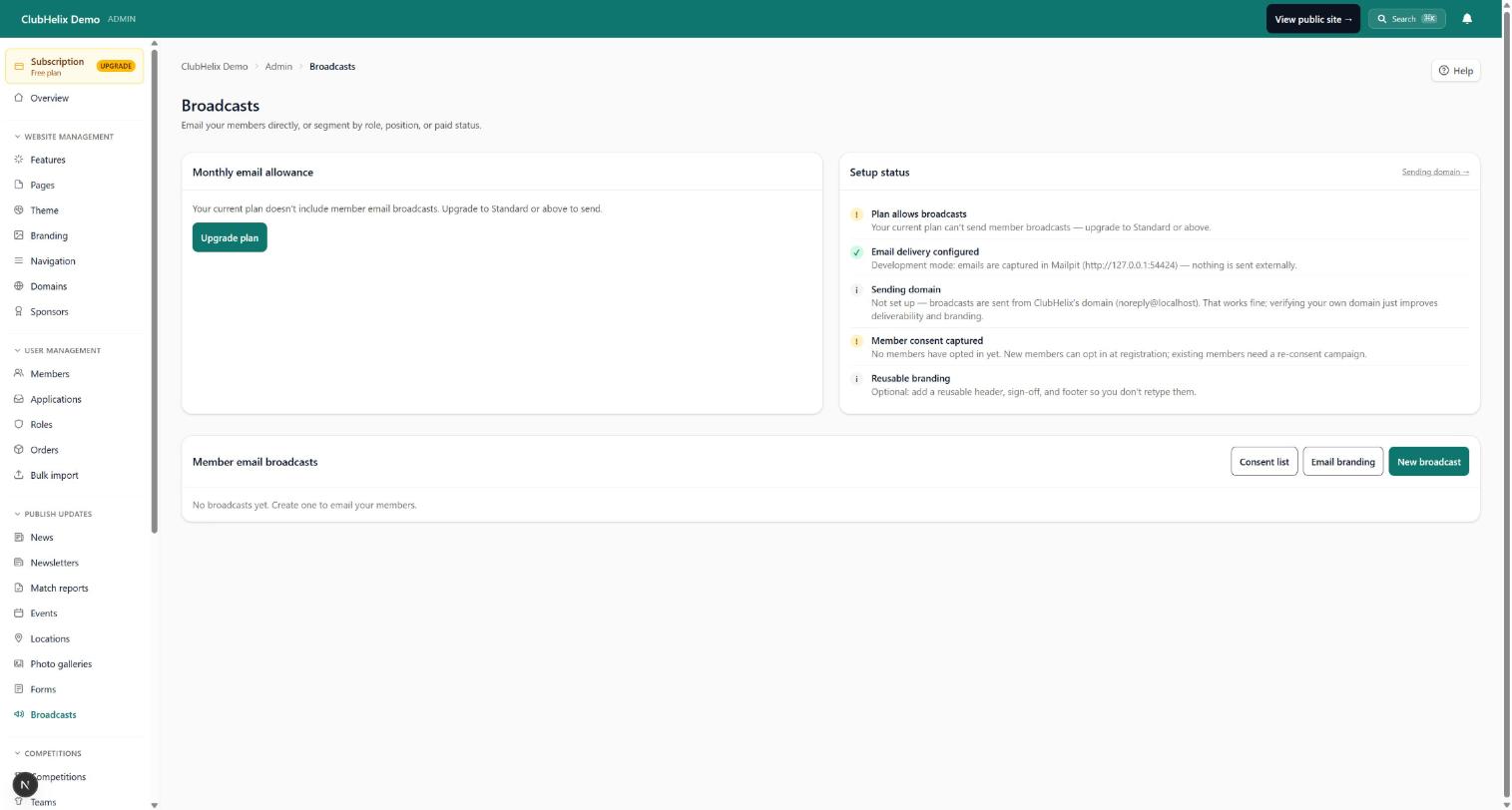
Sending from your society's own system rather than a committee member's personal account matters more than it sounds: member broadcasts keep the consent status against each member, add the unsubscribe link for you, and leave a send log the next committee inherits — instead of a mailing list that lives in one graduating student's sent folder. If your emails have historically gone missing, why club emails go to spam explains most of it.
There is also a legal side to the list you have just built. It is not onerous, but it is real, and it belongs to the committee rather than to the university.
Collecting names and addresses makes your committee responsible for them, and where the university treats your roster as an education record, FERPA and campus policy apply on top of your state's privacy law. Commercial email rules separately require an honest sender name, a postal contact and a working unsubscribe you honour promptly. Practically: say at sign-up what you will send, act on opt-outs straight away, and never pass the list to a sponsor. General information only — check with your activities office.
The first event has to already exist before the fair
Book the room and fix the date before you book the stall, so the pitch can say "Thursday the 14th, 6pm, room 2.11" instead of "we'll be in touch". Keep it free or nearly free, keep it low-commitment, and give one committee member the single job of talking to anyone standing alone. Take attendance, because the difference between "came once" and "never came" tells you exactly who deserves one more specific invitation — and who belongs on the general list. It is also the number your funding application will ask for later.
The fair-day run sheet
| When | What |
|---|---|
| Two weeks out | Stall booked and confirmed. First event booked — room, date, time. Sign-up page live. Roster filled. |
| One week out | Pitch written and circulated. QR tested on two phones. Payment tested end to end with a real card. Print ordered. |
| Night before | Crate packed against the kit list. Everything charged. Backup slips printed. Change counted if you take cash. |
| Fair day, hourly | Count sign-ups at every shift change and write the number down. |
| Packing up | Photograph every paper slip before it goes into a bag. |
| That night | Welcome email out, split into paid and unpaid. |
| +48 hours | One reminder to the unpaid, with the join link. |
| First event | Greeter on the door, attendance taken, photos for next year's banner. |
| +4 weeks | One last invitation to the people who never came, then stop chasing. |
Roster the day in ninety-minute shifts with three people on each: two out front talking, one behind on sign-ups and payments. Never leave one person alone — solo stalls stop converting within twenty minutes because there is nobody to hold the conversation while the sign-up happens. Cover water, food and breaks explicitly in the roster, and put your most enthusiastic first-years on the busiest shift rather than your most senior committee members — a prospective member wants to meet someone like them, not the president.
The crate: banner or backdrop, three A4 QR signs, two charged devices, a power bank, printed backup slips, tape, scissors, poster putty, a thick marker, spare pens, the tally sheet, water, snacks, and whatever the activity needs.
Frequently asked questions
How many sign-ups should we expect at a club fair?
A first-year society with a small stall and no reputation typically takes 30–60 sign-ups; an established society with a good pitch position, a banner and an activity takes 120–250. The variable that moves it most is not size or budget but whether someone is standing in front of the table talking to people, because a staffed, active stall converts several times better than an unstaffed one at the same pitch. Set your target from the number of active members you want in week eight rather than from bragging rights, and remember that a hundred sign-ups you follow up beats three hundred you never email.
Should we charge membership at the stall, or let people pay later?
Charge at the stall if your student association allows it — the drop-off between "signed up" and "paid" is the biggest leak in the whole funnel, and it widens every day you leave it. A sign-up form that ends in a card payment on the person's own phone routinely converts over 70%, against 35–55% for "we'll email you a link". If you genuinely cannot take payment on the day, at least make the very first follow-up email a payment link with a deadline attached to something real, such as a members-only first event.
Do we need to be affiliated before we can book a stall?
Almost always, yes — and the affiliation deadline usually falls weeks before the fair, before anyone is back on campus and checking email. Treat it as a fixed annual task owned by the secretary and written into the handover, not something to sort out once teaching starts.
Registration as a student organisation is renewed each year through the activities or campus involvement office and is checked before an involvement fair table is allocated. It usually needs a current officer list, updated bylaws, completed officer training and, on many campuses, a named faculty or staff adviser.
What do we do with the people who signed up but never paid?
Give them three touches and then stop. The welcome email, one reminder 48 hours before the first event, and one final message about four weeks in that says what they have missed and offers a last easy way in. After that, keep them on the general announcements list — plenty of people join a society in the second half of the year, or the year after — but stop treating them as a chase. Committees burn enormous energy on the twenty people who will never join and neglect the forty who already did.
Is a paper sign-up sheet ever the right answer?
Only as a backup, never as the plan. If the hall has no signal and both devices are dead, a well-designed slip — block capitals, one letter per box for the email address, and someone reading it back — will save the day. Photograph every slip as you pack up, before it goes into a bag, type them the same night while the handwriting is still fresh in someone's memory, and never let paper be the only copy of your list for longer than one evening.
Where ClubHelix fits
The fair is a conversion problem, and conversion problems are won by removing steps. ClubHelix gives a society one link that explains itself, collects the sign-up and the payment in the same breath, and puts the new member on a roster the next committee will inherit — so the QR on your banner leads to a member, not a to-do item. That evening, a broadcast to everyone who joined goes out with the consent record and unsubscribe handled for you.
You can have the site and the join page live before the fair on the free tier, and the paid tiers only start to matter once you are carrying a real roster and emailing a few hundred people — see pricing. If you would rather read the whole year before the whole afternoon, start with how to run a student society.


