
What this guide answers
- How much should a student society charge for membership?
Work it out rather than guessing: take your fixed costs for the year, subtract grants and sponsorship you have actually been awarded, add about 15% contingency, and divide by a realistic count of paying members based…
- Should we make membership free?
Usually no — charge something small instead. A free society ends up with a list of people who once expressed interest, which cannot tell you who to email, who may vote at the AGM, or how many members you have when your…
- Can we just charge for events instead of a membership fee?
You can, and plenty of societies do, but it changes what you are.
- What do we do about a member who genuinely cannot afford the fee?
Have a hardship rate, make it a single sentence on the join page, and never build a process around it.
- Do we have to charge a fee at all if we get funding?
No — some organisations are funded well enough that a fee is a top-up rather than the model, and a few are contractually discouraged from charging one.
USA edition. This guide is written for volunteer-run clubs in the United States. Where rules differ — grants, tax, incorporation, safeguarding — follow the USA-specific pointers below or check with your national body.
Ninety-one people wrote their name on your clipboard at the club fair. Thirty-four of them ever paid. By week four the treasurer is personally out of pocket for the welcome barbecue, the secretary has sent two increasingly apologetic reminder messages, and somebody at committee has suggested — for the third time this semester — that maybe membership should just be free.
That gap between sign-ups and payments is the single biggest financial problem student societies have, and it is almost never a pricing problem. Societies that charge more than yours collect more than yours, because they ask for the money in the ten seconds while someone is standing at the stall saying yes, instead of chasing them in week six when they have forgotten your society exists.
This guide covers the whole thing: how to work out the number from your budget rather than from a feeling, what each price band signals to a student, which membership types are worth offering, how to collect without a cash tin, and the three awkward conversations — the late joiner, the renewal, the refund — that every committee eventually has to script.
Start with the sum, not the number
Almost every committee argues about the fee before anyone has worked out what the year costs. Do it the other way around. The fee falls out of one line of arithmetic:
Fee = (fixed costs for the year − money you can reliably raise elsewhere) ÷ realistic paying members
Then round up to something tidy. The contingency belongs inside your fixed costs as its own line, not bolted on at the end where it quietly gets dropped.
Three of those four terms trip societies up.
Fixed costs are only the things you must pay whether twelve people or a hundred turn up. Per-head event costs do not belong here — they belong in each event's own ticket price.
Because this guide is read in a dozen currencies, the worked figures below are counted in coffees: one coffee is whatever a takeaway flat white costs near your campus. It is a surprisingly stable unit, and it keeps the arithmetic honest wherever you bank. A typical first-year society's fixed list, in coffees:
| Fixed cost line | Coffees | Notes |
|---|---|---|
| Club fair stall: printing, banner, giveaways | 6 | The banner is a one-off; budget it in year one and reuse it for five |
| Welcome social (subsidised, not ticketed) | 22 | The one event you deliberately run at a loss because it recruits |
| Room hire or equipment for weekly meets | 0–15 | Often free on campus, rarely free off it |
| Guest speaker travel or thank-you gifts | 8 | Two speakers a year, modestly |
| End-of-year awards and farewell | 30 | The item first-year committees always forget |
| Website, domain, design assets | 0–12 | Only if you are paying for it — see pricing |
| Contingency at 15% | ~10 | The thing that broke, the deposit you lost, the printer at 11pm |
Money you can reliably raise elsewhere means a grant already awarded or a sponsorship already signed — not one you intend to apply for. Optimism here is how societies end the year in deficit.
Realistic paying members is the term committees get most wrong. It is not last year's sign-up list. Across the societies we see, somewhere between 30% and 50% of names collected on a paper list at a fair ever pay anything. Use last year's paid count, not last year's interested count, and if this is year one, halve whatever number feels exciting.
Work it through with the list above. Room hire free, no website spend, so the lines come to 66 coffees, and 15% contingency takes it to 76. You have a confirmed grant worth 40 coffees, and last year 40 people actually paid. That leaves 36 coffees to raise across 40 members — nine-tenths of a coffee each. Round up to one, and the four spare coffees are your buffer against the members who join and never come back. Notice what happened there: the sum landed on the price of a single coffee without anyone in the room needing an opinion about it. That is the whole point of doing the arithmetic before the argument. Build the full version in the student society budget template before you take a number to committee.
What to charge, and what each price signals
Price is a message before it is a revenue line. Students read it instantly, and mostly what they read is "how serious is this and how much am I committing to". Same ruler as before — a coffee — because that is genuinely how the decision gets made at a stall.
| Band | What it signals | What it costs you |
|---|---|---|
| Free | Low commitment, everyone welcome | No revenue, and a member list where you cannot tell interest from membership |
| Token (under a coffee) | Real but painless; a deliberate filter | Card fees eat a visible share of a very small amount |
| One coffee | The default for a social or academic society | Almost nothing — this is the sweet spot for most societies |
| Two to three coffees | You get things: a shirt, subsidised entry, a resource | You now have to deliver those things, visibly, by week six |
| A meal out or more | Sports clubs, societies with kit, coaching or affiliation | Expect a real drop-off unless the value is obvious on the sign-up page |
Two things are true at once: the price is rarely the barrier, and free membership is rarely free. A society charging nothing has a list of people who once expressed interest, which is a very different asset from a list of people who have paid. Free lists do not tell you who to email, who can vote at the AGM, or who is actually a member when the students' organisation asks for numbers. If you genuinely want no financial barrier, charge a token amount and give it away quietly to anyone who asks, rather than charging nothing and losing the signal entirely.
The other half of the pricing question — what similar organisations charge, and how to compare — is worked through in how much should club membership cost.
What organisations here actually charge. Many registered student organisations charge nothing at all, because student activity fee allocations from student government cover the fixed costs — dues are then a top-up rather than the funding model. Where dues exist, $10 to $40 a year is common, and competitive club sports run into the hundreds once travel and league entry are counted. Your student activities or campus involvement office sets the rules you price inside, including whether dues may be collected off-campus at all. Check the current RSO handbook before you set a number; figures here are USD.
The membership types worth offering
Most societies need three types and no more. Every extra type is a rule someone has to remember on fair day.
| Type | Price | Who it is for | The catch |
|---|---|---|---|
| Standard, one year | Your headline fee | Everyone | Set the expiry to your academic year, not a rolling twelve months |
| Half-year / late joiner | 50–60% of the headline fee | Anyone joining after the mid-year break | Only offer it after a fixed date, published in advance |
| Life membership | 2.5–3× the annual fee | Final-years and enthusiasts | A permanent obligation bought with one year's cash — see below |
| Concession or hardship | Free or nominal | Anyone who asks | Keep it undocumented and discreet; do not build a means test |
| Associate / alumni | Around the annual fee | Graduates who still turn up | Decide now whether they can vote, or the AGM will decide for you |
Life membership deserves care. At 2.5 to 3 times the annual fee it is roughly fair to both sides for a member with three years left, and it is a genuinely good deal for a first-year who stays five. The problem is not the price, it is the accounting: you take the cash this year and owe the service for decades, and the committee that spends it is never the committee that honours it. If you sell life memberships, put the money in a reserve line the next committee inherits, cap the number sold each year, and write down what a life member is actually entitled to. Life membership criteria covers how to set the qualifying rules so the honour keeps its meaning.
Whatever types you settle on, the price list belongs on your own website next to the join button — not in a pinned message that scrolls away, and not in a committee member's head at the stall.
Legal shape and tax. Most groups exist purely as registered student organisations recognised by the university, often with a required faculty adviser, and hold no separate legal identity at all. That is usually the right answer: separate incorporation and 501(c) status only make sense once the organisation holds real money, employs someone or signs contracts in its own name. Dues, merchandise sales and sales tax are treated differently from one another, and university-held accounts have their own rules. This is general information — check with your student activities office or a professional.
Collect it in the ten seconds they say yes
Here is the whole problem in two numbers. A paper list at a stall converts somewhere around a third of names into payments. A sign-up that takes the money on the spot — phone out, code scanned, card details already saved in the phone's wallet — converts most of the people who bother to start it. Same society, same fee, same afternoon, roughly double the money and none of the chasing.
Cash at the stall is not the answer either, and every treasurer learns why the hard way:
- Somebody's personal account becomes the society's account, and nobody can reconstruct which deposit was whose.
- The float goes home in a jacket pocket the night of the fair.
- You cannot prove who paid, so week-eleven arguments about voting rights become unwinnable.
- The handover in June transfers a shoebox of receipts and a rough idea.
- Two committee members handled the tin, and now nobody can be cleared of anything, which is the worst outcome of all.
A good online join flow does five jobs in one step: it takes the fee, creates the member record, captures the fields you actually need (preferred name, student email, dietary and access requirements, emergency contact for anything physical), sends a receipt automatically, and marks the member paid until a date you set. That last one is what makes renewals possible at all. Self-serve paid registration does exactly this, and the detail of setting it up — what to ask, what not to ask, what a good form looks like — is covered in how to collect club membership fees online.
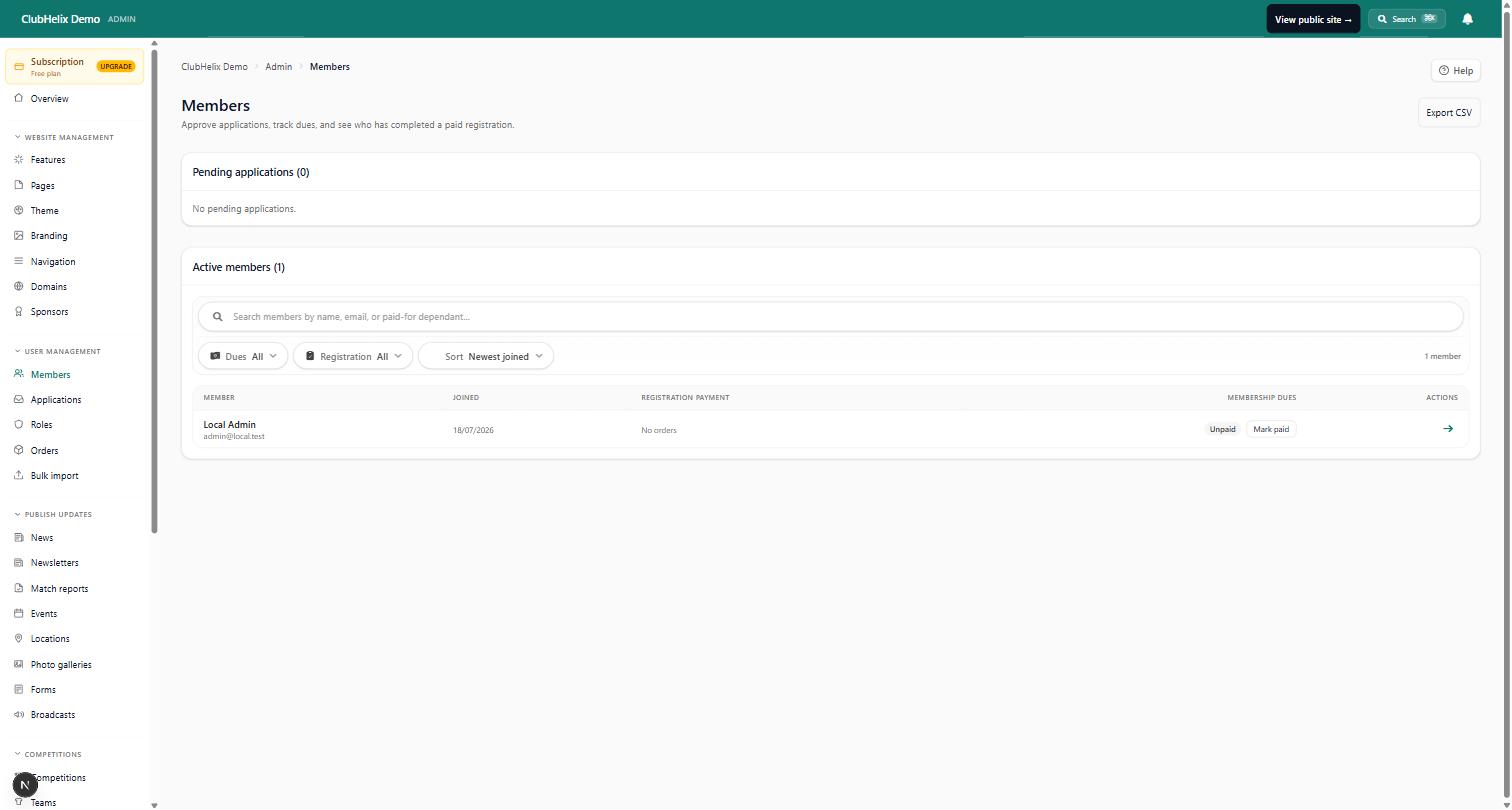
Once payments and records live together, the questions committees waste hours on answer themselves: how many paid members do we have, who lapsed, what did we take in the first fortnight of term, and how does that compare to the same fortnight last year. Reports turn that from a spreadsheet reconciliation into a number you can quote in a funding application.
Where the money lives. Many universities require registered student organisation funds to sit in a university-held agency account, with spending requests routed through the student activities office. Off-campus accounts usually need explicit approval and an EIN, and opening one without permission can put your recognition at risk. Some campuses provide an official online payment path for dues; others allow an external one. Ask the involvement office which model applies before you advertise a payment link, because unwinding it later is far worse than asking first.
The three awkward conversations
The person who joins in week eleven
They ask, reasonably, whether they have to pay a full year for six weeks. Decide the answer before anyone asks, publish it, and apply it without negotiation. The workable rule is a published crossover date — usually the start of the second half of the academic year — after which a cheaper half-year membership opens, priced at 50 to 60% of the headline fee and expiring on the same date as everyone else's. Do not attempt week-by-week pro-rata. It creates arithmetic at a trestle table, and the amounts are too small to matter.
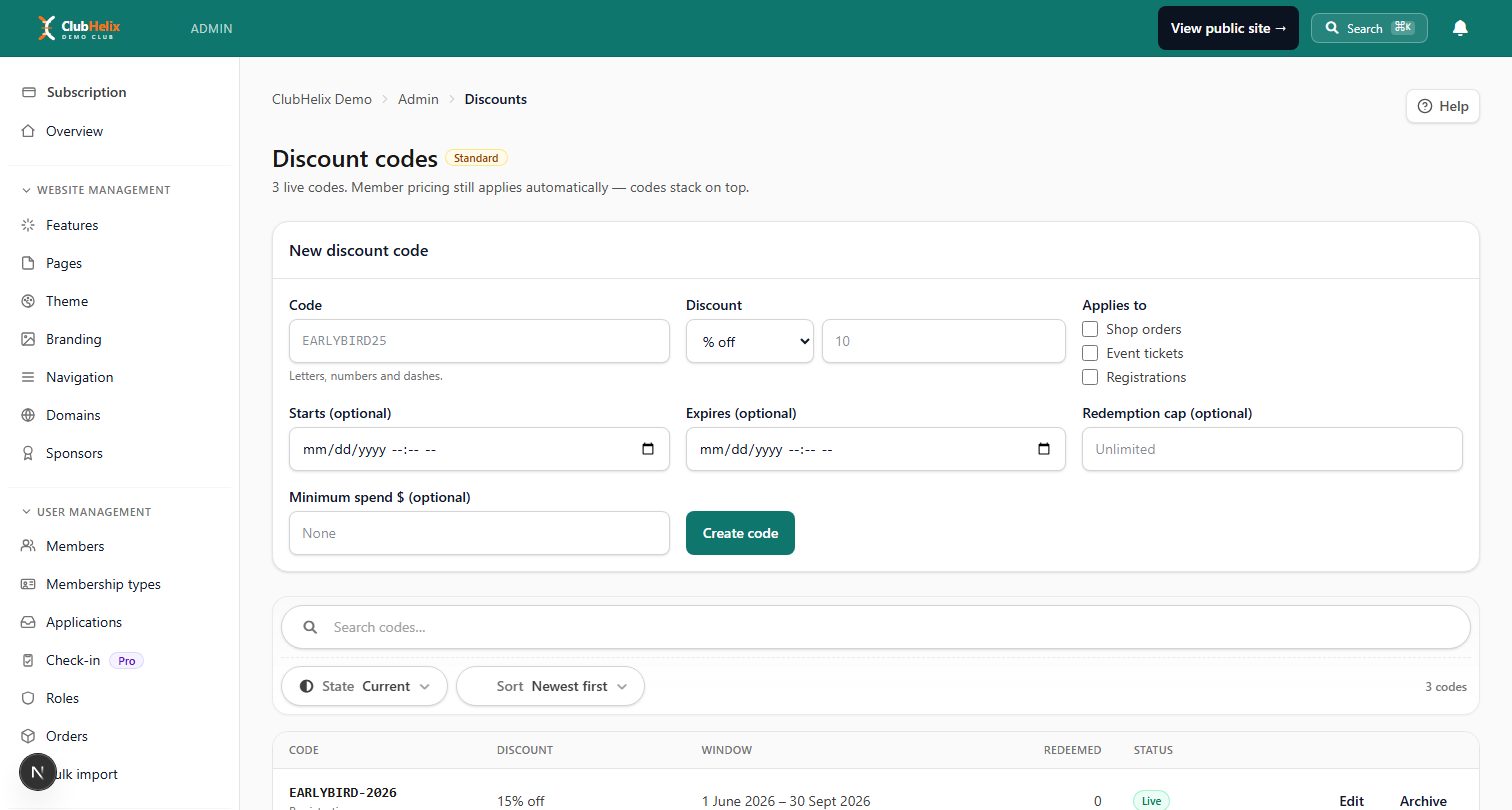
For the club fair itself, the other lever is a time-limited joining rate: a code that knocks a couple of units off the fee for anyone who signs up on the day or in the 48 hours afterwards. It converts the maybes while they still remember your stall, and unlike a permanent price cut it expires. Discount codes with an expiry and a redemption cap do this without anyone hand-checking a list, and the full stall playbook is in recruiting at the start-of-year club fair.
The renewal nobody sends
Set your membership year to the academic year — expiring in the break, not on 31 December — so renewal happens when students are already thinking about the year ahead. Then run three touches and stop:
- Two weeks before expiry: a short note that says what the society did this year, what is coming, and one link to renew. Lead with the year, not the invoice.
- On expiry: one line — "your membership ran out yesterday, here is the link" — plus the one concrete thing they will miss in the next month.
- Three weeks later: a genuine last one, framed as a question rather than a demand. "Still want to be on the list?" gets replies that "PAYMENT OVERDUE" never does.
After three, stop. A member who has ignored three messages is telling you something, and the fourth costs you goodwill worth more than the fee. Move them to a lapsed list, keep them on the general newsletter if they have not opted out, and try again at the next club fair.
The refund
Write the policy before you need it, because you will write a much worse one under pressure at 9pm. A sane student society policy: membership fees are non-refundable once the first event has run; ticket refunds are available up to a stated number of days before an event, minus any unrecoverable cost such as a per-head catering guarantee; and in genuine hardship or withdrawal from study, the president may refund at discretion. Put those three sentences on the join page. Nearly every refund argument a society has is really an argument about a policy that was never written down.
A 45-minute fee-setting meeting
Put this on the agenda of the last committee meeting before the club fair. It is one item, not a standing debate.
| Time | Item |
|---|---|
| 0–10 | Treasurer reads last year's actuals: paid members, total subs collected, total fixed costs |
| 10–20 | Build this year's fixed-cost list on a screen everyone can see; add the 15% contingency |
| 20–25 | Subtract only confirmed grants and signed sponsorships — nothing hoped for |
| 25–30 | Divide by a realistic paying-member count (last year's paid count, not last year's list) |
| 30–35 | Round to a tidy number; sanity-check it against what comparable societies on campus charge |
| 35–42 | Agree the type list: standard, half-year crossover date, life membership cap, hardship wording |
| 42–45 | Pass the motion, minute it, and give one person the job of updating the website before the fair |
The motion is worth minuting precisely, because next year's committee will need to know what was decided and why:
That membership fees for [year] be set at [amount] for standard annual membership, [amount] for half-year membership available from [date], and [amount] for life membership with no more than [number] sold in any year; that hardship membership be available at the President's discretion without documentation; and that fees be reviewed by the incoming committee before the [year+1] club fair.
Sensible defaults for the blanks a first-year committee always leaves empty: set the half-year crossover at the first day of teaching after the mid-year break, and cap life memberships at three to five a year for a society of around 40 members — enough that the honour means something, few enough that you are not quietly selling the next decade's income.
Carry that minute, the actuals and the login into your handover pack. Fees are one of the few decisions that genuinely must survive the committee that made them — the treasurer's report template and the wider guide to running a student society both assume the numbers are somewhere the next treasurer can find them.
Frequently asked questions
How much should a student society charge for membership?
Work it out rather than guessing: take your fixed costs for the year, subtract grants and sponsorship you have actually been awarded, add about 15% contingency, and divide by a realistic count of paying members based on last year's payments rather than last year's sign-up list. For most social and academic societies that lands somewhere around the price of a coffee. Sports clubs and societies with kit, coaching or affiliation costs land far higher, and that is fine as long as the sign-up page makes the value obvious.
Should we make membership free?
Usually no — charge something small instead. A free society ends up with a list of people who once expressed interest, which cannot tell you who to email, who may vote at the AGM, or how many members you have when your student association asks. A token fee filters casual interest, produces a real member count, and gives you a budget. If cost is the concern, keep the fee and give it away quietly to anyone who asks, rather than dropping it for everyone.
Can we just charge for events instead of a membership fee?
You can, and plenty of societies do, but it changes what you are. Event-only pricing means you have customers rather than members: no recurring income to plan a year around, no reason for anyone to turn up in a quiet month, and no defensible list when the students' organisation asks who your members are. The workable middle ground is a small annual fee plus member pricing on events — members pay less at the door, which makes the membership feel like a purchase rather than a donation.
What do we do about a member who genuinely cannot afford the fee?
Have a hardship rate, make it a single sentence on the join page, and never build a process around it. Something like "if the fee is a barrier, message the president and we will sort it out — no explanation needed" costs you two or three memberships a year and buys you a reputation worth far more. Do not ask for evidence, do not minute names, and do not create a form; the paperwork is precisely what stops people asking.
Do we have to charge a fee at all if we get funding?
No — some organisations are funded well enough that a fee is a top-up rather than the model, and a few are contractually discouraged from charging one. What matters is knowing which situation you are in before you set a budget, because grant money and subscription money behave very differently: one arrives once, on someone else's timetable, with conditions and an acquittal at the end, and the other arrives steadily and is yours to spend.
Student activity fee allocations from student government are the main source, usually decided in funding rounds against a submitted budget, and often spendable only through the university's own purchasing process rather than as cash.
Where ClubHelix fits
A society's fee problem is really a records problem: the money and the member list have to be the same thing, or the treasurer spends the year reconciling two lists that never agree. ClubHelix gives your society its own site with self-serve paid registration built in, so somebody at your stall joins and pays in one step and the member record exists before they walk away. Discount codes handle the fair-day rate, and reports tell you who is paid up, who lapsed and what you took — in a form you can paste straight into a funding application.
It also survives your handover, which a spreadsheet in a graduating treasurer's drive does not. See pricing for what it costs a society your size.


