
What this guide answers
- What is the single best fundraiser for a student society?
The one you can run again next year without begging for volunteers.
- How much can a society realistically raise in a year?
A 60-member society running two well-chosen fundraisers should expect $800 to $2,000 a year on top of membership fees.
- Can we fundraise for a charity as well as for ourselves?
Yes, and a great many societies do both — but keep them completely separate.
- Should we just charge more for membership instead of fundraising?
Often, yes — and it is the option committees skip because it feels awkward.
- Our fundraiser lost money — what do we do now?
Write down exactly what happened while it is fresh, tell the committee the real number rather than a rounded one, and put it in the treasurer's report.
UK edition. This guide is written for volunteer-run clubs in the UK. Where rules differ — grants, tax, incorporation, safeguarding — follow the UK-specific pointers below or check with your national body.
The fundraising meeting usually goes the same way. The treasurer says the society is about $1,400 short of what this year's program actually costs, somebody suggests a bake sale, everyone nods with relief, and six weeks later you have $140 in a takeaway container and four committee members who never want to hear the word "fundraiser" again.
The bake sale is not the problem. The problem is that societies almost never do the one calculation that makes fundraising work: what an idea returns per volunteer hour. A committee of seven has perhaps 90 to 120 hours of genuine, willing volunteer time in a term — after classes, assessment, paid work and the events you already promised. Spend 26 of those hours on a car wash that nets $220 and you have effectively bought money at $8 an hour, in the one currency your society cannot top up.
This guide ranks the fundraisers student societies really run by that measure. It shows the maths behind each one, flags the permissions you need before you announce anything, and names the ideas that are not worth the roster. It assumes you have no float to gamble with, no staff, and a committee that changes completely every twelve months.
Work out the gap before you pick an idea
"We should do more fundraising" is not a target. A target is a number with a deadline and a purpose attached, and you cannot get one until you have written down what the year costs.
Do it in this order. Add up the year's committed costs — the room hire you cannot avoid, the affiliation fee, the equipment that must be replaced, the subsidy you want to put on ball tickets so first-years can afford to come. Then subtract everything already coming: membership income at a realistic conversion rate, whatever your student association has actually granted you (not what you hoped for), confirmed sponsorship, and event income at break-even. What is left is the gap, and the gap is the only number your fundraising has to hit.
Three things change once you have written it down. You stop running fundraisers you do not need, which is the quickest way to burn a committee out. You get a purpose sentence — "$2,400 so nobody pays more than $55 for the ball" beats "funds for the society" by a factor most committees find hard to believe. And you can tell in advance whether an idea is even the right size: a $2,400 gap cannot be closed by bake sales, and a $300 gap does not justify a crowdfunder.
Write the gap into your budget as its own line so the next committee can see it. Our budget template has a term-by-term cash view built for exactly this, and before you fundraise a dollar, make sure you have not left free money on the table in the funding and grants guide or the sponsorship guide. Grant and sponsor money costs far fewer volunteer hours than anything below.
Rank by return per volunteer hour, not by gross
Gross takings are the number people quote at the AGM. Net per volunteer hour is the number that tells you whether to run it again.
Work it out like this: net = gross − direct costs − payment fees, then divide by every hour anyone spent, including planning, shopping, setting up, sitting at the table, packing down and reconciling afterwards. Count the treasurer's two hours of receipt-wrangling; it is real. Budget roughly 2–3% plus a small fixed amount per card transaction on anything you sell online, and count unsold stock as a loss even though it is sitting in someone's flat "still worth something".
Here is the honest league table for a society of 60 to 250 members. The ranges are wide because campuses differ, but the ordering is remarkably stable.
| Fundraiser | Typical net | Volunteer hours | Net per hour | Cash risked up front |
|---|---|---|---|---|
| Ask to the graduating cohort and past members | $300–1,200 | 4–8 | $50–200 | $0 |
| Online raffle with donated prizes | $500–1,500 | 10–15 | $40–125 | $0 |
| Sponsored challenge with individual pages | $800–2,500 | 20–30 | $30–100 | $0 |
| Crowdfunder for one named thing | $600–2,000 | 15–25 | $30–100 | $0 |
| Ticketed night in a venue that waives hire | $400–900 | 18–24 | $20–45 | $0–150 deposit |
| Pre-order merch drop | $300–700 | 12–18 | $20–50 | $0 if pre-ordered |
| Second-hand book, kit or costume sale | $100–300 | 10–14 | $8–25 | $0 |
| Food stall on a genuinely busy site | $250–600 | 20–28 | $10–25 | $150–300 of stock |
| Bake sale | $80–200 | 12–16 | $6–14 | $30–60 |
| Car wash | $150–350 | 24–30 | $6–13 | $40 |
| Catalogue or chocolate box drives | $100–250 | 20+ | $5–11 | $200–500 of stock |
Two patterns jump out. The top of the table is almost entirely asks — you are inviting people who already care to give money — while the bottom is almost entirely trading, where you swap volunteer hours for small margins on physical goods. And the top of the table risks nothing up front, which matters enormously when your float is $400 and the treasurer is a second-year who cannot afford to cover a shortfall personally.
One more constraint that no spreadsheet shows: goodwill is finite. A 250-member society tolerates roughly three direct asks for money a year beyond membership fees before people start muting you. Choose the three deliberately rather than letting them accumulate.
The high-return tier
The ask to the graduating cohort and past members
The single best return per hour in student fundraising, and almost nobody does it. Final-year students who had a good three years, and members who left two to five years ago and now have salaries, respond to a short, specific message from a named person. Not "please donate" — "we are raising $2,400 so next year's first-years pay $55 instead of $80 for the ball; $40 covers one ticket subsidy."
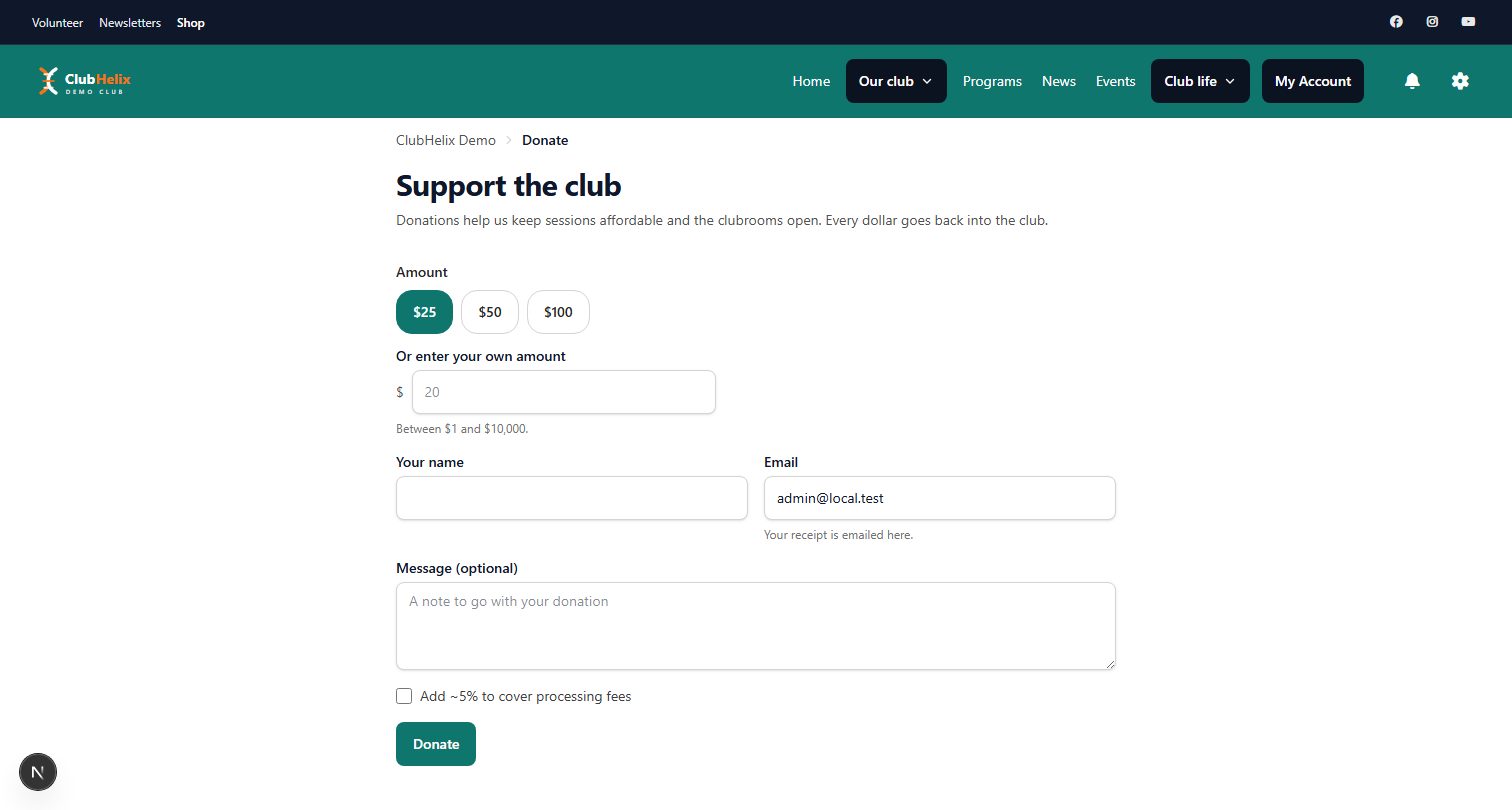
Send it once, from the president, with a real signature and a link that takes one tap. Expect 3–8% of a warm list to give something, at an average of $25–60. The reason this works and a general appeal does not is that the reader can see exactly what their money buys. A donations page on your own site with suggested amounts and a progress total does the whole job; the alternative — a payment link pasted into a chat with an honesty system — collects roughly a third as much and cannot be handed over to next year's committee.
Two rules. Keep a personal email address for every member before they graduate, because student addresses are switched off within months. And thank every giver by name within 48 hours, publicly if they agree, because that is what makes the second year's ask work.
The raffle with donated prizes
The workhorse. The economics are simple: if the prizes are donated, almost everything you take is net. If you buy a $300 hamper and sell 200 tickets at $2, you have netted $100 for a dozen volunteer hours, which belongs in the bottom half of the table, not the top.
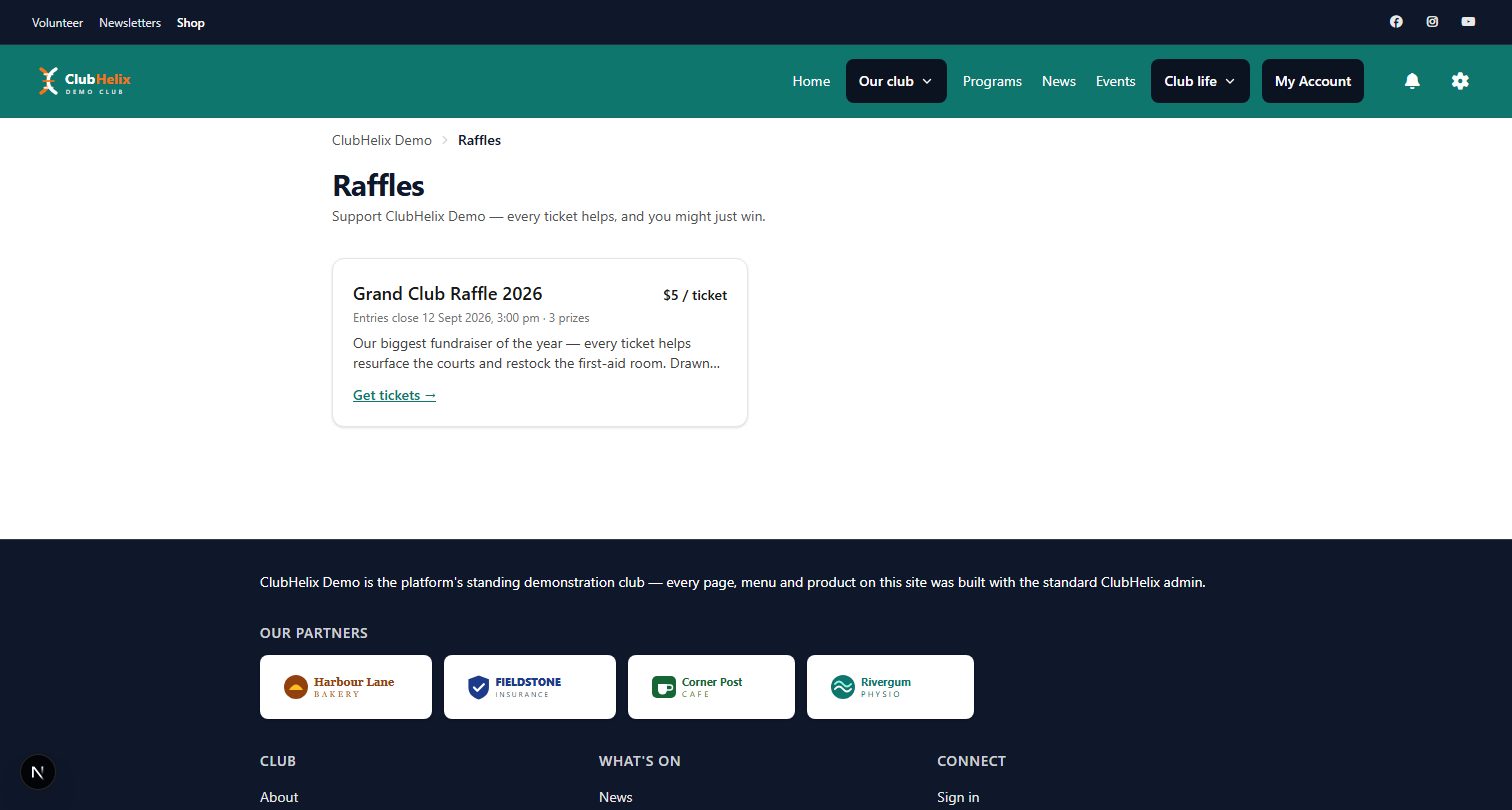
So the work is in the asking, not the selling. Approach ten local businesses that already want student customers — a café, a bookshop, a climbing gym, a barber, the venue you use — and ask for a voucher rather than cash. Roughly three will say yes, which is enough. Bundle small prizes into one attractive package instead of listing eleven $20 vouchers.
Sell tickets online rather than from a book. A physical ticket book means someone reconciling stubs against cash at midnight, members who "will pay you later", and a draw that cannot prove itself. An online raffle that issues numbered tickets, takes payment at the point of sale and records every buyer removes all of that, and members can forward one link to their family instead of doorknocking.
Before you print anything, check what you are allowed to run. This is the part committees skip.
Lotteries are regulated under the Gambling Act 2005, and the distinction that matters is between an incidental lottery and a society lottery. An incidental lottery is sold and drawn at a single event — tickets on the door, draw before the night ends, no rollover, prize spending inside the statutory cap — and needs no registration, which is why the raffle at your annual dinner is straightforward. The moment you sell tickets over days or weeks, or to anyone not at the event, you are running a society lottery, which must be registered with the local licensing authority. Your students' union often holds that registration already and will let affiliated societies run under it, so ask before you assume you cannot. A genuine free prize draw with no payment to enter is the other clean route. Keep to the age limits, publish the result, and keep a record of ticket sales. General information only — your union's activities team or a professional can confirm what applies.
The sponsored challenge
A 24-hour gaming marathon, a relay around the oval, a silent-study lock-in, everyone walking the equivalent of a mountain in a week. The mechanism, not the stunt, is what raises the money: each participant gets their own page and asks their own network, so twelve members bringing in $80 each is $960 without a single member being asked for the full amount.
Set a per-person target rather than a total, seed the page with the committee's own contributions before you launch (a page showing $0 raises nothing), and make the challenge slightly absurd rather than slightly impressive — people give to a friend doing something ridiculous, not to a friend being sensible.
The crowdfunder for one named thing
Crowdfunding for "society funds" fails. Crowdfunding for "a set of 24 second-hand instruments so the intro program can be free" works, because it is a thing with a price and a photograph. Run it for 10 to 14 days, not a month — momentum dies in week three — and line up 40% of the target before you go public, from the committee, the past-members list and two or three friendly local businesses. A page that hits 40% in the first 48 hours converts strangers at several times the rate of one sitting at 5%.
The pre-order merch drop
Merch is a fundraiser and a recruitment tool at once — a hoodie people wear around campus is advertising you do not pay for. It is also the single most common way societies lose money, because a committee orders 80 hoodies, sells 41, and the remaining 39 sit under a desk for two years.
The rule is absolute: take pre-orders first, order stock second. Open sales for ten days at a fixed price, close them, then place the order for exactly what sold plus two spares. Your margin should be at least 40% — if a supplier's price leaves you $6 a unit, the drop is not worth the roster. An online society shop with sizes, variants and a closing date does this without a spreadsheet of names, and it means the money is collected before you owe the supplier anything.
The middle tier: worth running, not worth building a year around
These earn their place because they do something besides raise money — they get first-years talking to committee members, they fill a quiet week, or they turn junk into cash.
A ticketed night at a venue that waives room hire in exchange for bar takings is the most reliable of these. Price it to cover costs at 55% of capacity, sell in waves rather than discounting in the final week, and give it one named owner and a run sheet. The event guide covers the mechanics, ticketing a formal covers the version with real financial risk, and the quiz night playbook is the cheapest format to start with — a quiz needs a room, a question writer and nothing else. If you would rather bolt a small fundraising element onto something you were running anyway, work through the social event ideas list and add a raffle at half time.
A second-hand sale of textbooks, kit, costumes or equipment costs nothing, clears storage and is genuinely useful to members. Take a commission on member-to-member sales rather than buying stock.
A skills or services auction — a member offers three hours of tutoring, another cooks a dinner — raises surprisingly well and costs only the evening it runs in.
And then there is the food fundraiser, which every campus has a version of.
The cake sale in a busy building foyer is the classic, and it works best when it is a coffee-and-cake stall in a department where your members already study, rather than a table nobody walks past. The bigger earners are the supermarket bag-pack, which trades two hours of smiling for steady donations and needs only the store manager's agreement, and the curry night or pizza night where a local restaurant gives you a fixed cut of every booking made under your society's name — near-zero volunteer hours for a share of a busy Tuesday. Check two things before you commit: your students' union almost certainly has catering rules that restrict selling food on its premises, and home-baked goods are treated differently to bought-in food under food hygiene guidance, with occasional charitable events sitting outside registration requirements but not outside the expectation that food is handled safely. Allergen information should be written on a card next to every item, not recited from memory. Budget £40–80 of ingredients and expect £80–250 from a good stall. General information only — confirm with your union's activities team.
The ones not worth the roster
Say no to these, kindly, when they come up in the meeting.
Catalogue and chocolate box drives. You take on unsold stock, chase members for money they spent, and the margin is thin. Twenty hours for $180 is the usual outcome.
Any raffle where you buy the prize. If the prize is not donated, you are running a low-margin trading business with paperwork attached.
The car wash. Popular because it feels like teamwork. Six people, five hours, a hose, and $240 on a good day — and it rains.
The sponsored silence, and its cousins. They raise nothing because there is no reason for anyone outside the room to care.
A club night where a promoter keeps the door. You supply 200 people and receive a bar tab. Negotiate a per-head fee in writing or do not run it.
Anything needing more than six volunteer shifts that you have not already filled. Confirm the names before you announce the event, not after. A half-staffed fundraiser is worse than no fundraiser: it burns your most reliable people, who are also the ones who will stand for committee next year.
Selling anything you had to buy before you sold it, unless the margin is above 40% and the stock is returnable.
Where the money lands, and what it costs you
Every fundraiser ends with the least glamorous question: whose account does this go into, and what are we allowed to say about it?
Get the cash discipline right regardless of where you are. Never bank fundraising takings through a committee member's personal account — it is how societies lose money to nothing more sinister than a flatmate's rent transfer, and it makes the treasurer personally accountable for a mess they did not cause. Two people count cash, both sign the count sheet, and it is banked or handed to your association's finance office within one working day. Reimburse anyone who fronted money within a week, because a member who is $180 out of pocket for six weeks does not volunteer twice. And take card payments wherever you can: cashless stalls take substantially more per customer, and every transaction records itself instead of becoming a tally on the back of an envelope.
In most cases the students' union holds society funds centrally: you requisition payments and claim reimbursements rather than running your own account. That removes the signatory problem entirely but slows your spend cycle, so build the lead time into every fundraiser — a supplier who wants paying in three days will not enjoy the process. On tax, the two points that matter are Gift Aid and VAT. Gift Aid adds 25% to eligible donations, but only a charity can claim it, and your society is not one: your union may be a charity and able to claim on funds it holds, or a charity partner can claim on money raised for them, so ask before you print anything promising it. VAT is normally the union's concern rather than yours because the union holds the money, but confirm before pricing a large ticketed event. Businesses wanting a deduction should be sold sponsorship rather than asked for a donation. General information only, not tax advice — check with your union or a professional.
A worked example: $2,400 in eight weeks
The society needs $2,400 to hold ball tickets at $55 instead of $80. Here is the plan that works, using three fundraisers rather than seven.
| Week | What happens |
|---|---|
| 1 | Confirm the number and the sentence. Assign one owner per fundraiser. Ask ten businesses for raffle prizes. |
| 2 | Prizes confirmed (aim for three). Raffle page live at $5 a ticket, 400 tickets. Committee buys the first 20 so the counter is not on zero. |
| 3 | Merch pre-order opens for ten days at a 45% margin. Raffle promoted at the weekly meeting and in the newsletter. |
| 4 | Past-member and graduating-cohort email goes out from the president, with the $40-subsidises-one-ticket line and a one-tap link. |
| 5 | Merch orders close; place the supplier order for exactly what sold. Second raffle push with the prize photos. |
| 6 | Raffle drawn publicly at the regular social. Winner published that night. Thank the prize donors by name. |
| 7 | Merch arrives and is distributed at a pick-up session, which doubles as a social. Second, shorter ask to anyone who did not open the first. |
| 8 | Reconcile. Publish the total and exactly what it bought. Write the debrief into the handover folder. |
Realistic arithmetic: raffle 320 tickets sold at $5 with donated prizes nets about $1,520 after fees; the merch drop sells 34 units at a $14 margin for $476; the past-member ask brings in $520 from 14 gifts. That is $2,516 for roughly 40 committee hours across two months — about $63 an hour, and none of it required the society to risk money it did not have.
The debrief in week eight is not optional. Write down what each fundraiser netted, how many hours it took, who owned it and what you would change. Without it, next year's committee re-runs the car wash.
Frequently asked questions
What is the single best fundraiser for a student society?
The one you can run again next year without begging for volunteers. If you want a specific answer, it is an online raffle with donated prizes, because it needs no stock, no venue and no roster, and the same three sponsors will usually donate again once you have thanked them properly. Its close rival is a direct ask to graduating and past members, which returns more per hour but only works if you have kept personal email addresses. Both beat any trading activity by a wide margin.
How much can a society realistically raise in a year?
A 60-member society running two well-chosen fundraisers should expect $800 to $2,000 a year on top of membership fees. A 250-member society with a good past-member list and one flagship ticketed event can reach $4,000 to $8,000, though most of that comes from two activities rather than ten. If your target is above that, the honest answer is that fundraising is not the lever — grants and sponsorship are, because they arrive in larger amounts for far fewer hours.
Can we fundraise for a charity as well as for ourselves?
Yes, and a great many societies do both — but keep them completely separate. Money raised for a cause is not yours to spend on the society's costs, not even temporarily and not even to cover the fundraiser's own expenses unless you said so up front. Run separate lines in the budget, state at the point of sale exactly where each dollar goes, get the charity's written permission before you use their name or logo, and transfer their share within a fortnight rather than at the end of the year.
Run it through your union's fundraising structure if there is one — it usually holds the charity relationships, the collection permissions and the Gift Aid mechanics already. Street collections need a licence from the local authority, and the charity's own fundraising team will supply a permission letter and branded materials.
Should we just charge more for membership instead of fundraising?
Often, yes — and it is the option committees skip because it feels awkward. Raising a $10 membership to $15 across 140 paid members is $700 a year for roughly zero volunteer hours, which no bake sale will ever match. The limit is that a higher fee excludes people, so raise it only alongside a concession rate and a visible reason. Work the numbers through with our membership fees guide before you commit a term to fundraising you may not need.
Our fundraiser lost money — what do we do now?
Write down exactly what happened while it is fresh, tell the committee the real number rather than a rounded one, and put it in the treasurer's report. A fundraiser that loses $200 is a cheap lesson; the same mistake repeated for three years because nobody recorded it is not. Then check the two usual causes: stock bought before it was sold, and a venue commitment signed before tickets went on sale. Both are avoidable with a pre-order and a break-even calculation, and both belong in your handover notes so the next committee inherits the lesson rather than the loss.
Where ClubHelix fits
Most of what makes society fundraising exhausting is admin: the ticket book being reconciled at midnight, the merch spreadsheet of names and sizes, the payment link pasted into a chat that nobody can audit, the donation total updated by hand. ClubHelix puts donation appeals, online raffles and a society shop on your own site alongside your member list and events, so the money, the buyer records and the running total all live in one place the society owns rather than in whoever's account set it up.
That matters most at handover, when the next treasurer needs to see what was raised, what it cost and who is owed a thank-you. If you are just getting the society organised, start with how to run a student society, browse the ready-made site templates, and see what a student clubs officer needs from the other side in our clubs officer overview. The free tier is for building the site and trying it out — taking payments online and being found in search start on the paid plans; the details are on the pricing page. For non-student clubs, the same ground is covered in our club fundraising ideas, and how to write a grant application covers the money that costs you the fewest hours of all.
ClubHelix gives your society one home for donations and appeals, online raffles and merchandise — with the records intact when the committee changes. Start free before your next fundraiser.


