
What this guide answers
- How often should a student society email its members?
Once a week during teaching weeks, at the same time each week, and much less often outside them.
- Can we email everyone who wrote their address on our sign-up sheet at the club fair?
If the sheet clearly said what they were signing up for — society news and events — then yes, that is the consent you need, and it is why the wording at the top of the form matters more than anything else on the stall.
- Should we send text messages as well as email?
Yes, but rarely and only for things that cannot wait — a cancelled session, a changed room, a ballot closing today.
- Our open rate is 14%. What is the first thing to fix?
Change the sender name to your society and change the subject line to name a day and a thing.
- How do we get members to actually reply and get involved?
Ask for something small, specific and time-boxed in every third or fourth email — "we need four people to help set up on Saturday from 5pm" works far better than "volunteers welcome".
UK edition. This guide is written for volunteer-run clubs in the UK. Where rules differ — grants, tax, incorporation, safeguarding — follow the UK-specific pointers below or check with your national body.
Your society has 312 email addresses in a spreadsheet and about a dozen people who reliably turn up. Somewhere between those two numbers sits the whole problem with student society communication: you can technically reach everybody, you are actually reaching almost nobody, and the weekly message goes out from the president's personal account at 11pm on a Wednesday, whenever she remembers.
The received wisdom is that students do not read email. That is not quite true. Students do not read bad email — the 900-word wall of text, the one that arrives every eleven days with no discernible pattern, the one whose subject line is simply the name of your society. A well-made society message, sent on a fixed day to a list of people who chose to be on it, opens somewhere between 35% and 55%. That is better than most professional marketing lists will ever manage, and it is entirely achievable by a committee of five with no budget and no marketing experience.
This guide covers what to send, when to send it, why society mail lands in spam when it does, what to do when email is simply too slow, and how to make sure the list still exists when the committee that built it has graduated. There is a complete weekly template you can copy near the end, and a bank of subject lines that have worked.
Know what a healthy society list looks like
Before you change anything, get four numbers. Almost every society we meet is guessing at all four, and the guesses are always kinder than reality.
| Number | Healthy for a society list | What a bad number is telling you |
|---|---|---|
| Open rate | 35–55% during term | Below 20%: wrong sender, wrong subject line, or a list that never opted in |
| Click rate | 4–8% on the one link that matters | Under 1%: you are announcing, not inviting — there is nothing to act on |
| Unsubscribe rate | Under 0.5% per send | Over 1%: too often, too long, or you are mailing people who never joined |
| Bounce rate | Under 2% per send | Over 5%: dead student addresses, typos from a paper sign-up sheet, or both |
Two of those deserve more attention than the others. Bounces are the one that quietly kills you — every send to a dead address is a small vote against your sender reputation, and a list that has never been cleaned will slowly stop arriving for everyone, including the people who do want it. Unsubscribes are information, not rejection. A member who leaves your list cleanly is far better than one who hits "report spam" because they could not find the link.
Write these four numbers into the secretary's report each term. It takes two minutes, it makes communication a committee-wide responsibility instead of one person's hobby, and it is the difference between "I feel like people aren't reading it" and a decision you can actually make.
Capture two addresses at the moment someone joins
The single highest-value change most societies can make costs nothing: collect a personal email address alongside the university one, at the point of sign-up, in the same form.
University addresses are deactivated somewhere between three and twelve months after a student stops being enrolled. That means every graduating cohort silently falls off your list, taking with them exactly the people who might have come back to the anniversary dinner, sponsored a prize, or told their employer about your careers night. A society that has collected personal addresses for four years has an alumni list. A society that has not is starting from zero every single year.
While you are fixing the form, fix the rest of it:
- Preferred name, not just the name on the enrolment record. It is the first word of every message you send.
- Two addresses, clearly labelled, with the personal one described as "so we can stay in touch after you graduate".
- A tick box for non-essential email, separate from membership itself. Recording when and how someone opted in is the thing you will wish you had.
- Nothing else. Every extra field costs you sign-ups at a stall and creates an obligation you inherit for years.
The other half of this is capture speed. A paper list at the club fair produces perhaps 60% legible addresses, gets typed up over the following fortnight if you are lucky, and means your welcome message lands on day eleven — by which point four other societies have already run their first social. A printed QR code pointing at a sign-up form on your own site produces a correctly spelled, timestamped, consented record the instant someone joins, and your welcome message can go out that evening. Our club fair recruitment guide covers the stall mechanics; the member records and privacy guide covers what to do with everything afterwards.
Two rule sets apply at once. PECR governs the sending of marketing email to individuals, and UK GDPR governs the member data behind it, with the Information Commissioner's Office enforcing both. In practice that means a clear opt-in for society news, accurate identification of who is writing, and a working unsubscribe on every message. The wrinkle worth knowing: in most cases your students' union is the data controller and your committee handles the data on its behalf, so the union's data protection policy is the rule book you actually have to follow — and some unions require society mailings to go through their own system for exactly that reason. Members can ask to see what you hold and you have a month to respond. Practically: never put 300 addresses in the To field, record when and how each person opted in, and delete addresses you no longer use. This is general information rather than legal advice; the union's data protection contact can confirm the specifics.
Do not build on a channel you do not own
Most societies communicate on borrowed ground: a chat server, a social page, and a listing on the student association's own site. All three are useful. None of them are yours.
A chat server reaches the 25% of members who are already engaged and effectively nobody else — most people mute it in week two and never come back. A social page reaches whoever the platform decides to show it to, which is a number you do not control and which has fallen every year for a decade. Both can vanish with the account that created them, and both belong to whoever set them up, which is usually someone who graduates in June.
Email and your own website are the two channels a society genuinely owns. Everything permanent — the constitution, the calendar, the committee contacts, the sign-up form, the membership price — belongs on the site, so the weekly email can be short and point at it rather than repeating it. Our student society website guide covers the six pages that matter, and the communication plan guide is a good hour if you want to map every channel deliberately rather than by accident.
Your students' union runs channels you should borrow without depending on: the union-wide student bulletin, your society's page on the union website, the freshers' fair guide, and — most importantly — the union's membership system, which usually sells your memberships and therefore holds your member list. Ask the activities team three things in your first fortnight. First, the cut-off date for the freshers' fair guide and the refreshers' fair in the new year. Second, whether you can mail your own members from the union's system, and who has to approve it — many unions insist on this because they are the data controller. Third, whether you can export your member list at all, and in what format. That last answer shapes everything else: if the export is locked, your own sign-up form becomes the only way to build a list you can still use after the union's system changes or your committee loses access to it.
The weekly rhythm that works around a timetable
Frequency beats cleverness. A predictable, slightly dull email that arrives every Sunday evening will out-perform a brilliant one that arrives whenever someone has time, because the second one never trains anyone to expect it.
The rhythm that works for most societies is one message a week during teaching weeks, sent at the same time. Sunday between 5pm and 7pm is the strongest slot: people are planning their week and are on their phones. Monday between 8am and 9am is the second-best. Avoid Friday afternoon entirely — it is the only send time that reliably underperforms everything else.
Then vary the shape by where you are in the year:
| Phase | Cadence | What the email is for |
|---|---|---|
| The week of the club fair | 1 within 24 hours | Welcome, one thing to come to this week, the membership link |
| Weeks 1–4 | Weekly, no misses | Turn sign-ups into attendees; this window produces most of your year |
| Weeks 5–10 | Weekly | The regular program, the flagship event, one thing to celebrate |
| Exam and study periods | One short message | Wish people well, no asks, remind them what is on the other side |
| Between terms | Fortnightly at most | Keep the door open; announce the next term's first event |
| The long break | 2 or 3 total | A "we're back" message before teaching resumes is worth more than five |
The welcome message deserves special mention because it is the highest-performing email your society will ever send. It routinely opens above 60% — people remember signing up, they are curious, and they have not yet decided you are noise. Send it within 24 hours of someone joining. Make it short, name one thing they can come to in the next fortnight, and include the membership link if you charge.
The calendar you are writing around usually looks like this: an autumn term from late September to mid December with a reading week around the midpoint, the Christmas vacation, a spring term from January to late March — with January exams on many courses — the Easter vacation, and a summer term dominated by exams in May and June. The two weeks nobody reads are the exam periods; send one short, no-ask message and then leave people alone. The two weeks everybody reads are freshers' week and the first full teaching week after it. The genuinely useful quirk of this calendar is that you get a second recruitment moment: the refreshers' fair in the new year reaches everyone who missed you in September and everyone whose first-choice society disappointed them. Plan a proper campaign for it rather than treating it as an afterthought, and use the Christmas vacation for exactly one message announcing what January holds.
What actually gets opened
Three things decide whether your email is read, in this order: who it is from, what the subject line says, and how long it looks when it opens.
The sender name should be your society, not a person. "Debating Society" gets opened. "Priya Raman" gets opened by the forty people who know Priya and ignored by everyone else, and it breaks completely when Priya graduates. Set the sender name once, to the society, and never change it — recognition is most of your open rate.
Keep the subject line under about 40 characters so it survives a phone lock screen, and make it about the reader's decision rather than your society's identity. "This Thursday: quiz night, 7pm, free entry" beats "Society Newsletter — Week 4" every time. Put the day and the thing in the first four words, because that is all many people will ever see. And use the preview text: most mail apps show it directly under the subject, and if you leave it empty they fill it with "View this email in your browser", which is a wasted line on every message you have ever sent.
Keep the whole thing between 200 and 350 words with one primary link. A society email is a signpost, not a document. If you have written 800 words, you have written a web page — put it on the site and link to it. Members read email on a phone, standing up, between classes, and the second scroll is where you lose them.
Two more things worth doing. Write in the voice a committee member would actually use out loud; the moment a society email starts saying "we are pleased to announce" it reads like a corporate newsletter and gets treated like one. And put one genuinely human item in every send — the photo from last week, the score, the thing that went wrong and was funny. That item is why people open the next one. For the longer-form craft, our club newsletter guide goes deeper on structure and content ideas.
The weekly email, written out in full
Here is the whole thing. Copy it, change the names, and send it every week for a term.
From: Film Society
Subject: Thursday: Blade Runner + free popcorn
Preview text: Plus tickets for the ball go live Monday
Hi Sam,
This week — Thursday 7pm, Arts Lecture Theatre 2. Blade Runner on the big screen, with a short introduction from Dr Neville and free popcorn. No booking, just turn up. Details and map on the site.
Coming up — Ball tickets go on sale Monday at 9am. 120 seats, and last year we sold out in four days, so set an alarm if you want a table with your friends.
One thing — Last Thursday's screening had 38 people, our biggest of the year, and someone left an origami unicorn on every seat. Photo on the site. Thank you, whoever you are.
Not a member yet? Membership is $10 for the year and gets you $2 off every screening.
See you Thursday,
Priya — President, Film Society
You're getting this because you signed up at our stall or joined online. Unsubscribe any time.
That is under 200 words and it does five jobs: one clear thing to attend, one thing to plan for, one human moment, one conversion opportunity, and one compliant footer. The structure never changes, which means writing next week's takes twelve minutes instead of an hour, and it means the person who takes over from you can produce a good one on their first attempt.
A bank of subject lines that work, to start you off:
- "Thursday: [thing], [time], [free / $X]"
- "Ball tickets live Monday 9am — 120 seats"
- "We need 4 people for Saturday"
- "Nominations close Friday — 3 roles open"
- "Last film of the term + what's on next"
- "You're missing free pizza (Wednesday, 6pm)"
- "Sorry — Tuesday's room has moved to G12"
Note what none of them do: none say "newsletter", none say "update", and none lead with the society's own name. If you want more starting points, our club email templates collection covers welcome messages, renewal reminders, event invitations and the awkward ones.
Why society mail lands in spam
Almost every deliverability problem a society has comes from one of four causes, and three of them are free to fix.
Sending from an address you have not authorised. If your society owns a domain and you send from the president's free webmail account "as" that domain, receiving servers see a mismatch and treat it accordingly. The fix is to send through a system that is properly authorised to send for your domain — the technical machinery is SPF, DKIM and DMARC, and the practical version is that whoever hosts your society's mail should be doing it for you rather than handing you DNS homework.
A dirty list. Typos from paper sign-up sheets, deactivated student addresses, and role addresses that no longer exist all bounce, and bounces accumulate against your reputation. Clean the list once a term: remove hard bounces immediately, and remove anyone who has not opened anything in twelve months after one final "still want these?" message.
Sending to people who never asked. This is the one that produces spam complaints, and a handful of complaints does more damage than a thousand ignored emails. A course cohort, a group chat member list and a forwarded spreadsheet are not consent. Get people onto the list through your own form.
Habits that look like bulk marketing. A single enormous image with no text, link shorteners, all-caps subject lines, and 300 visible addresses in the To field all raise flags. So does an irregular sending pattern — a list that receives nothing for four months and then a blast to 400 people looks exactly like a compromised account, because that is often what it is.
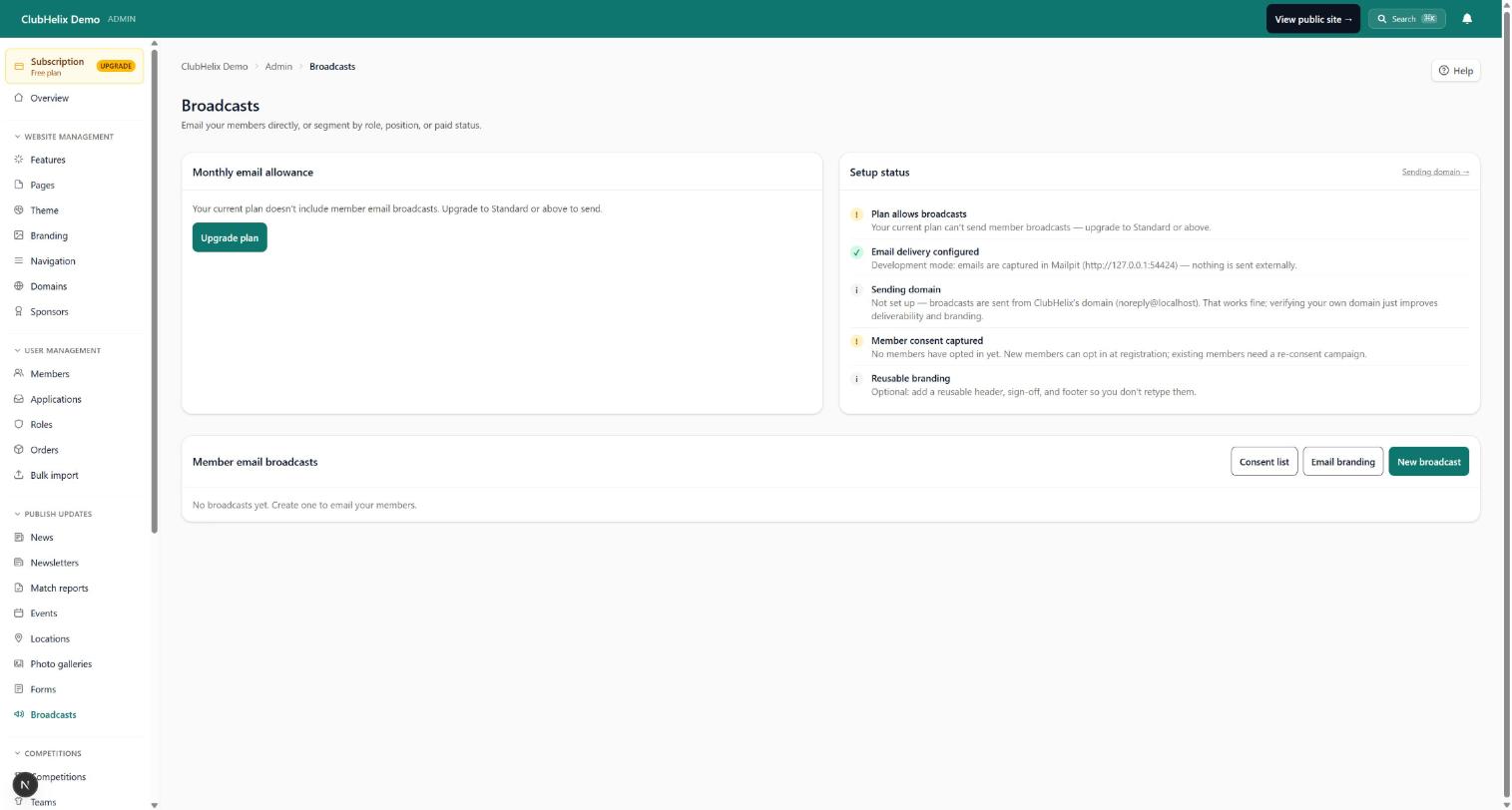
Our why club emails go to spam guide is the deep technical version, including a 30-minute diagnostic you can run this afternoon. The short answer for most societies is to stop sending bulk mail from a personal account and use a proper broadcast tool that handles bounces, suppression and unsubscribes for you — and to make sure your automatic messages, like registration confirmations and receipts, come from the same authorised sender through built-in transactional email rather than a second system with a different reputation.
When email is too slow
Email is the right channel for the week ahead. It is the wrong channel for "the room has changed" forty minutes before a meeting.
For genuinely time-critical messages, a text message reaches people in seconds and gets read almost universally. Use it rarely — three or four times a term at most — and only for changes and cancellations, never for promotion. The moment a society starts texting people about ticket sales, everyone opts out and the channel is gone when you actually need it. Cost is a few cents a message, so a 200-member society can budget for genuine emergencies without a line item anyone will query.
A push notification through a member app sits usefully between the two: instant like a text, free like an email, and opt-in by design. It is the right channel for "practice is on" and "the ballot closes at 5pm".
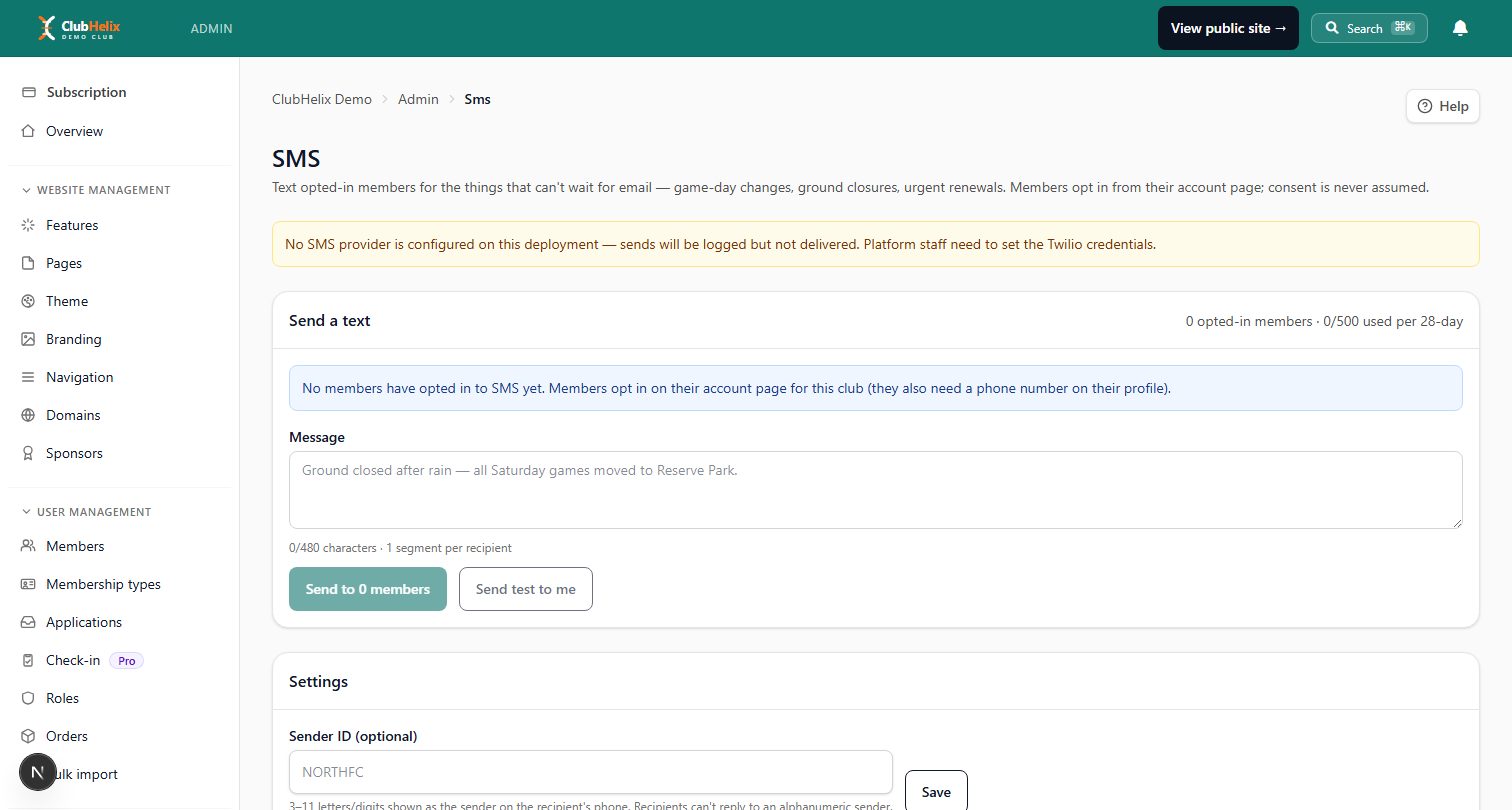
Whatever you use, consent has to be separate. Someone giving you a mobile number for the emergency contact field has not agreed to receive society texts. Ask for it explicitly, record the answer, and honour opt-outs on the spot. A consent-first SMS tool that only ever sends to opted-in members removes the judgement call entirely, which matters when the person pressing send is a stressed events officer at 8am.
The list that survives the handover
Everything above is worthless if the list leaves with the person who built it. Four rules make a society list outlive its committee.
Own the sender identity. The society's email should come from a society address — hello@ or committee@ your own domain — with recovery pointed at another society address, not at a graduate's personal inbox. Personal accounts are how societies get locked out of their own list.
Give access by role, not by password. Each committee member gets their own login with the permissions their role needs, and those permissions are removed when the role changes hands. A shared password means you cannot remove one person without disrupting everyone, and it means a member who graduated two years ago can still email 400 people.
Keep the list where the society keeps everything else. A list that lives inside your member records, alongside paid status and consent flags, is one thing to hand over. A list that lives in an export on someone's laptop, a second export in an email tool and a third in a chat pin is three things to hand over, and next year's committee will find one of them.
Hand over the numbers, not just the login. At the handover meeting, walk the incoming communications officer through the last term's opens, clicks and unsubscribes, the send day you settled on, and the two subject lines that worked best. That five-minute conversation is worth more than any document. Our handover checklist has the full agenda, and the AGM and elections guide covers proving your notice actually went out — which a proper send log does automatically.
Frequently asked questions
How often should a student society email its members?
Once a week during teaching weeks, at the same time each week, and much less often outside them. Weekly sounds like a lot until you realise you are competing with everything else in the inbox for attention, and irregular sending is what actually causes unsubscribes — people who cannot predict you treat you as noise. Drop to one short no-ask message during exam periods, fortnightly between terms, and two or three across a long break. The rhythm matters more than the volume.
Can we email everyone who wrote their address on our sign-up sheet at the club fair?
If the sheet clearly said what they were signing up for — society news and events — then yes, that is the consent you need, and it is why the wording at the top of the form matters more than anything else on the stall. What you cannot do is take addresses from a class list, a group chat, another society's list, or a shared spreadsheet someone forwarded you. Write the purpose on the form, keep a record of when each person joined, and include an unsubscribe link in every message. This is general information rather than legal advice — check the specifics with your student association.
Should we send text messages as well as email?
Yes, but rarely and only for things that cannot wait — a cancelled session, a changed room, a ballot closing today. Texts get read almost universally, which is exactly why overusing them destroys the channel: a society that texts about ticket sales will have nobody left subscribed when it needs to cancel a bus. Treat email as the weekly rhythm and text as the emergency channel, and collect consent for the two separately.
PECR treats marketing texts the same way it treats marketing email, so consent, clear identification of your society and a working opt-out all apply. Where you send from an alphanumeric sender name rather than a number, members cannot reply to unsubscribe, so include the opt-out instruction in the message itself.
Our open rate is 14%. What is the first thing to fix?
Change the sender name to your society and change the subject line to name a day and a thing. Those two changes alone typically move a struggling list into the twenties, because most low open rates are recognition problems rather than content problems — people do not know who is writing. After that, check your bounce rate: if it is above 5% you have a list hygiene problem that is suppressing delivery for everyone, and cleaning it will lift the open rate without you writing a single better sentence.
How do we get members to actually reply and get involved?
Ask for something small, specific and time-boxed in every third or fourth email — "we need four people to help set up on Saturday from 5pm" works far better than "volunteers welcome". Name the number of people, the task and the hours; vagueness reads as a big commitment and gets ignored. Once a term, send a short survey instead of a newsletter and act visibly on one result, so people learn that replying to you changes something. Our member survey guide has a set of questions worth asking.
Where ClubHelix fits
Most society communication problems are structural rather than creative: the list lives in a personal export, the send comes from a personal address, the consent is not recorded anywhere, and the whole thing has to be rebuilt every time the committee changes. ClubHelix keeps the member register, the sign-up form, the consent flags, the email broadcasts, the SMS and the automatic confirmations in the same place, owned by the society rather than by whoever set it up — so the communications handover is a permissions change rather than an excavation.
If your society is still working from a directory listing and a chat server, the student society website guide shows what a proper home looks like, and you can browse the ready-made site templates before committing to anything. There is more on how it fits a campus group on our university clubs page, and the pricing page includes a free tier for building the site and trying it out, with taking payments online and being found in search on the paid plans. The wider picture — affiliation, committee, money, events — is in our complete guide to running a student society.
ClubHelix gives your society email broadcasts to a list it actually owns, built-in transactional email for confirmations and receipts, and consent-first SMS for the things that cannot wait. Start free before your next club fair.


