
What this guide answers
- How long should a club newsletter be?
Around 400–600 words of body copy, readable in under two minutes on a phone.
- How often should a club send a newsletter?
Fortnightly during the season and monthly during the off-season suits most community clubs.
- What should be in a club newsletter?
Lead with three to five "need to know" bullets (deadlines, events, changes), then two to four short sections: a results wrap, an upcoming event, a member or volunteer spotlight, and a sponsor thank-you.
- Do we need a special tool, or can we just use regular email?
Once you're past a couple of dozen recipients, ordinary personal email is the wrong tool: addresses end up exposed or lost, there's no unsubscribe handling (a legal requirement for bulk email essentially everywhere)…
A good club newsletter is the cheapest engagement tool a committee has. It lands in every member's inbox, it reaches the parents and partners who never open the club's social pages, and it quietly does the work of a dozen noticeboard posters. A bad one — a wall of text sent whenever someone remembers — trains members to delete it unread, and once that habit sets in it's very hard to break.
The difference between the two isn't writing talent. It's structure, cadence and a repeatable process. This guide gives you all three: how to structure each issue, how often to send, a long list of content ideas you can pull from all season, and a template outline you can copy straight into your next edition.
Decide what your newsletter is for
Before you write a word, agree on the job. For most clubs, the newsletter has three jobs, in this order:
- Tell members what they need to do or know this fortnight. Registration deadlines, changed training times, the working bee, presentation night tickets. This is the "must read" layer — it's why members open the email.
- Celebrate people. Results, milestones, volunteer thank-yous, new sponsors. This is the layer that makes people enjoy opening it.
- Keep the club's story ticking over. Photos, a coach's note, a look ahead. This builds the sense that the club is alive and well-run.
Notice what's not on that list: everything. A newsletter is a digest, not an archive. If a topic needs more than a paragraph, publish the full story on your club website's news page and link to it. That keeps the email short, gives people a reason to visit the site, and means the story is still findable in six months — which an email never is.
The structure that works
Members read newsletters on their phones, standing at training or waiting for the kettle. Structure every issue so it can be skimmed in ninety seconds:
- Subject line that says what's inside. "Newsletter #14" tells nobody anything. "Rego closes Friday + round 6 wrap" earns the open. Put the most time-sensitive item first.
- One-line greeting, then straight in. Skip the half-page presidential preamble. If the president wants a column, it goes further down as its own short section.
- "What you need to know" box at the top. Three to five bullet points with dates and one link each. If a member reads nothing else, this is the bit they must see.
- Two to four short sections. Results wrap, upcoming events, a volunteer or player spotlight, a sponsor thank-you. Each section: a heading, 50–100 words, one image or one link.
- One clear call to action. The single thing you most want members to do this issue — buy the tickets, register, volunteer. One button, not six.
- Footer with the constants. Key contacts, links to the website, and a working unsubscribe link — a legal requirement for bulk email essentially everywhere, and in several markets one that must work with a single click. See our guide to why club emails go to spam.
The discipline that makes this all work: word budget. Cap the whole issue at roughly 500 words of body copy. Everything longer becomes a link to the website.
Cadence: how often should a club newsletter go out?
The right answer for almost every community club is fortnightly during the season, monthly in the off-season.
For a winter code that means fortnightly from April to September and monthly across the summer; summer sports simply invert it.
Here's the reasoning:
- Weekly is a treadmill. Volunteer editors burn out by round eight, issues start slipping, and members notice the gaps more than they'd notice a slower cadence.
- Monthly in-season is too slow. Fixtures change, events come up at short notice, and you end up sending "extra" emails anyway — at which point you've lost the predictability that makes a newsletter work.
- Fortnightly is sustainable. Enough news accumulates to fill an issue without padding, and the editor's job stays small.
Whatever cadence you choose, send on the same day at the same time. Tuesday or Wednesday evenings work well for club audiences — weekend sport is done, the next round is coming into view, and inboxes are quieter than on Mondays. Consistency matters more than the specific slot: members learn when to expect it, and the editor gets a fixed deadline instead of an open-ended chore.
One more cadence rule: the newsletter is not your only channel, so don't let urgent things wait for it. A ground closure on Saturday morning goes out as its own short message. If your platform supports it, that's a push notification job, not an email job — see our club communication plan for how the channels fit together.
Club newsletter ideas: a season's worth of content
Pin this list somewhere. When an issue feels thin, pull two or three of these:
People
- Player of the round / performance of the week (rotate across teams and grades, juniors included)
- Volunteer spotlight — 3 questions and a photo
- New member welcomes
- Milestones: 50/100/200 games, life memberships, birthdays for junior teams
- "Where are they now" with a past player
- Meet the committee — one role explained per issue (this quietly doubles as succession planning)
Club life
- Results wrap with one line per team, linking to full match reports on the website
- Ladder position and what's mathematically possible
- Upcoming fixtures with a "who's playing at home this weekend" callout
- Training changes, ground announcements
- Canteen roster and duty teams
- Photos from the weekend — two or three, with credits
Money and admin
- Registration deadlines and early-bird pricing
- Fundraiser progress ("$3,400 of $5,000 for the new nets")
- Sponsor of the issue — logo, a sentence about their business, and a genuine reason to use them
- Merchandise: new stock, sizes running low
- Grants won and what they'll fund

Seasonal
- Pre-season: key dates, fee tables, come-and-try days
- Mid-season: mid-year review, photo day, junior development news
- Finals: ticketing, venue details, supporter gear
- Off-season: AGM notice, committee vacancies, presentation night wrap, pre-registration for next season
A club newsletter template you can copy
Here is a complete issue outline. Replace the brackets and you have a newsletter:
Subject: [Most urgent item] + [most interesting item]
Hi [first name],
📌 What you need to know
- [Deadline + date + link]
- [Event + date + link]
- [Change or reminder + link]
🏆 Around the grounds — [50–80 words wrapping the weekend across teams, one standout performance named, link to full reports.]
🎟️ [Upcoming event name] — [When, where, what it costs, why to come. One button: "Get tickets".]
👏 [Spotlight: person or sponsor] — [50 words and a photo.]
[One clear call to action as a button]
[Footer: club contacts • website • manage preferences / unsubscribe]
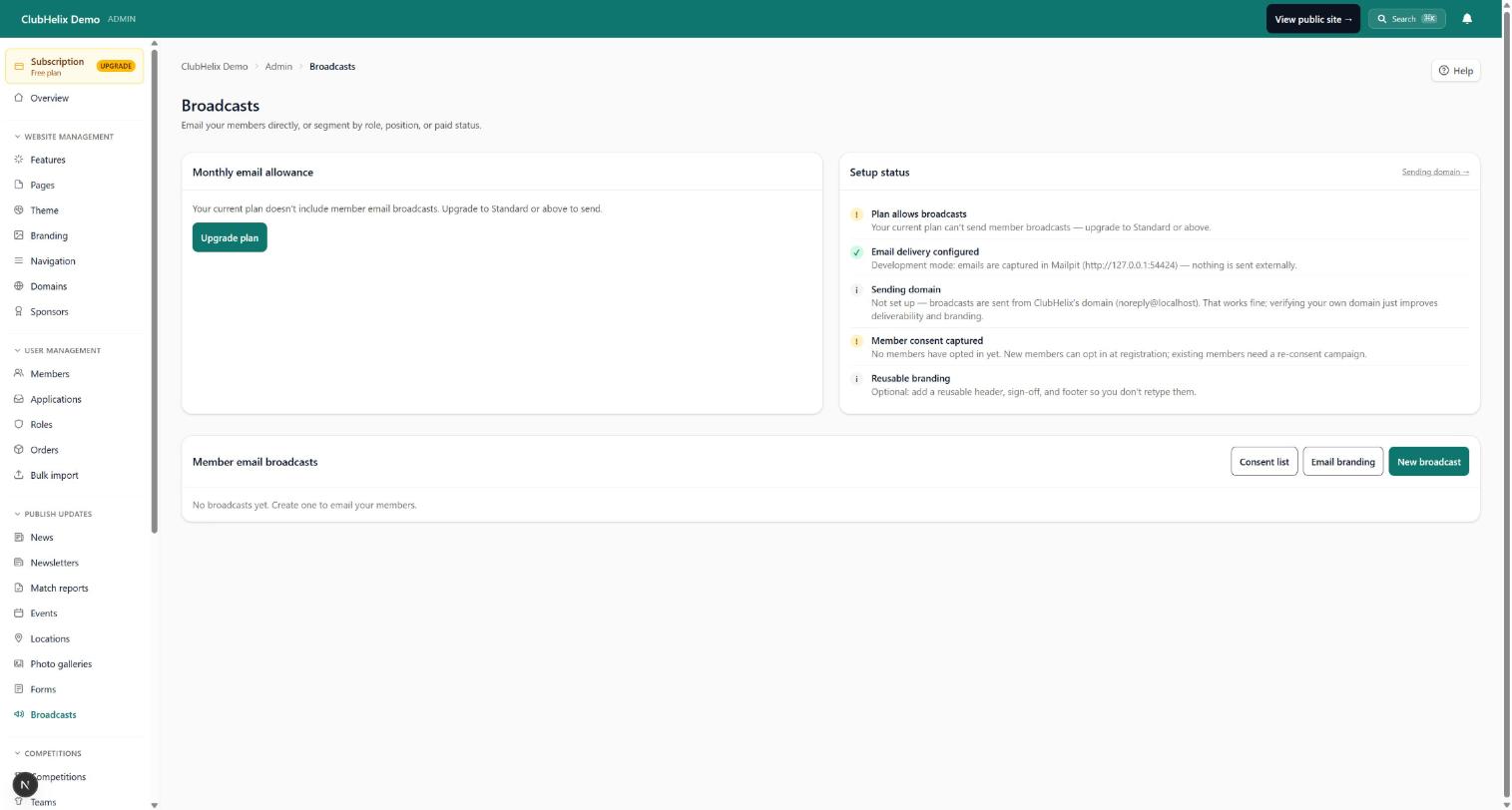
Save the outline as a reusable template in your email tool so every issue starts 80% built. In ClubHelix, the visual newsletter builder assembles each issue from drag-and-drop blocks — headings, photos, buttons, two-column layouts — with your club's colours applied automatically and three starter templates to begin from. Preview it in light or dark mode and on a phone-width screen, pick the audience (everyone, a role, or a hand-picked list), and every send reports opens and clicks without any third-party trackers. Each issue can also be published to your website's newsletter archive so it keeps working after the inbox moves on.
Writing tips that lift open rates
- Write like a person, not a minute-taker. "We won ugly on Saturday and Sam's hat-trick saved us" beats "The senior squad recorded a positive result."
- Names, names, names. Members scan for themselves and their kids. Every name you print is another guaranteed reader — and juniors' families forward the email around.
- Front-load every sentence. "Rego closes Friday 6pm" — not "A reminder that, as flagged previously, registrations for the upcoming season…"
- One image per section, maximum. Big image dumps slow the email down and get clipped by mail apps; put the full gallery on the website and link to it. (Need better photos to work with? See our guide on how to take good club photos.)
- Read it on a phone before sending. If a section needs two thumb-scrolls, cut it in half.
- Proofread the details, not just the spelling. The classic newsletter failure is a wrong date or venue. Have a second person check every date, time, price and link — nothing else, just those.
Measure it, lightly
You don't need a dashboard habit, but glance at two numbers each issue:
- Open rate. Community club newsletters to a genuine member list should comfortably beat typical commercial email — if fewer than about half your list opens, your subject lines are vague or your sending setup needs attention (authentication problems silently push email to spam; the fix is covered in why club emails go to spam).
- Click rate on your main call to action. If nobody clicks, the CTA was buried, unclear, or not actually useful.
Sending from your club's own domain rather than a personal address helps both numbers — it looks legitimate, survives committee handovers, and lets you set up proper email authentication. A custom sending domain is a one-off, fifteen-minute setup that pays off in every issue afterwards.
Make it survivable: the handover test
The newsletter must outlive its current editor. Three habits make that true:
- Template, not blank page. The issue structure lives as a saved template anyone can duplicate.
- Shared content folder. Photos and snippets accumulate in one shared place all fortnight, so issue day is assembly, not hunting.
- Documented process. One page: where the template is, when we send, who approves, where the member list lives. Store it with the committee handover documents alongside your club website logins.
If your newsletter tool is part of your club platform, most of this comes free — the member list is always current because it is the member database, and the next secretary inherits the login with the role.
Frequently asked questions
How long should a club newsletter be?
Around 400–600 words of body copy, readable in under two minutes on a phone. Anything that needs more depth should be published on your club website and linked from the newsletter. Short and consistent beats long and occasional every time — the goal is a habit, for readers and for the editor.
How often should a club send a newsletter?
Fortnightly during the season and monthly during the off-season suits most community clubs. Weekly burns out volunteer editors, and monthly in-season is too slow for fixtures and events. Send on the same day and time every issue so members learn to expect it, and handle genuinely urgent news through a faster channel like push notifications instead of waiting for the next issue.
What should be in a club newsletter?
Lead with three to five "need to know" bullets (deadlines, events, changes), then two to four short sections: a results wrap, an upcoming event, a member or volunteer spotlight, and a sponsor thank-you. Finish with one clear call to action and a footer with contacts and an unsubscribe link. Names and photos of members are the content people most reliably read.
Do we need a special tool, or can we just use regular email?
Once you're past a couple of dozen recipients, ordinary personal email is the wrong tool: addresses end up exposed or lost, there's no unsubscribe handling (a legal requirement for bulk email essentially everywhere), no templates, and no idea whether anyone read it. Use a proper broadcast tool — ideally one connected to your member database, so the list is always current and departing members stop receiving automatically.
Ready to send better club emails? ClubHelix broadcasts come with branded templates, audience targeting straight from your member database, and your own sending domain — see pricing to get started.


