
What this guide answers
- Does our club need to be incorporated to get a grant in Victoria?
Most state and council programs require an incorporated association or a legally constituted body, though many accept an incorporated auspice organisation applying on your behalf.
- Who applies for facility grants — the club or the council?
In many Victorian facility funding streams the land owner applies, which for most clubs means the local council.
- How often do Victorian sports grant rounds open?
State sport programs typically run to an annual cycle with fixed dates, and councils usually run one or two community rounds a year.
- What happens if we can't spend the grant as planned?
Contact the funder and request a variation before you spend differently — most program teams are reasonable when asked early.
Victoria likes to call itself the sporting capital, and one upside for volunteer committees is real: community sport funding in Victoria is broad, recurring and genuinely winnable for ordinary suburban and country clubs. Equipment, pavilion upgrades, lighting, junior programs, volunteer training — there is a funding stream somewhere for almost every project on your club's wishlist.
What separates the clubs that win from the clubs that wish is rarely the quality of the project. It's knowing where Victorian sports club grants actually live, having the paperwork ready before a round opens, and writing an application an assessor can say yes to quickly. Here's how to do all three — and how to handle the acquittal that follows.
Where to find sports club grants in Victoria
Sport and Recreation Victoria. The state's sport and recreation agency runs the flagship community sport programs — long-running streams that fund equipment, minor facility works, participation initiatives and volunteer development. Programs are refreshed and renamed between budget cycles, so always work from the current guidelines at sport.vic.gov.au rather than what your club applied for two years ago.
The Victorian Government grants gateway. Every open grant across state departments is listed at vic.gov.au/grants. Set a monthly reminder to scan it: clubs regularly qualify for community resilience, volunteering, energy-efficiency and inclusion rounds that never use the word "sport".
Your local council — and not just for money. Victorian councils run their own annual community grants (smaller, less contested, great for shade sails, defibrillators, storage and junior gear). But councils matter twice in Victoria: most major facility funding is delivered in partnership with councils, because the council usually owns your ground and pavilion. If your project involves lighting, surfaces or buildings, talk to your council's recreation officer early — in many state facility streams, the council is the applicant and your club is the evidence.
National and sector programs. National community sport funding tends to flow through state and national sporting bodies, so ask your association what's open and whether it runs pass-through grants or subsidised equipment schemes of its own. Community foundations, bank community programs and local service clubs round out the picture for small, quick grants.
This is general information, not legal or financial advice — always confirm eligibility and current requirements for any round on the official site linked above before applying.
What Victorian sports club grants typically fund
| Category | What it usually funds | What assessors want to see |
|---|---|---|
| Equipment | Balls, nets, goals, uniforms, first-aid and safety gear | Quotes, member numbers, who benefits and how often |
| Facilities | Lighting, surfaces, pavilions, female-friendly change rooms, access | Council partnership, landowner consent, co-contribution |
| Participation | Junior programs, come-and-try days, female and all-abilities sport | A delivery plan, realistic targets, how you'll measure success |
| Volunteer training | Coach and official accreditation, first aid, club governance courses | Named roles being trained and how the skills stay at the club |
Two Victorian patterns worth writing to: facility rounds have strongly favoured female-friendly and universally accessible facilities for years, and participation rounds reward projects that get new people playing rather than servicing existing members. If your project honestly does either, lead with it and attach the numbers.

Get grant-ready before the round opens
Victorian rounds commonly open and close inside six weeks. The winning move is to have a standing "grant kit" ready in January, not to write faster in the last week. It needs:
- Incorporation. Most programs require an incorporated association (Consumer Affairs Victoria administers incorporation — see consumer.vic.gov.au) or an incorporated auspice body applying for you. Our guide on how to incorporate a club covers the process and why it matters.
- Insurance. A current public liability certificate of currency, plus knowledge of what your association's blanket cover actually includes.
- Financials. Twelve months of statements and a one-page budget showing income, expenses and reserves — assessors want to see the club is solvent and the project is costed.
- Governance records. Constitution, latest AGM minutes, committee list, ABN, and a bank account in the club's name.
- Evidence on hand. Photos of the problem, current quotes, letters of support from your league and council, and up-to-date membership statistics.
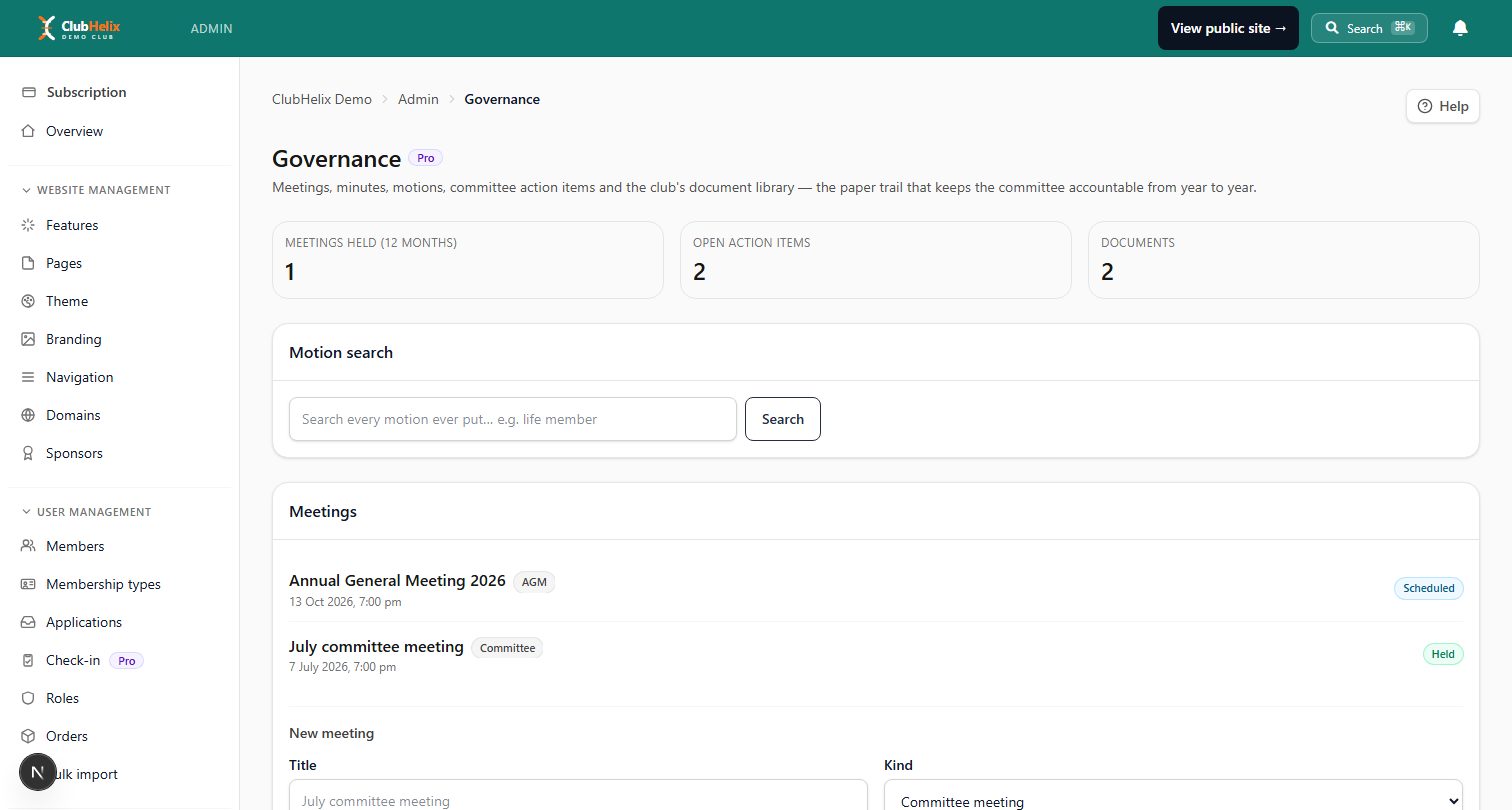
Store all of it somewhere the whole committee can reach. Clubs that keep minutes and documents in one digital home (for example governance and document storage) can turn an application around in an evening when a surprise round opens.
Membership records are your evidence base
Almost every Victorian application asks for the same data: total members, junior numbers, female participation, growth over recent seasons, and the suburbs or towns you draw from. Clubs that still run registration through paper forms and a shared spreadsheet spend most of the application window reconstructing those numbers — or guessing, which experienced assessors can smell.
Taking registrations online fixes this at the source. With online registration every member record is captured once, consistently, and stays current through renewals; with roles and permissions the grants writer can pull member reports themselves without borrowing the registrar's login. When the form asks "how many juniors will this project benefit?", you want a number you can defend, exported in thirty seconds.
Writing the application
Our full guide to how to write a grant application covers structure and drafting in depth. The Victoria-specific short course:
- Mirror the program's objectives. If the round exists to grow participation, your first paragraph should say how many new participants your project creates.
- Quantify the problem. "Three junior teams share one set of portable goals and lose forty minutes of training a week moving them" is fundable; "we need more equipment" is not.
- Real quotes, exact budget. Attach written quotes and make the numbers reconcile to the dollar, including your club's co-contribution.
- Letters of support from your league, council recreation officer and local schools are quick to obtain and consistently influential.
- Talk to the program owner. Councils and state program teams will often review a draft or confirm eligibility before you submit — use that.
Comparing what's available beyond Victoria? Our national round-up of grants for sports clubs in Australia sits alongside this guide, as does the NSW edition if your league straddles the border.
Acquittal basics: finish the job properly
Every grant comes with an acquittal — the report proving the money was spent as approved. Build it into the project from day one rather than reconstructing it a year later:
- File every invoice and receipt in the same folder as the application.
- Photograph before, during and after, and keep attendance records for funded programs.
- Stick to the approved budget. If quotes change or the project shifts, request a variation from the funder before spending differently.
- Submit on time. An overdue acquittal can freeze your club — and sometimes your council partner — out of future rounds.
A clean acquittal is also your best asset for next year's application: a delivered, documented project is the strongest evidence that your club can be trusted with public money.
Most of a strong application is simply your club's own records, kept well. ClubHelix gives Victorian clubs one home for registrations, member numbers, minutes and documents, so the evidence is ready whenever a round opens — there's a free tier to start on, and you can see pricing or set up your club this week.
Frequently asked questions
Does our club need to be incorporated to get a grant in Victoria?
Most state and council programs require an incorporated association or a legally constituted body, though many accept an incorporated auspice organisation applying on your behalf. Check the eligibility criteria in the specific round's guidelines before you start writing.
Who applies for facility grants — the club or the council?
In many Victorian facility funding streams the land owner applies, which for most clubs means the local council. Your job is to make the case irresistible: participation numbers, letters of support and a clear community benefit. Talk to your council's recreation team early.
How often do Victorian sports grant rounds open?
State sport programs typically run to an annual cycle with fixed dates, and councils usually run one or two community rounds a year. A monthly scan of the Victorian grants gateway plus your council's website will catch nearly everything relevant.
What happens if we can't spend the grant as planned?
Contact the funder and request a variation before you spend differently — most program teams are reasonable when asked early. Spending outside the approved budget without approval can mean repaying funds and losing eligibility for future rounds.

