
What this guide answers
- Does our club need to be incorporated to get a grant in NSW?
Most state and council programs require applicants to be incorporated associations or otherwise legally constituted, though some allow an incorporated "auspice" organisation to apply on your behalf.
- How often do NSW sports grant rounds open?
Most state sport programs run annually with fixed opening and closing dates, and councils typically run one or two community grant rounds a year.
- Can a small club really compete with big clubs for grants?
Yes. Many rounds explicitly weigh need, participation growth and community benefit rather than club size, and council rounds are only contested by other local groups.
- What is a grant acquittal?
It's the report you submit after spending the grant, showing the funds were used as approved — usually receipts, a short outcomes summary and photos.
Membership fees keep the lights on, but they rarely stretch to the big-ticket items — a new set of goals, a canteen refit, better lighting, or a program that gets more locals playing. That's what grants are for, and New South Wales clubs are better served than most: between state government sport funding, a whole-of-government grants portal, local councils and national programs, there's nearly always a round open somewhere that your club could be applying for.
The hard part isn't whether community sport funding in NSW exists — it's knowing where to look, being ready when a round opens, and writing an application that gives assessors exactly what they need. This guide covers all three, plus the step clubs most often get wrong: the acquittal.
Where to find sports club grants in NSW
The state sport and recreation agency. The NSW Government's sport agency runs recurring grant programs for community sport. The long-running streams cover the things clubs actually need: equipment, small facility upgrades, participation initiatives and volunteer development. Programs get renamed and re-scoped between years, so never rely on last season's guidelines — check the current rounds at sport.nsw.gov.au and read the guidelines for the specific round you're applying to.
The NSW Government grants portal. The state lists every open grant across all departments in one place — the grants and funding portal on nsw.gov.au. It's worth a monthly check even when you have no project in mind, because sports clubs are frequently eligible for community-building, infrastructure, energy-efficiency and volunteering rounds that don't mention sport anywhere in the title.
Local council community grants. Almost every NSW council runs its own community grants program, usually once or twice a year. The amounts are smaller, but so is the competition, and the assessors often already know your club. Council grants are the natural fit for modest local projects — shade sails, a storage shed, a defibrillator, junior equipment. Find the program on your council's website and subscribe to the council newsletter so you hear the moment a round opens.
National funding programs. National community sport funding is usually distributed through state and national sporting bodies rather than direct to clubs, so ask your association what's currently available and whether it runs its own pass-through grants or subsidised equipment schemes. Beyond government, look at community foundations, bank community programs and local registered clubs, which are required to direct a share of revenue to community purposes — a polite letter to the club down the road can go further than you'd expect.

This is general information, not legal or financial advice — always check eligibility and current requirements for any round on the official site linked above before you apply.
What NSW sports club grants typically fund
Most rounds fall into four categories, and each has its own idea of a strong application:
| Category | What it usually funds | What assessors want to see |
|---|---|---|
| Equipment | Balls, goals, uniforms, first-aid kits, safety gear | Written quotes, who benefits, current member numbers |
| Facilities | Lighting, playing surfaces, canteens, storage, accessibility upgrades | Landowner consent, quotes, evidence of co-contribution |
| Participation | Come-and-try days, junior programs, female and all-abilities sport | A delivery plan, realistic targets, how you'll measure success |
| Volunteer training | Coaching and officiating courses, first aid, governance training | Who's being trained and how the skills stay at the club |
A pattern worth knowing: participation rounds increasingly prioritise growing female sport, all-abilities programs and getting inactive people active. If your project genuinely serves one of those goals, say so plainly and back it with numbers — it's often the difference between funded and unfunded.
Get grant-ready before a round opens
Most NSW rounds are open for only four to six weeks. Clubs that win consistently aren't writing faster — they've done the groundwork before the round opened. Your grant-ready kit:
- Incorporation. Most programs require you to be an incorporated association (or apply through an auspicing organisation). NSW Fair Trading administers incorporation — see fairtrading.nsw.gov.au — and our guide on how to incorporate a club walks through what's involved.
- Insurance. A current public liability certificate of currency is a near-universal attachment. Know where yours is and when it expires.
- Financials. Recent bank statements and a simple annual budget showing income, expenses and any reserves. If you don't have one, start with our club budget template.
- Governance basics. Your constitution, latest AGM minutes, current committee list, ABN and a bank account in the club's name.
- An evidence folder. Photos of the problem you're fixing, recent quotes, a letter-of-support template for your association and local groups, and up-to-date member statistics.
Keep the lot in one shared place the whole committee can reach — not in one volunteer's inbox. Clubs that store minutes and documents digitally (for example with governance and document storage) can assemble an application in an evening instead of a fortnight.
Tidy membership records win grants
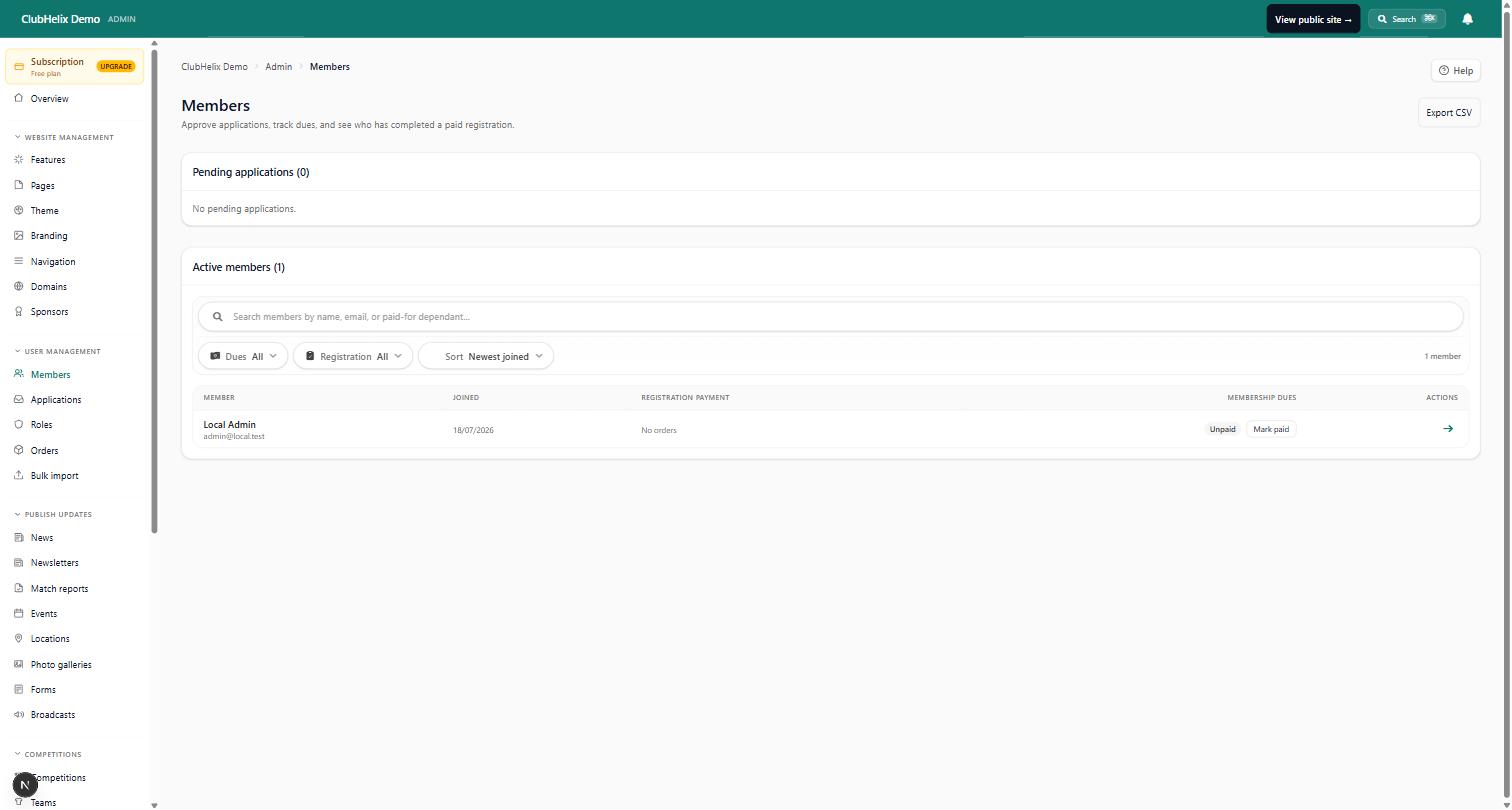
Almost every application asks the same questions: how many members do you have, how many are juniors, are you growing, and which suburbs do you draw from? If the honest answer lives across three spreadsheets and a retired registrar's laptop, you'll either guess (risky) or spend your whole application window reconstructing numbers.
Clubs that take registrations digitally have those answers on tap. Online registration means every member record is current and consistent, and roles and permissions let the secretary, treasurer and whoever writes the grant all pull the same reports without sharing one login. When an application asks for "evidence of participation", exporting a clean member count by age group beats a hand-waved estimate every time.
Writing the application
The full craft is covered in our guide to how to write a grant application, but the short version for NSW rounds:
- Answer the question asked, in the funder's own language. If the program's objective is increasing participation, your application should say — with numbers — how many new participants it creates.
- Quantify everything. "Around 40 juniors train on an unlit field and finish in the dark by May" beats "our lighting is inadequate".
- Attach real quotes, not estimates, and make the budget add up to the cent.
- Letters of support from your association, council or school partners are cheap to ask for and carry real weight.
- Get a fresh reader. Someone outside the committee should read the draft cold — if they can't repeat back what you're asking for and why, assessors won't either.
If you're weighing up rounds across states or national programs too, our overview of grants for sports clubs in Australia is a good companion piece.
Acquittal basics: keep the money you won
Winning is only half the job. Nearly every grant requires an acquittal — a short report, due after the project, showing the money was spent as promised. Treat it as part of the project from day one:
- Keep every receipt and invoice in the same shared folder as the application.
- Take before-and-after photos and keep attendance records for funded programs.
- Spend only on what was approved. If the project changes — a quote expires, a supplier vanishes — ask the funder for a variation before spending differently.
- Hit the deadline. An unacquitted grant can make your club ineligible for future rounds across the whole program, which is an expensive way to save an hour of paperwork.
Done well, a tidy acquittal actually helps your next application: you now have a documented, photographed, delivered project as evidence that your club spends grant money properly.
Most of a grant application is really just your club's own records, presented well. ClubHelix keeps registrations, member numbers, meeting minutes and club documents in one place, so the evidence is ready before the round opens — there's a free tier to start with, and you can see pricing or create your club site in an afternoon.
Frequently asked questions
Does our club need to be incorporated to get a grant in NSW?
Most state and council programs require applicants to be incorporated associations or otherwise legally constituted, though some allow an incorporated "auspice" organisation to apply on your behalf. Check the eligibility section of the specific round's guidelines.
How often do NSW sports grant rounds open?
Most state sport programs run annually with fixed opening and closing dates, and councils typically run one or two community grant rounds a year. A monthly check of the NSW grants portal and your council's website will catch nearly everything.
Can a small club really compete with big clubs for grants?
Yes. Many rounds explicitly weigh need, participation growth and community benefit rather than club size, and council rounds are only contested by other local groups. Small clubs with tidy records and a clear, costed project win regularly.
What is a grant acquittal?
It's the report you submit after spending the grant, showing the funds were used as approved — usually receipts, a short outcomes summary and photos. Missing an acquittal deadline can make your club ineligible for future rounds, so diarise it when you accept the funding.

